
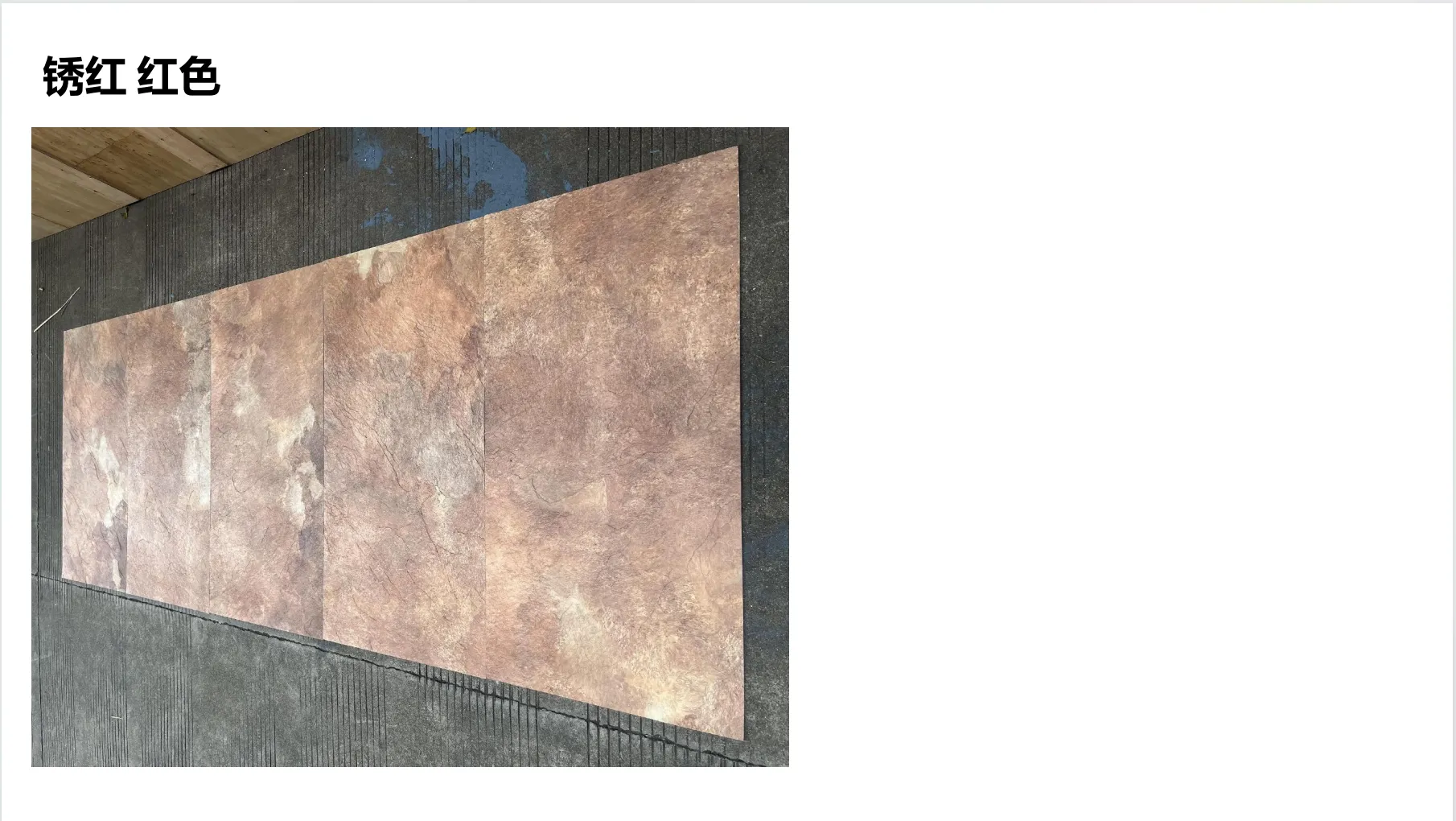
Walk into any modern commercial space—a sleek downtown office, a bustling hotel lobby, or a trendy retail store—and you'll likely notice the walls first. They set the mood, reflect the brand, and often tell a story. But beyond aesthetics, those walls hold a silent responsibility: keeping people safe. In a world where building codes grow stricter and safety is non-negotiable, one feature has risen to the top of every architect's and builder's checklist: fire resistance. And when it comes to materials that balance beauty with brawn, few stand out like Rusty Red MCM —a modified composite material that's not just turning heads with its warm, earthy tones, but also earning trust with its impressive fire safety credentials.
If you're involved in commercial construction, you know the stakes. A single fire incident can cost lives, destroy livelihoods, and leave a trail of regulatory fines. That's why fire resistance ratings aren't just boxes to tick—they're promises. Promises to occupants that the building has their back. Promises to inspectors that compliance isn't an afterthought. And for material suppliers, they're a testament to engineering excellence. Today, we're diving deep into why Rusty Red MCM has become a go-to choice for commercial building material suppliers and designers who refuse to compromise on either safety or style.
First, let's get familiar with the star of the show: MCM, short for Modified Composite Material. Think of it as the underdog of the building world that's now stealing the spotlight. Unlike traditional stone or concrete, MCM is a lightweight, flexible material made by bonding natural minerals (like stone powder or fibers) with high-performance polymers. The result? A material that's thin enough to bend around curves, tough enough to withstand harsh weather, and versatile enough to mimic the look of everything from rustic wood to polished marble.
Now, enter Rusty Red MCM. Picture a hue that's equal parts timeless and bold—warm terracotta undertones swirled with deeper, iron-rich accents, like the patina of an old barn door or the glow of a desert sunset. It's the kind of color that adds character to a space without overwhelming it, making it perfect for everything from restaurant facades to hotel exteriors. But here's the kicker: beneath that striking surface lies a core engineered for safety. While many materials prioritize looks over performance, Rusty Red MCM was designed to excel at both. It's a material that answers the question, "Why can't safety feel inviting?"
Let's talk about fire resistance ratings—what they mean, and why they matter more than you might think. In simple terms, a fire resistance rating measures how long a material can withstand fire before it fails (i.e., catches fire itself, spreads flames, or loses structural integrity). Ratings are typically assigned classes, with Class A being the highest (most resistant) and Class C the lowest. For commercial buildings, especially high-occupancy spaces like malls or hospitals, Class A is often non-negotiable. It's not just about passing an inspection; it's about buying time. Time for sprinklers to activate, time for alarms to sound, time for people to evacuate.
But here's where it gets personal: those ratings directly impact real people. Imagine a hotel guest waking up to a fire alarm in the middle of the night. They don't care about the technical specs of the wall panels—they care that those panels aren't feeding the flames as they race for the exit. For building owners, a higher fire rating can mean lower insurance premiums, fewer legal liabilities, and a reputation as a responsible operator. For architects, it's the freedom to design spaces that feel open and welcoming, without sacrificing the safety net of robust materials.
So, where does Rusty Red MCM fit in? Let's cut to the chase: it boasts a Class A fire resistance rating, the gold standard for commercial construction. That means in standardized tests (we'll get to those in a minute), it withstood temperatures over 1,000°C (1,832°F) without igniting, releasing toxic fumes, or allowing flames to spread. To put that in perspective, the average house fire reaches temperatures of around 600°C (1,112°F), while a commercial kitchen fire can spike to 900°C (1,652°F). Rusty Red MCM doesn't just meet the bar—it leaps over it.
Fire resistance doesn't happen by accident. It's the result of rigorous testing and intentional design. Let's break down what makes Rusty Red MCM a fire-resistant champion.
First, the composition. MCM's polymer binder is key here. Unlike materials with organic binders (think wood or some plastics) that burn easily, Rusty Red MCM uses flame-retardant polymers engineered to char, not burn. When exposed to high heat, the surface forms a protective layer (called charring) that insulates the core, slowing down heat transfer and preventing the material from catching fire. It's like a self-defense mechanism—instead of fueling the fire, it starves it.
Then there's the mineral content. Rusty Red MCM is packed with natural stone particles, which are inherently non-combustible. These minerals act as a barrier, absorbing heat and preventing the spread of flames. Compare that to traditional materials like untreated wood, which can ignite in seconds, or even some types of foam insulation, which release toxic gases when burned. Rusty Red MCM's mineral-rich makeup is a silent guardian, turning heat into a non-issue.
Of course, none of this matters without third-party validation. Rusty Red MCM has been tested to meet some of the most stringent standards in the industry, including ASTM E119 (the gold standard for fire resistance in the U.S.) and ISO 1182 (a global test for non-combustibility). In ASTM E119 tests, which measure how long a material maintains structural integrity under fire conditions, Rusty Red MCM clocked in at over 2 hours of fire resistance—far exceeding the 1-hour minimum required for most commercial walls. For context, that's enough time for firefighters to arrive, evacuate occupants, and contain a blaze before the material fails.
Numbers tell a story, but comparisons bring it to life. Let's take a look at how Rusty Red MCM stacks up against other popular commercial building materials when it comes to fire resistance. We've compiled data from industry tests to give you a clear picture:
| Material | Fire Resistance Rating | Key Fire-Safety Features | Common Applications |
|---|---|---|---|
| Rusty Red MCM | Class A (ASTM E119: 2+ hours) | Non-combustible mineral core, flame-retardant polymer binder, low smoke emission | Exterior facades, interior accent walls, retail spaces, hotels |
| Fair-Faced Concrete | Class A (ASTM E119: 1–3 hours, depending on thickness) | Inherently non-combustible, high thermal mass | Industrial buildings, minimalist interiors, structural walls |
| Traditional Travertine (Vintage Gold) | Class B (ASTM E119: 30–60 minutes) | Natural stone, but porous structure can trap heat; may spall (crack) under extreme heat | High-end interiors, decorative accents |
| Foamed Aluminium Alloy Board (Vintage Silver) | Class A (ASTM E119: 1–1.5 hours) | Non-combustible metal core, lightweight, but may melt at very high temperatures | Modern exteriors, ceiling panels, signage |
The takeaway? Rusty Red MCM holds its own against heavyweights like fair-faced concrete, while outperforming more decorative options like traditional travertine. What's more, it does this without the bulk of concrete or the conductivity of metal. It's a material that proves you don't have to choose between "tough" and "tailored."
Fire safety might be the headline, but Rusty Red MCM brings more to the table than just a stellar rating. Let's talk about the perks that make commercial building material suppliers keep coming back—and why architects are specifying it in their designs.
First, sustainability. In an era where "green building materials" aren't just a trend but a requirement, Rusty Red MCM shines. It's made with recycled stone particles (up to 40% in some formulations), reducing the need for quarrying raw materials. Its lightweight nature also cuts down on transportation emissions—imagine hauling 100 panels of traditional stone versus 100 panels of MCM; the fuel savings alone are significant. Plus, it's 100% recyclable at the end of its lifespan, aligning with LEED and BREEAM certification goals. For builders aiming for net-zero projects, Rusty Red MCM isn't just a safe choice—it's a sustainable one.
Then there's installation ease. Traditional stone or concrete requires heavy machinery, specialized labor, and weeks of installation time. Rusty Red MCM, on the other hand, weighs just 3–5 kg per square meter (about 1/5 the weight of natural stone). That means it can be installed by a small crew with basic tools, cutting labor costs and project timelines. It's flexible, too—able to bend around columns, archways, or custom shapes without cracking. For a hotel chain rolling out a brand refresh across 50 locations, or a retail store racing to open before the holiday season, that speed and simplicity are game-changers.
And let's not forget aesthetics. Fire-resistant materials have a reputation for being… well, boring. Think gray concrete blocks or utilitarian metal panels. Rusty Red MCM flips that script. Its rich, variegated color adds warmth to sterile office lobbies. Its texture—subtly rough, like weathered stone—creates depth in minimalist spaces. It pairs beautifully with other materials, too: imagine it alongside wood grain board for a cozy restaurant vibe, or with foamed aluminium alloy board (vintage gold) for a modern, industrial look. Designers no longer have to choose between "safe" and "stunning"—Rusty Red MCM lets them have both.
Let's ground this in reality with a hypothetical (but entirely plausible) scenario. Meet Maria, a project manager for a mid-sized hotel chain. She's overseeing the renovation of a 12-story downtown hotel, and fire safety is her top priority. The hotel's old exterior was made of vinyl siding (Class C fire rating—yikes), and the city's new fire code requires Class A materials. Maria needs something that won't break the budget, looks great, and passes inspection with flying colors. Her commercial building material supplier suggests Rusty Red MCM.
At first, Maria is skeptical. "It looks too nice to be fire-resistant," she thinks. But after reviewing the test reports—2+ hours of fire resistance, low smoke emission, Class A rating—she's intrigued. The installation crew loves it: they finish the exterior in half the time they'd budgeted for stone. The design team is thrilled: the Rusty Red hue complements the hotel's brand identity, a mix of historic charm and modern comfort. And when the fire inspector arrives, he's impressed. "This is the first time I've seen a material this attractive with such a strong rating," he notes. The hotel passes with zero issues, and Maria breathes a sigh of relief. For her, Rusty Red MCM isn't just a material—it's peace of mind.
Stories like Maria's are becoming more common. From boutique coffee shops in Chicago to luxury resorts in Dubai, Rusty Red MCM is proving that safety doesn't have to be. It's a material that adapts to the needs of the space, whether that's a high-traffic airport terminal or a quiet library. And as building codes continue to evolve, it's setting a new standard: safety should feel like an upgrade, not a compromise.
We get it—change is hard. If you're used to specifying traditional materials, you might have questions. Let's tackle the big ones:
"Is it more expensive than other Class A materials?" Initially, yes—Rusty Red MCM costs slightly more per square foot than basic concrete. But factor in installation (faster, cheaper labor), durability (it resists fading, cracking, and water damage, so less maintenance), and energy efficiency (its lightweight nature reduces structural load, cutting foundation costs), and it often works out to be more cost-effective long-term. Think of it as an investment in safety and style that pays off over time.
"How does it hold up in harsh weather?" MCM was built for the elements. Rusty Red MCM is water-resistant, UV-stable (so it won't fade in the sun), and freeze-thaw resistant. It's been tested in desert heat, coastal humidity, and snowy winters, and it performs consistently. Unlike natural stone, which can absorb water and crack in cold climates, Rusty Red MCM stands strong.
"Can it be repaired if damaged?" Absolutely. Because it's installed in panels, a damaged section can be replaced individually—no need to redo an entire wall. Commercial building material suppliers often keep extra panels in stock, so repairs are quick and painless.
As we look ahead, one thing is clear: fire safety in commercial construction will only get more important. Climate change is leading to hotter temperatures and more frequent extreme weather events, increasing fire risks. Meanwhile, consumers and tenants are demanding more transparency about building safety. In this landscape, materials like Rusty Red MCM aren't just options—they're necessities.
But it's not just about compliance. It's about redefining what a safe building looks like. A building that feels welcoming, not fortress-like. A space that inspires confidence, knowing every material was chosen with care. Rusty Red MCM embodies that vision. It's a material that says, "We care about your safety, and we care about how you feel in this space."
For commercial building material suppliers, this means opportunity. The demand for Class A materials with aesthetic appeal is skyrocketing, and Rusty Red MCM is perfectly positioned to meet it. For architects and designers, it's a new tool in their toolkit—one that lets them push creative boundaries without compromising on responsibility. And for all of us who step into commercial spaces every day, it's a reminder that safety and beauty can coexist.
At the end of the day, Rusty Red MCM is more than just a building material. It's a statement. A statement that safety isn't optional. That design shouldn't be limited by regulations. That the materials we surround ourselves with should protect us, inspire us, and stand the test of time.
Whether you're a builder racing to meet a deadline, a designer chasing the perfect aesthetic, or a project manager losing sleep over fire codes, Rusty Red MCM offers something rare: peace of mind. It's a material that works as hard as you do, so you can focus on what matters—creating spaces that people love, and that love them back.
So the next time you walk into a commercial space and pause to admire the walls, take a closer look. Maybe they're made of Rusty Red MCM. And if they are, know this: someone cared enough to choose both beauty and safety. That's a legacy worth building.
Recommend Products












