
How a single material can turn cold structures into spaces that breathe with the earth
Step into a typical modern office building, and you'll likely be greeted by the hum of air conditioning, the glare of fluorescent lights, and walls of polished steel and glass. It's efficient, sleek—and often strangely alienating. Your shoes click against the marble floor, your reflection stares back from every surface, and somewhere, a part of you craves something softer, something *familiar*. Now imagine walking into a space where the walls feel like weathered canyon clay, where the color warms like a sunset over red rock, and the texture invites you to reach out and touch it. Suddenly, the air feels lighter. You relax. You belong. That's the power of biophilic design—and at the heart of that transformation? Materials that don't just build spaces, but *connect* us to the natural world. Today, we're diving into one such material: Rusty Red MCM, and how it's redefining how we bridge architecture and nature.
Biophilic design isn't just about adding a few potted plants to a room (though greenery certainly helps). Coined by ecologist E.O. Wilson in the 1980s, the term refers to the innate human need to connect with nature—and the design principles that nurture that connection. At its core, biophilic design is about creating spaces that don't fight against our evolutionary bond with the natural world, but celebrate it. Think of it as architecture with a heartbeat.
There are three key pillars to biophilic design: direct experience of nature (think sunlight, plants, water), indirect experience (textures, colors, patterns that evoke nature), and space and place (design that reflects local landscapes or cultural ties to the environment). For architects and designers, the challenge often lies in the second pillar: how to bring the *feeling* of nature into spaces where direct elements like trees or streams might not fit. That's where materials take center stage—and why Rusty Red MCM has become such a game-changer.
Walk through most urban centers, and you'll notice a pattern: glass, steel, and concrete dominate. These materials are durable, cost-effective, and great for modern aesthetics—but they often feel… *lifeless*. A glass facade might reflect the sky, but it doesn't *breathe* like a forest. A concrete wall might be strong, but it doesn't warm like sun-baked earth. The result? Spaces that feel transactional, not transformative. We rush through them, check our phones to escape, and leave feeling more drained than when we arrived.
Traditional natural materials like stone or wood can help, but they come with their own hurdles. Natural stone is heavy, limiting where it can be used; solid wood warps with moisture and requires constant maintenance. Synthetic imitations, meanwhile, often miss the mark—their "wood grain" feels plastic, their "stone texture" looks printed. They're nature in a funhouse mirror: recognizable, but not *authentic*.
Enter MCM—Modified Composite Material—a category of building materials designed to bridge this gap. Lightweight, flexible, and engineered to mimic the organic beauty of natural materials without their drawbacks, MCM has become a favorite for biophilic designers. And among its many variants, one stands out for its ability to evoke the raw, earthy warmth of the natural world: Rusty Red MCM.
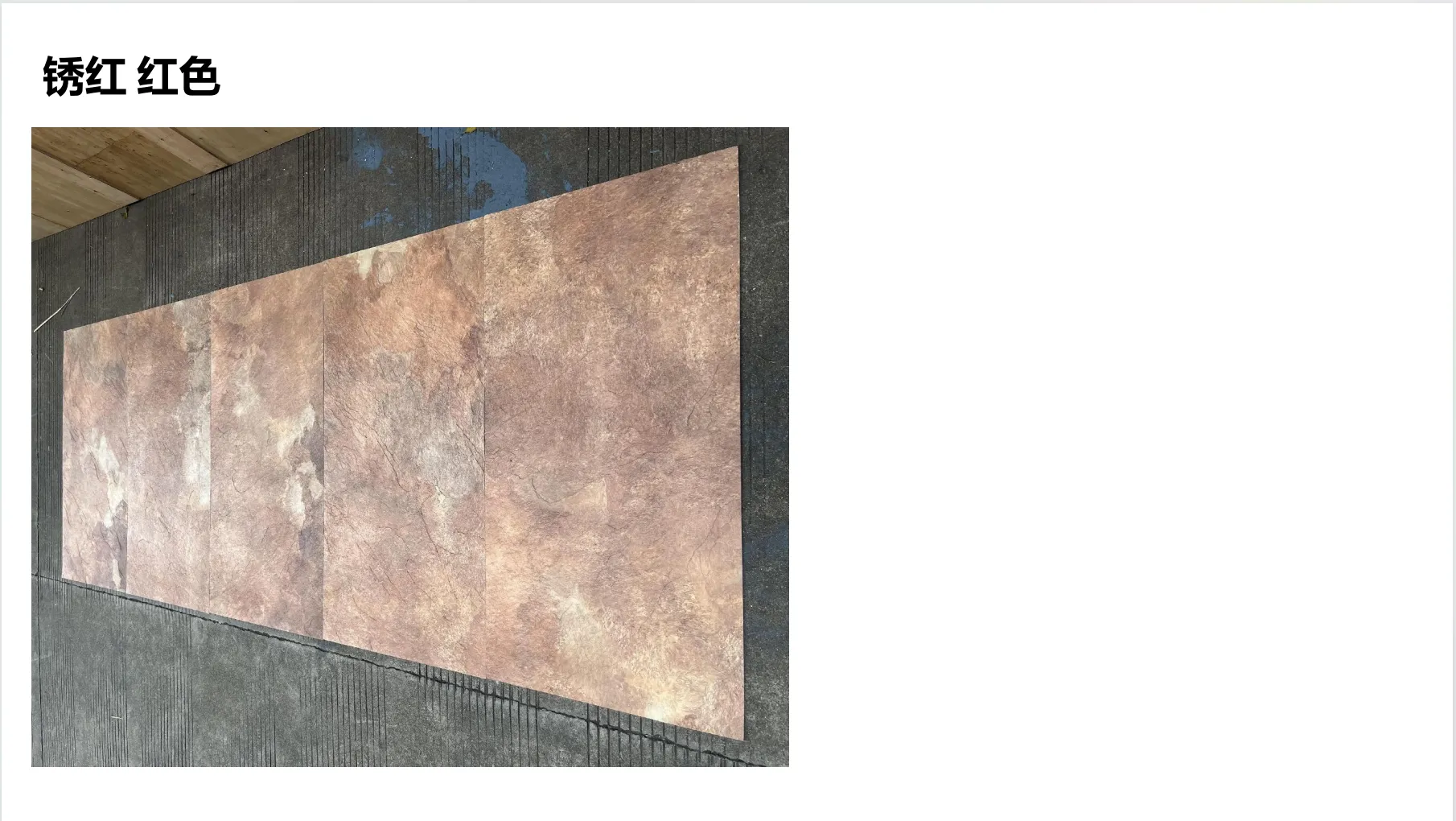
If you close your eyes and picture "Rusty Red," what comes to mind? Maybe the walls of a desert canyon at dusk, stained by iron oxide and time. Or the weathered roof of a mountain cabin, aged by rain and sun into a hue that feels like a hug from the earth. That's exactly the feeling Rusty Red MCM captures—not a flat, uniform "red," but a living, breathing palette of terracotta, amber, and burnt sienna, swirled with subtle variations that mimic the unpredictability of nature.
Run your hand over a panel of Rusty Red MCM, and you'll notice something else: texture. It's not smooth like plastic or overly rough like unpolished stone. Instead, it has the tactile quality of sandstone that's been gently worn by wind—firm enough to feel solid, but with microscopic grooves that catch the light and invite touch. This isn't just about looks; it's about sensory connection. When we touch a surface that feels "natural," our brains relax—we're wired to trust textures that remind us of the world outside our cities.
But what truly sets Rusty Red MCM apart is its flexibility—both literally and figuratively. As part of the MCM flexible stone series, it's lightweight (up to 80% lighter than natural stone) and can be bent, curved, or cut into almost any shape. This means architects aren't limited to flat walls or sharp angles; they can design flowing, organic forms that mimic the curves of a riverbed or the slope of a hill. Imagine a community center with a facade that undulates like sand dunes, clad in Rusty Red MCM—it's not just a building anymore. It's a landscape.
Let's break down how Rusty Red MCM embodies biophilic design principles, one element at a time:
Red and its earthy variants (like the rusty hue of this MCM) are deeply rooted in our collective consciousness. They remind us of soil, clay, and the raw materials that sustain life. Studies show that warm, earthy colors in interior spaces can lower stress levels and increase feelings of comfort—think of how a cozy terracotta mug makes your morning coffee taste better. Rusty Red MCM doesn't just decorate a wall; it wraps a room in the reassuring warmth of the natural world.
Biophilic design isn't just visual—it's tactile. Rusty Red MCM's surface mimics the "imperfect perfection" of natural materials. Unlike synthetic panels with repeating, computer-generated patterns, each Rusty Red MCM panel has unique variations in color and texture, just like a slab of real stone. This randomness is key: our brains are wired to find order in chaos, and organic irregularities feel more "alive" than perfect symmetry. It's why a field of wildflowers feels more vibrant than a perfectly trimmed hedge—and why a wall clad in Rusty Red MCM feels more inviting than one covered in smooth, uniform tiles.
Biophilic design isn't just about *looking* like nature—it's about *honoring* it. Rusty Red MCM checks this box too. Its manufacturing process uses recycled materials and low-VOC (volatile organic compound) adhesives, reducing its environmental footprint. Because it's lightweight, transporting and installing it requires less energy than natural stone, cutting down on carbon emissions. And unlike wood or natural stone, it doesn't require mining or deforestation—so we can bring the beauty of nature into our cities without harming the ecosystems we're trying to connect with.
To understand the power of Rusty Red MCM, let's look at two projects where it's been used to create biophilic magic:
In the arid landscape of Arizona, architects wanted to design a community center that felt rooted in the local desert environment. They turned to Rusty Red MCM for the main facade, pairing it with Gobi panel accents—a sandy, textured MCM variant that mimics the region's iconic dunes. The result? A building that seems to rise naturally from the earth, its Rusty Red walls glowing like sunset rock at dawn and dusk. Inside, the lobby features curved Rusty Red MCM walls that flow into Lunar Peak Black accents, evoking the contrast of desert earth and night sky. Local residents report spending more time in the center than expected—kids play longer, seniors linger over coffee, and everyone comments on how "at home" they feel. "It's like the building knows where it is," one resident told the design team. "It doesn't fight the desert. It *is* the desert."
A family in Boulder wanted their home to feel like a retreat from city life, even though they lived in a suburban neighborhood. The designer used Rusty Red MCM for the exterior siding, then carried the theme indoors with a feature wall in the living room. To add depth, they incorporated Travertine (starry blue) panels above the fireplace—small, iridescent flecks in the stone that catch the light like stars in the night sky. The combination of Rusty Red's earthiness and the starry travertine's celestial sparkle creates a space that feels both grounded and aspirational. "We wanted to bring the mountains inside," the homeowner said. "Now, when I sit on the couch, I feel like I'm sitting in a canyon at night—warm, safe, and connected to something bigger."
Still wondering how Rusty Red MCM stacks up against other materials in biophilic design? Let's break it down:
| Feature | Traditional Natural Stone | Synthetic Imitation Panels | Rusty Red MCM |
|---|---|---|---|
| Weight | Heavy (hard to install on high floors/curved surfaces) | Light, but rigid (limited design flexibility) | Lightweight and flexible (can bend to 3D forms) |
| Texture & Color | Organic, but inconsistent (hard to match panels) | Uniform, repetitive patterns (feels artificial) | Organic variations with controlled consistency (natural look, easy to install) |
| Sustainability | Mining/quarrying can harm ecosystems | Often made with non-recyclable plastics | Recycled materials, low-VOC, energy-efficient production |
| Biophilic Alignment | High, but limited by weight/installation | Low (lacks sensory authenticity) | High (authentic texture/color + design flexibility) |
While Rusty Red MCM is a star player in biophilic design, it rarely works alone. Designers often pair it with other MCM products to create layered, nature-inspired spaces. Here are a few standouts:
Together, these products create spaces that tell a story—a story of earth and sky, of warmth and wonder, of the deep, ancient bond between humans and nature.
As we spend more time indoors, the need for biophilic design has never been clearer. It's not a luxury; it's a necessity. Our mental health, productivity, and overall well-being depend on feeling connected to the natural world—even when we're surrounded by skyscrapers and concrete.
Rusty Red MCM represents the future of this movement: materials that don't just look like nature, but *behave* like it—flexible, adaptive, and inherently life-affirming. It's a reminder that architecture doesn't have to be a barrier between us and the world outside. With the right materials, it can be a bridge.
So the next time you walk into a space that feels "right"—where the walls seem to breathe, the colors wrap around you, and you suddenly feel a little more alive—take a closer look. Chances are, there's a material like Rusty Red MCM working quietly in the background, connecting you to the nature you carry in your bones. And that's the true power of biophilic design: it doesn't just build buildings. It builds belonging.
Recommend Products












