
Exploring the interplay of texture, light, and hue in creating design magic
Walk into any well-designed space, and you'll notice something subtle but powerful: color isn't just a static shade on a wall. It breathes, shifts, and tells a story—all because of the surface it's on. Nowhere is this truer than with rusty red, a hue that's equal parts bold and warm, but whose personality transforms entirely based on the texture of the material it adorns. In the world of Modern Composite Materials (MCM), this relationship between surface finish and color intensity isn't just a happy accident; it's a design superpower.
Today, we're diving into how MCM products like Rust board , Travertine (starry red) , and even contrasting options like fair-faced concrete use surface finish to turn rusty red from a simple color into an experience. Whether you're an architect sketching a facade or a homeowner dreaming up a feature wall, understanding this dynamic will change how you see color forever.
Color perception is a dance between light and texture. Let's start with the basics: a flat, smooth surface—say, a glossy red paint—reflects light in a straight line. The color hits your eye as a single, intense wave, bright and unyielding. But add texture? Suddenly, that light has places to play. Grooves, pores, and ridges scatter photons, breaking up the color into a million tiny fragments. What was once a shout becomes a conversation.
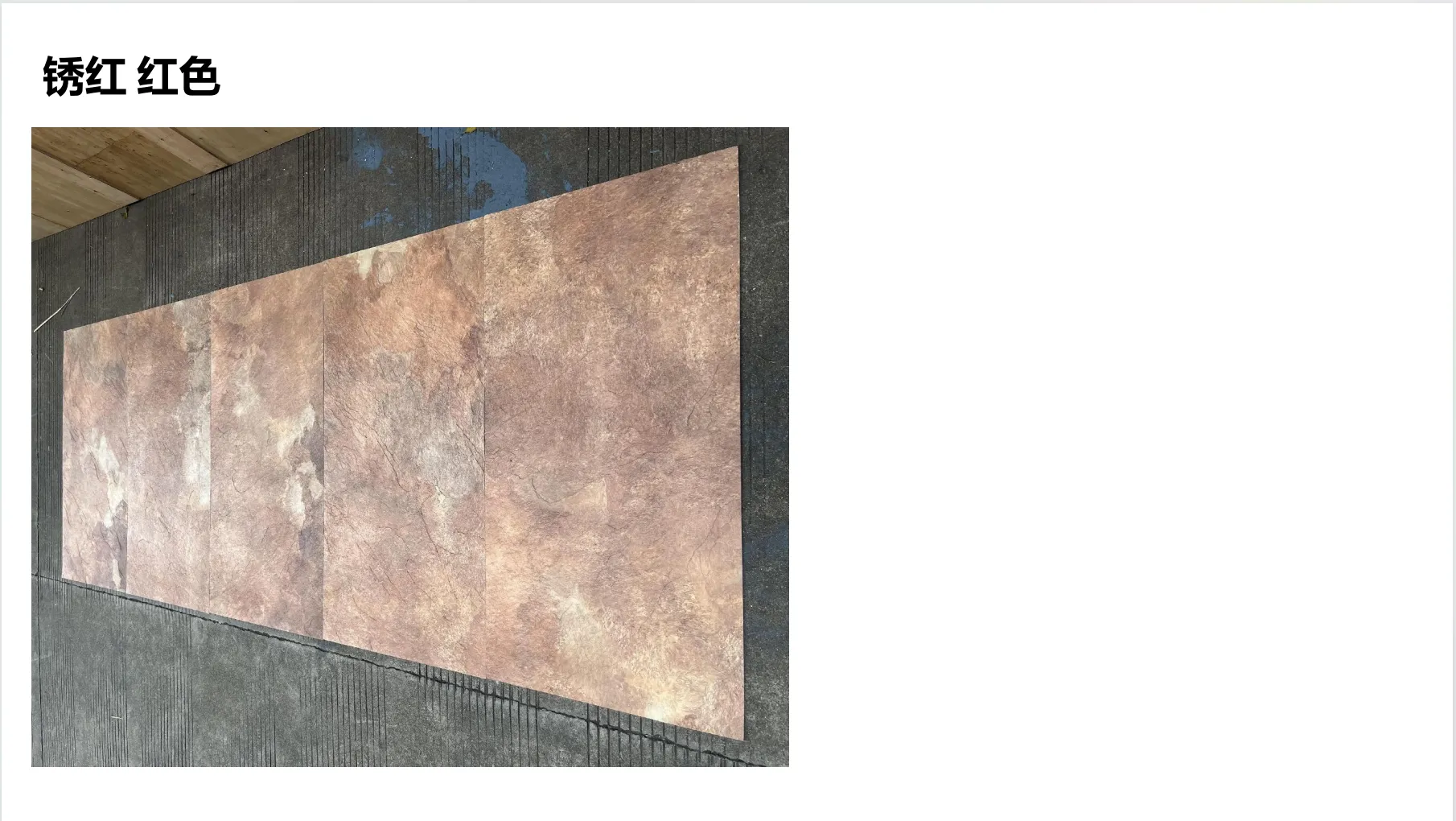
Rusty red is uniquely suited to this dance. Its base hue is already rich—think of aged barn metal, or the crust of a perfectly baked sourdough loaf. But when paired with MCM's signature textures, it becomes something more. Take Rust board , for example. Run your palm over it, and you'll feel the kind of texture that feels lived-in, like it's been shaped by wind and time. Those micro-irregularities don't just add tactile interest; they turn the color into a gradient. In direct sunlight, the peaks catch gold, while the valleys sink into deep, earthy tones. Step into shade, and the whole surface softens, leaning into terracotta warmth. It's not just red anymore—it's a spectrum held together by texture.
MCM doesn't just offer rusty red—it reimagines it through a lens of texture. Let's meet the key players:
If rusty red were a book, Rust board would be the hardcover with embossed letters—tactile, full of character. Its surface mimics the look of naturally weathered metal, with subtle pits and grain that catch light like a campfire. Unlike a flat paint, which can feel cold or artificial, Rust board's texture reads as organic. It's the kind of material that makes a room feel grounded, like it has history. In a cozy bookstore, for instance, Rust board walls would wrap around you, the red softened by texture, making even the smallest space feel warm and inviting. It's not just a backdrop; it's a character in the room.
For something with a touch of drama, there's Travertine (starry red) . Travertine is known for its natural voids and veining, but the "starry" variant takes it further—tiny, reflective particles embedded in the surface catch light like distant stars. Here, rusty red becomes a canvas. The base color is deep, almost burgundy, but those starry flecks add sparks of brightness, creating depth that shifts as you move. Imagine a restaurant with a feature wall of this travertine: as diners shift in their seats, the wall seems to twinkle, turning a simple meal into an experience. It's proof that texture isn't just about touch—it's about movement, too.
To truly appreciate rusty red's texture, contrast it with something sleek: fair-faced concrete . Concrete, when left "fair-faced" (unfinished, with the natural texture of the formwork), has a subtle, uniform grain. Now, add a rusty red pigment to that concrete. The result? A color that's calm, almost meditative. The concrete's smooth-but-not-glossy surface diffuses light evenly, turning rusty red into a quiet hum rather than a roar. It's perfect for modern spaces where the goal is sophistication, not warmth. A lobby with fair-faced concrete walls in rusty red feels intentional, like the color was poured into the material itself, not just applied on top.
| Product | Surface Texture | Light Interaction | Perceived Color Vibe |
|---|---|---|---|
| Rust Board | Rough, pitted, weathered-look | Scatters light; peaks reflect warm tones, valleys absorb | Earthy, lived-in, like aged terracotta |
| Travertine (Starry Red) | Semi-rough with reflective "star" particles | Voids absorb light; stars reflect bright sparks | Dramatic, twinkling, like a night sky in autumn |
| Fair-Faced Concrete (Rusty Red Pigment) | Smooth, uniform, with subtle formwork lines | Diffuses light evenly; minimal shadow | Calm, sophisticated, like a modern art piece |
What if you want the texture of Rust board but need it to bend—say, for a curved facade or a custom-shaped wall? Enter MCM flexible stone . This material is a game-changer because it marries durability with flexibility, all while preserving the texture that makes rusty red sing. Unlike rigid stone or metal, which can crack or warp when bent, MCM flexible stone moves with the structure, its surface texture intact.
Take a commercial building with a sweeping, curved entrance. Clad it in MCM flexible stone in rusty red, and the texture doesn't flatten or stretch. Instead, those same peaks and valleys that make Rust board so tactile follow the curve, creating a wave of color that feels organic, not forced. The rusty red here isn't just a color—it's a sculptural element, shaped by the building's form and brought to life by its texture. It's design without compromise: you get the look you love, even in the trickiest spaces.
And because MCM flexible stone is lightweight, it opens up possibilities for interior design, too. Imagine a home with a feature wall that arcs around the living room, wrapped in rusty red flexible stone. The texture adds depth, making the space feel larger, while the color adds warmth. It's the kind of detail that turns a house into a home—not because it's flashy, but because it feels intentional, like the material was chosen to fit the way people actually live in the space.
Architects and designers don't just pick colors—they pick feelings. And surface finish is the tool that turns a color into a mood. Let's say you're designing a community center in a bustling neighborhood. You want it to feel welcoming, a place where kids and elders alike feel at ease. Rust board walls would do the trick: their textured rusty red feels approachable, like a big, warm hug. The color isn't overwhelming; it's inviting, like the front door of a favorite aunt's house.
Now, shift to a high-end boutique in the city. Here, the goal is luxury with an edge. Travertine (starry red) on the walls adds that "wow" factor. The starry particles catch the spotlights, turning the rusty red into something glamorous, like a red carpet for the eyes. It's bold but not brash, sophisticated but not cold—exactly the vibe for a space selling statement pieces.
Or consider a co-working space aiming for a minimalist, focused atmosphere. Fair-faced concrete in rusty red keeps things calm. The uniform texture and diffused color create a backdrop that doesn't compete with the work happening there, but still adds warmth—no sterile white walls here. It's the kind of space where ideas flow, because the environment feels balanced, not distracting.
The point? Rusty red isn't a one-note color. With MCM's range of surface finishes, it can be cozy, glamorous, calm, or bold. It's all about how you play with texture.
As design trends lean into authenticity and sensory experiences, surface finish is becoming just as important as hue. MCM's rusty red products are at the forefront of this shift, proving that color isn't static—it's dynamic, shaped by the way we touch, see, and interact with it. Whether it's the weathered charm of Rust board, the sparkle of Travertine (starry red), or the understated elegance of fair-faced concrete, each texture tells a different story with the same base color.
So the next time you're choosing a color for a project, ask yourself: What story do I want to tell? Then reach for the texture that will make that story sing. With MCM, rusty red isn't just a color—it's a conversation starter, a mood setter, and a design tool that lets you paint with light, shadow, and touch.
Recommend Products












