
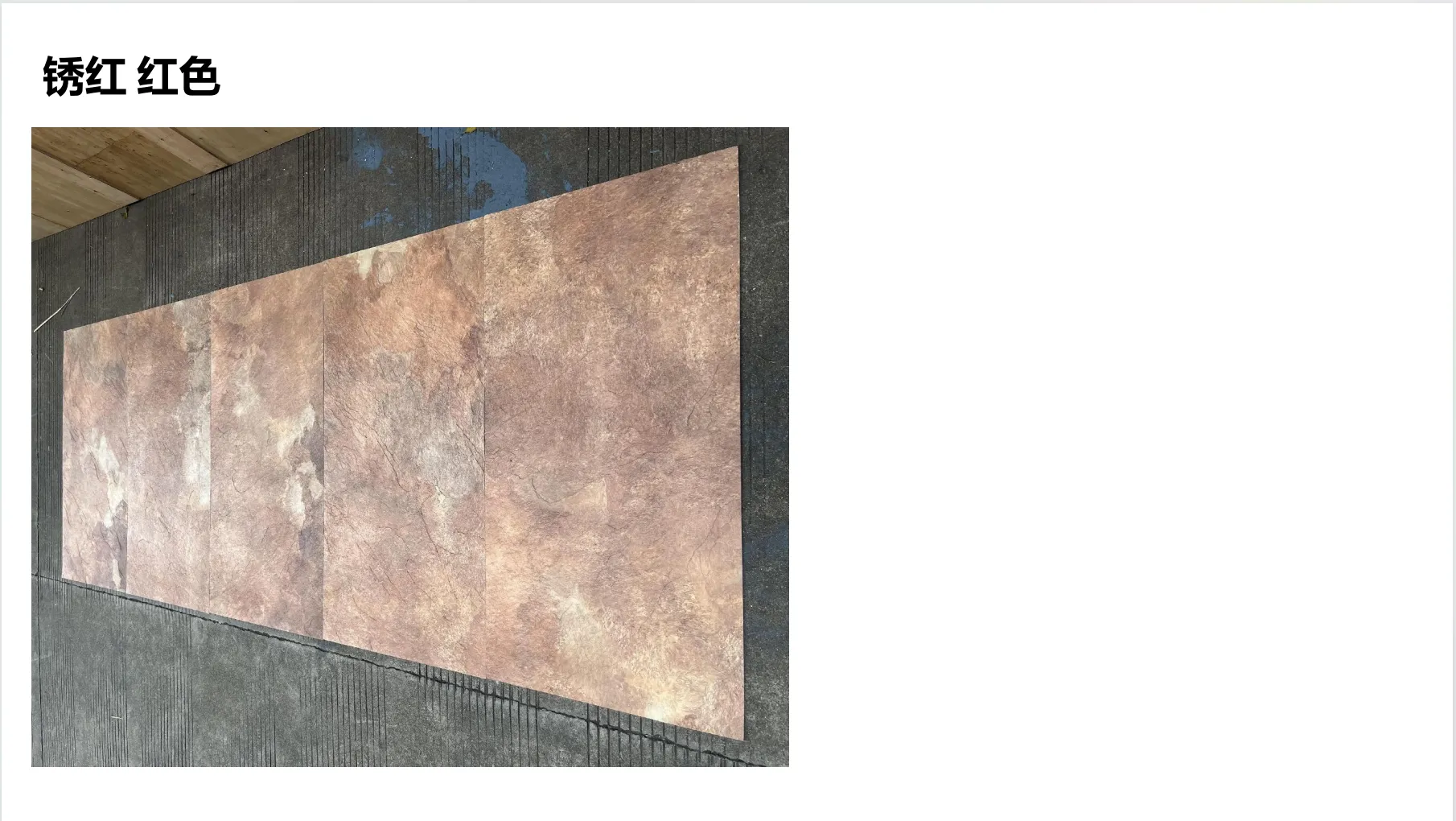
It was 3 a.m. when Elena, a lead architect at a Barcelona-based firm, found herself staring at a spreadsheet filled with red flags. Her latest project—a luxury resort in Bali—needed a facade that blended rustic warmth with modern durability, and she'd fallen in love with the rich, earthy tones of Rusty Red MCM panels. But the logistics? A nightmare. Traditional stone slabs would mean oversized cargo fees, weeks of shipping delays, and a 20% risk of breakage. "I'd already revised the design three times to cut costs," she later admitted. "I was ready to settle for a local material that didn't quite match the vision." That's when her project manager mentioned MCM's Project Board Series. "It's not just the material," he said. "It's how they ship it."
For architects, developers, and contractors tackling global projects, the struggle is universal: How do you deliver high-quality, visually striking materials across oceans and continents without blowing budgets or sacrificing deadlines? Enter MCM's lineup—where innovation meets logistics, and where even the most stunning designs, like Rusty Red , arrive on-site not just intact, but on time. Let's dive into how MCM is redefining international material shipping, one flexible, lightweight panel at a time.
Traditional building materials have long been a headache for cross-border projects. Take natural travertine, for example: stunning, but dense. A single 120x60cm slab can weigh 30kg, requiring reinforced packaging and specialized shipping containers. Then there's marble—elegant, but fragile. A minor jolt during transit can leave hairline cracks that ruin the aesthetic. "We once shipped 500 sqm of imported marble to a hotel in Riyadh," recalls a logistics coordinator at a major freight company. "By the time it arrived, 15% was chipped. The client refused delivery, and we had to absorb the $80,000 loss."
Add to that the rising costs of fuel and labor, and the math gets ugly. A 40-foot container of traditional stone might cost $5,000 to ship from Italy to Singapore. With MCM, that number drops by 40%—and that's before factoring in savings from reduced breakage and faster delivery times. "It's not just about the material cost," explains James, a construction economist. "It's the opportunity cost of delays. If a facade installation is held up by shipping issues, the entire project timeline shifts, costing clients thousands in lost revenue."
MCM's breakthrough lies in reimagining materials from the ground up—with shipping in mind. Take mcm flexible stone , the star of the Project Board Series. Unlike rigid natural stone, it's crafted from a modified composite material that's 70% lighter (just 4-6kg per sqm) and bendable up to 15 degrees. "We tested it in our lab with a hydraulic press," says Dr. Lin, MCM's lead materials engineer. "It can flex under pressure without cracking, which is crucial during transit. Imagine a container bouncing over rough seas—traditional stone would chip; MCM's flexible panels absorb the shock."
But flexibility is just the start. Let's look at three key innovations that make MCM a logistics dream:
Consider foamed aluminium alloy board (vintage gold) , a favorite for modern facades. Traditional aluminium panels weigh around 18kg per sqm; MCM's foamed version? Just 8kg. That's a 55% reduction, which translates to more panels per container. A standard 40-foot container can hold 2,500 sqm of MCM's foamed aluminium—twice the amount of traditional aluminium. "We shipped 3,000 sqm to a mall in Dubai last year," says a logistics manager at MCM. "It fit in two containers instead of four. The client saved $12,000 on freight alone."
Then there's lunar peak silvery , a fan favorite for its metallic sheen. Unlike natural granite (28kg/sqm), Lunar Peak clocks in at 12kg/sqm. "We used it for a corporate headquarters in Seoul," says an architect. "The facade required 1,200 sqm. With traditional granite, we'd need three containers. MCM fit it all into one. Customs cleared it in 48 hours instead of a week. We finished the facade a month early."
Lightweight doesn't mean flimsy. MCM subjects every product to rigorous testing, simulating the harshest shipping conditions. Take travertine (starry red) , with its galaxy-like speckles. It undergoes 10,000 cycles of vibration testing (mimicking truck and ship movement), temperature extremes (-20°C to 60°C), and impact tests (dropping panels from 1.5m onto concrete). "We had a shipment to Norway last winter," recalls a quality control inspector at MCM. "The container got stuck in a snowstorm for three days. When we opened it, every Starry Red panel was perfect. The client thought we'd replaced them."
Even delicate-looking options like weaving (khaki) , with its textured, fabric-like finish, are built tough. "We once had a container tip during unloading in Brazil," says a freight agent. "The crates shifted, but the weaving panels? Not a scratch. Traditional woven materials would have frayed or torn. MCM's composite base acts like a shield."
MCM's 3D Printing Series takes logistics a step further by letting architects order panels in custom sizes—no more cutting stone on-site (and no more wasted space in containers). "A client in Tokyo wanted thread -patterned panels for a restaurant ceiling," explains a design consultant at MCM. "Instead of shipping standard 120cm slabs and trimming them down, we 3D-printed panels in 90cm widths to fit their ceiling grid. We saved 25% on container space, and the installers didn't have to rent cutting equipment."
Customization also extends to thickness. For high-traffic areas like hotel lobbies, MCM offers reinforced options (e.g., boulder slab (vintage black) at 15mm thick). For accent walls, thinner panels (like slate veil white at 6mm) work perfectly—and weigh even less. "It's like having a material wardrobe," jokes an architect. "You pick the right 'outfit' for the project, and MCM tailors the shipping to match."
It's not just the materials—it's the method. MCM's shipping process is a masterclass in efficiency, designed to minimize hassle for clients. Here's how it works:
Each panel is wrapped in shock-absorbing foam, then stacked in reinforced wooden crates with dividers to prevent shifting. For fragile finishes like marble interstellar gray , MCM adds a layer of micro-perforated film to protect against moisture. "We shipped marble veil white to a villa in the Maldives during monsoon season," says a packaging specialist. "The crates are water-resistant, and the panels are sealed in airtight bags. No mold, no water damage—even after three weeks at sea."
MCM's logistics team uses 3D modeling software to maximize container space. "We once fit Rusty Red , lunar peak golden , and foamed aluminium alloy board (vintage silver) into a single container for a mixed-use project in Bangkok," says a loader. "Traditional shipping would have required two containers. The client saved $3,500 and reduced their carbon footprint by 30%."
Clients get a GPS tracker for each container, along with digital copies of all customs documents (certificates of origin, material safety data sheets, etc.). "I monitored our shipment to Sydney from my phone," says a project manager. "When it hit a storm near Indonesia, I got an alert—but MCM's team had already rerouted it to avoid delays. They even sent photos of the panels being unloaded. Total peace of mind."
Back to Elena, the Barcelona architect. Her Bali resort project needed a facade that felt "earthy yet luxurious"—a balance she'd struggled to achieve with local materials. After discovering MCM, she revised the design to include Rusty Red panels for the main facade, paired with travertine (starry blue) accents and bamboo mat board for the interiors. "I was skeptical at first," she admits. "How could something so lightweight look like real stone?"
The shipment left MCM's factory in China on a Monday. By Friday, it was in Singapore, cleared customs by Tuesday, and on-site in Bali by the following Thursday—10 days total, compared to the 25 days quoted for traditional stone. "The installers were shocked," Elena laughs. "They expected heavy lifting, but two people could carry a Rusty Red panel with ease. And the color? Exactly as the samples. The client cried when she saw it—she thought we'd settled for less, but we'd actually gotten more."
Today, the resort's facade is a local landmark, with guests often commenting on the "vibrant, rusty hue that feels both ancient and modern." "It wasn't just about shipping," Elena says. "It was about trusting that my vision wouldn't get lost in transit. MCM didn't just deliver materials—they delivered the project."
Still not convinced? Let's compare. Below is a breakdown of how MCM stacks up against traditional materials in key shipping metrics:
| Material | Weight (sqm) | Shipping Time (China to Dubai) | Breakage Risk | 40ft Container Capacity (sqm) | Estimated Shipping Cost |
|---|---|---|---|---|---|
| Natural Travertine | 25kg | 21-28 days | 15-20% | 800 | $5,200 |
| MCM Travertine (Starry Red) | 6kg | 10-14 days | 2-3% | 3,200 | $3,100 |
| Natural Granite | 28kg | 24-30 days | 10-15% | 700 | $5,800 |
| MCM Lunar Peak Silvery | 12kg | 10-14 days | 1-2% | 2,800 | $3,400 |
| Traditional Aluminium Panels | 18kg | 18-22 days | 5-8% | 1,200 | $4,500 |
| MCM Foamed Aluminium (Vintage Gold) | 8kg | 8-12 days | 1% | 2,500 | $2,700 |
Don't just take our word for it. MCM's clients span the globe, and their feedback tells the story. "We've used MCM's rough granite stone (dark grey) for three projects in Africa," says a developer. "Each time, the shipment arrives within the window, and the panels are consistent. No more 'this batch is darker than the sample' surprises."
Another client, a contractor in Dubai, puts it simply: "MCM has turned 'international shipping' from a stressor into a non-issue. We recently used boulder slab (vintage black) for a mall facade. The panels arrived pre-cut to size, so installation took half the time. We saved $60,000 on labor alone."
While Rusty Red steals the spotlight for its warm, inviting tone, MCM's lineup is a treasure trove of shipping-friendly options. Here are a few fan favorites:
As construction goes global, the demand for materials that bridge design and logistics will only grow. MCM is already ahead of the curve, with new innovations in the pipeline—like their upcoming 3D Art Concrete Board , which combines the industrial look of concrete with the flexibility of MCM's composite base. "We're testing it now," says Dr. Lin. "Early results show it's 50% lighter than traditional concrete panels and just as durable."
For Elena, the architect who once feared compromising her vision, MCM has been a game-changer. "My Tokyo hotel project won an award for 'Best Use of Material,'" she says. "The jury praised the Rusty Red facade for its 'timeless warmth.' They had no idea it was shipped from China in 10 days. That's the magic of MCM—it lets you dream big, then delivers."
Whether you're designing a resort in Bali, a corporate tower in Dubai, or a boutique hotel in Lisbon, MCM's materials are built to travel. From the rich hues of Rusty Red to the sleek elegance of foamed aluminium alloy board (vintage gold) , every panel is a testament to the idea that great design shouldn't be limited by geography.
So, what's your next project? And how can MCM help you ship it—beautifully, efficiently, and stress-free?
The world is waiting for your vision. With MCM, it's never been easier to bring it to life.
Recommend Products












