
When Maria decided to revamp her home's exterior last year, she was torn between two options: the classic charm of red brick or the sleek, modern look of Rusty Red MCM. Her contractor, Juan, laid out the pros and cons, but what stuck with her most was his offhand comment: "Brick'll look great, but you'll be paying for my crew's time for a week. MCM? We could finish in three days, easy." That got her thinking—was the traditional route worth the extra time and money? If you've ever found yourself in a similar dilemma, you're not alone. Let's dive into the nitty-gritty of installation time and labor costs to see how Rusty Red MCM stacks up against brick.
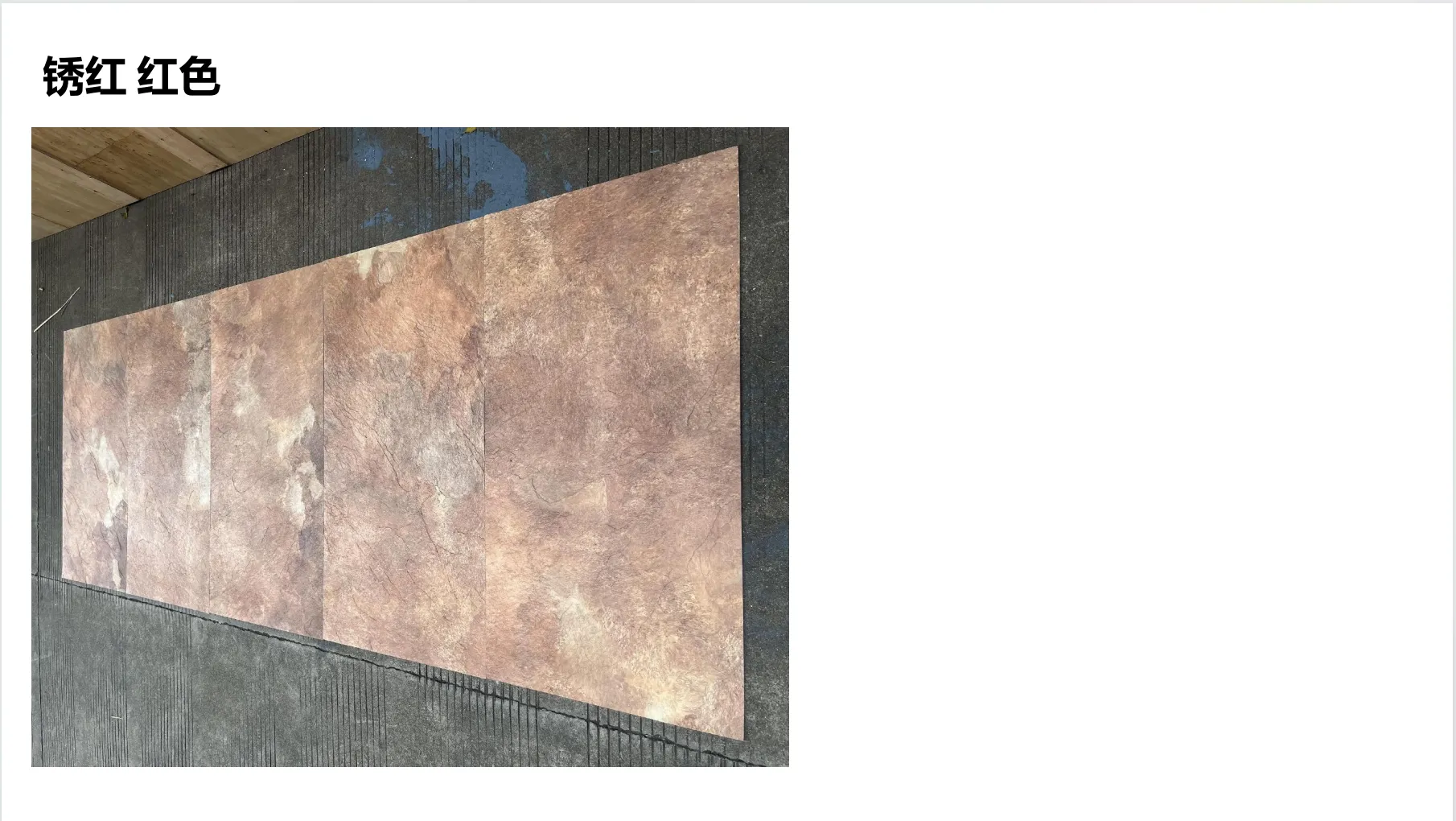
First things first: Let's demystify Rusty Red MCM. MCM stands for Modified Composite Material, and it's a game-changer in the world of building materials. Rusty Red MCM, part of the broader MCM flexible stone family, is designed to mimic the rich, earthy tones of rusty red natural stone—think the warm hues of a desert sunset or aged terracotta—but with a twist: it's thin, lightweight, and incredibly easy to install.
Unlike solid stone slabs or clunky bricks, MCM panels are typically 3-5mm thick, flexible, and made from a blend of natural minerals and polymers. This makes them durable yet maneuverable. Imagine holding a large, thin panel that bends slightly in your hands—no chipping, no heavy lifting, just a material that adapts to your project's needs. It's no wonder contractors like Juan get excited about it.
And Rusty Red MCM isn't alone. The MCM family includes everything from the organic texture of bamboo mat board to the industrial edge of fair-faced concrete, but today, we're focusing on its rusty red star. Now, let's contrast that with the material we all know: brick.
Brick has been around for millennia, and for good reason. It's sturdy, fire-resistant, and exudes a timeless, homey vibe. Walk through any historic neighborhood, and you'll see brick homes that have stood for 100+ years—proof of its durability. But here's the catch: that durability comes with a price, and it's not just monetary. It's about time and labor.
Brick is heavy—each standard clay brick weighs about 4.5 pounds. A pallet of 500 bricks? That's over a ton. Moving them requires muscle or machinery, and laying them? That's a skill. Bricklayers spend years mastering the art of even mortar joints, level rows, and precise cuts for corners. It's craftsmanship, no doubt, but craftsmanship takes time.
Juan put it bluntly: "Laying brick is like solving a 3D puzzle. Each brick has to fit perfectly, and the mortar needs time to set. Miss a level by a hair, and the whole wall could lean. It's rewarding, but man, does it drag on."
Let's get to the numbers. We'll compare installing a 500 square foot exterior wall—a common project for homes or small commercial buildings. We'll assume a 3-person crew for both materials, since that's standard for mid-sized jobs.
Brick installation isn't just "stacking bricks." Here's the play-by-play:
Total time for 500 sq ft? Around 250 hours of labor. With a 3-person crew working 8-hour days, that's 10+ days (250 hours ÷ 24 crew hours/day = ~10.4 days). Yikes.
Now, let's flip the script with Rusty Red MCM. Here's how Juan's crew would tackle the same 500 sq ft wall:
Total time? About 100 hours of labor. With the same 3-person crew, that's 4 days (100 hours ÷ 24 crew hours/day = ~4.2 days). That's less than half the time of brick!
Time is money, and nowhere is that truer than in construction. Let's break down labor costs for our 500 sq ft wall. We'll use average hourly rates: bricklayers in the U.S. earn ~$30/hour, and MCM installers (often general contractors or carpenters) earn ~$28/hour (slightly less because MCM requires less specialized training).
| Aspect | Rusty Red MCM | Traditional Brick |
|---|---|---|
| Average Installation Time (per sq ft) | 0.2 hours (12 minutes) | 0.5 hours (30 minutes) |
| Total Time for 500 sq ft Wall | ~100 hours (3-4 days with 3-person crew) | ~250 hours (7-10 days with 3-person crew) |
| Labor Cost (per sq ft) | $5.60 ($28/hour x 0.2 hours) | $15.00 ($30/hour x 0.5 hours) |
| Total Labor Cost for 500 sq ft Wall | $2,800 (100 hours x $28/hour) | $7,500 (250 hours x $30/hour) |
| Key Installation Steps | Measure, cut (minimal), adhesive, mount | Mix mortar, lay brick, cut, mortar joints, cure |
Let that sink in: for the same 500 sq ft wall, brick labor costs $7,500, while Rusty Red MCM comes in at $2,800. That's a savings of $4,700—enough to fund a new patio or landscaping. And remember, this doesn't include other costs like equipment (cranes for brick transport) or mortar materials. Juan estimated Maria would save another $500 on mortar alone.
Maria's 500 sq ft exterior wall was the perfect test case. Juan's crew started on a Monday with Rusty Red MCM. By Thursday afternoon, they were done—three and a half days. Total labor cost: $3,100 (a bit more than our estimate, thanks to a tricky corner that required extra cutting). If they'd used brick? Juan quoted $8,200 and a 10-day timeline. "Maria was shocked when we handed her the final bill," he laughed. "She kept saying, 'That's it? I was budgeting for twice that!'"
Let's scale up to a 1,500 sq ft commercial storefront. For brick, a 5-person crew would take ~14 days (350 hours) at $30/hour: $10,500 in labor. For Rusty Red MCM, the same crew could finish in 5 days (200 hours) at $28/hour: $5,600. The store owner, eager to open, saved not just $4,900 but also 9 days of construction delays—priceless in the retail world.
Sure, time and money are big players, but Rusty Red MCM has more tricks up its sleeve. Let's talk weight: a 4x8 ft MCM panel weighs ~15-20 pounds, while a pallet of bricks (500 bricks) weighs over a ton. For Maria's two-story home, that meant Juan's crew carried panels up a ladder by hand. Brick would've required a small crane—another $500-$1,000 in equipment costs.
Then there's design flexibility. Brick is rigid—you're stuck with straight lines and standard sizes. Want a curved accent wall? Good luck cutting bricks to fit. Rusty Red MCM, being flexible, bends gently around curves, opening up creative possibilities. And since MCM comes in styles like bamboo mat board or fair-faced concrete, you can mix and match. Maria, for example, paired her Rusty Red exterior with bamboo mat board accents on her patio, creating a cohesive yet dynamic look.
Durability? Don't sleep on MCM. It's resistant to moisture, UV rays, and temperature swings—no need to repoint mortar every 10 years like you do with brick. Juan puts it this way: "Brick lasts, but MCM lasts with less work . I've seen MCM walls hold up in coastal storms and desert heat—they're tough as nails."
At the end of the day, brick has its place—if you have the time, budget, and love for tradition, it's a solid choice. But for most of us, time is money, and flexibility matters. Rusty Red MCM cuts installation time by 50% or more, slashes labor costs, and offers design freedom brick can't match.
Maria couldn't be happier with her decision. "Every time I pull into my driveway, I smile," she says. "The Rusty Red MCM looks like it was chiseled from stone, but I know it took half the time and cost. And when my neighbor grumbles about repointing his brick chimney? I just pat my wall and say, 'No thanks.'"
So, if you're weighing material options, ask yourself: Do I want to pay for weeks of labor and limited design, or invest in a material that works with your timeline and budget? For Maria, and for many others, the answer was clear: Rusty Red MCM isn't just a material—it's a smarter way to build.
Recommend Products












