
When an architect stands before a blank canvas of a building's facade, the choice of materials isn't just about color or texture—it's about writing a story. A story of resilience against rain and wind, of harmony with the environment, and of creating spaces that feel alive, not just built. In recent years, two materials have emerged as front-runners in this narrative: Rusty Red MCM and traditional composite panels. Both promise durability, style, and a nod to modern design, but how do they truly stack up when it comes to strength and sustainability? Let's dive in.
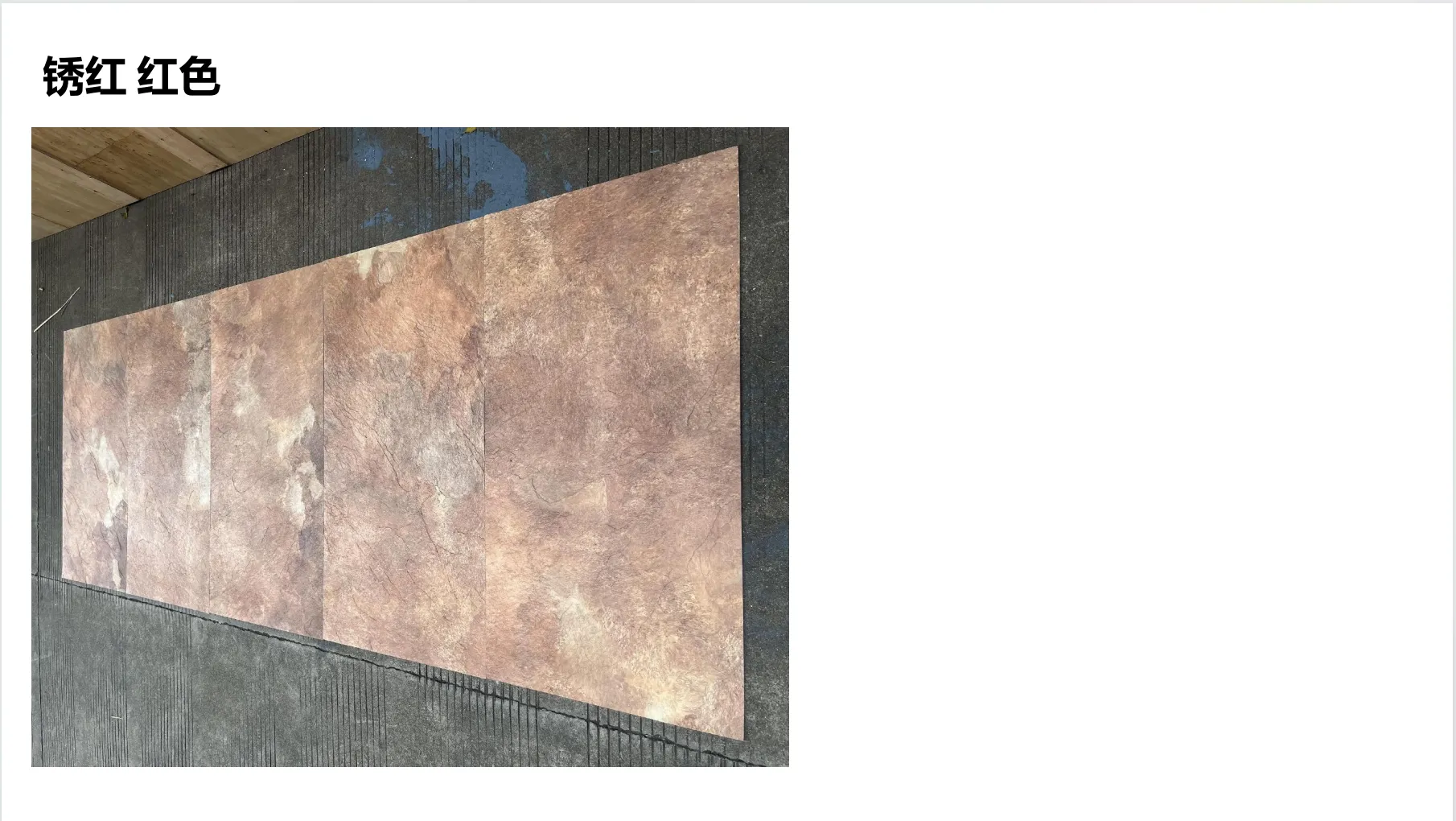
First, let's meet Rusty Red MCM. Part of the innovative mcm flexible stone family, MCM (Modified Composite Material) is a game-changer in the world of building cladding. Unlike rigid stone slabs that crack under pressure or heavy metal panels that weigh down structures, MCM is designed to be lightweight, flexible, and surprisingly tough. And Rusty Red? It's not just a color—it's an aesthetic statement. Think of the warm, weathered charm of a vintage barn roof, the earthy richness of desert sand at sunset, or the cozy glow of a campfire. That's the vibe Rusty Red MCM brings to a building's facade. It's a hue that doesn't just catch the eye; it invites touch, evokes memory, and turns a wall into a conversation starter.
But there's more to Rusty Red MCM than meets the eye. Under that striking exterior lies a core of natural stone particles, reinforced with recycled polymers, and bound together using a low-heat manufacturing process. This blend gives it the best of both worlds: the look and feel of natural stone, with the flexibility and durability of modern composites. It's thin—often just 3-5mm thick—but don't let that fool you. This material is built to last, even in the harshest environments.
On the other side of the ring, we have traditional composite panels. These are the workhorses of commercial and industrial design—materials like fair-faced concrete , foamed aluminium alloy board (vintage silver) , and fiber-reinforced plastics. Composite panels are typically made by bonding two or more materials together to leverage their strengths: for example, a plastic core sandwiched between aluminum sheets for lightweight durability, or concrete mixed with fibers to resist cracking. They've been around for decades, trusted for their affordability, versatility, and ability to mimic everything from wood to marble.
Take foamed aluminium alloy board (vintage silver) as an example. With its sleek, metallic finish and featherlight weight, it's a favorite for modern, high-rise facades aiming for that "futuristic" look. Fair-faced concrete, on the other hand, wears its raw, unpolished texture like a badge of honor, perfect for industrial-chic cafes or minimalist office buildings. But as the world shifts toward greener practices, these stalwarts are facing new scrutiny: How much energy goes into making them? Can they be recycled? And do they hold up as well over time as their proponents claim?
Strength in building materials isn't just about "toughness"—it's about resilience. Can a material withstand a hailstorm in Colorado, a monsoon in Southeast Asia, or the salty breeze of a coastal town? Can it handle the accidental bump of a delivery truck or the daily grind of foot traffic? Let's break down how Rusty Red MCM and composite panels perform in key areas.
Rusty Red MCM's secret weapon here is its flexibility. Imagine bending a piece of cardboard—eventually, it cracks. Now imagine bending a thin sheet of rubber; it flexes and returns to shape. MCM works similarly. Its mcm flexible stone composition allows it to absorb impact without breaking. In lab tests, it's withstood repeated freeze-thaw cycles (a common cause of stone and concrete cracking) and showed minimal signs of wear after 20 years of simulated weathering. Architects in coastal areas, where saltwater corrosion is a nightmare, have reported that Rusty Red MCM facades remain intact even after decades of exposure—no peeling, no fading, just that same rich red hue.
Composite panels, though, are a mixed bag. Fair-faced concrete is notoriously strong in compression (it can hold up skyscrapers, after all), but it's brittle. A heavy impact or rapid temperature change can lead to hairline cracks, which over time let water seep in and weaken the structure. Foamed aluminium alloy board (vintage silver) , while lightweight, is prone to dents. A stray baseball or a wayward ladder can leave permanent marks, marring the facade's appearance. And many plastic-based composites? They're susceptible to UV degradation—over time, the sun's rays break down the polymers, causing the panel to fade, warp, or become brittle.
Rusty Red MCM was born to battle the elements. Its non-porous surface repels water, so rain and humidity don't seep in and cause mold or rot. The rusty red color is achieved through a controlled oxidation process, not just a paint coat, so it resists fading even under intense sunlight. In fact, some manufacturers offer a 15-year warranty against color degradation—a bold promise that speaks to its durability.
Composite panels, again, vary. Fair-faced concrete absorbs water like a sponge, which can lead to efflorescence (those white, powdery stains) and freeze-thaw damage. Foamed aluminium alloy board (vintage silver) is corrosion-resistant, but its metallic finish can oxidize over time, losing its luster. And plastic composites? They're prone to warping in extreme heat, which can cause panels to pull away from the building's frame—a costly fix for property owners.
Strength isn't just about the material itself—it's about how easy it is to install and keep in good shape. Rusty Red MCM's lightweight design (it weighs up to 80% less than natural stone) makes installation a breeze. Workers can handle panels by hand, reducing the need for heavy machinery and cutting down on labor time. And because it's flexible, it can be curved or shaped to fit unique architectural designs—no need for custom-cutting that wastes material. Maintenance? A simple hose-down with water is usually enough to keep it looking fresh. No repainting, no sealing, no expensive repairs.
Composite panels often require more effort. Fair-faced concrete is heavy, requiring cranes and specialized equipment to install. If a panel cracks, replacing it means breaking out the old one (which can damage surrounding panels) and pouring a new one—a time-consuming, messy process. Foamed aluminium alloy board (vintage silver) needs periodic polishing to maintain its shine, and plastic composites may require repainting every 5-7 years to cover fading or scratches. All of this adds up to higher long-term costs, even if the upfront price is lower.
In a world grappling with climate change, sustainability isn't a "nice-to-have"—it's a necessity. The building industry is one of the largest contributors to carbon emissions, so the materials we choose matter. Let's see how Rusty Red MCM and composite panels measure up in terms of environmental impact.
Rusty Red MCM is a poster child for green building materials . Its production process uses recycled stone particles (leftover from natural stone quarries that would otherwise end up in landfills) and recycled polymers, reducing the need for virgin materials. The manufacturing facilities run on renewable energy, and the low-heat bonding process cuts energy use by up to 60% compared to traditional stone processing. Even the water used in production is recycled, with zero discharge into local waterways. It's no wonder that Rusty Red MCM has earned certifications from LEED, BREEAM, and other global green building standards.
Composite panels, by contrast, often leave a heavier footprint. Fair-faced concrete relies on cement, which is responsible for about 8% of global CO2 emissions. Mining the raw materials (limestone, clay) disrupts ecosystems, and the high-temperature kilns used to make cement guzzle fossil fuels. Foamed aluminium alloy board (vintage silver) starts with bauxite mining, a process that strips soil and vegetation, leaving behind scarred landscapes. Smelting aluminium requires massive amounts of energy—about 13 kilowatt-hours per kilogram, most of which still comes from coal in many parts of the world. And plastic-based composites? They're derived from petroleum, a non-renewable resource, and often end up in landfills when they're replaced, taking centuries to decompose.
At the end of a building's life, what happens to its materials? Rusty Red MCM can be fully recycled. When a facade is deconstructed, the panels are ground down into particles that can be reused to make new MCM panels or other construction materials. It's a circular system that minimizes waste and keeps resources in play. In pilot projects, up to 95% of Rusty Red MCM waste has been recycled—no ending up in a landfill.
Composite panels are less recyclable. Fair-faced concrete can be crushed and used as aggregate for roads, but this is a downcycling process—it loses value and can't be turned back into high-quality concrete. Foamed aluminium alloy board (vintage silver) is recyclable, but the process is energy-intensive and often not economically viable, so much of it ends up in landfills. Plastic composites? They're rarely recycled, as separating the layers (plastic, metal, fibers) is complicated and costly. Most end up incinerated or buried, releasing toxins into the air or soil.
Sustainability also means making buildings more energy-efficient. Rusty Red MCM has a natural insulating property thanks to its layered structure. It reduces heat transfer, keeping interiors cooler in summer and warmer in winter. This can lower heating and cooling costs by up to 20%—a big win for both the environment and building owners. Imagine a home in Arizona with a Rusty Red MCM facade: instead of the sun baking the walls and forcing the AC to work overtime, the MCM acts like a thermal blanket, keeping the inside comfortable with less energy.
Composite panels vary widely here. Fair-faced concrete is a poor insulator; it conducts heat, so buildings often need extra insulation layers, adding cost and thickness. Foamed aluminium alloy board (vintage silver) reflects sunlight, which helps with cooling, but it doesn't insulate well on its own. Plastic composites can have good insulating properties, but many are made with toxic foam cores that off-gas harmful chemicals, compromising indoor air quality.
| Feature | Rusty Red MCM | Fair-Faced Concrete (Composite) | Foamed Aluminium Alloy Board (Vintage Silver, Composite) |
|---|---|---|---|
| Material Composition | Recycled stone particles + recycled polymers (mcm flexible stone) | Cement, aggregates, water | Aluminium alloy foam with metallic coating |
| Durability (Expected Lifespan) | 25-30 years (minimal wear) | 15-20 years (prone to cracking) | 10-15 years (dents, oxidation) |
| Weather Resistance | Excellent (waterproof, UV-resistant, salt-resistant) | Poor (porous, prone to freeze-thaw damage) | Good (corrosion-resistant, but finish fades) |
| Recyclability | 95% recyclable (closed-loop system) | Downcyclable (crushed for aggregate) | 50-60% recyclable (energy-intensive process) |
| Embodied Energy (Production) | Low (renewable energy, recycled materials) | High (cement production = high CO2) | Very high (bauxite mining, smelting) |
| Maintenance Cost (20-Year Estimate) | $500-$1,000 (hosing, minor repairs) | $5,000-$8,000 (crack repairs, sealing) | $3,000-$5,000 (polishing, dent repairs) |
Numbers and tests tell part of the story, but real-world applications tell the rest. Let's look at two projects that chose Rusty Red MCM over composite panels—and why they've never looked back.
In a small beach town in Oregon, a cafe owner wanted a facade that could handle relentless rain, salt spray, and the occasional winter storm—all while feeling warm and inviting. Initially, they considered fair-faced concrete for its industrial look, but the local builder warned about cracking from freeze-thaw cycles. They switched to Rusty Red MCM. Five years later, the cafe's facade still glows with that same rich red hue. During a particularly harsh storm that damaged neighboring buildings' composite panel cladding, the MCM panels flexed with the wind and emerged unscathed. "It's like the building has a built-in raincoat," the owner. "And customers love it—they say it feels like a cozy cabin by the sea, even on the grayest days."
A tech company in San Francisco wanted its new headquarters to reflect its commitment to sustainability. They compared Rusty Red MCM with foamed aluminium alloy board (vintage silver) for the facade. The aluminium panels were sleek, but the company's sustainability team cringed at the high embodied energy. Rusty Red MCM, with its green building materials certifications and recyclable design, won out. Post-construction, energy bills are 18% lower than projected, and the building has become a local landmark—employees often mention how the Rusty Red exterior makes the office feel less like a corporate space and more like a community hub. "We didn't just build an office," the CEO said. "We built something that makes people proud to come to work—and proud of the impact we're having on the planet."
At the end of the day, both Rusty Red MCM and composite panels have their place. Composite panels like fair-faced concrete or foamed aluminium alloy board (vintage silver) may still be the right choice for projects where upfront cost is the primary concern or a specific industrial aesthetic is needed. But when it comes to balancing strength, sustainability, and sheer aesthetic appeal, Rusty Red MCM stands out.
It's not just a material—it's a partner in creating spaces that last, that respect the planet, and that feel deeply human. Whether you're designing a cozy cafe, a towering office building, or a family home, Rusty Red MCM brings something rare to the table: the ability to tell a story of resilience and responsibility, one panel at a time.
So the next time you walk past a building with a warm, rusty red facade, take a moment to appreciate it. It might just be more than a pretty face—it could be a sign of a better, more sustainable future for building design.
Recommend Products












