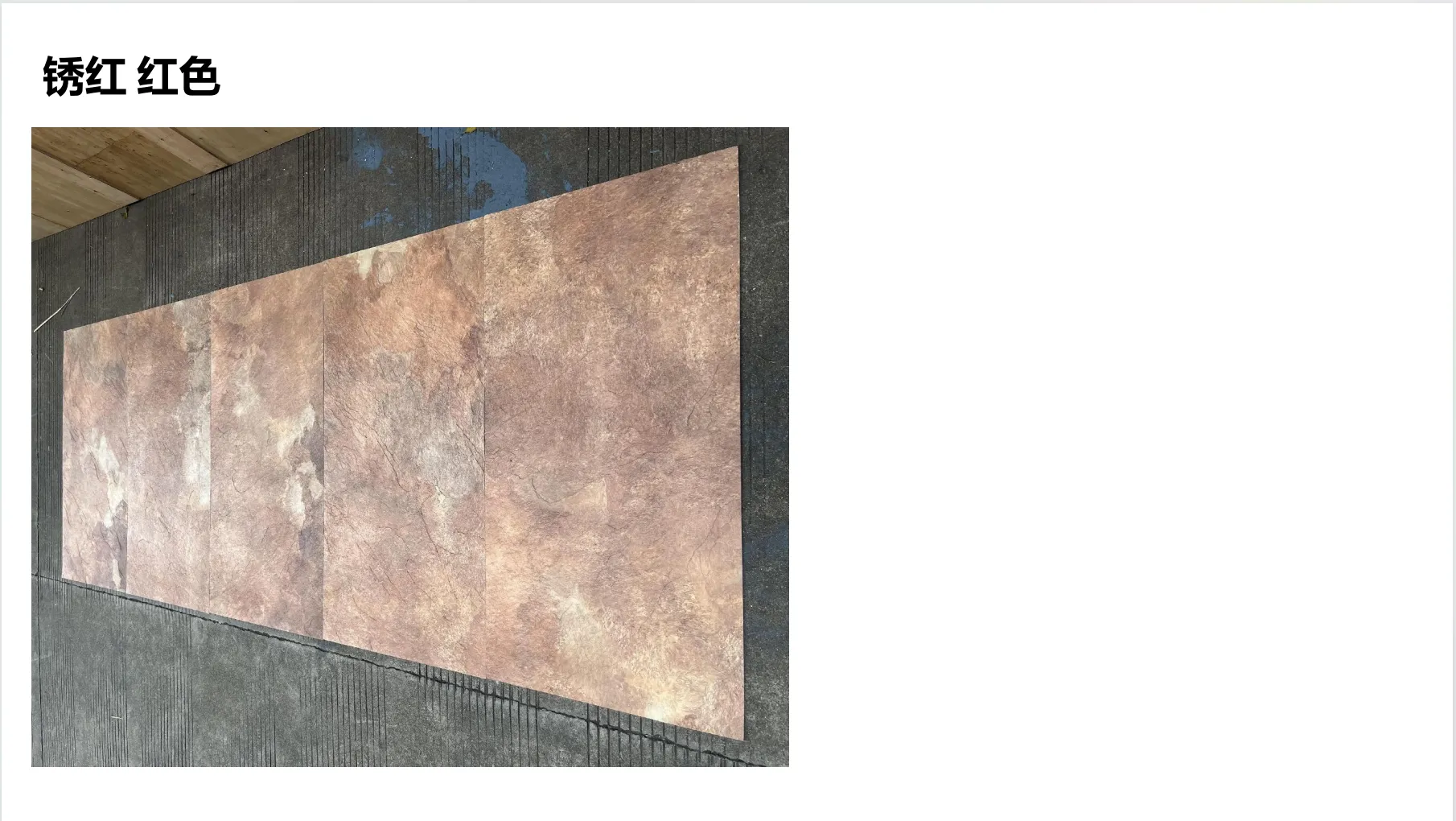
To really understand which material is tougher, let's put them through the ultimate weather test: rain, UV rays, freeze-thaw cycles, and the slow creep of time. We'll break it down into key categories, so you can see exactly where each shines (or falls short).
1. Water Resistance: Keeping the Rain Out (and the Walls Dry)
Rain is the most common enemy of exterior cladding. Even a little moisture seeping in can lead to mold, rot, or structural damage over time. Let's see how each material handles a downpour.
Rusty Red MCM:
Thanks to its composite makeup, MCM flexible stone is inherently water-resistant. The polymers in the mix create a tight bond around the stone aggregates, forming a barrier that repels water rather than absorbing it. Think of it like a rain jacket for your walls—water beads up and runs off, instead of soaking in. And because it's non-porous, there's no risk of water getting trapped inside the panels, which is a big deal in humid climates where mold loves to grow. I've seen MCM-clad homes in coastal areas (where rain and salt spray are constant) that still look brand-new after 10 years—no water stains, no peeling, just that same Rusty Red glow.
Limewash:
Limewash, by contrast, is porous by design. While this porosity helps old buildings release moisture, it also means it soaks up rainwater like a sponge. When it rains heavily, you might notice streaks running down limewashed walls as water carries away tiny particles of the wash. Over time, this can lead to uneven fading or even erosion, especially on walls with heavy exposure. And if water sits on the surface long enough, it can seep into the underlying brick or stone, causing damage from the inside out. To make matters worse, limewash doesn't bond to surfaces as strongly as MCM; repeated wetting and drying can loosen its grip, leading to flaking or peeling.
2. UV Resistance: Fighting Fade from the Sun
The sun's UV rays are silent but destructive, breaking down pigments and weakening materials over time. A material that fades quickly isn't just an eyesore—it's a sign that its protective layers are breaking down, leaving the underlying surface vulnerable.
Rusty Red MCM:
MCM panels are engineered with UV-stable pigments that are mixed directly into the composite material. That means the Rusty Red color isn't just a topcoat—it's part of the panel itself. UV rays might hit the surface, but they can't penetrate deep enough to fade the color dramatically. In fact, most MCM manufacturers back their products with warranties for color retention (often 10+ years), even in sunny climates. I visited a home in Arizona last year that had been clad in Rusty Red MCM for 12 years, and you could barely tell the difference between the original panels and new ones—no sun bleaching, no patchy discoloration.
Limewash:
Limewash's UV resistance depends almost entirely on the pigments used. Natural pigments (like iron oxides for reds or yellows) can hold up better than synthetic ones, but even the best will fade over time. The sun breaks down the lime matrix, causing the color to lighten and the surface to become chalky. In areas with intense sunlight (think Florida or the Southwest), you might notice significant fading in as little as 2–3 years. And because limewash is porous, that chalky residue can wash off in the rain, leaving streaks and uneven coloration. It's not that limewash can't handle the sun—it just needs more frequent touch-ups to stay vibrant.
3. Freeze-Thaw Cycles: Surviving the Cold (Without Cracking)
For anyone living in a climate with cold winters, freeze-thaw cycles are public enemy number one. Water seeps into tiny cracks, freezes (expanding by 9%), and then thaws, weakening the material over time. This repeated stress can turn small flaws into big problems.
Rusty Red MCM:
MCM flexible stone was practically made for freeze-thaw zones. Its flexibility is key here—unlike rigid stone or brick, MCM panels can expand and contract with temperature changes without cracking. And because they're water-resistant, there's minimal moisture to seep in and freeze. I worked on a project in upstate New York a few years back, where winters hit -20°F and snow piles up for months. The home was clad in Rusty Red MCM, and after five winters, there wasn't a single crack or chip. The panels just "moved" with the cold, no drama.
Limewash:
Limewash doesn't fare as well in freeze-thaw conditions. Remember that porosity we talked about? Water soaks into the limewash, freezes, and expands, which can cause the material to flake or peel. Over time, those flakes turn into bigger patches, exposing the underlying surface to more moisture and damage. In regions with harsh winters, homeowners often have to reapply limewash every 3–5 years to keep up with the damage. It's not impossible to use limewash in cold climates, but it requires more maintenance than MCM.
4. Long-Term Durability: How They Age Over Decades
Weather resistance isn't just about surviving a single storm—it's about looking good and protecting your home for decades. Let's talk about how each material ages.
Rusty Red MCM:
MCM is built to last. The composite material is resistant to rot, mold, and pests (no termites or algae growth here), and its structural integrity holds up over time. The panels won't warp, crack, or delaminate under normal conditions, and as we mentioned, the color stays true for years. Most MCM installations have a lifespan of 25–30 years with minimal maintenance—impressive for any exterior material. Compare that to
fair-faced concrete
(another durable option), which can develop cracks over time; MCM's flexibility gives it an edge in long-term structural resilience.
Limewash:
Limewash ages gracefully in its own way—many people love the "patina" it develops, with subtle color variations and a soft, worn look. But "aging gracefully" doesn't always mean "lasting long." As the lime matrix breaks down, the material becomes thinner and more vulnerable. In ideal conditions (mild climate, minimal rain/sun), it might last 5–7 years before needing a full reapplication. In harsher conditions? Maybe 3–4 years. And each reapplication means stripping the old limewash, prepping the surface, and reapplying—a labor-intensive process that adds up over time.