
Picture this: You're standing in front of your dream home, its exterior glowing under the sun—a warm, earthy hue that feels both timeless and vibrant. But if you live in a place where the air hangs thick with moisture, where rainstorms roll in like clockwork and humidity clings to walls like a second skin, that dream can quickly turn into a nightmare. Peeling paint, moldy patches, and cracked surfaces become all too familiar. When it comes to exterior materials, the choice isn't just about looks; it's about survival. Today, we're pitting two contenders against each other in the ultimate humidity showdown: Rusty Red MCM (Modified Composite Material) and traditional stucco. Which one will stand tall when the rain pours and the mold spores lurk?
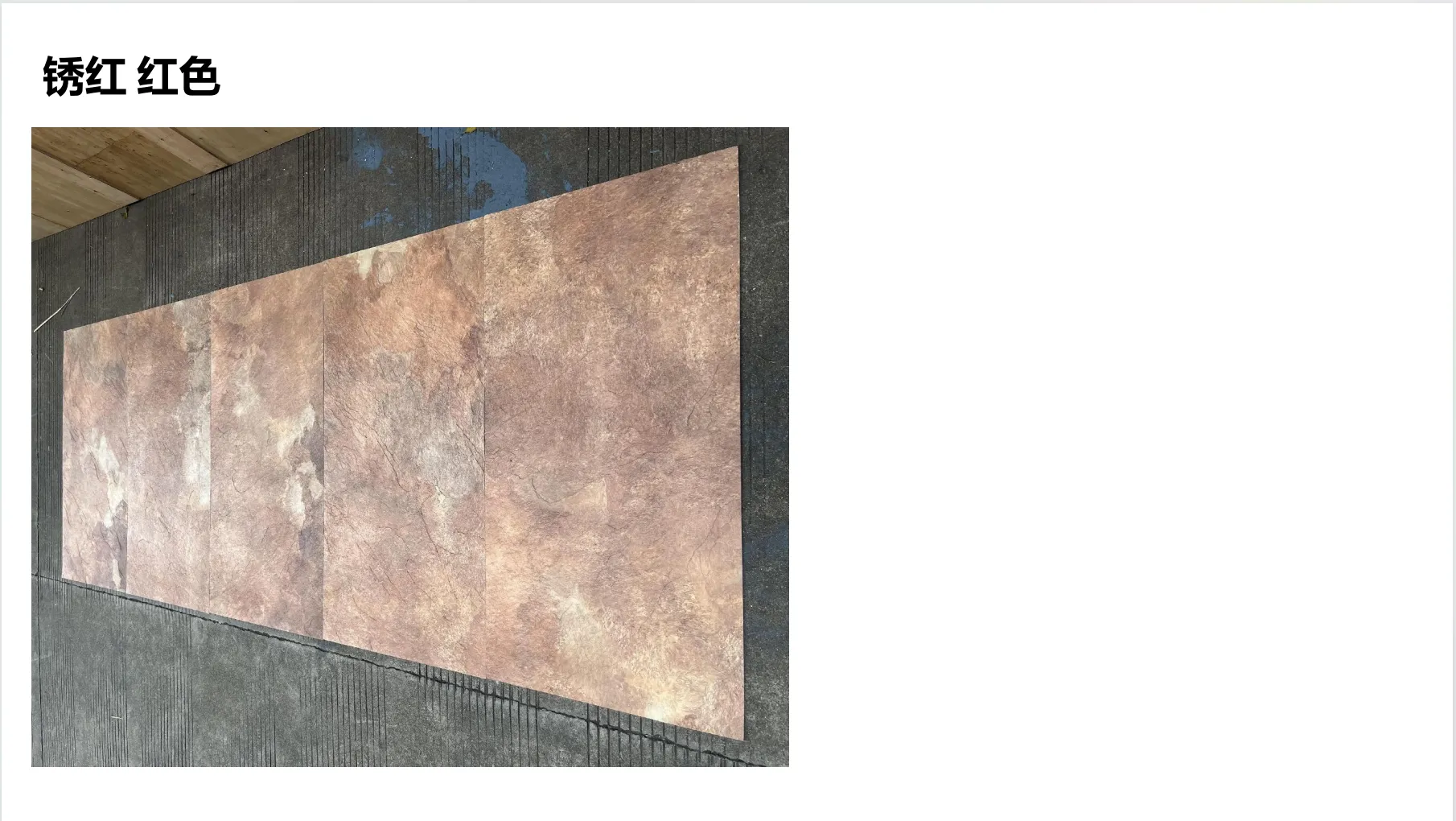
If you're not familiar with MCM, let's start there. Short for Modified Composite Material, MCM is the new kid on the block, but it's quickly making a name for itself as a game-changer in building design. Think of it as nature's best features—rich textures, organic colors—reimagined with 21st-century engineering. Rusty Red MCM is a standout in the MCM lineup, boasting a finish that mimics the weathered beauty of natural stone, with deep reds and warm oranges that evoke the rugged charm of desert landscapes or the patina of aged metal. But it's what's under the hood that matters most.
MCM panels are typically crafted from a blend of mineral aggregates, polymers, and fibers, often incorporating technologies like flexible stone —a material that bends without breaking, unlike brittle natural stone. This flexibility is key, especially in climates where temperatures swing and moisture expands and contracts materials. Rusty Red MCM isn't just a pretty face; it's a product of years of innovation, designed to bridge the gap between natural aesthetics and modern durability. It's part of broader MCM collections like Epoch Stone and Century Stone , lines built to withstand the test of time (and weather).
Stucco, on the other hand, is the tried-and-true veteran. For centuries, builders have mixed cement, sand, and lime to create a thick, paste-like coating that hardens into a solid, matte finish. It's beloved for its clean, Mediterranean-inspired look and its ability to be textured or smooth, fitting a range of architectural styles. Walk through neighborhoods in Florida, Arizona, or parts of California, and you'll see stucco everywhere—it's the default for a reason: it's affordable, easy to apply, and has that classic, understated appeal.
But here's the catch: stucco is, by nature, porous. Those tiny holes that give it texture also act like sponges, soaking up moisture from rain, dew, or humid air. In dry climates, that's less of a problem—moisture evaporates quickly, and the stucco stays stable. But in humid environments? That moisture lingers, and trouble starts to brew.
Humid climates are brutal on exteriors. Let's break down the threats:
Imagine a coastal home in Charleston, South Carolina. After a summer of daily thunderstorms and 90% humidity, the exterior walls are constantly damp. Stucco here might start to show hairline cracks within a few years. By year five? You could be looking at mold spots, peeling paint, and the need for expensive repairs. That's the reality of building in humidity—and why choosing the right material isn't just about aesthetics; it's about avoiding a never-ending maintenance battle.
Now, let's talk about Rusty Red MCM —the underdog that's rewriting the rules for humid-climate exteriors. Here's how it stacks up:
MCM panels are engineered to be hydrophobic, meaning they repel water rather than absorb it. Unlike stucco, which soaks up moisture like a sponge, Rusty Red MCM has a tight, non-porous surface that lets rain bead up and roll off. Tests show that MCM absorbs less than 1% of its weight in water, compared to stucco's 10-15% absorption rate. That's a huge difference—less absorption means less trapped moisture, and less trapped moisture means fewer mold problems and less cracking.
Here's where MCM gets clever: it's water-resistant and breathable. While it keeps external moisture out, it allows any internal moisture (like condensation from inside the home) to escape as vapor. This "breathability" prevents the buildup of water between the panel and the wall, a common issue with non-breathable materials that leads to rot and mold. Stucco, on the other hand, often traps moisture behind its surface, especially if it's painted with a non-breathable coating—creating the perfect environment for mold to thrive.
Thanks to its flexible stone technology, MCM panels bend and flex with temperature changes. In humid climates, days can be scorching hot, and nights can cool down significantly. Stucco, being rigid, doesn't flex—it cracks. MCM, however, moves with the wall, resisting those hairline fractures that let moisture in. It's like the difference between a rigid plastic ruler and a flexible rubber one—drop the plastic ruler, and it snaps; the rubber one bounces back.
Mold needs organic material and moisture to grow. MCM's synthetic polymer base and mineral aggregates don't provide food for mold, and its low moisture absorption starves it of water. Stucco, made with organic materials like lime and sometimes wood fibers, is a buffet for mold when wet. Even with mold-resistant additives, stucco in humid climates often develops dark spots that require harsh cleaners to remove—only to return a few months later.
In 2018, two identical homes were built in Miami Beach: one with Rusty Red MCM exterior panels, the other with traditional stucco. Both faced the same salty air, daily humidity, and seasonal hurricanes. In 2023, here's what inspectors found:
Stucco isn't all bad—far from it. In dry climates, it can last 50+ years with minimal upkeep. But in humidity, its flaws become hard to ignore:
Stucco's porous nature means it absorbs water, which can seep into the underlying structure (wood framing, insulation). Over time, that can lead to rotting wood, damaged drywall, and even structural issues. In extreme cases, stucco homes in humid areas have required complete exterior replacement—a $20,000+ job for a average-sized house.
Stucco dries hard and brittle. When the ground shifts (common in areas with clay soil, which swells when wet), or when temperatures fluctuate, it cracks. Even "crack-resistant" stucco mixes can't fully prevent this in humid climates, where moisture exacerbates the expansion-contraction cycle.
To keep stucco looking good in humidity, you'll need to:
What starts as an affordable upfront choice quickly becomes a money pit.
Let's not forget about looks. Rusty Red MCM isn't just tough—it's stunning. Its finish mimics the depth of natural stone, with subtle variations in color and texture that catch the light. Unlike stucco, which often looks flat and uniform, MCM has character. And because the color is integrated into the material (not just painted on), it resists fading. Even after years of sun and rain, that Rusty Red hue stays vibrant.
Stucco, while charming initially, can look tired fast in humidity. Fading, staining, and the need for frequent repainting mean it rarely maintains that "new home" glow. And when you do repaint, matching the original color is tricky—leading to patchy, inconsistent results.
Compare this to other durable materials like fair-faced concrete , which has a sleek, industrial look but lacks the warmth of Rusty Red MCM. MCM offers the best of both worlds: the organic beauty of natural materials with the resilience of modern composites.
Installing Rusty Red MCM is faster and cleaner than stucco. MCM panels are lightweight (about 1/5 the weight of natural stone) and can be cut to size on-site, reducing waste. They're attached to the wall with mechanical fasteners, eliminating the need for messy wet mixes. A typical home exterior can be wrapped in MCM in 3-5 days, compared to 1-2 weeks for stucco (which requires multiple coats and drying time).
Maintenance? For MCM, it's simple: hose it down once or twice a year to remove dirt. No repainting, no patching, no sealing. Stucco, as we've seen, demands regular attention—and cash. Over 10 years, the average stucco home in a humid climate will cost 3-4 times more in maintenance than an MCM home.
Stucco has its place—in dry climates, on budget builds, or where a minimalist look is preferred. But in humid environments, it's a compromise that costs more in the long run. Rusty Red MCM, with its flexible stone technology, water resistance, and low maintenance, isn't just a material—it's an investment in peace of mind. It lets homeowners enjoy their exteriors without worrying about cracks, mold, or fading. It's the difference between dreading the next rainstorm and admiring how your home stands strong, Rusty Red glow intact, year after year.
So, if you're building or renovating in a humid climate, ask yourself: Do I want a material that fights humidity, or one that surrenders to it? The answer, for durability, beauty, and your wallet, is clear.
| Feature | Rusty Red MCM | Traditional Stucco | Fair-Faced Concrete |
|---|---|---|---|
| Water Resistance | High (low absorption, repels moisture) | Low (porous, absorbs water) | Medium (dense but can stain) |
| Mold Resistance | Excellent (no organic food source) | Poor (traps moisture, prone to mold) | Good (non-porous but lacks texture) |
| Maintenance Cost (10 Years) | ~$2,000 (cleaning only) | ~$8,000 (repainting, patching, mold treatment) | ~$3,500 (sealing, stain removal) |
| Aesthetic Longevity | High (color integrated, resists fading) | Low (fades, stains easily) | Medium (industrial look, prone to weathering) |
| Installation Time | 3-5 days (panel installation) | 7-14 days (multiple coats, drying time) | 5-7 days (formwork, pouring, curing) |
Recommend Products












