
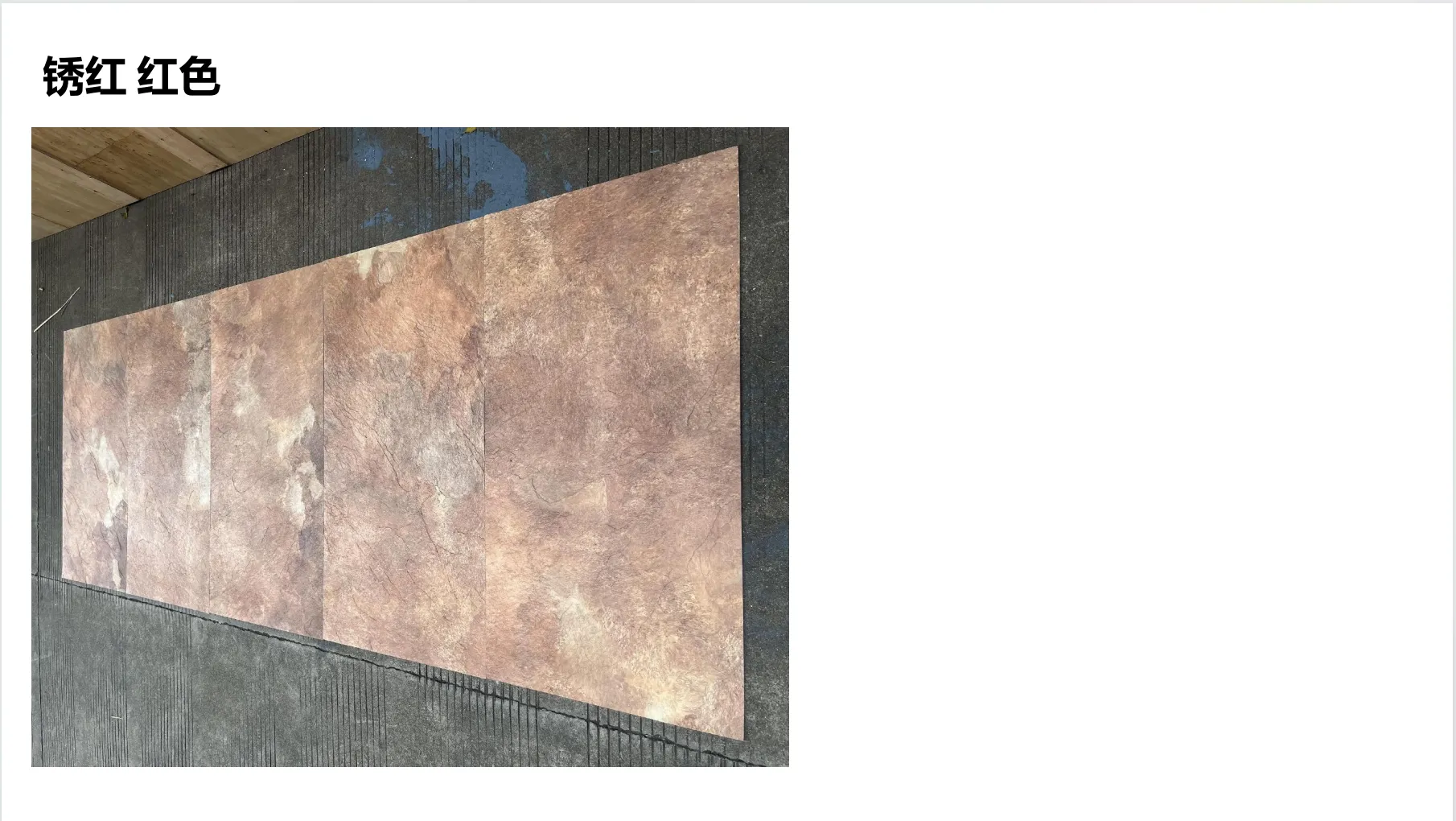
Picture this: You're standing on a sunlit construction site, blueprint in hand, surrounded by samples of building materials. To your left, a panel of Rusty Red MCM shimmers, its textured surface catching the light like weathered iron with a modern twist. To your right, a terracotta tile sits warm and earthy, its clay-based hue evoking centuries of architectural history. Both promise sustainability, but which one fits your project's budget without compromising on eco-friendliness? For architects, builders, and homeowners alike, this is the kind of decision that shapes not just a building's look, but its long-term impact—on the planet and the bottom line.
Before diving into costs, let's get clear on what we're actually looking at. These two materials might both grace building facades, but their stories, compositions, and personalities are worlds apart.
Rusty Red MCM isn't just a color—it's a statement. Part of the broader MCM flexible stone family, this material is a blend of natural minerals, high-performance polymers, and reinforced fibers. Think of it as nature meets engineering: it mimics the rugged beauty of rusted metal or weathered stone but with a flexibility that traditional materials can't match. At just 3-5mm thick, it's lightweight enough to cling to curved surfaces, reducing structural load, yet tough enough to withstand harsh weather, from scorching deserts to freezing winters.
What makes it "Rusty Red"? The hue comes from iron oxide pigments integrated during manufacturing, giving it that rich, warm tone that feels both industrial and organic. And unlike real rusted metal, it won't flake or corrode—this color is built to last. For projects aiming for a bold, contemporary look with a nod to sustainability, Rusty Red MCM checks a lot of boxes.
Terracotta, on the other hand, is a material with stories to tell. Derived from the Italian words for "baked earth," it's made by shaping clay into tiles or panels, then firing them in kilns at high temperatures. The result? A porous, breathable material with a warm, earthy palette that ranges from soft terracotta orange to deep russet. For millennia, it's adorned everything from ancient Roman villas to 20th-century Art Deco skyscrapers—and for good reason: it's durable, naturally insulating, and biodegradable at the end of its life.
But terracotta isn't stuck in the past. Modern versions often include additives to boost strength or reduce water absorption, making it a viable choice for contemporary builds too. Still, its charm lies in its imperfection—the slight variations in color and texture that come from handcrafted production, a quality that feels increasingly rare in our mass-produced world.
Sustainable architecture isn't just a trend; it's a responsibility. Both Rusty Red MCM and terracotta claim eco-friendly credentials, but let's dig deeper to see how they stack up.
Embodied energy—the total energy used to extract, manufacture, and transport a material— is a key sustainability metric. Terracotta, made from clay (a abundant resource), has a lower upfront footprint than many synthetic materials, but firing it in kilns requires significant heat, driving up energy use. Rusty Red MCM, by contrast, uses less energy in production: its thin, lightweight panels require fewer raw materials, and its polymer binders are often sourced from recycled plastics, cutting down on waste.
A building's material choice impacts heating and cooling costs for decades. Terracotta's porosity acts as natural insulation, keeping interiors cool in summer and warm in winter—a boon for energy efficiency. Rusty Red MCM, while not porous, reflects solar radiation (thanks to its pigment technology), reducing heat gain. In hot climates, this can lower air conditioning use by up to 15%, according to some manufacturers. Both materials help shrink a building's operational carbon footprint, but MCM's reflectivity gives it an edge in sun-drenched regions.
At the end of a building's life, what happens to its materials? Terracotta, being clay-based, is fully biodegradable—crush it, and it returns to the earth. Rusty Red MCM, while not biodegradable, is recyclable: its mineral components can be crushed and reused in new panels, and its polymer fibers can be repurposed. Neither ends up in landfills easily, but terracotta's "return to nature" narrative holds strong for eco-conscious clients.
Sustainability matters, but budgets talk too. Let's break down the costs—from the initial purchase to the final dollar spent over a material's lifetime.
Walk into a supplier's yard, and you'll notice the first difference: terracotta tiles typically cost $15–$30 per square foot, depending on thickness and finish. Rusty Red MCM, being a high-tech composite, starts higher, around $20–$35 per square foot. At first glance, terracotta seems cheaper, but here's the catch: terracotta is heavy. A standard terracotta panel weighs 15–20 pounds per square foot, while MCM clocks in at just 2–4 pounds. That weight difference? It changes everything when it comes to installation.
Installing heavy materials requires more labor, specialized equipment, and structural support. Terracotta often needs reinforced framing to hold its weight, adding $5–$10 per square foot to installation costs. MCM, lightweight and flexible, can be cut on-site with basic tools, installed directly over existing surfaces, and requires minimal structural reinforcement. Installation costs for MCM average $8–$12 per square foot, compared to terracotta's $12–$18. For a 10,000-square-foot facade, that's a difference of $40,000–$60,000 upfront—enough to swing the initial budget in MCM's favor, even with its higher material cost.
Sustainability isn't just about the planet—it's about longevity. Terracotta, while durable, is porous: in rainy climates, it can absorb water, leading to cracks or mold over time. Sealing it every 3–5 years costs $2–$4 per square foot annually. Rusty Red MCM, with its non-porous surface, resists water, mold, and UV damage. It needs nothing more than an annual hose-down, costing $0.50–$1 per square foot. Over 20 years, that's a maintenance bill of $80,000 for terracotta vs. $10,000 for MCM on that same 10,000-square-foot facade. Ouch.
To truly compare costs, we need to look at the total lifecycle—how long each material lasts and what it costs over that time. Terracotta, when well-maintained, can last 70–100 years. Rusty Red MCM, with its resistance to weathering, averages 50–60 years. But factor in maintenance costs, and the math shifts. Let's visualize this with a comparison:
| Cost Category | Rusty Red MCM | Terracotta |
|---|---|---|
| Initial Material Cost (per sq ft) | $20–$35 | $15–$30 |
| Installation Cost (per sq ft) | $8–$12 | $12–$18 |
| Annual Maintenance Cost (per sq ft) | $0.50–$1 | $2–$4 |
| Typical Lifespan | 50–60 years | 70–100 years |
| Total Lifecycle Cost (per sq ft, over lifespan) | $53–$87 | $109–$210 |
Even with terracotta's longer lifespan, its higher maintenance costs push its total lifecycle cost far above MCM's. For a building designed to stand 50 years, Rusty Red MCM ends up being the more cost-effective choice—by a lot.
Cost aside, some projects just "fit" one material better than the other. Let's explore where each truly shines.
Rusty Red MCM's flexibility (it bends to curved surfaces) and lightweight nature make it ideal for modern designs—think statement facades, accent walls, or even interior feature panels. Its uniform color (with subtle texture variations) works well in commercial projects, where consistency is key. For example, a tech startup's headquarters might opt for MCM to signal innovation, while a retail store could use it to create a striking, on-brand exterior. It's also a favorite for retrofits: its thin panels can be installed over existing concrete or brick, avoiding the cost of tearing down old facades.
Terracotta thrives in projects that prioritize tradition or context. Historic renovations, boutique hotels, or residential buildings in heritage districts often lean on terracotta to blend in with surrounding architecture. Its handcrafted look adds character to homes, where a "perfectly imperfect" aesthetic is desired. In regions with mild climates (to minimize water absorption), it's also a star: imagine a Mediterranean-style villa with terracotta roof tiles and facade panels, radiating warmth under the sun.
Numbers tell part of the story, but real projects bring it to life. Let's look at two examples where these materials were put to the test.
In downtown Austin, a 10-story office building needed a facade that balanced sustainability and budget. The team considered terracotta but worried about the city's heavy rains (and the resulting maintenance costs). They opted for Rusty Red MCM. The result? Initial material and installation costs totaled $320,000 for 10,000 square feet—$80,000 less than terracotta would have cost. Five years in, maintenance has been minimal: a yearly power wash and minor repairs to a few panels damaged by a storm. The building's energy bills are also 12% lower than similar-sized offices, thanks to MCM's solar reflectivity. "We're saving on both upfront and ongoing costs," says the project architect. "And the rusty red hue has become a neighborhood landmark."
In Savannah, Georgia, a 1920s schoolhouse was being converted into luxury apartments. The local historic society required materials that matched the original terracotta facade. The team sourced reclaimed terracotta tiles, supplementing with new ones to replace damaged sections. Initial costs were high—$450,000 for 8,000 square feet, including custom matching—but the material's authenticity was non-negotiable. To offset maintenance, they installed a drainage system behind the facade to reduce water absorption, cutting sealing needs to every 5 years. "It's a labor of love," says the developer. "But in 50 years, when these terracotta tiles are still here, we'll know it was worth it."
So, how do you choose? Ask yourself three questions:
Rusty Red MCM and terracotta are both champions of sustainable architecture—just in different ways. MCM offers lower lifecycle costs, modern versatility, and minimal maintenance, making it a workhorse for budget-conscious, forward-looking projects. Terracotta, with its timeless beauty and biodegradable nature, appeals to those willing to invest in tradition and long-term character.
At the end of the day, the "right" choice depends on your project's unique needs. But here's the good news: whether you lean into Rusty Red MCM's modern edge or terracotta's historic warmth, you're choosing sustainability—a win for both your budget and the planet. And in a world where buildings outlive us all, that's the most important cost of all.
Recommend Products












