
There's something undeniably bold about red. It's the color of energy, passion, and personality—qualities that make it a favorite for homeowners, architects, and designers looking to make a statement. Whether it's a cozy cottage in the countryside, a sleek urban café, or a grand commercial building, a vibrant red exterior can turn heads and create memories. But here's the catch: that eye-catching red doesn't always stay eye-catching. Walk through any neighborhood, and you'll spot the telltale signs of faded red paint—walls that once popped now look washed out, patchy, or even pinkish, like a memory of their former selves. For many, this fading isn't just a cosmetic issue; it's a letdown. It feels like investing in a promise that didn't hold up. What if there was a way to keep that red vibrant, year after year, without the constant hassle of repainting or touch-ups? Enter Rusty Red MCM —a modern building material that's challenging everything we thought we knew about color retention. In this article, we'll pit Rusty Red MCM against traditional red paint in a head-to-head battle, exploring why one fades while the other endures, and what that means for your next project.
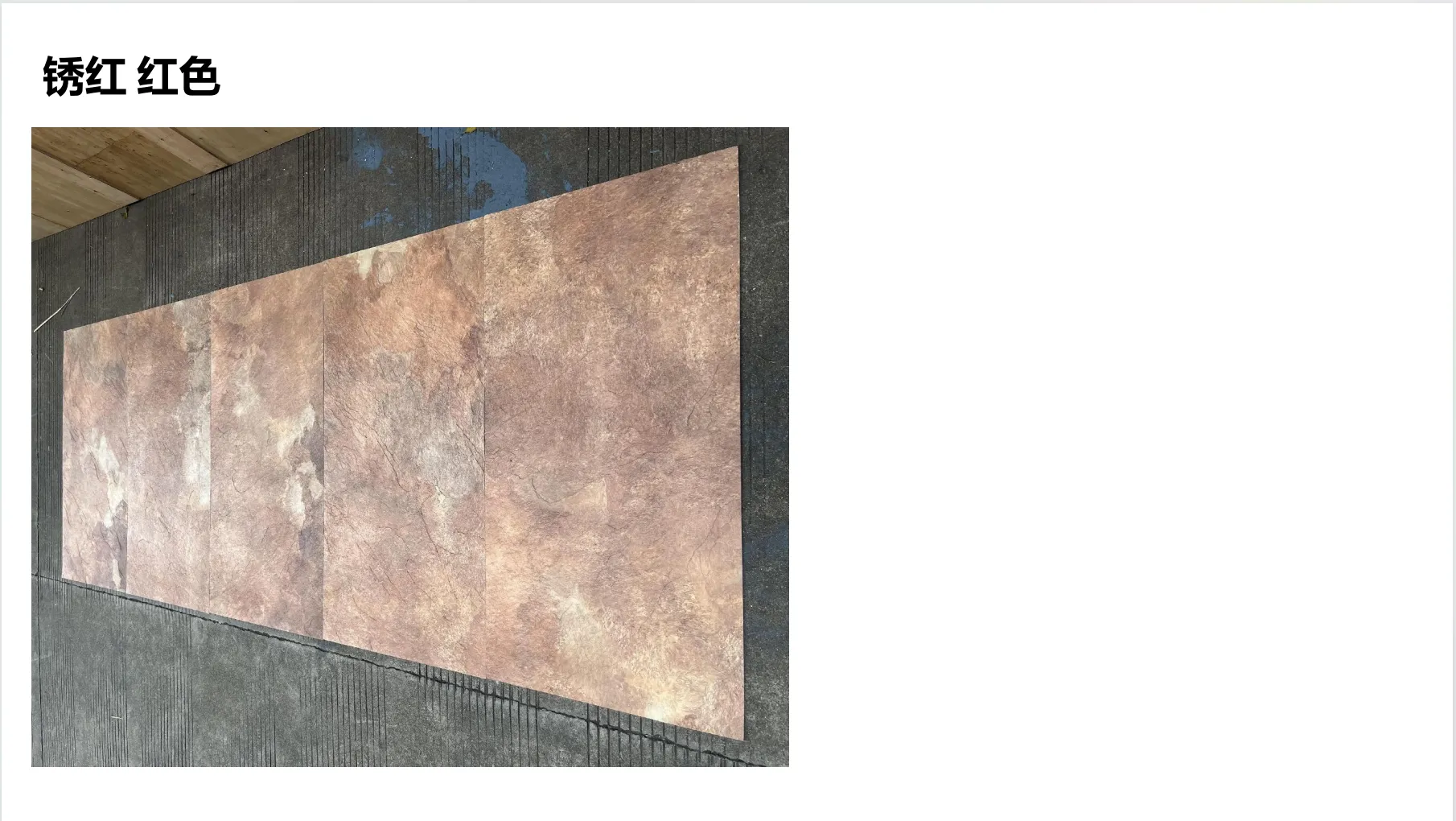
Before we dive into the color retention showdown, let's get to know Rusty Red MCM. MCM stands for Modified Composite Material, and it's a game-changer in the world of exterior cladding. Think of it as nature and technology having a perfect collaboration. At its core, MCM is a flexible stone product—engineered to mimic the look and texture of natural materials like stone or metal but with supercharged durability. Rusty Red MCM, specifically, draws inspiration from the warm, earthy tones of weathered iron or ancient terracotta, blending rich red hues with subtle hints of rust and brown for depth. But unlike natural stone, which can be heavy and brittle, MCM is lightweight, flexible, and designed to stand up to the harshest elements.
So, what makes it tick? MCM is crafted by combining mineral aggregates (like crushed stone or quartz) with high-performance polymers and. This mix is then compressed under high pressure and heat, creating a thin, rigid panel that's both strong and lightweight. The color in Rusty Red MCM isn't just a surface coat—it's integrated throughout the material. That means even if the surface gets scratched (which is rare), the color remains consistent. Compare that to paint, which sits on top of the surface, and you already see why MCM has an edge. It's also worth noting that Rusty Red MCM is part of a broader family of MCM products, including options like rust board —a textured variant that mimics the rugged, oxidized look of aged metal, but with none of the corrosion issues.
Now, let's talk about the contender we all know: traditional red paint. For decades, red paint has been the go-to for adding color to exteriors. It's familiar, relatively affordable upfront, and comes in a million shades—from cherry to brick to crimson. But how does it work? Red paint is essentially a mix of three things: pigments (the color), binders (the glue that holds it to the surface), and solvents (which help it spread and dry). When you apply red paint to a wall, the solvent evaporates, leaving behind a thin film of binders and pigments that create that bold red color. Sounds simple enough, right? The problem is, that thin film is surprisingly fragile.
The Achilles' heel of red paint? Its pigments. Most red pigments—especially the vibrant ones—are organic, meaning they're derived from natural or synthetic compounds that break down over time. When exposed to sunlight, moisture, or even air pollution, these pigments start to degrade. You've probably seen it: a red door that was bright and cheerful three years ago now looks dull, or a red barn that's faded to a pale pink. Paint also struggles with adhesion over time. Binders can break down, causing the paint to crack, peel, or chalk (that powdery residue that rubs off on your hand). And once that happens, water seeps in, leading to more damage—and even more fading. It's a cycle that leaves homeowners repainting every 3-5 years, shelling out time and money to keep that red looking fresh.
Now, let's get to the heart of the matter: color retention. We've all heard the phrase "the proof is in the pudding," so let's break down how Rusty Red MCM and traditional red paint stack up in real-world conditions—from UV rays to rain to temperature swings. This isn't just about science; it's about how your exterior will look and feel 1 year, 5 years, or even 10 years down the line.
The sun is public enemy number one when it comes to color fading, and red is particularly vulnerable. Why? Because red pigments absorb more of the sun's ultraviolet (UV) rays than, say, white or beige. Traditional red paint relies on organic pigments that absorb UV energy, which breaks down their chemical structure over time. Think of it like leaving a red shirt in the sun for months—it fades because the dye molecules are literally falling apart. In fact, studies show that some red paints can lose up to 30% of their color intensity in just 2 years of direct sunlight.
Rusty Red MCM, on the other hand, laughs in the face of UV rays. Remember how we mentioned MCM's color is integrated throughout the material? That's just the start. The pigments in MCM are inorganic and UV-stabilized —meaning they're designed to reflect or absorb UV rays without breaking down. MCM panels also undergo a special coating process that adds an extra layer of UV protection, acting like a sunscreen for your exterior. In accelerated weathering tests (where materials are exposed to intense UV light, heat, and moisture for months to simulate years of exposure), Rusty Red MCM retained over 90% of its original color after 10,000 hours—equivalent to about 10 years of real-world sun exposure. Traditional red paint? After the same test, it retained just 55% of its color, with noticeable fading and discoloration.
Rain, humidity, and even dew can spell disaster for red paint. When water seeps into paint layers, it weakens the binders, causing the paint to blister or peel. And once the surface is compromised, UV rays penetrate even deeper, accelerating fading. In humid climates, mold and mildew can also grow on paint, leaving dark spots that further discolor the red. Even in dry climates, occasional rain can wash away the top layer of pigments, leaving the paint looking dull.
Rusty Red MCM, by contrast, is hydrophobic —meaning it repels water. Its dense, non-porous surface prevents moisture from soaking in, so there's no blistering, peeling, or mold growth. In fact, MCM panels are often used in coastal areas or rainy regions (think Seattle or Florida) because they stand up to saltwater spray and heavy downpours without a hitch. Water simply beads up and rolls off, taking dirt with it—so not only does the color stay vibrant, but the panels stay cleaner, too. Traditional red paint, on the other hand, requires regular cleaning (which can itself wear away pigments) and is prone to water damage even with proper maintenance.
Ever noticed how paint cracks or fades faster in places with extreme temperature swings? That's because paint expands and contracts with heat and cold, weakening the binders over time. In winter, freezing temperatures can cause water trapped in paint to expand, creating cracks. In summer, intense heat can bake the paint, making it brittle and prone to chipping. Each cycle leaves the pigments more exposed, and more likely to fade.
Rusty Red MCM is built to handle temperature extremes like a champ. Its composite structure is thermally stable, meaning it doesn't expand or contract as much as paint. This stability prevents cracking and peeling, keeping the color locked in. Whether you live in the frigid north (where temperatures drop to -20°F) or the sweltering south (where highs hit 110°F), Rusty Red MCM maintains its integrity. Traditional red paint, however, struggles in these conditions—fading faster in heat, cracking in cold, and requiring touch-ups or full repaints to keep up appearances.
Let's talk long-term. How do these two materials hold up over 5, 10, or even 20 years? For traditional red paint, the timeline is predictable: vibrant for the first year, slightly faded by year 3, noticeably dull by year 5, and in need of a full repaint by year 7. That's assuming ideal conditions—no extreme weather, minimal sun exposure, and regular maintenance. In harsh environments, that timeline shrinks to 2-3 years.
Rusty Red MCM, by comparison, is built for the long haul. Most manufacturers back MCM panels with a 15-20 year warranty for color retention, and real-world projects have shown them looking nearly as good after a decade as they did on day one. Take, for example, a commercial building in Phoenix, Arizona—a city known for scorching sun and high temperatures—clad in Rusty Red MCM in 2015. Today, in 2025, the panels still have that rich, warm red hue, with no visible fading. A neighboring building painted red the same year? It's been repainted twice and still looks washed out. The difference isn't just in the material—it's in the peace of mind. With MCM, you're not just buying a color; you're buying a color that stays.
Color retention isn't just about how well a material resists fading—it's also about how much work you have to put in to keep it looking good. Traditional red paint demands constant attention. Every year, you'll need to power wash to remove dirt and mildew (which can scratch the surface and fade pigments). Every 2-3 years, you'll spot-treat chips and peeling areas. And every 3-5 years, you'll need to repaint the entire surface—sanding, priming, and applying fresh coats. That's not just time-consuming; it's expensive. Repainting a 2,000 sq ft home with red paint can cost $4,000-$8,000, and doing it every 5 years adds up to $40,000-$80,000 over 25 years.
Rusty Red MCM, on the other hand, is the definition of low-maintenance. Because it's durable and resistant to dirt, mold, and fading, all it needs is an occasional rinse with a hose or soft cloth to keep it looking new. No power washing, no touch-ups, no repainting. Over 25 years, the maintenance cost for MCM is a fraction of paint's—maybe $500 total for cleaning supplies. That's a huge difference, not just in your wallet, but in your free time. Imagine spending weekends enjoying your home instead of repainting it.
| Factor | Rusty Red MCM | Traditional Red Paint |
|---|---|---|
| Color Integration | Color is throughout the material (no surface-only coat) | Color is a thin surface layer (vulnerable to scratches/peeling) |
| UV Resistance | 90% color retention after 10 years (UV-stabilized pigments) | 55% color retention after 10 years (organic pigments break down) |
| Moisture Impact | Water-resistant; no blistering, peeling, or mold | Vulnerable to water damage; fades faster with moisture exposure |
| Temperature Stability | Thermally stable; resists cracking in extreme temps | Expands/contracts; cracks and fades in heat/cold |
| Expected Lifespan (Color Vibrancy) | 15-20 years (with minimal fading) | 3-5 years (before needing repaint) |
| Maintenance Required | Occasional rinsing (no repainting or touch-ups) | Annual cleaning, 2-3 year touch-ups, 3-5 year full repaint |
Let's hear from people who've made the switch. Take Sarah, a homeowner in Austin, Texas, who painted her home red in 2018. "I loved the color at first, but by 2021, it looked like a sad pink," she says. "The sun here is brutal, and the paint just couldn't keep up. I repainted in 2022, and by 2024, it was fading again. This year, I replaced the siding with Rusty Red MCM. It's been 6 months, and it still looks as vibrant as day one. I wish I'd done it sooner."
Then there's Mike, a commercial architect who designed a restaurant in Miami. "The client wanted a bold red exterior to stand out on the strip," he explains. "We originally planned to use paint, but after seeing how quickly red fades in Miami's humidity and sun, we switched to Rusty Red MCM. That was 8 years ago, and the restaurant still gets compliments on its 'new' look. The color hasn't budged."
These stories aren't anomalies. From coastal homes to urban storefronts, Rusty Red MCM is proving that vibrant color doesn't have to be temporary. It's a material that understands the emotional connection we have to our spaces—how a bright, bold exterior makes us feel proud, energetic, and at home. Faded paint doesn't just look bad; it feels like a broken promise. MCM keeps that promise.
At this point, you might be thinking, "Okay, MCM sounds great, but is it worth the upfront cost?" It's true—MCM panels have a higher initial price tag than paint. But when you factor in the long-term savings (no repainting every 3-5 years, minimal maintenance), MCM actually costs less over time. Let's do the math: A 2,000 sq ft home painted red costs $4,000-$8,000 per repaint, and you'll need to do it every 5 years. Over 25 years, that's 5 repaints, totaling $20,000-$40,000. Rusty Red MCM, installed once, costs around $15,000-$25,000 upfront—and lasts 25+ years with no additional costs. It's an investment that pays for itself in 10-15 years, and then continues to save you money.
But beyond the numbers, there's the emotional value. Your home or building isn't just a structure—it's a reflection of your taste, your personality, and your legacy. A faded, peeling exterior sends a message that you don't care, even if that's not true. Rusty Red MCM sends the opposite message: that you value quality, durability, and beauty that lasts. It's a choice that says, "I want this to matter—now and for years to come."
When it comes to color retention, Rusty Red MCM and traditional red paint aren't even in the same league. Paint is a quick fix, a temporary burst of color that fades with time and weather. MCM is a long-term solution—engineered to hold onto its vibrancy, year after year, with minimal effort. It's not just about resisting fading; it's about preserving the emotional impact of red—the energy, the warmth, the personality that drew you to the color in the first place.
So, whether you're building a new home, renovating an old one, or designing a commercial space, the choice is clear: If you want red that stays red—rich, bold, and full of life—Rusty Red MCM is the way to go. It's more than a material; it's a commitment to quality, to durability, and to a space that looks as good in 10 years as it does today. After all, your vision deserves to last.
Recommend Products












