
Walk down any street, and you'll notice buildings telling stories—of design, of purpose, of the people who built them. But there's a silent threat many of these stories omit: moisture damage. It starts small—a hairline crack, a discolored patch—and grows, eating away at facades, weakening structures, and turning proud buildings into costly repair projects. For architects, builders, and property owners, this isn't just a problem; it's a source of stress, lost time, and endless "what-ifs." What if there was a material that could stand up to rain, humidity, and spills without breaking a sweat? Enter Rusty Red MCM —a game-changer in the world of building materials, designed to blend beauty with unbeatable water resistance.
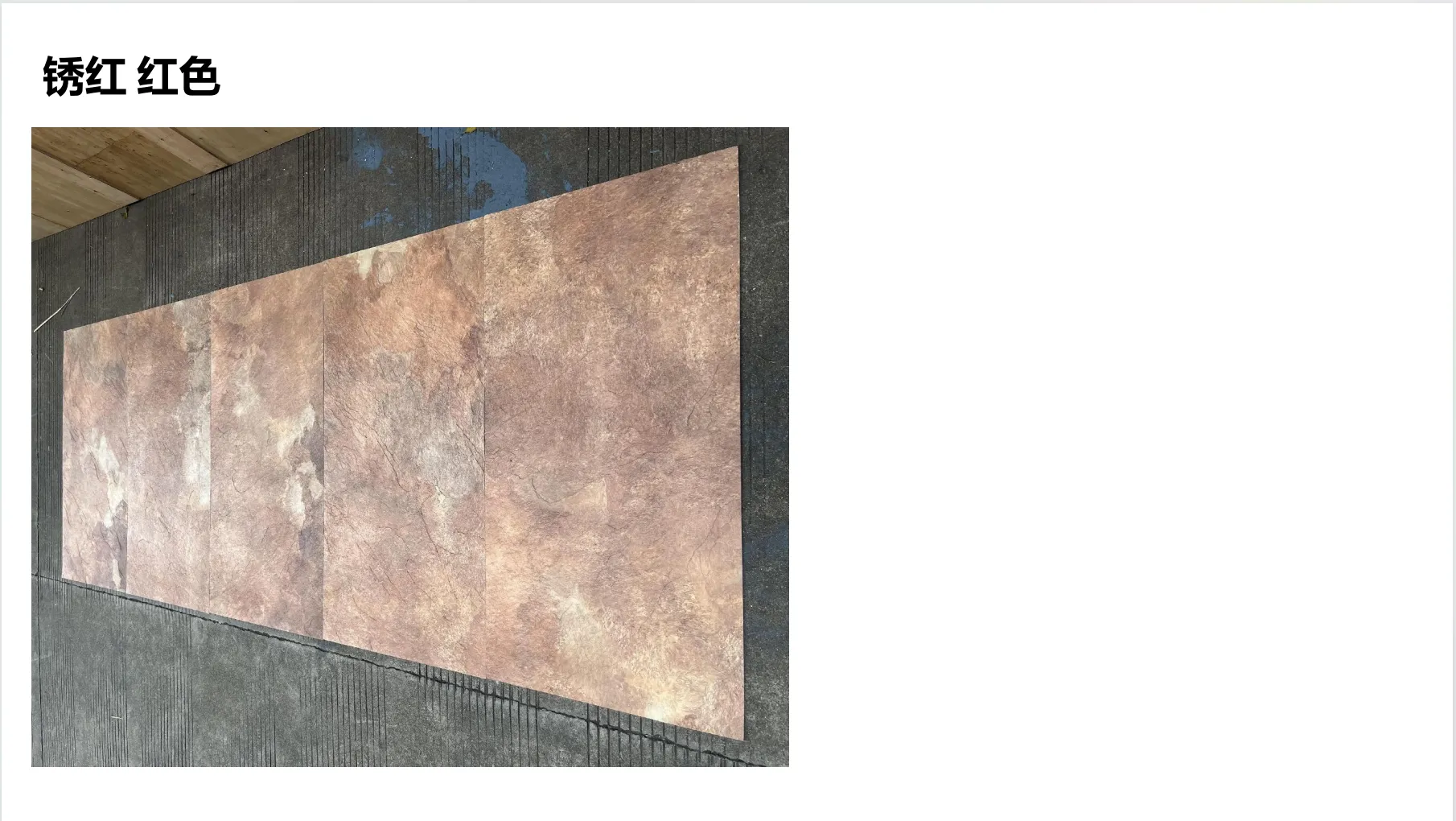
First things first: MCM stands for Modified Composite Material, a revolutionary category of building cladding that marries the best of natural aesthetics with cutting-edge engineering. Rusty Red MCM isn't just another stone or panel—it's part of the mcm flexible stone family, known for its adaptability, and the mcm big slab board series , celebrated for its seamless, grand-scale applications. Imagine the rich, earthy tone of weathered terracotta, infused with subtle metallic flecks that catch the light like embers—this is Rusty Red. It looks like it was pulled from the heart of a desert canyon, yet it's engineered to outlast the harshest elements, starting with one of the biggest foes: water.
Unlike traditional materials that treat water resistance as an afterthought, Rusty Red MCM makes it a core identity. It's not just "waterproof enough"—it's designed to repel moisture, ensuring that rain, dew, or even accidental spills don't seep in and cause trouble. But how does it do that? Let's dive into the details.
At its core, Rusty Red MCM is a composite of natural minerals, high-performance polymers, and a specialized protective layer—all fused together through a precision manufacturing process. Traditional stone, like marble or even some travertines, is porous by nature. Think of a sponge: water soaks in, leading to staining, cracking, or mold over time. Rusty Red MCM flips the script. Its surface is non-porous, meaning water beads up and rolls off instead of penetrating. But it doesn't stop there—even the edges and seams (often weak points in cladding) are reinforced, creating a barrier that moisture can't breach.
Let's put this into perspective. If you've ever seen a building with a stone facade that's started to look dull or pitted, chances are moisture is to blame. Rainwater carries dirt and pollutants, which settle into pores and eat away at the material. With Rusty Red MCM, that cycle is broken. Its smooth, sealed surface resists both water and the grime it carries, so the color stays vibrant, and the texture remains intact—year after year.
But here's where flexibility (thanks to its mcm flexible stone DNA) adds another layer of protection. Traditional rigid slabs can crack when buildings shift slightly—common in areas with temperature fluctuations or minor seismic activity. Those cracks become entry points for water. Rusty Red MCM, however, bends gently with the building's movement, avoiding cracks altogether. It's like a suit of armor that moves with you, rather than chaffing and breaking.
Water resistance is a star feature, but Rusty Red MCM brings more to the table. Let's break down why it's becoming a go-to for projects where both form and function matter:
It's one thing to talk about features; it's another to see them in action. Let's look at a few scenarios where Rusty Red MCM has made a tangible difference:
Commercial Facades: A boutique hotel in Seattle, known for its rainy climate, wanted a facade that would stand out while withstanding constant drizzle. They chose Rusty Red MCM big slabs for the main exterior. Three years later, the facade still looks brand-new—no water stains, no peeling, just that rich, warm hue that draws guests in. The maintenance team reports spending 70% less time on upkeep compared to the previous stone cladding.
Restaurant Interiors: A popular bistro in Miami needed a backsplash material that could handle splashes from sinks, steam from ovens, and the humidity of the coastal air. Rusty Red MCM panels were installed behind the bar and kitchen area. Not only does it resist water and heat, but its non-porous surface also prevents mold growth—a critical factor in food service environments. Plus, the color complements the restaurant's warm, rustic theme perfectly.
Residential Exteriors: A homeowner in Arizona, where monsoon season brings sudden downpours, replaced their old, water-damaged siding with Rusty Red MCM. "I used to worry every time it rained—now I just watch the water bead up and roll off," they said. "And the best part? It still looks like it did the day it was installed, even after two monsoon seasons."
You might be thinking, "Can't I just use traditional stone or concrete for water resistance?" The short answer: you could, but you'd be missing out. Let's compare Rusty Red MCM to common alternatives:
| Material | Water Resistance | Installation Ease | Long-Term Durability | Design Flexibility |
|---|---|---|---|---|
| Rusty Red MCM | Non-porous; repels water entirely | Lightweight, big slabs reduce seams | Resists cracking, fading, and mold | Flexible for curves and custom shapes |
| Natural Travertine | Porous; requires frequent sealing | Heavy; needs reinforcement | Prone to staining and pitting over time | Rigid; limited to flat surfaces |
| Concrete Panels | Moderate; can develop cracks | Heavy; difficult to install on curves | Prone to spalling in freeze-thaw cycles | Limited color and texture options |
| Vinyl Siding | Water-resistant but not impermeable | Lightweight but prone to warping | Fades quickly in UV light | Plastic appearance; limited design appeal |
The difference is clear: Rusty Red MCM doesn't just match traditional materials in one area—it outperforms them across the board, especially when it comes to keeping water at bay.
At the end of the day, building materials aren't just about bricks and mortar—they're about trust. Trust that the facade will protect the building for decades. Trust that the investment won't be eaten away by repairs. Trust that the beauty of the design will endure, even when the weather doesn't cooperate.
Rusty Red MCM delivers that trust. It's more than a panel; it's a promise that your building will stand strong, look stunning, and stay dry—no matter what Mother Nature throws at it. Whether you're designing a skyscraper, a cozy café, or your dream home, choosing Rusty Red MCM means choosing peace of mind, one water-resistant panel at a time.
So, the next time you walk down that street of storytelling buildings, imagine one clad in Rusty Red MCM. Its story? One of resilience, beauty, and a future free from moisture worries. Now, isn't that a story worth building?
Recommend Products












