
Walk onto any construction site, and you'll notice a silent battle unfolding—one between beauty and practicality. For decades, architects and builders have turned to natural stone for its timeless appeal, but that beauty often comes with a heavy price: literally. Slabs of granite, travertine, or marble can weigh 25–30 kilograms per square meter, turning installation into a logistical nightmare. Enter MCM flexible stone —a modern marvel that's redefining what's possible in construction. Among its many variants, Rusty Red stands out not just for its warm, weathered charm but for a game-changing trait: it's dramatically lighter than traditional stone. Let's dive into why this matters, and how Rusty Red MCM is making construction smarter, safer, and more stunning.
To understand the revolution Rusty Red MCM brings, let's first talk about the elephant in the room: weight. When a construction crew lifts a 28kg slab of travertine (starry blue) or a 30kg piece of granite portoro , they're not just moving stone—they're navigating a minefield of challenges. Heavy materials demand specialized equipment: cranes, forklifts, and teams of laborers to avoid accidents. Structural engineers lose sleep over load-bearing limits, often forced to reinforce walls or foundations just to support the stone's weight. Even after installation, the risk lingers: a loose slab could crack under its own heft, or worse, endanger workers below.
Take fair-faced concrete , a staple in industrial design. At 20–22kg per square meter, it's lighter than granite but still cumbersome. Installing it on high-rise facades requires scaffolding and precision, driving up project timelines and costs. For homeowners or small businesses, the math gets even steeper: heavier materials mean higher transportation fees, more labor hours, and fewer design options. It's no wonder the industry has been crying out for a material that delivers stone-like aesthetics without the stone-like weight.
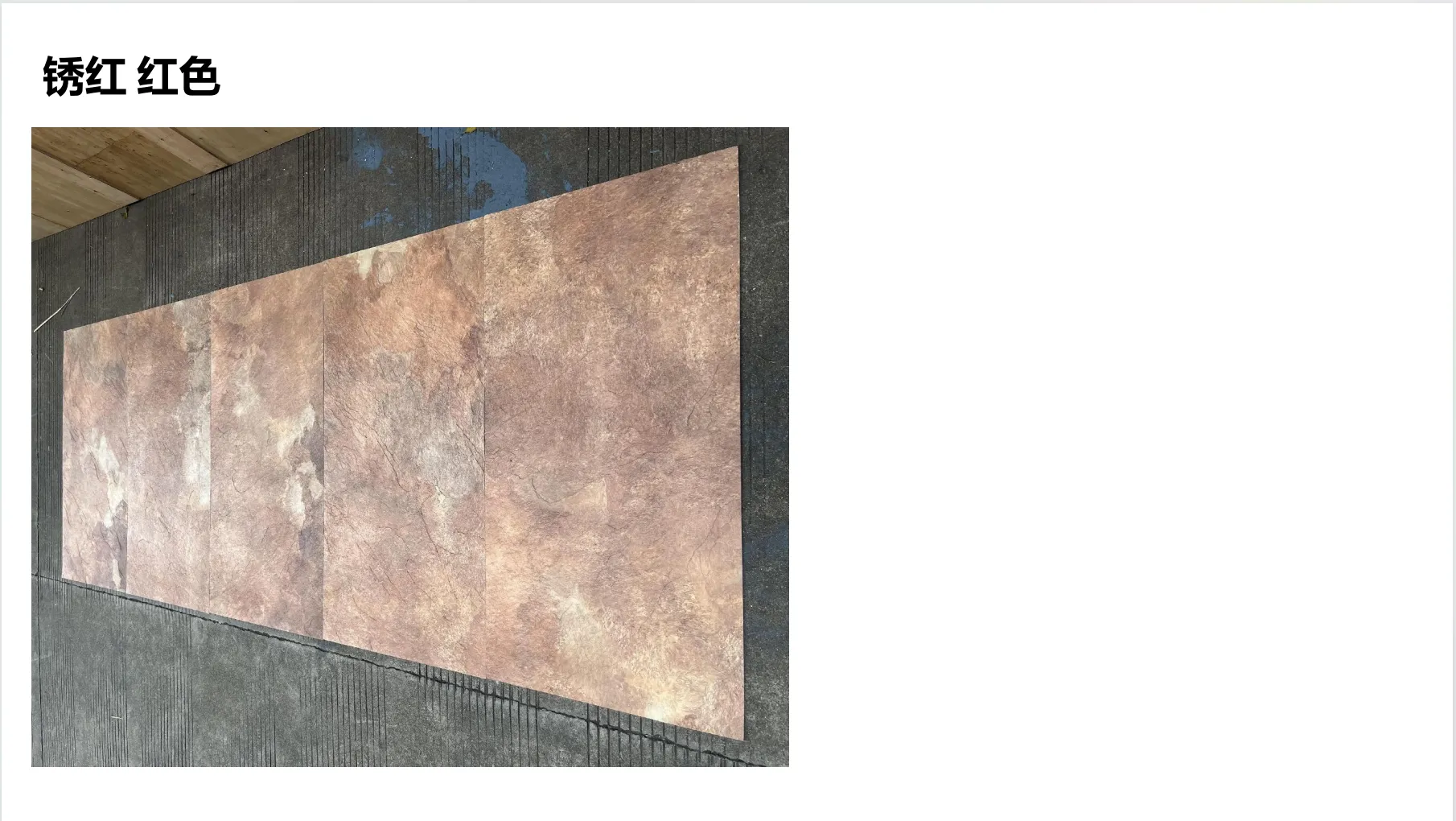
Enter MCM flexible stone —short for Modified Composite Material. Born from a blend of natural minerals, polymers, and reinforced fibers, MCM is engineered to mimic the look and texture of stone while shedding the bulk. Rusty Red, one of its most popular variants, captures the rugged beauty of aged iron or sun-baked terracotta, with rich, earthy tones that warm up any space. But its real magic? It weighs just 8–10kg per square meter. That's less than half the weight of most natural stones and even lighter than fair-faced concrete.
How is this possible? MCM's secret lies in its composition. Unlike solid stone, which is quarried in dense blocks, MCM is a layered material: a thin surface layer (replicating stone textures) bonded to a lightweight, flexible core. This design cuts weight drastically without sacrificing strength. Hold a Rusty Red MCM panel in your hands, and you'll be surprised by how manageable it feels—light enough for two workers to carry up a flight of stairs, yet tough enough to withstand rain, UV rays, and daily wear.
Numbers tell the story best. Let's compare Rusty Red MCM to common construction materials, measuring weight per square meter—a critical metric for installers and engineers:
| Material | Weight per sq.m (kg) | Installation Challenges |
|---|---|---|
| Rusty Red MCM | 8–10 | Installed by 2 workers; no heavy machinery needed |
| Travertine (Starry Blue) | 25–30 | Requires crane for lifting; risk of structural overload |
| Granite Portoro | 28–32 | High labor costs; may need foundation reinforcement |
| Fair-Faced Concrete | 20–22 | Heavy for vertical installations; prone to cracking during transport |
| Foamed Aluminium Alloy Board (Vintage Silver) | 12–14 | Lighter than stone but less versatile in texture |
Look at that gap: Rusty Red MCM weighs 15–20kg less per square meter than travertine or granite. On a 100 sq.m project, that's a difference of 1,500–2,000kg—nearly the weight of a small car. For installers, this translates to faster work: a crew can install Rusty Red panels in half the time it takes to mount natural stone, since there's no need for cranes or complex rigging. For builders, it means lower labor costs and fewer delays. For architects, it opens doors to designs once deemed impossible—think sweeping, curved facades or multi-story feature walls that wouldn't bear the weight of real stone.
The benefits of Rusty Red MCM's light weight extend far beyond installation day. Let's break them down:
Heavy materials are a leading cause of construction site injuries—strains, falls, and crushed limbs. Rusty Red MCM reduces that risk dramatically. With panels that are easy to handle, workers are less likely to overexert themselves or drop loads. On high-rise projects, lighter panels mean less stress on scaffolding and rigging, lowering the chance of collapses. It's a small change that makes a big difference in keeping crews safe.
Lighter materials equal lower costs, from start to finish. Transportation fees drop because MCM panels are stackable and take up less space—you can fit twice as many Rusty Red panels on a truck compared to granite slabs. Labor costs shrink, too: a team of two can install Rusty Red MCM in the time it takes four workers to handle natural stone. Even structural costs decrease, as buildings require less reinforcement to support the panels. For a 500 sq.m commercial project, these savings can add up to tens of thousands of dollars.
Architects often limit bold designs because of weight constraints. Want a curved accent wall? With natural stone, it's nearly impossible without custom-cutting (and extra weight). Rusty Red MCM, however, is flexible—it can be bent to follow curves, cut into intricate shapes, or even applied to uneven surfaces. Pair it with other lightweight MCM products, like foamed aluminium alloy board (vintage silver) , for a modern, mixed-material look. Suddenly, that rooftop garden wall or spiral staircase feature becomes feasible.
Skeptics might wonder: Does lighter mean weaker? Not with MCM. Rusty Red panels are tested to withstand extreme temperatures, heavy rain, and even fire. Unlike natural stone, they won't crack or chip easily, and their color resists fading from sunlight. In coastal areas, where saltwater eats away at traditional stone, MCM holds up remarkably well. It's a material built to age gracefully, maintaining its beauty for decades with minimal maintenance.
Don't just take our word for it—ask the builders who've made the switch. Take a recent boutique hotel renovation in Barcelona, where the design called for a rustic exterior to match the city's historic architecture. The original plan used travertine (starry blue) , but structural engineers flagged weight concerns: the old building's walls couldn't support the load. Enter Rusty Red MCM. The installers completed the 300 sq.m facade in three days (half the projected time), and the hotel saved €15,000 on labor and transportation. Guests now rave about the "charming, weathered stone" exterior—unaware it's actually MCM.
Or consider a homeowner in Portland who wanted a backyard patio with the look of aged brick. Traditional brick would have required reinforcing the ground to handle the weight, but Rusty Red MCM panels laid flat over a simple gravel base. The result? A patio that looks like it's been there for decades, installed in a weekend, and light enough to reconfigure if the homeowner ever wants a new layout.
In an era of eco-conscious building, Rusty Red MCM checks the sustainability box, too. Quarrying natural stone is resource-intensive: it disrupts ecosystems, consumes vast amounts of water, and releases greenhouse gases from heavy machinery. MCM, by contrast, uses recycled materials in its core and requires less energy to produce. Its lightweight design also cuts carbon emissions during transportation—fewer trucks on the road mean a smaller footprint. For builders aiming for LEED certification or green building standards, Rusty Red MCM is a smart choice that aligns with environmental goals.
Rusty Red MCM isn't just a material—it's a sign of where construction is headed. As cities grow taller and design tastes lean toward bold, textured surfaces, the demand for lightweight, high-performance materials will only rise. MCM flexible stone leads the charge, proving that you don't have to choose between beauty and practicality. Whether you're building a skyscraper, a home, or a small café, Rusty Red offers the best of both worlds: the warmth of natural stone, the ease of a lightweight panel, and a list of benefits that make builders, architects, and homeowners smile.
So the next time you walk past a stunning stone facade or run your hand over a textured wall, take a closer look—it might just be Rusty Red MCM. Lightweight, durable, and undeniably beautiful, it's changing the way we build, one panel at a time.
Recommend Products












