
Walk into any home, café, or boutique hotel, and you'll notice it immediately—the materials that shape a space. They're not just surfaces; they're storytellers. For decades, designers and builders have turned to nature for that "authentic" feel, with sawing wood boards topping the list for their warm grain and organic charm. But here's the quiet frustration that's followed every wood lover: stability. Warped panels after a rainy season. Gaps between boards in dry weather. The endless battle to keep that perfect look from fading. Now, imagine a material that captures that same natural allure but skips the guesswork. Enter MCM flexible stone and its pre-cured stability—a modern solution that's making even the most die-hard wood enthusiasts rethink their go-to choice.
Sawing wood boards have been a staple in design for centuries, and it's easy to see why. There's something irreplaceable about the way light plays on a sawn oak plank, or the way a walnut board feels under your fingertips—raw, real, and full of character. But that character comes at a cost: seasoning. Let's break it down.
Seasoning is the process of drying freshly sawn wood to remove moisture. It sounds simple, but it's a balancing act that can take months , even years. Logs are cut into boards, stacked with spacers to let air circulate, and left to weather the elements. Kiln-drying speeds things up, but even then, you're at the mercy of temperature, humidity, and the wood's natural tendency to "move." A board that's perfectly seasoned in a dry climate might swell in a coastal home; one dried in a kiln might crack if exposed to sudden moisture.
Take wood grain board, a popular variant of sawing wood board that highlights those signature stripes and swirls. It's stunning in a kitchen backsplash or a feature wall—until the first winter. I once worked with a client who fell in love with wood grain board for their restaurant ceiling. Six months later, after a particularly humid monsoon season, the boards had warped so much they looked like waves. The repair bill? Twice what they'd budgeted for the initial install. "We loved the look," they sighed, "but we didn't sign up for a yearly maintenance project."
The problem isn't just the time or cost. It's the unpredictability. Wood is a living material, even after it's cut. It breathes, shifts, and reacts to its environment. For small projects—a decorative shelf, a tabletop—this might be part of the charm. But for large-scale builds or high-moisture areas (think bathrooms, exteriors, or commercial spaces), it's a risk many designers can't afford.
So, what if you could have the texture of natural stone, the warmth of wood, or the industrial edge of concrete—without the seasoning drama? That's where MCM flexible stone comes in. Short for Modified Composite Material, MCM is a blend of natural minerals (think marble dust, quartz) and high-performance polymers, engineered to mimic the look of traditional materials but with a game-changing twist: pre-cured stability.
Unlike sawing wood boards, which rely on on-site or post-installation seasoning, MCM flexible stone is cured in controlled factory environments. Every panel is exposed to precise temperatures, humidity levels, and pressure to lock in stability from day one. No waiting for moisture to evaporate. No crossing fingers that the weather cooperates. By the time it arrives on-site, the material's moisture content is already balanced to resist shrinking, swelling, or warping—even in extreme conditions.
Let's talk specifics. MCM flexible stone is thin (often just 3-5mm thick), lightweight, and surprisingly flexible. I visited a construction site last year where workers were installing MCM panels on a curved exterior wall—something you'd never dream of doing with solid wood or even traditional stone. The panels bent gently with the curve, locking into place without a single crack. And when I asked about maintenance? "Wipe it with a damp cloth if it gets dirty," the foreman shrugged. "No sealing, no sanding, no worrying about rot or pests."
Compare that to sawing wood board, which needs regular sealing to repel moisture, refinishing to hide scratches, and careful monitoring to catch warping early. It's not that wood is "bad"—it's just that it's a material from a different era, one where buildings moved slowly and maintenance was a way of life. Modern design demands more: durability without the fuss.
One of the biggest arguments for sawing wood boards is uniqueness—no two boards are alike. But MCM isn't just stable; it's creative. The MCM 3D printing series takes customization to a whole new level, letting designers dream up textures and patterns that would be impossible (or wildly expensive) to achieve with natural materials.
Imagine a feature wall that looks like a forest floor, with 3D-printed "roots" winding across the surface. Or a restaurant bar that mimics the ripples of a stream, each indentation precise and consistent. With MCM 3D printing, these designs aren't just possible—they're repeatable. And because the material is pre-cured, every panel in that 3D-printed pattern will behave the same way over time. No warped "roots," no cracked "ripples"—just a design that stays as stunning as the day it was installed.
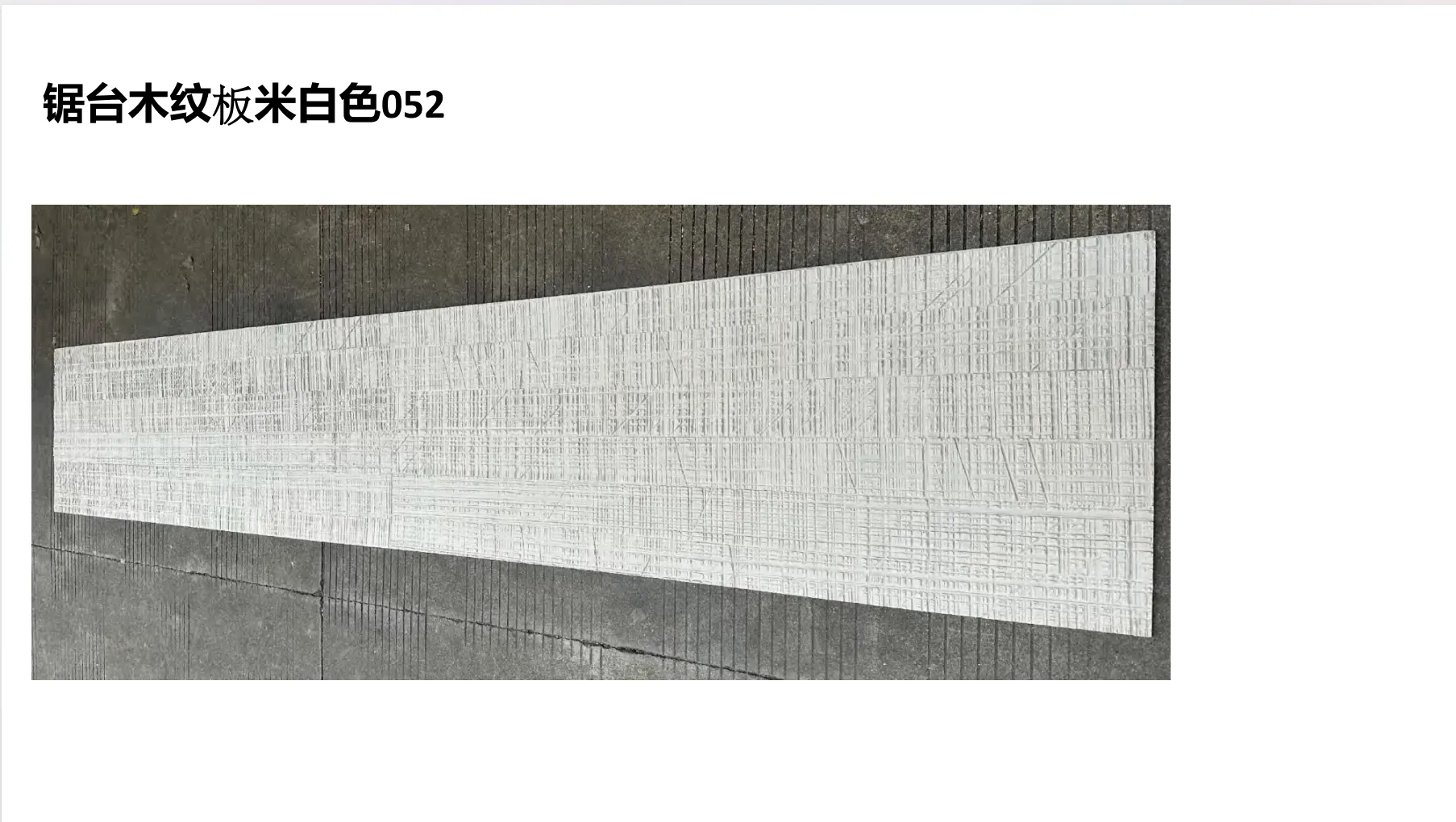
Wood grain board lovers, listen up: MCM even has you covered. MCM wood grain board replicates the look of sawing wood board so faithfully, you'd swear it was the real thing. Close your eyes and run your hand over it—the texture is there, the subtle variations in the grain, the warmth. Open them, and you'll see the same rich tones of oak, walnut, or teak. But here's the kicker: it won't expand in humidity, shrink in dry air, or attract termites. A boutique hotel in Bali recently swapped their warped wood grain board accent wall for MCM's version. "Our guests can't tell the difference," the manager told me. "But our maintenance team? They're thrilled."
It's not just wood that's facing competition. Fair-faced concrete has long been the poster child for industrial-chic design—raw, minimalist, and unapologetically bold. But like sawing wood board, it has its own stability struggles. Traditional concrete can develop hairline cracks if not cured perfectly, and surface irregularities (air bubbles, discoloration) are common, even with skilled craftsmen.
MCM offers a fair-faced concrete finish that's indistinguishable from the real thing—except for the consistency. Every MCM panel is cured in a controlled environment, so there are no surprises. No random air bubbles, no uneven coloration, and no cracking from temperature swings. A tech startup in Tokyo recently used MCM fair-faced concrete panels for their office walls. "We wanted that raw, unfinished look," their designer explained, "but we needed it to hold up in a city with extreme humidity and temperature changes. MCM gave us both."
| Feature | Sawing Wood Board (Seasoned) | MCM Flexible Stone (Pre-Cured) |
|---|---|---|
| Seasoning Time | Months to years (air-dried) or weeks (kiln-dried), with no guarantee of long-term stability | Factory-cured in days; arrives on-site ready to install with locked-in stability |
| Moisture Resistance | Low—absorbs/expels moisture, leading to warping or swelling | High—resists moisture absorption; ideal for bathrooms, kitchens, and exteriors |
| Maintenance | Regular sealing, sanding, and refinishing to prevent damage | Minimal—wipe clean with water; no sealing or special treatments needed |
| Design Flexibility | Limited by wood grain direction and natural defects | Unlimited—3D printing, custom textures, and finishes (including wood grain board mimicry) |
| Durability | Prone to scratches, dents, rot, and pest damage | Scratch-resistant, impact-resistant, and impervious to pests |
At the end of the day, materials aren't just about looks—they're about solving problems. A beachfront hotel in Thailand switched from sawing wood boards to MCM flexible stone for their outdoor cabanas. "Wood lasted 18 months before rotting from saltwater spray," the owner told me. "MCM? It's been three years, and it still looks brand new." A museum in Italy used MCM 3D printing series to recreate ancient stone carvings for their exterior—lightweight, durable, and stable enough to withstand the country's harsh winters.
Does this mean sawing wood boards are obsolete? Not at all. For small, low-moisture projects where character and imperfection are part of the charm (a vintage bookshelf, a rustic accent wall), wood will always have a place. But for modern builds—where time, budget, and long-term durability are non-negotiable—MCM flexible stone and its pre-cured stability are hard to beat.
Sawing wood board seasoning is a tradition rooted in craftsmanship and natural beauty. But traditions evolve, and MCM is proof that innovation doesn't have to sacrifice soul. Whether you're drawn to the warmth of wood grain board, the edge of fair-faced concrete, or the creativity of 3D-printed textures, MCM flexible stone delivers the look you love with the stability you need.
At the end of the day, design is about storytelling—and the best stories don't include chapters about warped boards or cracked panels. They're about spaces that feel alive, authentic, and reliable . With MCM, that story gets to shine—no seasoning required.
Recommend Products












