
Walk through any historic district, and you'll likely be drawn to the warmth of wooden facades—their natural grains, soft textures, and the way they age into a rich patina. For decades, wood has been the gold standard for bringing organic charm to buildings, from cozy cottages to grand commercial spaces. But as architecture pushes for taller structures, bolder designs, and materials that can withstand the test of time (and the elements), the limitations of traditional wood boards have become impossible to ignore. Enter MCM big slab board series —a revolutionary line of building materials that's redefining what's possible in construction and design. In this deep dive, we'll explore why the thickness constraints of sawing wood boards are no longer acceptable for modern projects, and how MCM big slabs are stepping in to offer unparalleled versatility, durability, and beauty.
To understand why MCM big slabs are gaining traction, let's first unpack the challenges that have long plagued traditional wood boards. At first glance, wood seems like the ideal material: renewable, aesthetically pleasing, and easy to work with. But dig deeper, and you'll find a litany of limitations—many of which stem from one critical factor: thickness .
Most sawing wood boards used in construction today max out at around 5-7 centimeters in thickness. Why? It's not for lack of demand for thicker, more robust wood panels. Rather, it's a series of practical hurdles that make thick wood boards impractical for large-scale use. For starters, thick wood is heavy—exponentially so. A 10cm-thick oak board, for example, can weigh upwards of 70kg per square meter. This weight creates a domino effect: structural supports must be reinforced, transport costs skyrocket, and installation becomes a labor-intensive (and risky) process. Imagine a crew trying to hoist a 200kg wooden slab to the 10th floor of a building—safety risks aside, the sheer logistics are enough to make project managers wince.
Then there's the issue of warping and stability. Wood is a living material, prone to expanding and contracting with changes in humidity and temperature. Thicker boards exacerbate this problem: the outer layers dry faster than the core, leading to cracks, bowing, or cupping. Over time, even well-sealed wood can twist out of shape, compromising the integrity of the facade or interior wall. This isn't just a cosmetic issue—warped boards create gaps that let in moisture, pests, and drafts, driving up maintenance costs and shortening the lifespan of the structure.
Durability is another Achilles' heel. Exterior wood boards face relentless assault from rain, UV rays, and pests like termites. Even with treatments, a wooden facade might need refinishing every 3-5 years, and full replacement within 15-20 years in harsh climates. Interior wood isn't immune either—kitchen backsplashes or bathroom walls near moisture sources can rot or develop mold, turning that "cozy" aesthetic into a health hazard.
Perhaps most frustrating for designers is the lack of flexibility. Wood's thickness limits aren't just about how thick it can be—they're also about how thin it can go without losing strength. Ultra-thin wood panels (less than 2cm) are fragile, prone to bending and breaking during installation. This leaves architects stuck in a middle ground: boards that are too thick to be lightweight, yet too thin to offer the design freedom needed for modern, innovative projects.
If traditional wood boards are a square peg in a round hole for modern construction, MCM big slab board series is the custom-fit solution. MCM, or Modified Composite Material, is a cutting-edge technology that combines natural minerals, high-performance polymers, and advanced manufacturing techniques to create panels that are lightweight, ultra-strong, and—most importantly— unshackled from thickness limits .
So, what makes MCM big slabs different? Let's start with the basics. Unlike solid wood, MCM is a composite material, typically structured as a thin, rigid core (often aluminum or fiberglass) sandwiched between layers of mineral-based coatings. This "sandwich" design gives MCM slabs the best of both worlds: the strength of metal, the lightness of foam, and the aesthetic versatility to mimic natural materials like wood, stone, or marble.
When it comes to thickness, MCM big slabs laugh in the face of wood's constraints. These panels can range from as thin as 3mm (ideal for lightweight interior accents) to as thick as 30mm (perfect for heavy-duty exterior cladding). And unlike wood, increasing thickness doesn't translate to a proportional increase in weight. A 20mm-thick MCM big slab weighs just 8-12kg per square meter—less than a quarter of the weight of a comparably thick wood board. This game-changing lightness opens doors for designs that were once impossible: think sweeping cantilevered facades, double-height interior feature walls, or even curved surfaces that wood could never achieve without cracking.
But MCM's versatility goes far beyond thickness. These slabs are engineered to be flexible—both literally and figuratively. Physically, they can bend slightly without breaking, making them ideal for curved walls or rounded architectural details. Design-wise, they're a playground for creativity. Want the look of reclaimed barn wood? There's a wood grain board variant that captures every knot and imperfection, without the rot or pests. Dreaming of a stone facade that shimmers like the night sky? Travertine (starry green) —a type of flexible stone MCM—blends the organic texture of travertine with flecks of iridescent green, mimicking a starry forest floor. The options are endless, and they all come with the same core benefits: durability, low maintenance, and a fraction of the weight of traditional materials.
One of the most compelling reasons designers are ditching wood for MCM big slabs is the sheer breadth of design options. MCM doesn't just replace wood—it elevates the possibilities by offering materials that look and feel natural, but perform like modern engineering marvels. Let's take a closer look at some standout variants that are reshaping the industry.
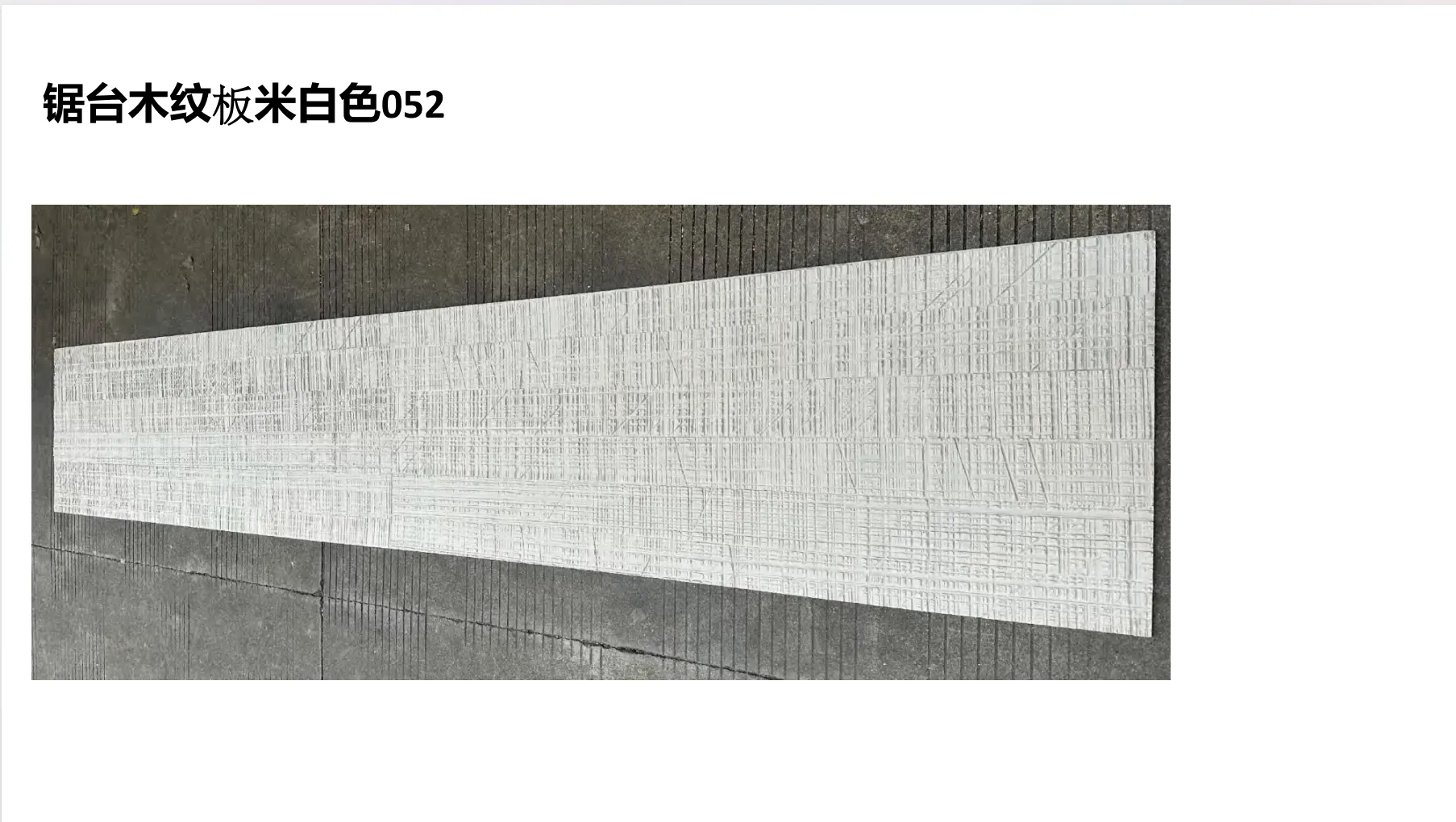
For projects that crave the cozy, inviting vibe of wood, wood grain board MCM is a revelation. These panels are crafted using advanced printing technology that replicates the texture, color, and grain patterns of real wood—from the honeyed tones of oak to the deep richness of walnut, and even the weathered gray of driftwood. But unlike real wood, they're impervious to moisture, UV rays, and pests. A wood grain MCM slab installed in a bathroom won't warp; one used on an exterior wall won't fade under the sun; and there's zero risk of termites turning your facade into a buffet.
What's more, wood grain MCM isn't limited by the size constraints of natural wood planks. Traditional wood boards are often cut to standard lengths (2-4 meters) due to tree size limitations. MCM wood grain slabs, on the other hand, can be custom-manufactured in lengths up to 6 meters or more, creating seamless, uninterrupted surfaces that enhance the sense of space. Imagine a restaurant ceiling clad in 5-meter-long wood grain MCM panels—no unsightly seams, no warping, just a smooth, continuous wave of wood-like warmth that draws the eye upward.
If wood grain MCM caters to warmth, flexible stone MCM leans into luxury. Take travertine (starry green) as an example. Travertine is a natural stone prized for its porous, organic texture—think the ancient Roman Colosseum, with its honey-colored walls and subtle veining. But natural travertine is heavy (up to 25kg per square meter for a 2cm slab), brittle, and expensive to quarry and transport. MCM flexible stone changes the game by capturing travertine's essence in a lightweight, bendable panel.
Travertine (starry green) MCM takes this a step further. It starts with a base layer that mimics travertine's classic pitted texture, then adds a sprinkle of iridescent green particles that catch the light, evoking a starry night sky reflected on water. The result is a material that feels both timeless and futuristic—equally at home on a boutique hotel's exterior as it is on a high-end retail store's accent wall. And because it's flexible, it can be curved around columns or shaped into custom geometries that natural stone would never allow. A designer recently used starry green travertine MCM to clad the lobby of a mountain resort, creating a feature wall that looks like a slab of quarried stone but weighs so little, it was installed in a single day.
Wood grain and flexible stone are just the tip of the iceberg. The MCM big slab board series includes a dizzying array of options, each designed to solve a specific design challenge. Need a material that looks like concrete but won't crack under thermal stress? There's fair-faced concrete MCM. Want to add a metallic sheen to a facade without the cost of solid metal? Foamed aluminium alloy board (vintage gold) offers the luster of brass with a fraction of the weight. Even niche aesthetics are covered: bamboo mat board brings tropical vibes to urban spaces, while lunar peak silvery mimics the moon's pockmarked surface for otherworldly interiors.
The key here is that MCM doesn't force designers to choose between beauty and practicality. With wood, you get beauty but sacrifice durability and flexibility. With traditional stone, you get durability but lose design freedom and add cost. MCM big slabs? They offer it all—beauty, durability, flexibility, and affordability—all wrapped into a single material.
To truly grasp the gap between traditional wood boards and MCM big slabs, let's put them head-to-head. The table below breaks down key factors that matter most to architects, builders, and homeowners:
| Criteria | Traditional Sawing Wood Boards | MCM Big Slab Board Series |
|---|---|---|
| Max Thickness | 5-7cm (limited by weight/warping) | 30cm+ (lightweight, stable at any thickness) |
| Weight (per sqm) | 40-70kg (thick boards) | 8-15kg (even at maximum thickness) |
| Durability | Prone to warping, rot, pests; 15-20 year lifespan (exterior) | Weather-resistant, UV-stable, pest-proof; 50+ year lifespan (exterior) |
| Installation | Heavy, requires reinforced supports; 2-3 crew members per slab | Lightweight, can be installed with basic tools; 1-2 crew members per slab |
| Design Flexibility | Limited to straight cuts; thick boards can't bend | Curved, custom shapes, and large seamless panels available |
| Maintenance | Requires annual sealing, refinishing every 3-5 years | Wash with water; no sealing or refinishing needed |
| Cost (Lifetime) | Low upfront cost, high long-term maintenance | Slightly higher upfront cost, minimal long-term costs |
The data speaks for itself: MCM big slabs outperform wood in nearly every category that matters for modern construction. But numbers alone don't tell the whole story. It's the real-world impact that's turning heads. A property developer in Chicago recently swapped wood cladding for MCM wood grain slabs on a 12-story apartment building. The result? Installation time dropped by 40%, structural support costs were cut by $50,000, and residents rave about the "wooden" balconies that never need staining. A boutique hotel in Bali replaced its rotting wooden facade with bali stone MCM slabs—now, after three monsoon seasons, the facade looks as fresh as the day it was installed, with zero mold or water damage.
The construction industry is no stranger to innovation, but every so often, a material comes along that doesn't just improve on the old—it redefines the rules. MCM big slabs are that material. They address the fundamental flaws of traditional wood boards (thickness limits, weight, durability) while expanding the design possibilities for architects and designers.
Looking ahead, the demand for MCM big slabs is only set to grow. As cities become more crowded, buildings are getting taller, and facades are becoming more critical to a project's identity. Homeowners, too, are seeking materials that require less maintenance and last longer—especially in regions prone to extreme weather. MCM checks all these boxes, and then some.
But perhaps the most exciting thing about MCM big slabs is their potential to blend the best of the past with the promise of the future. They can mimic the warmth of wood, the grandeur of stone, or the sleekness of metal—all while leveraging modern technology to be lighter, stronger, and more sustainable. In a world where "green building" is no longer a trend but a requirement, MCM's low carbon footprint (many variants are made from recycled materials) and long lifespan make it a responsible choice, too.
Traditional sawing wood boards have served us well, but their time as the go-to material for innovative construction is coming to an end. The thickness limits, weight issues, and durability concerns that plague wood are simply incompatible with the demands of modern architecture. The MCM big slab board series isn't just a replacement for wood—it's a leap forward. With its unmatched versatility (wood grain, flexible stone, starry travertine, and beyond), lightweight design, and decades-long lifespan, MCM is empowering designers to create buildings that are more beautiful, more functional, and more sustainable than ever before.
So, the next time you walk past a building with a striking facade—one that seems to defy the laws of physics with its thin, sweeping lines or its impossible curves—take a closer look. Chances are, it's not wood, stone, or metal. It's MCM. And in that moment, you'll see the future of building materials: a future where thickness limits are a thing of the past, and possibility is the only constraint.
Recommend Products












