
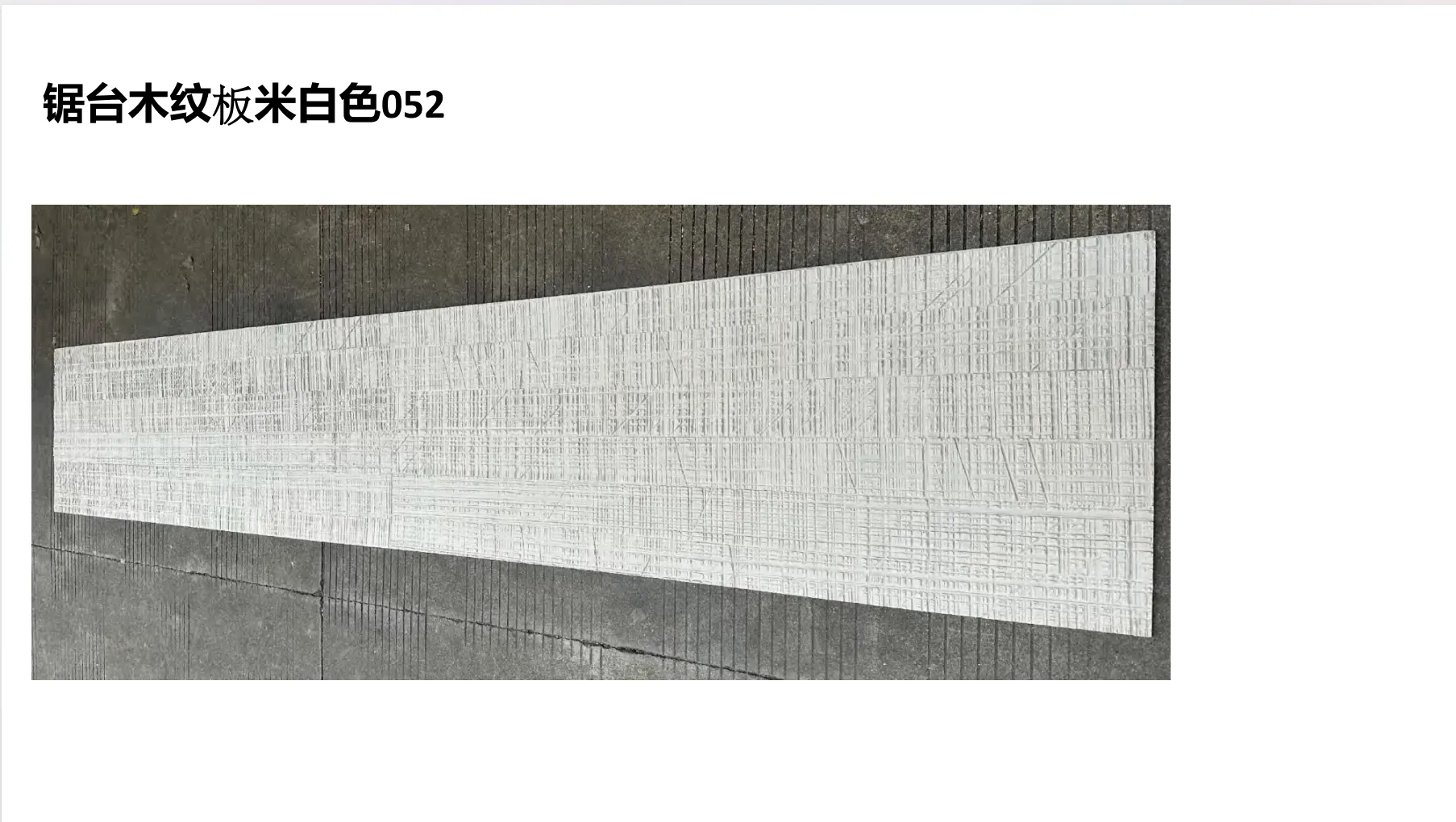
Walk into any architecture studio, and you'll hear the same question echo through the drafting tables: "Does this material play well with the structure?" For designers and builders alike, the battle between aesthetics and practicality often boils down to one critical factor: weight. In a world where every kilogram matters—whether for aging building frames, high-rise facades, or eco-conscious construction—two materials have emerged as front-runners: the timeless sawing wood board and the innovative MCM (modified composite material) series, including game-changers like MCM flexible stone and MCM big slab board series . Let's dive into how their weight differences shape structural design, and why that matters more than you might think.
There's a reason sawing wood board has been a staple for centuries. Run your hand over its surface, and you'll feel the story of the tree it came from—the knots, the grain, the subtle variations that make each plank unique. It's warm, organic, and carries a rustic charm that's hard to replicate. Architects reach for it when they want spaces to feel grounded, whether in a mountain cabin's interior walls or a heritage building's facade restoration.
But here's the catch: that natural beauty comes with a weighty price. A standard 20mm-thick sawing wood board weighs in at roughly 18–25 kg per square meter, depending on the wood species. Oak, for example, leans toward the heavier end, while pine is lighter but still no featherweight. When you multiply that by hundreds or thousands of square meters in a commercial project, the numbers add up fast. Suddenly, what seemed like a design choice becomes a structural challenge.
Take the 2019 renovation of a 1920s theater in Chicago. The design team dreamed of restoring the lobby with original-style sawing wood paneling to honor the building's history. But when engineers ran the numbers, they discovered the existing floor joists couldn't support the added weight without extensive (and expensive) reinforcement. The team was forced to scale back, replacing half the wood panels with lighter alternatives—a compromise that left both designers and historians disappointed.
Installation day tells another story. Carrying 25 kg planks up scaffolding or maneuvering them into tight corners isn't just backbreaking work; it slows down crews, increases labor costs, and raises the risk of accidents. And once installed, that weight lingers, putting constant stress on beams, foundations, and load-bearing walls. In seismic zones or high-rise buildings, where every extra kilogram amplifies risk, sawing wood board often moves from "dream material" to "last resort."
Enter MCM, the underdog that's redefining what's possible. Short for modified composite material, MCM is engineered in labs and factories, not forests—but don't mistake "engineered" for "cold." Think of it as nature's best qualities, reimagined with science. Take MCM flexible stone : it mimics the texture of travertine, slate, or granite so closely that you'd swear it was quarried from the earth. But at just 3–6 kg per square meter, it weighs a fraction of the real thing. Similarly, the MCM big slab board series offers the grandeur of large-format stone slabs (up to 1.2m x 3.6m) without the crane-required heaviness.
How do they do it? MCM starts with a core of lightweight minerals and polymers, layered with a thin veneer of real stone, wood, or other natural materials. The result is a material that's not just light but flexible—able to bend slightly without cracking, making it ideal for curved facades or uneven surfaces. Lightweight flexible stone sheets roll up for easy transport, unroll on-site, and adhere to substrates with minimal fasteners. It's like comparing a hardcover book to an e-reader: same information (or in this case, beauty), but infinitely easier to handle.
Consider the 2023 expansion of the Seattle Art Museum. The architects wanted a facade that felt both modern and timeless, with the depth of stone but the freedom to cantilever over the sidewalk. MCM big slabs in "travertine (starry blue)" checked all the boxes. At 4.5 kg per square meter, the slabs were light enough to install with a small crew, and the reduced structural load meant the cantilever could extend 3 meters farther than originally planned—turning a cramped entrance into a dramatic, sheltered plaza. "We didn't just save on steel reinforcement," the project engineer noted. "We gained design space we never thought possible."
| Factor | Sawing Wood Board | MCM (e.g., Flexible Stone, Big Slabs) |
|---|---|---|
| Weight per m² | 18–25 kg | 3–6 kg |
| Structural Load | Requires reinforced framing; high load on foundations | Minimal load; compatible with standard framing |
| Installation Time | Slow; requires 2–3 workers per panel | Fast; 1–2 workers can handle large slabs |
| Transportation Costs | High; requires heavy-duty trucks and cranes | Low; lightweight sheets stack efficiently |
| Design Flexibility | Limited by weight; hard to use on curves or high-rises | High; flexible enough for curves, cantilevers, and tall buildings |
A 1950s hotel in Miami Beach was ready for a glow-up, but there was a catch: its original concrete structure couldn't handle any additional weight. The design team wanted to replace the outdated exterior with something that screamed "tropical luxury"—think warm stone tones and textured surfaces. Sawing wood board was out of the question (too heavy), and real stone was even worse. Then they discovered MCM flexible stone in "bali stone" finish.
The MCM panels weighed just 4.2 kg/m², allowing them to be installed directly over the existing facade without reinforcing the structure. The result? A facade that looks like weathered beach stone, with the bonus of MCM's durability (resistant to saltwater and humidity). "We didn't have to tear down walls or upgrade the foundation," the project manager said. "The weight savings alone cut our timeline by 6 weeks and our budget by 15%."
None of this is to say sawing wood board is obsolete. In small-scale projects—like a cozy cabin in the woods or a boutique café with sturdy, modern framing—its weight is manageable. There's also the emotional factor: some clients simply won't compromise on "real" wood, valuing its tactile warmth over practicality. And in heritage projects where strict preservation rules apply, MCM might not yet have the historical approval (though that's changing as manufacturers perfect vintage finishes, like travertine (vintage silver) or rust board granite ).
But even then, MCM is closing the gap. The latest MCM 3D printing series allows for custom wood-grain textures that mimic sawing wood board so precisely, only a trained eye can tell the difference. And with options like wood concrete board (a hybrid of wood fibers and concrete), you get the best of both worlds: wood-like aesthetics with reduced weight.
As cities grow taller and sustainability becomes non-negotiable, lightweight materials like MCM are no longer just "alternatives"—they're necessities. Every kilogram saved on a facade reduces the carbon footprint of transportation, cuts down on steel reinforcement, and makes buildings safer and more efficient. And with innovations like foamed aluminium alloy board (vintage gold) and lunar peak silvery finishes, MCM is proving it can match (and sometimes exceed) the aesthetic range of traditional materials.
Sawing wood board will always hold a special place in design history, a reminder of our connection to nature. But for the projects shaping our future—skyscrapers, green buildings, adaptive reuse developments—MCM is the material that lets us dream bigger, build smarter, and create spaces that feel human without weighing the world down.
So the next time you walk past a building with a stunning stone facade or a warm wood-like interior, take a moment to wonder: is it heavy, or is it MCM? Chances are, the lighter choice is the one that made that design possible.
Recommend Products












