
For decades, architects have carried a quiet burden: the gap between the wild, wonderful shapes in their minds and the unyielding limitations of the materials at their disposal. Picture this: it's 2 a.m., and an architect sits hunched over a drafting table, coffee gone cold, sketching a facade that curves like a wave, or a ceiling that spirals upward like a staircase to the stars. Their eyes light up—this is the one, the design that will make people stop and stare, that will turn a building into a story. But then reality creeps in. They remember the last time they tried to use traditional stone for a curved wall: cracks during installation, misaligned seams, a final result that felt more like a compromise than a masterpiece. "Why can't the materials keep up with the dream?" they mutter, setting down their pencil. It's a question that's echoed through design studios around the world, a quiet frustration that's kept too many bold ideas locked on paper.
Enter Starmoon Stone 3D Printing Technology —not just a new material, but a bridge between imagination and reality. It's the answer to that late-night lament, the key that unlocks those sketches and turns them into tangible, touchable spaces. But to truly appreciate its magic, we need to first understand the journey that brought us here: the evolution of architectural materials, the breakthroughs that led to flexibility, and how 3D printing finally gave shape to the unshapable.
Think about the buildings of the past. Stone was king—strong, enduring, but stubbornly stiff. Marble, granite, limestone—they're beautiful, but they're also heavy, brittle, and unforgiving. To build with them was to work within straight lines, right angles, and flat surfaces. Then came concrete, a marvel of its time, but still constrained by formwork; you could pour it into molds, but those molds were expensive, time-consuming, and limited in complexity. Glass added transparency, but it too was rigid, shattering if pushed beyond its limits.
The turning point came with the rise of "flexible" materials, but even then, compromises lingered. Early composite panels offered some give, but they lacked the depth, texture, and organic feel of natural stone. Architects found themselves choosing between beauty and flexibility, between durability and design freedom. That is, until the MCM (Modified Composite Material) Project Board Series arrived on the scene, laying the groundwork for something extraordinary.
MCM materials changed the game by blending the best of both worlds: the aesthetic richness of natural stone with the lightweight, adaptable properties of modern composites. Suddenly, walls could bend, facades could flow, and surfaces could mimic the look of travertine or granite without the weight. But even MCM had room to grow—until Starmoon Stone and 3D printing joined forces.
Starmoon Stone isn't just a material—it's a collaboration between geologists, engineers, and artists. At its core, it's a proprietary blend of natural minerals, polymers, and reinforced fibers, but what makes it special is how those ingredients come together: not as a rigid block, but as a malleable, durable substance that can be shaped, layered, and printed into forms that once seemed impossible.
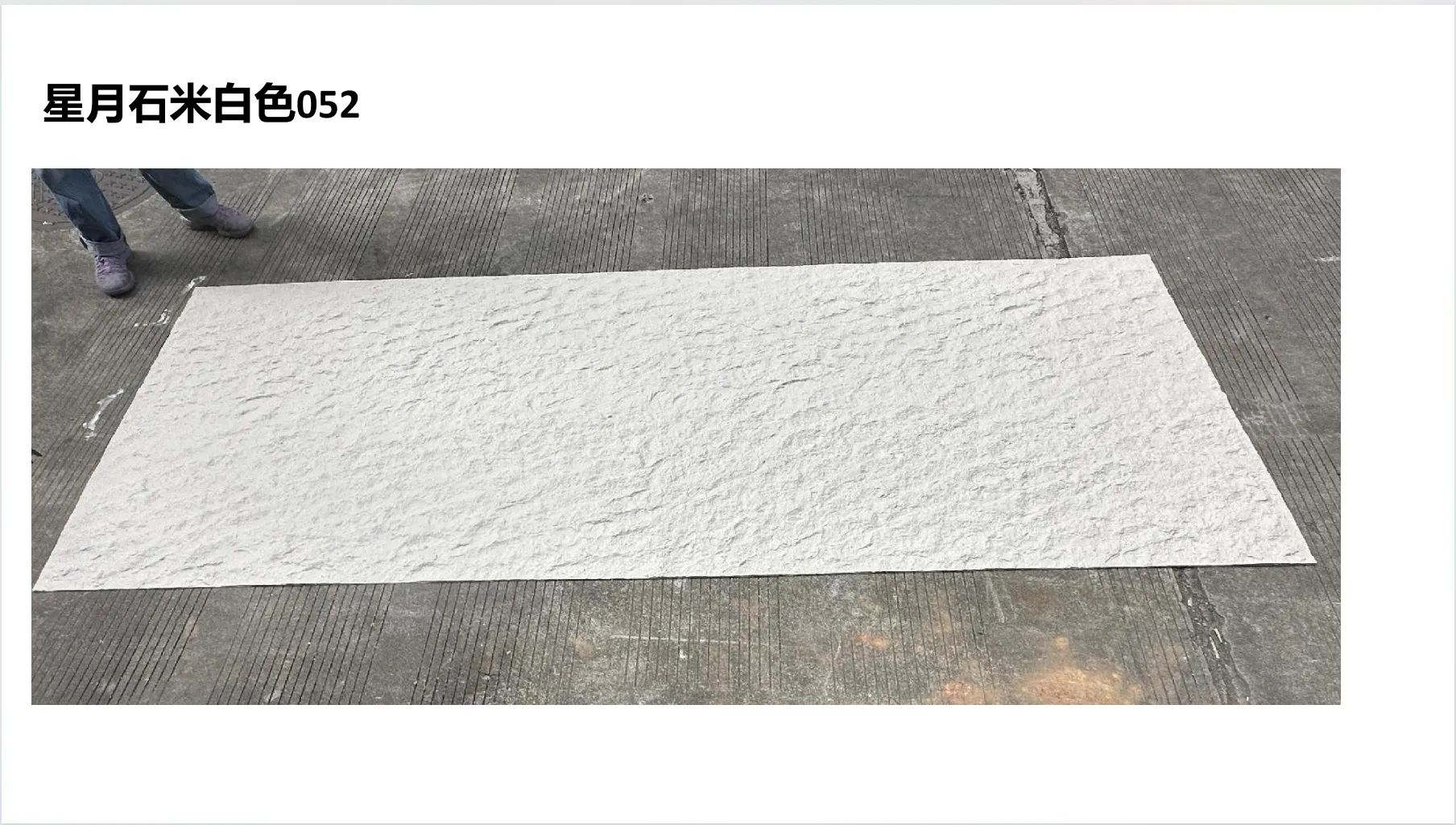
Let's break down its superpowers. First, flexibility . Unlike traditional stone, which cracks under stress, Starmoon Stone bends—ever so slightly—without breaking. Imagine pressing your hand against a wall made of it; it has a subtle, almost alive responsiveness, like touching a piece of polished driftwood that's been shaped by the ocean. Second, lightweight . It weighs up to 70% less than natural stone, which means structures can support more complex shapes without extra reinforcement. Third, texture . Run your fingers over it, and you'll feel the same granular, earthy texture as travertine or sandstone, complete with tiny pores and veins that mimic nature's own artistry. And finally, durability . It resists weather, fire, and fading, ensuring that those curved facades and spiral ceilings stay beautiful for decades.
But the real magic happens when you pair this material with 3D printing. Traditional 3D printers lay down plastic or metal in thin layers, but Starmoon Stone printers are a different beast. They extrude the material with pinpoint precision, building up layers as thin as 0.5mm to create seamless, organic shapes. No more cutting stone into blocks and piecing them together—now, the printer acts like a digital sculptor, following the architect's design file to the millimeter. Want a wall that curves inward like a hug, then outward like a wave? The printer does it in one continuous flow, with no seams to break the illusion.
Starmoon Stone is the star of the show, but it's part of a larger family of innovative materials under the MCM umbrella. These products work together to give architects a toolkit for every vision, from sleek modernism to rustic warmth. Let's take a closer look at some of the key players, including a few that have become favorites among designers for their ability to complement Starmoon Stone's 3D-printed curves:
| Product Series | Key Features | Perfect For |
|---|---|---|
| MCM 3D Printing Series | Starmoon Stone core, layer-by-layer extrusion, custom color matching | Organic curves, spiral staircases, sculptural facades |
| MCM Flexible Stone | Thin (3-5mm), bendable panels, mimics natural stone textures | Curved walls, column wraps, furniture accents |
| MCM Big Slab Board Series | Large-format panels (up to 3m x 1.5m), minimal joints | Expansive, seamless walls and ceilings |
| Foamed Aluminium Alloy Board (Vintage Silver) | Metallic sheen, lightweight, corrosion-resistant | Modern accents, contrast panels with Starmoon Stone |
| Lunar Peak Silvery | Iridescent, moon-like texture, cool gray tones | Celestial-themed designs, nightclubs, planetariums |
| Travertine (Starry Green) | Deep green base with flecks of gold (like stars in a forest) | Eco-friendly buildings, indoor gardens, wellness spaces |
Take, for example, the Foamed Aluminium Alloy Board (Vintage Silver) . Its sleek, metallic surface pairs stunningly with Starmoon Stone's earthy textures. Imagine a 3D-printed Starmoon Stone wall curving around a lobby, with vertical strips of vintage silver aluminium running up its length—like stars cutting through a mountain range. Or Lunar Peak Silvery , which has a shimmer that shifts with light; when printed into a wave-like ceiling, it looks like moonlight dancing on water. These materials don't just fill gaps—they elevate each other, turning a single "wow" element into a symphony of texture and color.
Enough talk—let's walk through some spaces where Starmoon Stone 3D printing has already left its mark. These aren't just buildings; they're proof that the impossible is now possible.
When the architects at Studio Ocean set out to design the Azure Wave Hotel, they wanted it to feel like a part of the island's coastline—curves that mirrored the waves, textures that echoed the sand and coral. But traditional stone was too heavy for the cantilevered sections, and concrete lacked the organic feel they craved. Enter Starmoon Stone 3D printing.
The hotel's signature feature is its "Wave Wall," a 50-meter-long facade that curves inward and outward, mimicking the ocean's rhythm. Printed on-site over three weeks, the wall uses Travertine (Starry Blue) Starmoon Stone, which has tiny blue and silver flecks that catch the sunlight, making it look like water sparkling. Guests often pause to run their hands over it, surprised by how warm and alive it feels compared to cold concrete. "It's not just a wall," says lead architect Maya Lin. "It's a story about Bali's relationship with the sea, told in stone."
In Iceland, where the night sky is alive with the Northern Lights, the Lunar Library was designed to be a "temple to knowledge and the cosmos." Its domed ceiling was the biggest challenge: a spiral that starts at the floor and twists upward 12 meters, resembling a galaxy. Traditional construction would have required hundreds of stone blocks and steel supports, but with Starmoon Stone 3D printing, the entire ceiling was printed in 16 sections and assembled on-site.
The team chose Lunar Peak Black for the ceiling, a deep, inky shade with subtle silver veins that glow under the library's star-shaped lights. "When you stand in the center and look up, it feels like you're standing at the center of a black hole, with stars swirling around you," says librarian Elin Bjornsson. "Kids love it—they call it the 'magic ceiling' and beg to read under it."
For a private home in the Arizona desert, architect Javier Cruz wanted to blend modern design with the rugged beauty of the landscape. The result? A house with a facade that looks like wind-carved rock, complete with indentations and ripples that mimic the Gobi Desert's sand dunes. To achieve this, he used MCM Flexible Stone for the smaller, curved sections and 3D-printed Starmoon Stone for the larger, sculptural elements, paired with Gobi Panel accents that add a weathered, earthy texture.
The homeowner, a retired geologist, says, "Every morning, I walk outside and run my hand over that wall. It feels like touching the desert itself—rough, warm, full of stories. But unlike real desert rock, it's cool in the summer and holds heat in the winter. It's the best of both worlds."
Starmoon Stone 3D printing isn't just changing what we build—it's changing how we think about building. For too long, architecture has been a battle between form and function, beauty and practicality. Now, those lines are blurring. Architects are no longer asking, "Can we build this?" but "What story do we want to tell?"
Take sustainability, for example. Traditional stone mining is resource-intensive, but Starmoon Stone uses recycled minerals and requires less energy to produce. The 3D printing process also minimizes waste—only the exact amount of material needed is used, unlike traditional cutting, which can waste up to 30% of a stone block. "It's not just about making pretty shapes," says sustainability expert Dr. Amara Patel. "It's about building in harmony with the planet, without sacrificing creativity."
And then there's customization. In the past, a unique facade might cost millions and take years. Now, with Starmoon Stone 3D printing, small businesses, schools, and even homeowners can afford one-of-a-kind designs. Imagine a community center with a wall printed to look like the local forest, or a school where the entrance is shaped like an open book—all made possible by this technology.
Go back to that architect we mentioned at the beginning—the one with the cold coffee and the sketchbook. Today, they're sitting in the same chair, but their expression is different. They're smiling, because they know their curved, spiraling, starry-eyed design isn't just a sketch anymore. It's a file on their computer, ready to be sent to a Starmoon Stone 3D printer. It's a building that will make people stop, touch, and feel something—a connection to the earth, to the sky, to the stories we tell through the spaces we create.
Starmoon Stone 3D printing isn't just a technology. It's a promise: that the future of architecture will be as limitless as our imaginations. It's about taking the rigidity of the past and melting it into something fluid, alive, and deeply human. So the next time you walk past a building with a curve that seems to defy gravity, or a wall that feels more like art than stone, take a moment to appreciate it. Behind it is a dreamer, a material that finally kept up, and a printer that turned lines on a page into a place where people live, work, and wonder.
And who knows? Maybe one day, that building will be yours.
Recommend Products












