
Navigating the choice between bold innovation and tried-and-true tradition in modern building materials
Picture this: You're standing in a sunlit showroom, surrounded by samples of stone, metal, and composite panels. Your client wants a lobby that feels both grand and intimate—something that makes visitors pause and say, "Wow." On one side of the table, there's a massive slab of Starmoon Stone, its surface swirled with silvery veins that catch the light like moonlight on water. On the other, a stack of standard-sized lunar peak silvery panels, neat and uniform, each one easy to tuck under an arm. Which do you choose?
For architects and builders, this isn't just a design question—it's a puzzle of practicality, budget, and vision. In recent years, MCM's big slab board series, including standout options like Starmoon Stone, has redefined what's possible in surface design. But standard sizes, the workhorses of construction for decades, still hold their ground. Let's dive into the pros and cons of each, so you can make the call that turns your project from "good" to "unforgettable."
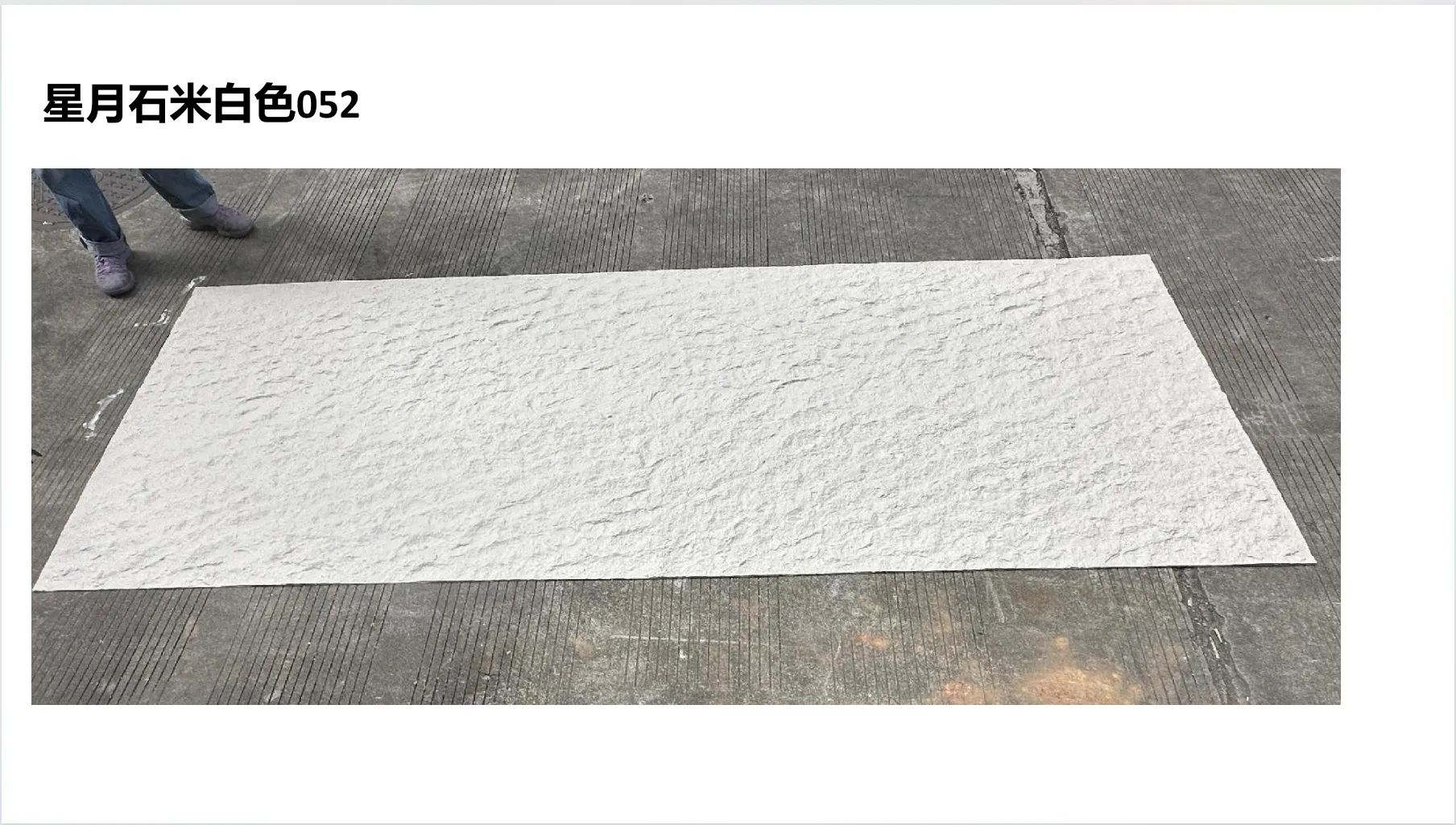
First, let's get to know the newcomer. Starmoon Stone is part of MCM's big slab board series, a line of materials engineered for maximum impact. These aren't your average panels—we're talking sizes that start at 1200x2400mm (that's 4x8 feet, for those who prefer imperial) and go up from there. Think of it as the "statement piece" of building materials: bold, unapologetic, and designed to command attention.
What makes Starmoon special? It's a blend of MCM's 3D printing series technology and flexible stone innovation. The 3D printing process allows for intricate textures—swirls, veins, even subtle "crater" patterns that mimic lunar landscapes—while the flexible stone base ensures it's durable enough for high-traffic areas. Unlike traditional stone slabs, which can crack under their own weight, Starmoon bends slightly, making installation on curved surfaces possible (yes, you read that right: a big slab that can curve). It's like combining the strength of granite with the adaptability of a vinyl sheet.
And let's talk aesthetics. Starmoon's surface isn't just "smooth" or "rough"—it's dynamic . Depending on the light, it shifts from a soft, silvery glow to deeper, shadowed tones, almost like the surface of the moon (hence the name). Pair it with complementary materials like travertine (starry green)—with its speckled, galaxy-like pattern—and you've got a space that feels both grounded and otherworldly.
Now, let's circle back to the classics: standard sizes. These are the panels and tiles you've seen in homes, offices, and retail spaces for years—typically 600x600mm, 800x800mm, or 300x600mm. Think of lunar peak silvery, a popular choice with its muted, metallic finish that pairs with almost any color scheme, or the warm, earthy tones of lime stone(beige), which feels like bringing a piece of the outdoors inside.
Standard sizes exist for a reason: they're easy. Easy to transport (no need for specialized trucks), easy to handle (a single worker can carry most panels), and easy to replace (if one tile cracks, you swap it out without redoing the entire wall). They're also versatile. Want to mix textures? Combine rough granite stone (medium grey) with smooth marble veil white in a checkerboard pattern. Need to work around odd angles? Cut a 300x600mm panel to fit without worrying about wasting half a slab.
For smaller projects or tight budgets, standard sizes are a lifesaver. They're mass-produced, so costs are lower, and with so many options—from the industrial edge of fair-faced concrete to the rustic charm of bamboo mat board—there's a standard panel for every design vision.
Imagine a wall covered in Starmoon Stone: one continuous surface, with seams so minimal they're almost invisible. That's the magic of big slabs. Seams can break up a design, making a space feel busy or cheap. With Starmoon, you get a sleek, uninterrupted look that's perfect for high-end projects like luxury hotels or corporate lobbies. It's the difference between a wall with a pattern and a wall that is the pattern.
You might think bigger slabs mean slower work, but here's the twist: fewer pieces to install. A 1200x2400mm Starmoon slab covers 2.88 square meters. A standard 600x600mm panel? Just 0.36 square meters. Do the math: covering a 50-square-meter wall with Starmoon would take roughly 18 slabs. With standard sizes? 139 panels. That means fewer hours of labor, fewer trips up and down ladders, and a project that finishes ahead of schedule.
MCM's big slab board series isn't just about looks—it's built tough. Starmoon is made with a reinforced core and a scratch-resistant surface, so it can handle the chaos of a busy restaurant or the foot traffic of a shopping mall. And because there are fewer seams, there are fewer places for moisture to seep in, reducing the risk of mold or water damage over time. It's a material that looks good and lasts, which is music to any client's ears.
A single Starmoon slab can weigh 50-70kg (110-154 lbs). That's not something two workers can just "muscle through." You'll need specialized equipment: forklifts, suction cups, maybe even a crane for upper floors. If your project is in a tight urban area or an old building with narrow stairwells, moving big slabs can be a logistical nightmare. And if you drop one? Say goodbye to your budget (and maybe a floor tile).
Big slabs aren't cheap. Starmoon costs 30-50% more per square meter than standard sizes, and that's before factoring in delivery and installation equipment. For small projects or clients on a tight budget, this can be a dealbreaker. Yes, you'll save on labor, but the initial investment might be too steep to justify.
Big slabs mean big mistakes. If you mismeasure a cut or the slab arrives damaged, you can't just trim a corner—you might have to scrap the entire piece. That's expensive and wasteful. Standard sizes, by contrast, are forgiving: cut a 600x600mm panel too short? Use it as a border or in a smaller area. With Starmoon, there's no "oops, let's repurpose that."
A standard 600x600mm panel weighs 15-20kg—light enough for one person to carry. No need for cranes or forklifts; just a dolly and a helper. This makes installation faster in tight spaces, like apartment bathrooms or narrow hallways. It also reduces the risk of injury, which is a win for your crew and your insurance premiums.
Standard sizes are mass-produced, so they cost less to manufacture and transport. You'll pay less per square meter, and with lower installation costs (no special equipment), your total budget stays in check. For residential projects or clients who want quality without the luxury price tag, standard sizes are the way to go.
Mix, match, and get creative! Standard sizes let you play with patterns: herringbone with linear travertine(claybank), checkerboard with dolomitic travertine(dark grey) and white, or a mosaic with rust mosaic stone. You can also experiment with textures—pair the rough feel of masonry stone with the smoothness of polish concrete. With big slabs, you're limited to one texture per surface; with standard sizes, the design possibilities are endless.
More panels mean more seams. Even with careful installation, seams can collect dirt, look uneven, or disrupt a design's flow. In a minimalist space, this can be a dealbreaker. Imagine a bathroom wall with white marble panels—those thin grout lines might not seem like much, but up close, they can make the space feel cluttered.
Installing 100+ panels takes time. Each one needs to be aligned, spaced, and secured, which adds hours (or days) to your timeline. For commercial projects with tight deadlines, this can lead to overtime costs or missed openings.
Standard sizes are reliable, but they're not always memorable. A wall covered in 600x600mm lunar peak golden panels looks nice, but it won't make someone stop and take a photo. If your project needs to stand out—like a boutique hotel or a flagship store—standard sizes might feel too safe.
| Factor | Starmoon Stone Big Slab | Standard Sizes |
|---|---|---|
| Size Range | 1200x2400mm and up | 300x300mm to 800x800mm |
| Installation Time | Faster (fewer pieces) | Slower (more pieces) |
| Aesthetic Impact | High (seamless, dramatic) | Moderate (seams may disrupt flow) |
| Cost | Higher (30-50% more per sqm) | Lower (budget-friendly) |
| Handling | Requires specialized equipment | Easy (one person can carry) |
| Waste Risk | High (mistakes = full slab loss) | Low (scrap pieces can be repurposed) |
| Best For | High-end commercial, large open spaces | Residential, tight budgets, mixed textures |
Still on the fence? Let's look at two hypothetical projects to see how the choice plays out.
Client wants: A grand entrance that feels opulent and modern. Budget: Mid-to-high. Timeline: 3 months. Space: Large, open lobby with 10-meter walls.
Best choice: Starmoon Stone Big Slab. Why? The seamless walls will make the lobby feel expansive and high-end. Pair Starmoon with foamed aluminium alloy board (vintage gold) accents for a touch of luxury, and installation will be faster, keeping the project on track. The client is willing to pay more for that "wow" factor, and the large space means fewer cuts (lower waste risk).
Client wants: A durable, easy-to-clean backsplash that complements their wooden cabinets. Budget: Moderate. Timeline: 1 week. Space: Small kitchen with odd angles around appliances.
Best choice: Standard sizes. Why? The small space and tight timeline call for lightweight, easy-to-cut panels. Lunar peak silvery in 300x600mm fits perfectly, and if a panel gets chipped during installation, it's easy to replace. Mix in a few travertine (starry blue) tiles for a pop of color—something you couldn't do with a single big slab.
Starmoon Stone Big Slab and standard sizes aren't enemies—they're tools. Big slabs are for making a statement, for projects where design is the priority and budget is flexible. Standard sizes are for practicality, for spaces where function and cost matter most. And sometimes, the best solution is a mix: use Starmoon for the main wall and standard sizes for accents or smaller areas.
At the end of the day, the right choice depends on your client's vision, your budget, and the story you want the space to tell. Whether you go big and bold or small and steady, remember: the best materials are the ones that make people feel something. And with MCM's lineup—from the innovation of Starmoon to the reliability of lunar peak silvery—you're never short on options to turn a house into a home, or a building into a landmark.
Recommend Products












