
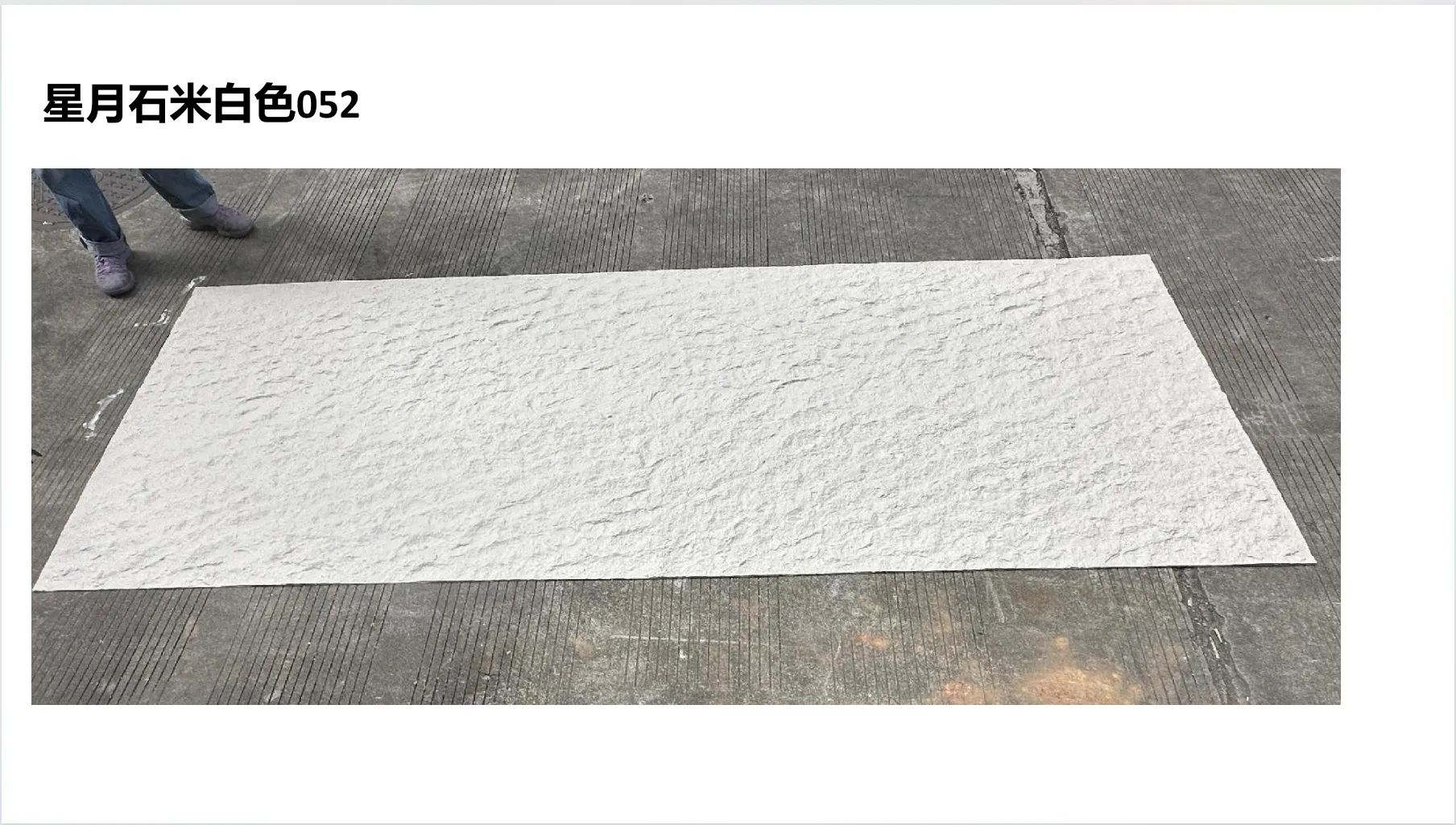
Gone are the days when architecture and interior design were confined to sharp angles and flat surfaces. Today's creators crave movement—curves that flow like rivers, textures that tell stories, and materials that bend to the imagination rather than resist it. Enter Starmoon Stone Flexible Stone , a revolutionary material that's not just changing how we build, but how we feel about spaces. Blending the timeless beauty of natural stone with cutting-edge flexibility, it's the answer to a design world hungry for both form and function.
Traditional stone—marble, granite, travertine—has long been celebrated for its elegance, but it comes with a trade-off: rigidity. Heavy, brittle, and unforgiving, it struggles to adapt to the organic shapes modern design demands. Starmoon Stone Flexible Stone flips that script. Crafted using MCM (Modified Composite Material) technology, it's a lightweight marvel that retains the depth and character of natural stone while boasting the flexibility of a fabric. Imagine a material so adaptable it can wrap around a spiral staircase, cling to a curved facade, or nestle into the contours of a custom fireplace—all without cracking, warping, or sacrificing durability.
At its core, Starmoon Stone is a symphony of innovation: a thin layer of natural stone veneer bonded to a high-strength, flexible backing. This hybrid construction shaves off weight (up to 70% lighter than solid stone!) while adding resilience, making installation a breeze and reducing structural load on buildings. It's not just a material—it's a design liberation.
Curves in architecture aren't just aesthetic—they're emotional. A curved wall feels welcoming, a rounded ceiling evokes openness, and a sweeping facade commands attention. But achieving these shapes with traditional materials often means compromising on beauty or budget. Starmoon Stone erases those compromises, turning curved visions into reality with stunning results.
Modern commercial buildings are ditching boxy exteriors for soft, flowing lines, and Starmoon Stone is leading the charge. Take, for example, the Azure Hotel in downtown Seattle, where the architects wanted a facade that mimicked the nearby Puget Sound's waves. Using wave panel textured Starmoon Stone in a gradient of blues, they created a undulating exterior that shifts with the light—no heavy steel supports or cracked stone in sight. The material's flexibility allowed each panel to follow the curve of the building's frame, while its weather-resistant properties ensure it stands up to rain, wind, and salt air.
Inside, curved feature walls are transforming lobbies, restaurants, and homes into immersive experiences. The Elemental Spa in Miami, for instance, wanted a reception area that felt like stepping into a cave—organic, calming, and tactile. They chose Starmoon Stone in travertine (starry blue) , a finish that mimics the night sky with subtle, glittering flecks. The stone was molded to create gentle, sweeping curves that guide guests from the entrance to the treatment rooms, its matte surface absorbing light to create a serene atmosphere. "It's not just a wall," says the spa's designer, "it's a journey."
Flexible stone isn't limited to grand surfaces—it shines in smaller, more intimate details too. Custom furniture designers are embracing it for curved countertops, rounded cabinet doors, and even ergonomic chair backs. A boutique café in Portland recently commissioned a set of curved bar stools wrapped in lunar peak silvery Starmoon Stone. The cool, metallic sheen contrasts with warm wood legs, while the stone's flexibility ensures the stools fit comfortably against the rounded bar. "Guests run their hands over them—they can't believe it's stone," laughs the café owner. "It's become a conversation starter."
Starmoon Stone isn't just about covering large surfaces—it's about elevating the little things that make a space memorable. Decorative accents, often overlooked, are where personality lives, and flexible stone adds depth, texture, and storytelling to these moments.
Imagine a kitchen backsplash that isn't just functional but a work of art. Starmoon Stone's wave panel finish, with its subtle, rippling texture, turns a utilitarian space into a focal point. Paired with foamed aluminium alloy board (vintage gold) trim, it creates a luxurious contrast—warm metal against cool stone—that feels both modern and timeless. In bathrooms, it's being used for curved shower niches, adding a spa-like touch without the weight of traditional tile. Even crown moldings, once plain and predictable, are getting a makeover: Starmoon Stone in travertine (vintage gold) adds a gilded, old-world charm to modern living rooms.
Fireplaces have always been gathering spots, but with Starmoon Stone, they're becoming sculptural centerpieces. A family in Colorado recently renovated their living room with a curved fireplace surround wrapped in travertine (starry red) , its deep crimson tones and star-like flecks mirroring the state's fiery sunsets. The stone's flexibility allowed the surround to curve gently upward, framing the fire without overwhelming the room. "It's like having a piece of art that also keeps us warm," says the homeowner. "Every guest comments on it."
Still on the fence? Let's break down how Starmoon Stone stacks up against traditional options. The table below compares key factors that matter most to designers, builders, and homeowners:
| Material | Weight (per sq. ft) | Flexibility | Installation Ease | Durability | Cost (Relative) |
|---|---|---|---|---|---|
| Starmoon Stone Flexible Stone | 2-3 lbs | High (bends to 30° curves) | Easy (lightweight, no special tools) | Excellent (resistant to chips, moisture, UV rays) | Moderate (less than solid stone, more than tile) |
| Solid Marble/Granite | 15-20 lbs | Low (brittle, cracks on curves) | Difficult (requires heavy equipment, skilled labor) | Good (prone to staining, etching) | High |
| Ceramic/Porcelain Tile | 5-7 lbs | Low (breaks on tight curves) | Moderate (grout required, time-consuming) | Good (prone to chipping at edges) | Low |
| Traditional Concrete | 12-15 lbs | Very Low (rigid, no curve adaptability) | Difficult (requires forms, curing time) | Excellent (but heavy, prone to cracking) | Moderate-High |
Beyond the practical benefits, there's an emotional draw to Starmoon Stone. It bridges the gap between nature and innovation—offering the soul of stone without the constraints. Designers love that it can be customized to match any vision: from the industrial edge of foamed aluminium alloy board (vintage gold) to the earthy warmth of travertine, or the otherworldly allure of travertine (starry blue) . It's a material that doesn't just fit into a design—it elevates it.
Take the recent renovation of a historic theater in Chicago. The architects wanted to honor the building's 1920s grandeur while adding a modern twist. They chose Starmoon Stone in muretto stone (light grey) for the curved proscenium arch, a finish that mimics weathered stone but with the flexibility to follow the arch's gentle curve. Paired with gold leaf accents, it's a nod to the past and a leap into the future. "It feels timeless," says the lead architect, "but also fresh. That's the magic of flexible stone."
As our lives become more digital, we crave spaces that feel human—tactile, organic, and alive. Starmoon Stone Flexible Stone isn't just a material; it's a tool for creating those connections. Whether wrapping a skyscraper in flowing curves, adding a starry accent to a kitchen, or turning a chair into a work of art, it reminds us that beauty lies in both the grand gestures and the tiny details.
So, the next time you walk into a space that takes your breath away—a hotel with a curved facade that shimmers at dusk, a home with a stone-wrapped fireplace that feels like a hug—chances are, Starmoon Stone is behind it. Because in the end, great design isn't just about how a space looks. It's about how it makes you feel.
Starmoon Stone Flexible Stone: Where nature meets innovation, and curves meet possibility.
Recommend Products












