
Let's start with the obvious: curves are hard. Not just to design, but to build. Walk through any historic district, and you'll notice most old buildings stick to straight lines and right angles—for good reason. Quarrying a block of marble and chiseling it into a gentle arc requires master craftsmanship, time, and a budget that would make even luxury developers pause. Modern concrete can be poured into curved forms, but it's heavy, prone to cracking over time, and lacks the refined texture of natural stone. Even thin-cut natural stone panels, once hailed as a solution, often crack when bent beyond a minimal radius, turning a designer's vision into a construction headache.
Take the example of a boutique hotel in Lisbon I visited last year. The architect had sketched a stunning curved facade meant to mimic the rolling hills of the surrounding countryside. The original plan called for travertine, a stone known for its warm, porous texture. But when the first panels arrived, the installation team quickly realized a problem: even the thinnest travertine sheets (about 2cm thick) couldn't bend to the 1.5-meter radius the design required without snapping. The project stalled for weeks, the budget ballooned as custom-cut panels were ordered, and by the end, the curves were noticeably shallower than intended. "We had to choose between the design and the material," the lead architect told me, shaking his head. "And that's a choice no designer should have to make."
This is the reality of curved wall installations with traditional materials: they demand trade-offs. Trade-offs between aesthetics and feasibility, between budget and timeline, between the vision on paper and the structure that finally rises.
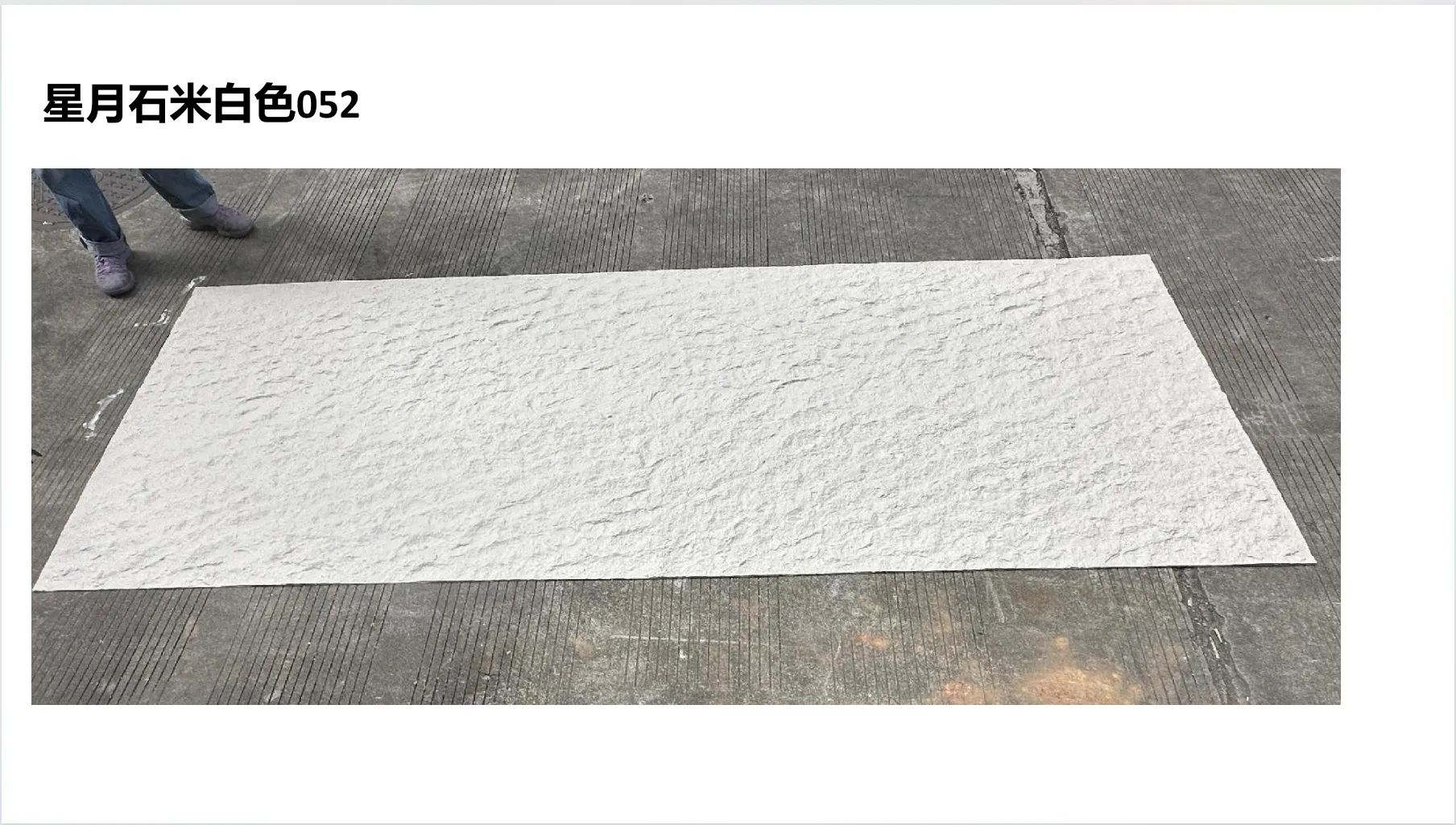
Starmoon Stone isn't just another building material—it's a rethink of what a stone cladding can be. As part of the broader MCM flexible stone family, it's engineered from a blend of natural minerals (think crushed stone, marble dust) and high-performance polymers, fused together through a proprietary process that balances strength with flexibility. The result? A panel that's thin (as little as 4mm), lightweight (8-12 kg per square meter, compared to 25-30 kg for natural stone), and—most importantly—able to bend. We're talking tight radii here: Starmoon Stone can curve to as little as 30cm without cracking, opening up possibilities for everything from gentle arcs to dramatic, sweeping spirals.
But flexibility alone isn't enough. A material that bends but chips easily, or fades in sunlight, is just a novelty. Starmoon Stone addresses this with a focus on durability. The polymer matrix protects the natural mineral core from moisture, UV rays, and impact—so that curved wall in a coastal hotel won't warp in the salt air, and the starry blue finish in a sunlit atrium won't fade to a dull gray after a few years. I spoke with a materials engineer at the MCM production facility who put it simply: "We wanted to create something that feels like stone but behaves like a high-performance composite. Starmoon Stone isn't just flexible—it's tough. It's built to last 50+ years, even in harsh environments."
And then there's the aesthetics. Starmoon Stone doesn't skimp on the "stone" part of the equation. Thanks to advanced printing and texturing techniques (some of which borrow from MCM's 3D printing series), the panels mimic the look and feel of natural stone with uncanny accuracy. Run your hand over a Starmoon Stone panel finished in "travertine (starry green)," and you'll feel the same subtle pits and ridges as you would on quarried travertine. Choose "lunar peak silvery," and you get the sleek, metallic sheen of polished granite, but with the ability to wrap around a curved wall like a second skin. It's the best of both worlds: the beauty of natural stone, with the versatility of a modern composite.
Flexibility might be Starmoon Stone's headline feature, but it's the secondary benefits that often win over architects and contractors. Let's break them down:
Imagine hoisting a 30kg slab of natural stone up to the 10th floor of a construction site. Now imagine doing that for every panel in a curved facade. It's not just backbreaking work—it's dangerous. Starmoon Stone's lightweight design cuts that risk dramatically. A two-person crew can carry and install panels by hand, no cranes or heavy machinery required. On a recent project in Dubai, a contractor told me they reduced installation time by 40% compared to a similar curved wall done with natural stone. "We used to need a team of six for a day's work on curves," he said. "Now it's three people, and they're done by lunch."
Let's talk numbers. Natural stone curved panels often require custom cutting, which adds 30-50% to the material cost. Then there's transportation: heavier panels mean more trucks, higher fuel costs, and stricter weight limits on job sites. Starmoon Stone eliminates most of these expenses. The panels are pre-fabricated in standard sizes (though custom cuts are available) and stack flat, reducing shipping volume by up to 60%. Installation labor is cheaper too, since fewer workers and less time are needed. One hotel developer I interviewed estimated that switching to Starmoon Stone for their curved lobby wall saved them $80,000 on a $500,000 project. "That's not pocket change," they said. "That's money we could put into other design elements—like the custom lighting that really makes those curves pop."
Natural stone is beautiful, but it's needy. Marble etches if you spill lemon juice on it; travertine absorbs stains; even granite needs regular sealing to stay looking fresh. Starmoon Stone? It's practically maintenance-free. The polymer coating resists stains, so a spilled coffee or rainwater won't leave a mark. UV resistance means colors stay vibrant, even in direct sunlight. And because there are no pores (unlike natural stone), mold and mildew can't take hold in humid environments. A property manager at a Miami condo with Starmoon Stone curved walls laughed when I asked about upkeep: "We hose them down once a month. That's it. No sealers, no special cleaners, no worrying about guests scratching them. It's been five years, and they look like the day they were installed."
| Feature | Starmoon Stone (MCM Flexible Stone) | Natural Marble | Concrete Panels | Thin-Cut Natural Travertine |
|---|---|---|---|---|
| Minimum Bend Radius | 30cm (tight curves possible) | 2m+ (limited curves) | 1m+ (prone to cracking) | 1.5m+ (high risk of breaking) |
| Weight (kg/m²) | 8-12 | 25-30 | 20-25 | 18-22 |
| Installation Time (100m² curved wall) | 1-2 days | 5-7 days | 3-4 days | 4-5 days |
| Material Cost (per m²) | $50-80 | $150-250 | $60-90 | $120-180 |
| Maintenance Required | Minimal (hose down, occasional wipe) | High (sealing every 1-2 years, stain removal) | Moderate (sealing every 3-5 years) | High (sealing, porous surface prone to stains) |
| Durability (Expected Lifespan) | 50+ years | 20-30 years (prone to cracking) | 30-40 years (may spall) | 15-20 years (thin panels crack easily) |
| Aesthetic Options | Wide (starry patterns, metallic finishes, wood grains, etc.) | Limited (natural veining, color variation) | Basic (stamped textures, limited colors) | Moderate (natural travertine variations) |
The Yunfeng Cultural Center was meant to be a landmark—a building that celebrated Sichuan's mountainous landscape through architecture. The design called for a sweeping, curved interior wall in the main exhibition hall, meant to evoke the region's famous bamboo forests (hence the desire for a "flowing" structure). The original plan used traditional bamboo mat board, but concerns about fire safety and durability quickly scrapped that idea. Next, the team considered marble, but the 1-meter radius of the curve made it unfeasible. That's when they discovered Starmoon Stone.
The solution? Starmoon Stone in "bamboo mat board" finish—a pattern that mimics the texture of woven bamboo, printed onto flexible panels that could bend to the required radius. The installation took just 3 days (compared to the 2 weeks projected for marble), and the result was stunning: a 20-meter-long curved wall that feels both organic and modern, with the warm, tactile quality of real bamboo but the fire resistance and longevity of a composite material.
Today, the Yunfeng Cultural Center's curved wall is one of its most photographed features—a testament to how Starmoon Stone can turn design challenges into opportunities.
Curved walls aren't just for grand cultural centers. Starmoon Stone's versatility makes it a fit for projects of all scales, from residential to commercial. Here are a few spaces where it's shining:
Imagine a home office with a curved accent wall that wraps around your desk, creating a sense of enclosure without feeling claustrophobic. Or a master bedroom where a curved headboard wall in Starmoon Stone's "lunar peak golden" finish adds warmth and luxury. In a recent renovation in Portland, Oregon, a homeowner replaced a straight drywall wall with a curved Starmoon Stone panel in "travertine (beige)," transforming a plain living room into a space that feels like a high-end boutique hotel. "I wanted something that felt natural but not sterile," the homeowner said. "The curve softens the room, and the travertine texture makes it feel grounded. Guests always ask where we got it."
Retail stores, restaurants, and hotels use curved walls to guide customer flow and create memorable experiences. A coffee chain in Tokyo, for example, used Starmoon Stone in "starry red" for a curved counter backdrop, making the ordering area the visual focal point of the shop. The panels' flexibility allowed the curve to follow the shape of the counter exactly, creating a seamless, inviting space. "Customers linger longer now," the store manager noted. "They take photos of the wall, post them online—it's become part of our brand."
Airports, train stations, and museums need materials that can handle heavy foot traffic, constant cleaning, and the test of time. Starmoon Stone checks all these boxes. In the arrivals hall of a major European airport, a curved wall clad in "fair-faced concrete" finish Starmoon Stone has withstood years of luggage bumps, cleaning chemicals, and thousands of daily passengers—all while maintaining its sleek, industrial look. "We chose Starmoon Stone because it looks like real concrete but won't chip or stain," the facilities director explained. "And the curve? It slows people down, makes them pause and take in the space. That's the power of good design—even in a busy airport."
In an era where "green building" is no longer optional, Starmoon Stone holds its own. The manufacturing process uses recycled stone waste (up to 30% of the raw material is post-industrial recycled content), and the lightweight panels reduce the need for structural steel, lowering a building's overall carbon footprint. Because Starmoon Stone is so durable, it also reduces the need for replacement—unlike natural stone, which may need repairs or replacement after 20 years, Starmoon Stone panels can last 50+ years with minimal upkeep. That means less waste in landfills and fewer resources spent on manufacturing replacements.
Additionally, the low VOC emissions during production and installation make it a healthier choice for indoor spaces—a key consideration for schools, hospitals, and homes. "Sustainability isn't just about the environment," said Maria Gonzalez, a green building consultant I spoke with. "It's about creating spaces that are healthy for people too. Starmoon Stone delivers on both."
As architects and designers continue to push the boundaries of what buildings can be—moving away from rigid boxes toward organic, flowing forms—materials like Starmoon Stone will become essential tools. They're not just solving problems; they're inspiring new ideas. Imagine a skyscraper with a curved facade that changes color based on the time of day (Starmoon Stone's metallic finishes, like "foamed aluminium alloy board (vintage gold)," could make that possible). Or a museum where every wall is curved, creating a journey through art that feels more like a walk through nature.
Starmoon Stone is also opening doors for smaller-scale innovators. With lower costs and easier installation, even boutique designers and homeowners can experiment with curves that were once reserved for mega-projects. "I used to think curved walls were only for clients with unlimited budgets," said a residential designer in Chicago. "Now, with Starmoon Stone, I'm suggesting them to first-time homebuyers. It's democratizing good design."
Curved walls have always been a symbol of architectural ambition—of humanity's desire to build not just structures, but spaces that move us. For too long, that ambition was limited by the materials available. Starmoon Stone, as part of the MCM flexible stone revolution, is changing that. It's a material that bends so your vision doesn't have to—a material that turns "impossible" curves into "why not?"
Whether you're designing a cultural center, a coffee shop, or your own home, Starmoon Stone invites you to think differently about walls. They don't have to be straight. They don't have to be heavy. They can flow, curve, and adapt—just like the people who use them. And in a world that often feels rigid and unchanging, that's a beautiful thing.
So here's to the curves—the ones on the drawing board, the ones under construction, and the ones we haven't even imagined yet. With Starmoon Stone, the only limit is your creativity.
Recommend Products












