
Walk through any modern city skyline, and you'll notice them—high-rises piercing the clouds, symbols of progress and ambition. But behind those gleaming exteriors lies a world of construction challenges. Builders and architects don't just worry about height; they grapple with every detail, especially when it comes to exterior materials. Weight, installation speed, safety, and durability—these are the puzzle pieces that can make or break a project. Today, we're diving into a material that's changing the game for high-rise exteriors: Starmoon Stone . Its secret? A lightweight design that doesn't just make installation easier, but transforms how we build upward.
Let's start with the basics: high-rise buildings are heavy. Every floor, every beam, every piece of furniture adds up. But when it comes to exterior cladding—the "skin" of the building—traditional materials have long been a headache. Think about marble, granite, or even thick concrete panels. These materials are beautiful, sure, but they're also dense . A single square meter of granite can weigh 25–30 kilograms; marble, even more. Multiply that by the thousands of square meters on a 50-story building, and you're talking about hundreds of tons of extra weight.
Why does that matter? For starters, structural engineers have to overdesign the building's frame to support all that weight, driving up costs. Then there's installation: hoisting heavy slabs with cranes, maneuvering them into place with teams of workers, and securing them with complex anchoring systems. It's slow, labor-intensive, and risky. drop a 30kg slab from the 20th floor, and you're looking at disaster. Plus, longer installation times mean longer construction schedules—and in the world of real estate, time is money.
Architects, too, feel the squeeze. Heavy materials limit design flexibility. Want a cantilevered facade or a curved balcony? Traditional cladding might make that impossible without massive structural reinforcements. It's no wonder the industry has been crying out for a better way.
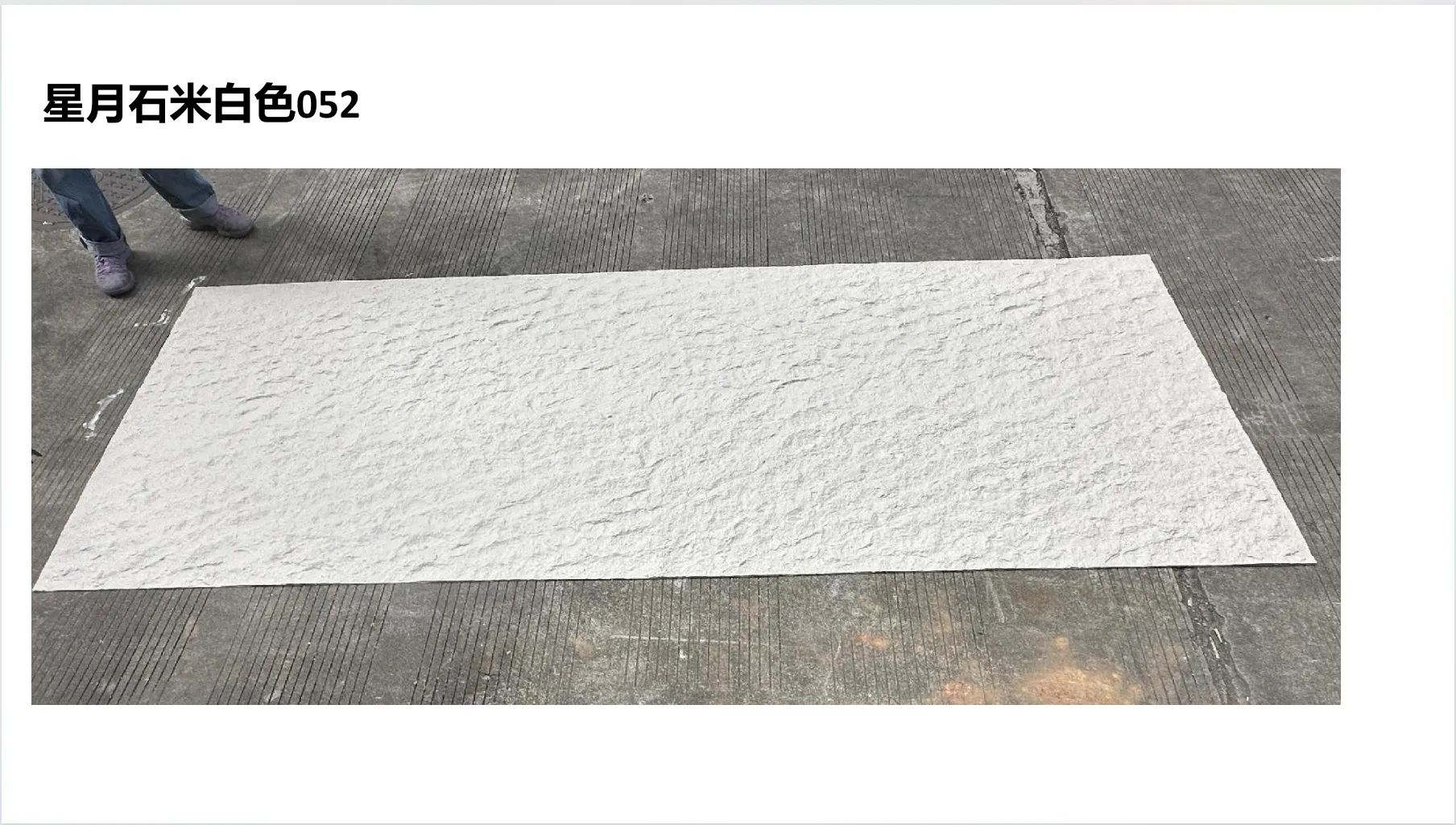
This is where Starmoon Stone steps in. Developed as part of the MCM flexible stone family—a category of modified composite materials—it's redefining what exterior cladding can be. At first glance, you might mistake it for natural stone: the texture, the depth, the subtle variations in color. Run your hand over it, and you'll feel the cool, earthy grit of travertine or the smooth sheen of polished marble. But pick it up, and you'll do a double-take. This stuff is light .
So, what makes it so lightweight? Starmoon Stone starts with a high-strength, flexible base—think of it as a "stone sandwich." The core is a lightweight, reinforced polymer matrix, layered with a thin veneer of natural stone particles or mineral composites. This combo cuts weight dramatically while retaining the look and feel of the real thing. Compare that to traditional stone, which is solid all the way through, and you can see why it's a game-changer.
But it's not just about cutting corners. Starmoon Stone is engineered for performance. The manufacturing process (which sometimes incorporates techniques from the MCM 3D printing series for precision textures) ensures uniformity and strength. It's water-resistant, fire-retardant, and built to withstand the elements—from scorching desert sun to freezing winter rains. In short, it's tough enough for the harshest high-rise environments.
Let's get specific. How light is Starmoon Stone, really? On average, it weighs just 4–6 kilograms per square meter. Compare that to granite (25–30kg/sqm) or even lightweight concrete panels (15–20kg/sqm), and the difference is staggering. To put it in perspective: a worker can carry a 2m x 1m Starmoon Stone sheet by themselves—no need for a team of four or a forklift. That's a game-changer on a busy construction site.
For builders, this translates to three big wins:
Let's paint a picture. It's 7 a.m. on a high-rise construction site in Singapore. The crew is installing exterior cladding on the 35th floor. With traditional granite, this would involve a crane lifting 25kg slabs one by one, a team of four workers guiding each into place, and hours spent drilling anchors into the concrete facade. By lunch, they might have installed 10 square meters—if everything goes smoothly.
Now, swap in Starmoon Stone. The sheets arrive stacked on a pallet, each 2m x 1m and weighing 8kg. Two workers carry them up the service elevator (no crane needed). They peel off the protective backing, apply a high-strength adhesive to the back, and press the sheet onto the prepped facade. No drilling, no anchoring, no waiting for mortar to set. By lunch, they've installed 40 square meters. That's the difference lightweight and flexibility make.
The key here is the adhesive system. Starmoon Stone uses a specialized, weather-resistant adhesive that bonds directly to the building's substrate—concrete, steel, even existing cladding. It cures quickly, so workers can move on to the next sheet in minutes. And because the material is flexible, it can conform to slight irregularities in the facade, ensuring a tight, seamless fit. No more gaps, no more cracked corners from rigid slabs.
Safety, too, gets a boost. With no heavy lifting or crane operations, the risk of falls or collisions drops dramatically. Workers can move freely on scaffolding without worrying about maneuvering bulky materials. Insurance companies have even taken notice: some projects using Starmoon Stone report lower liability premiums thanks to reduced accident risks.
Critics might ask: "If it's that light, is it strong enough?" The answer is a resounding yes. Starmoon Stone is tested to withstand impacts, high winds (up to 180km/h in wind tunnel tests), and temperature extremes from -40°C to 80°C. It's also resistant to UV rays, so colors won't fade, and moisture-resistant, preventing mold or mildew growth. In accelerated aging tests, it shows minimal wear after 50 years—comparable to natural stone.
But where Starmoon Stone really shines is design flexibility. Unlike traditional stone, which is limited by what nature provides, Starmoon Stone can be customized in ways that make architects giddy. Want a facade that shimmers like the night sky? Opt for travertine (starry blue) with embedded metallic flecks. Dreaming of a warm, earthy look? Try lunar peak golden with a textured finish that mimics sun-baked sand. There are even options that mimic wood grain, bamboo mats, or wood line patterns for a organic, natural vibe.
And because it's flexible, it can be bent or curved to create unique shapes. Imagine a high-rise with a undulating facade that looks like waves—possible with Starmoon Stone, impossible with rigid granite. Or a spiral tower where the cladding twists as it rises. The only limit is the architect's imagination.
Starmoon Stone isn't the only lightweight cladding option out there. Materials like foamed aluminium alloy board (vintage silver) or fiber cement panels have been around for years. So, what makes Starmoon Stone stand out?
Foamed aluminium, for example, is ultra-light (3–5kg/sqm) and durable, but it has a metallic, industrial look that doesn't suit every project. Fiber cement is affordable but can feel flat and artificial compared to stone. Starmoon Stone bridges the gap: it has the warmth and authenticity of natural stone, the lightness of aluminium, and the design flexibility of modern composites.
To visualize the differences, let's look at a quick comparison:
| Material | Weight (kg/sqm) | Installation Time (sqm/day/team) | Aesthetic Appeal | Cost (USD/sqm) |
|---|---|---|---|---|
| Traditional Granite | 25–30 | 10–15 | High (natural stone look) | 150–300 |
| Foamed Aluminium (Vintage Silver) | 3–5 | 30–40 | Medium (metallic finish) | 80–120 |
| Starmoon Stone | 4–6 | 40–50 | High (natural stone mimicry) | 100–180 |
Starmoon Stone's sweet spot is clear: it matches the installation speed of foamed aluminium but offers the premium look of natural stone at a mid-range price. For developers and architects balancing aesthetics, budget, and practicality, that's a winning combo.
Let's take a real example. In 2024, a 60-story mixed-use tower in Dubai—dubbed "The Azure Spire"—opted for Starmoon Stone's travertine (vintage gold) finish for its exterior. The developer's goal was to create a building that looked like it was carved from golden stone but without the weight penalty of real travertine.
The results? Installation time for the cladding was cut by 45% compared to the original granite plan. The structural engineer was able to reduce the size of the facade support beams, saving $1.2 million in steel costs. And because the material was so easy to handle, the project finished two months ahead of schedule—netting the developer an extra $5 million in pre-lease revenue.
But the best part? The tenants love it. "It looks like Italian travertine, but the building feels lighter, more airy," said one office tenant. "The golden hue catches the sunset perfectly—it's become a landmark in the area."
As cities grow taller and construction timelines tighter, materials like Starmoon Stone are no longer a luxury—they're a necessity. The lightweight revolution is here, and it's not just about making installation easier. It's about building smarter, safer, and more sustainably. Less structural steel means less mining and manufacturing; fewer transport trips mean lower carbon emissions; faster construction means less disruption to city life.
And for architects? It's a blank canvas. With Starmoon Stone, they can finally bring their boldest visions to life—curved facades, dynamic textures, and designs that play with light and shadow—without worrying about the weight. It's a material that respects the past (mimicking the beauty of natural stone) while embracing the future (lightweight, flexible, high-tech).
High-rise buildings are more than just structures—they're symbols of human ambition. But to reach new heights, we need materials that can keep up. Starmoon Stone, with its lightweight design, easy installation, and uncompromising quality, is helping us do just that. It's proof that sometimes, the strongest solutions are the ones that don't weigh us down.
So, the next time you look up at a gleaming high-rise, take a closer look at its exterior. Chances are, it's not just stone—it's Starmoon Stone. And behind that beauty is a story of innovation, practicality, and the relentless drive to build better.
Recommend Products












