
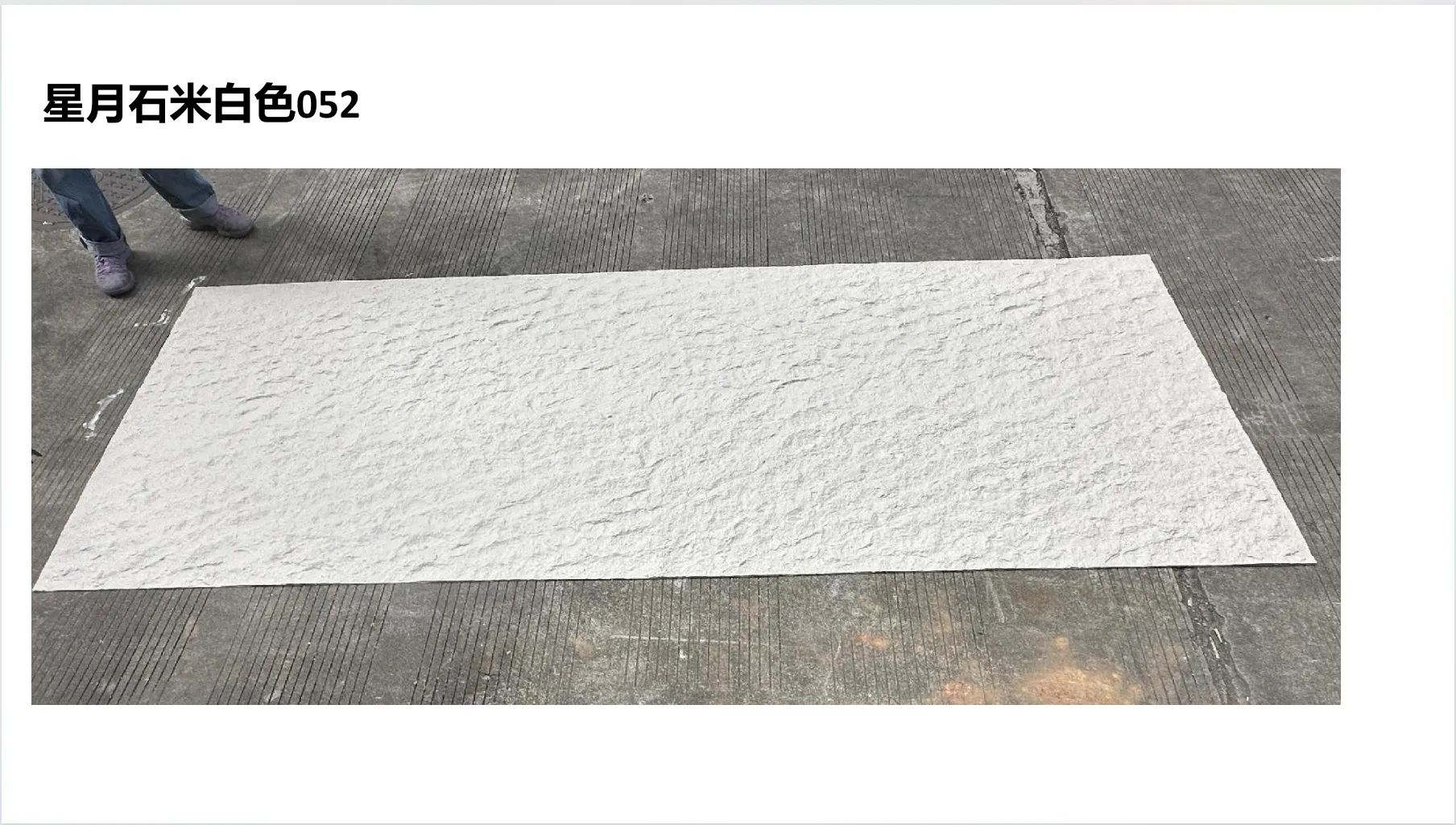
Starmoon Stone isn't just a material—it's a category of MCM (Modified Composite Material) that blends the best of natural stone and modern engineering. Think of it as stone reimagined: lighter, more adaptable, and brimming with texture. Part of the MCM Flexible Stone family, it's designed to mimic the depth of natural materials like travertine or slate but with a flexibility that traditional stone can only dream of. From the starry sparkle of Travertine (Starry Green) to the metallic sheen of Lunar Peak Silvery , Starmoon Stone comes in a palette that reads like a love letter to both earth and sky.
What truly sets it apart? Its core is a composite that's thin (often just 3-5mm thick) and lightweight, making it easy to bend, curve, or cut into almost any shape. This isn't stone that demands flat, rigid surfaces—it thrives on curves, angles, and even 3D installations, thanks in part to innovations from the MCM 3D Printing Series . Whether you're craving the rough-hewn look of rock cut stone or the smooth flow of wave panels , Starmoon Stone bends to your vision, not the other way around.
Concrete Cladding, on the other hand, is the quiet powerhouse of the building world. Most often associated with fair-faced concrete —that raw, unpolished finish that celebrates the material's natural texture—it's the go-to for architects chasing minimalist, industrial, or brutalist aesthetics. Unlike Starmoon Stone, it's a mix of cement, aggregates, and water, poured into molds and cured to form rigid panels. When polished, it becomes polish concrete , sleek and reflective; left raw, it's tactile and organic, with visible aggregates and subtle color variations.
Concrete's charm lies in its simplicity. It doesn't pretend to be something it's not—its beauty is in its honesty: the way light catches its tiny air bubbles, the slight variations in tone, the weight of its presence. But this simplicity can also be a limitation. Heavy, dense, and rigid, traditional concrete cladding isn't known for flexibility. It works best on large, flat surfaces where its mass becomes part of the design statement.
Design flexibility isn't just about "looking pretty"—it's about how a material responds to creativity. Can it be shaped into a wave? Painted to match a sunset? Installed on a curved ceiling? Let's break down the critical areas where these materials shine (or stumble).
Texture is the silent storyteller of a space. A rough surface feels grounded and organic; a smooth one feels sleek and modern. Here's how our contenders compare:
Starmoon Stone is a texture chameleon. Thanks to advanced manufacturing, it can replicate almost any natural or abstract pattern. Want the pitted, porous look of travertine ? Done. Craving the layered, veiny elegance of marble veil white ? Consider it achieved. The MCM Big Slab Board Series even offers large-format panels with continuous patterns, so you can create walls that look like they're carved from a single stone. And let's not forget the fun stuff: star gravel inlays for a cosmic touch, thread textures that mimic woven fabric, or gobi panel designs that evoke desert landscapes. It's texture without limits.
Concrete Cladding has texture, but it's more constrained. Traditional fair-faced concrete offers a uniform, matte finish with subtle aggregate exposure—think small pebbles or sand grains visible just below the surface. Polish concrete ups the ante with a glossy, reflective surface, but the texture range is narrow: smooth, slightly rough, or somewhere in between. You can add color pigments, but patterns? They're hard to pull off without expensive custom molds. Concrete's texture tells one story well—industrial, honest—but it struggles to whisper, "What if we tried something wild?"
Color isn't just about aesthetics; it's about emotion. Warm tones feel inviting, cool tones feel calm, metallic finishes add luxury. Here's how the color palettes stack up:
Starmoon Stone is a color lover's dream. The Travertine (Starry) series alone offers starry red , starry orange , and starry blue —each with tiny, glittering flecks that catch light like constellations. The Lunar Peak line leans into metallics: silvery for a moonlit glow, golden for warmth, black for drama. For earthier vibes, there's lime stone (beige) , historical pathfinders stone (a weathered, antique hue), or bali stone (warm terracotta with subtle veining). Even foamed aluminium alloy board options— vintage silver , vintage gold —add industrial-chic shine. Starmoon Stone doesn't just offer colors; it offers moods.
Concrete Cladding plays in a smaller sandbox. Traditional concrete is gray—various shades, from light ash to deep charcoal—but that's the baseline. Add pigments, and you can get lime stone (beige) or soft terracotta, but bold colors? They're rare and often fade over time. Fair-faced concrete leans into its neutrality, which is part of its appeal—it lets other design elements (art, furniture, light) take center stage. But if you're dreaming of a wall that shifts from rusty red at the base to cloud-dragon gray at the top? Concrete can't deliver that.
A material's true flexibility shines in how it adapts to space. Can it climb a curved staircase? Cover a 20-foot ceiling? Stick to a tiny bathroom wall? Let's see:
Starmoon Stone is the ultimate multitasker. Its lightweight nature (often under 5kg per square meter) makes it ideal for vertical surfaces, ceilings, and even furniture. Want to wrap it around a cylindrical column? Its flexibility lets it bend without cracking. Dream of a 3D art concrete board installation that juts out from the wall like a sculptural wave? The MCM 3D Printing Series can make that a reality. Even small spaces benefit: semicircle board cuts add softness to a bathroom, while bamboo mat board textures warm up a kitchen backsplash. It works indoors (bedrooms, restaurants) and outdoors (facades, patios), resisting weathering thanks to its durable composite core.
Concrete Cladding is a heavyweight—literally. Traditional panels can weigh 50kg or more per square meter, making them tough to install on ceilings or upper floors without extra structural support. Curved surfaces? Possible, but expensive and labor-intensive (think custom molds and specialized installers). It's at home on large, flat exteriors or ground-floor interiors where its mass adds presence. A concrete-clad lobby feels imposing and solid, which is great for a corporate headquarters—but try putting it in a cozy café, and it might feel cold and uninviting. Concrete has boundaries; it just needs a lot of space to stretch its legs.
Every project is unique, and materials that can adapt to specific needs are worth their weight in gold (or foamed aluminium alloy board (gold) , in this case).
Starmoon Stone thrives on customization. Need a big slab board that's 4 meters long for a seamless wall? The MCM Big Slab Board Series delivers. Want to mix textures—say, wood grain board on the lower half of a wall and stream limestone (dark grey) on top? No problem. Even custom colors are possible: match a brand's signature hue, or create a gradient using gradient color rammed earth board techniques. It's a material that says, "Tell me your vision, and I'll fit."
Concrete Cladding can be customized, but it comes with trade-offs. You can order panels in specific sizes, add aggregate mixes (like gravel omani stone for a speckled look), or embed objects (metal, glass) during pouring. But these tweaks add cost and time—custom molds for unique shapes can take weeks to make, and color matching is tricky (concrete cures differently each time). It's customizable for those willing to invest, but it's not the material you'd turn to for last-minute design changes.
| Feature | Starmoon Stone (MCM Flexible Stone) | Concrete Cladding (Fair-Faced/Polish) |
|---|---|---|
| Texture Variety | Extensive: Starry, woven, gravel, wood grain, wave, and more | Limited: Matte, polished, or subtle aggregate exposure |
| Color Range | Broad: Starry hues, metallics (Lunar Peak), earth tones, gradients | Narrow: Grays, beiges, and a few pigmented options |
| Weight (per sqm) | 3-5kg (lightweight, easy to install) | 40-60kg (heavy, requires structural support) |
| Curved/3D Applications | Excellent: Bends easily without cracking | Possible but costly/labor-intensive |
| Custom Sizing | Highly flexible (MCM Big Slab up to 4m+) | Limited by mold size and weight |
Starmoon Stone and Concrete Cladding aren't enemies—they're tools for different stories. Here's how to pick:
Choose Starmoon Stone if... you want a space that feels alive with texture, color, and creativity. It's perfect for boutique hotels, restaurants, or homes where design is a priority. Think: a yoga studio with lunar peak silvery walls that glow like moonlight, or a retail store with travertine (starry blue) accents that draw customers in. It's the material for dreamers who want their walls to tell a story.
Choose Concrete Cladding if... you're after a minimalist, industrial, or monolithic look. It shines in modern offices, museums, or public buildings where "less is more" is the mantra. A concrete-clad library feels timeless and sturdy; a concrete home exterior makes a bold, unapologetic statement. It's for designers who love the beauty of simplicity.
Recommend Products












