
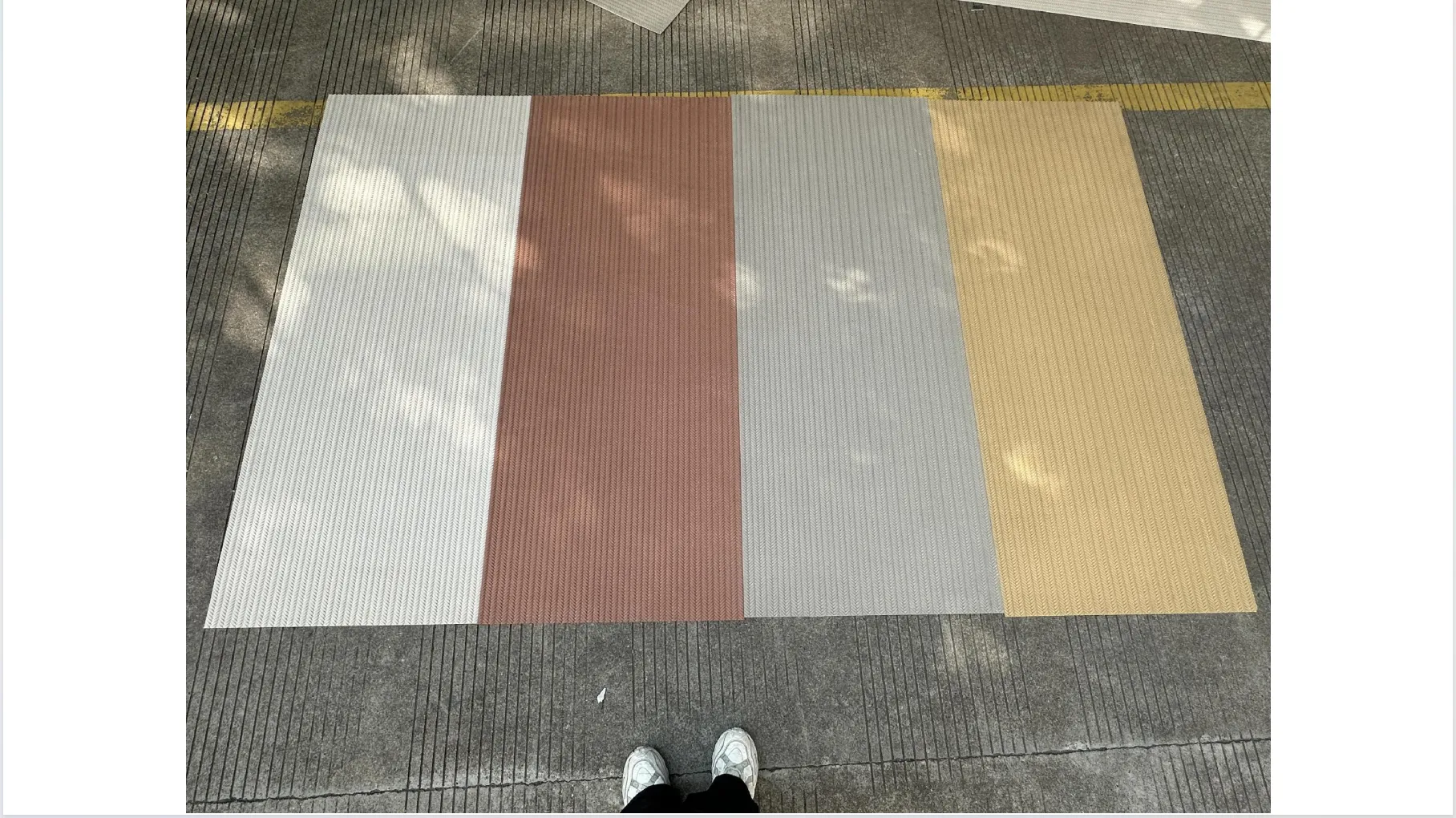
In the world of architecture and design, materials don't just exist —they tell stories. They whisper of craftsmanship, innovation, and the quiet dialogue between human hands and cutting-edge technology. Nowhere is this more true than in MCM's 3D Printing Series, a collection where flexible stone cladding panels, intricate woven textures, and hyper-realistic finishes come together to redefine what's possible in building design. But here's the thing: these materials don't just need to be seen —they need to be felt , even through a screen. That's where the art of capturing real photos comes in. Not stock images, not CGI renders, but honest, unfiltered snapshots that lay bare every groove, every thread, every play of light on stone. Today, let's dive into why these photos matter, how to capture the soul of MCM's woven textures, and why this work is so much more than just "taking pictures."
Walk into any designer's studio, and you'll likely find a stack of material samples: swatches of fabric, chips of stone, maybe a small panel of wood concrete board. These tactile fragments are non-negotiable—they let designers feel weight, texture, and color in a way digital files never could. But in a world where projects span continents and collaborations happen over Zoom, physical samples aren't always feasible. That's where real photos step in as the next best thing. They're not just marketing tools; they're bridges between the factory floor and the drawing board.
For MCM's 3D Printing Series, this is especially critical. Take, for example, the woven (khaki) and woven (jacinth) panels—textures so (, xìnì, "" means "delicate" in Chinese, but we'll stick to English: so delicate) they mimic handwoven textiles, yet durable enough to clad a skyscraper. A poorly lit photo might flatten those threads, making them look like a cheap print. A great photo? It makes you want to reach out and run your fingers over the surface, to imagine how the light would shift across it at different times of day. That's the power of authenticity: it builds trust. Architects and designers need to know exactly what they're specifying, and real photos say, "This is it—no smoke, no mirrors."
Capturing woven textures isn't just about pointing a camera and clicking. It's a dance between light, angle, and patience. Let's break it down. First, lighting. Harsh, direct flash? That's the enemy. It washes out details and creates harsh shadows that obscure the weave. Instead, soft, diffused light is key—think north-facing windows on an overcast day, or a softbox positioned at a 45-degree angle to the panel. This way, light seeps into the crevices of the weave, highlighting the depth between threads without blowing out the highlights.
Then there's the angle. Shoot straight-on, and you might as well be looking at a flat piece of paper. Tilt the camera slightly—maybe 15 degrees from the horizontal—and suddenly, the texture pops. You can see how each "thread" (a term MCM uses to describe the raised elements in their 3D-printed patterns) overlaps, how some catch the light while others recede into shadow. For wider shots, step back and include context: maybe a section of the panel leaning against a raw concrete wall, or paired with a sample of lunar peak silvery (a sleek, metallic finish that contrasts beautifully with woven warmth). Context helps designers visualize scale—how that woven panel might look on a feature wall, or alongside other MCM materials like bamboo mat board or rust square line stone .
Macro photography is another secret weapon. A 50mm macro lens can turn a small section of woven (grey) into a landscape—each ridge and valley becomes a mountain range, each thread a river. This isn't just artistic; it's practical. Designers need to see how the texture will interact with light in small spaces, like a boutique interior or a residential accent wall. A macro shot of the weave's "threads" reveals whether it will catch dust (spoiler: MCM's materials are designed to be low-maintenance, but the photo should still show that the texture is intentional, not accidental).
Not all materials photograph equally—and that's a good thing. Some demand the spotlight, others play supporting roles, but all have stories to tell. Let's highlight a few MCM stars that truly come alive in real photos:
| Product Line | Texture Highlight | Best Lighting for Photography | Top Application Scenario (in Photos) |
|---|---|---|---|
| Woven Series (Khaki/Jacinth) | Overlapping "threads," soft dimensionality | Diffused natural light (north-facing window) | Residential accent walls, boutique interiors |
| Flexible Stone Cladding Panels | Realistic stone veining, bendable edges | Side lighting (to emphasize curvature) | Commercial facades, curved feature walls |
| Wood Concrete Board | Wood grain embedded in concrete matrix | Mixed lighting (warm + cool sources) | Industrial-chic offices, restaurant backsplashes |
| Travertine (Starry Blue) | Metallic mineral flecks, subtle veining | Single-point spotlight (to highlight "stars") | Hotel lobbies, high-end retail feature walls |
| Lunar Peak Silvery | Sleek, metallic sheen with micro-texture | Soft overhead lighting (to avoid harsh reflections) | Modern corporate buildings, tech office interiors |
Let's be real: capturing these photos isn't always easy. MCM materials are designed to be dynamic —they change with light, angle, and even humidity. Take foamed aluminium alloy board (vintage gold) : its metallic surface can turn from warm amber to brassy orange depending on the time of day. Or rough granite stone (medium grey) , which has tiny pits and crevices that can look like black holes in low light. Then there's color accuracy. rona yellow , a cheerful, sunlit hue, can easily shift to neon in photos if the white balance is off. And don't even get me started on fair-faced concrete —its subtle variations in tone (some areas lighter, some darker) are what make it beautiful, but they're a nightmare to capture without making it look "dirty" or uneven.
But here's the joy: overcoming these challenges. It's about learning that slate veil white (a soft, marbled white) needs a polarizing filter to cut down on glare, or that charcoal burnt wood board (with its deep, smoky tones) shines in golden-hour light, when the sun is low and the shadows are long. It's about experimenting—taking 20 shots of the same woven panel, each with a slightly different angle, until you find the one that makes your breath catch. Because when you nail it? That photo doesn't just sell a product. It inspires a designer to say, "I need this in my project." It makes a homeowner imagine coming home to that texture every day. It turns a material into a memory.
If you're an architect or designer scrolling through MCM's photo library, how do you translate these images into real-world spaces? Start by looking beyond the "pretty picture." Ask: What's the texture doing ? Is that woven panel adding warmth to a minimalist room? Is the golden travertine (white golden) (a creamy, sunlit stone) bouncing light around a small space? Then, consider scale. Most MCM photos include a reference object—a pen, a hand, a ruler—to show size, but if not, compare it to known materials. For example, boulder slab (vintage black) has a chunky, organic texture; it might overwhelm a small bathroom but shine on an exterior facade.
Also, pay attention to lighting in the photos. If a woven panel looks stunning in soft, natural light, chances are it will perform the same way in a room with large windows. If rammed earth board (gradient) (with its shifting hues of red and orange) pops in warm, artificial light, it could be perfect for a restaurant or hotel lobby. And don't be afraid to mix and match, using the photos as a mood board. Pair woven (beige) with stream limestone (claybank) (a smooth, river-washed stone) for a earthy, organic vibe, or contrast foamed aluminium alloy board (vintage silver) (sleek and modern) with historical pathfinders stone (a weathered, timeworn texture) for a story of past and future.
At the end of the day, capturing real photos for MCM's 3D Printing Series isn't just a job. It's a love letter to materials—to the engineers who dreamt up flexible stone cladding panels that bend like fabric, to the artisans who tweak 3D printers until the "threads" of a woven panel feel just right, to the designers who will take these photos and turn them into spaces where people live, work, and connect. These photos are proof that in a world of shortcuts, MCM chooses depth. They're proof that when you respect the material, the material respects you back—by telling its story, honestly and beautifully.
So the next time you scroll through MCM's gallery, take a second look. Notice the way the light hits that woven panel. Trace the veins in that travertine (starry orange). And remember: that's not just a photo. That's a promise—of quality, of innovation, and of a future where buildings don't just house us, but inspire us. And really, isn't that what great design is all about?
Recommend Products












