
Step into the heart of Rome, and you'll feel it—the quiet grandeur of travertine. It's in the Colosseum's weathered arcs, the Trevi Fountain's sun-warmed basin, the cobblestone streets that hum with centuries of stories. This stone, born from mineral-rich springs and shaped by time, isn't just a building material; it's a living chronicle of human ingenuity. Its porous surface, soft honey hues, and subtle veining have made it a favorite for architects who crave warmth in stone—something that feels less like rock and more like a handshake from the past.
But here's the thing about legacy: it's meant to evolve. Traditional travertine, for all its beauty, comes with trade-offs. Quarrying massive slabs is labor-intensive, transporting them risks cracks, and fitting them to modern, curved or high-rise designs? Often a headache. Enter MCM—a brand that doesn't just replicate Roman travertine, but reimagines it. Their mission? To capture that ancient soul, then set it free to thrive in today's spaces, where flexibility, sustainability, and (individuality) matter as much as history.
Texturing travertine isn't just about copying a pattern—it's about translating the feeling of stone that's been kissed by rain, baked by sun, and caressed by time. MCM's team knows this intimately, which is why their 3D printing series isn't just a tech tool; it's a bridge between past and present. Imagine a machine that can map the microscopic pits of a 2,000-year-old Roman column, then replicate that texture onto a slab with such precision, you'd swear you could trace the same raindrop paths with your finger.
But here's the magic: they don't stop at mimicry. The 3D printing process lets designers tweak textures—soften a vein here, deepen a pore there—to suit a space's mood. Want a travertine wall that feels like a quiet forest floor? They can dial up the organic, uneven texture. Craving something sleeker for a minimalist café? They'll smooth the surface, letting the stone's color take center stage. It's a dance of digital precision and human intuition—engineers coding algorithms, artisans adjusting parameters, all to ensure the end result doesn't just look natural, but responds to touch. Run your hand over an MCM 3D-printed travertine slab, and you'll feel it: the slight resistance of a real stone, the warmth that seeps into your palm, the quiet reassurance that this wasn't mass-produced in a factory, but crafted with intention.
If 3D printing is the "how," then MCM flexible stone is the "why." Traditional travertine slabs are heavy—often 20-30kg per square meter—making them tricky to install on high floors or curved surfaces. MCM's flexible stone flips that script. At just 3-5mm thick and weighing a fraction of the traditional version, it bends, wraps, and conforms to shapes that would leave old-school masons scratching their heads. Picture a boutique hotel lobby with a sweeping, curved wall clad in travertine (starry green)—not a single seam, not a hint of rigidity. That's the freedom flexible stone offers. It turns "impossible" designs into "let's do it."
Then there's the MCM big slab board series —because sometimes, grand spaces demand grand gestures. Traditional travertine slabs max out around 3 meters; MCM's big slabs stretch up to 6 meters, creating seamless walls and floors that feel endless. Walk into a conference hall lined with these giants, and you're not just in a room—you're in a cathedral of stone, where the veining flows like a river unbroken by grout lines. It's a trick of scale that makes spaces feel larger, calmer, more connected to the outdoors. And because they're lighter than natural stone, installation is faster, safer, and kinder to the environment (fewer trucks, less waste).
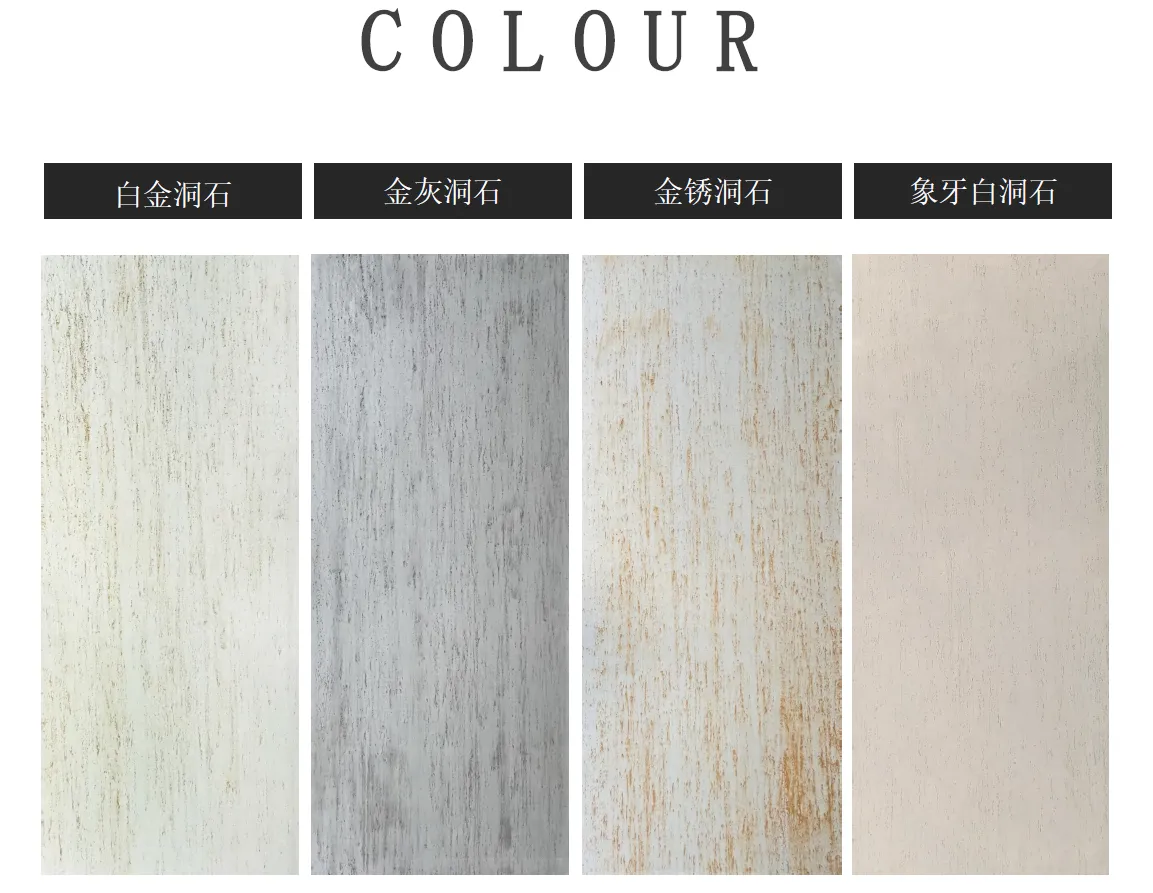
Travertine has always been a chameleon, shifting from creamy whites to rich golds under different lights. But MCM asks: why stop there? Their travertine (starry green) is a love letter to twilight—deep, moody, with flecks of iridescent "stars" that catch the light like distant galaxies. It's not just a color; it's an emotion. Imagine a home office with this stone as a backdrop—suddenly, work feels less like a task and more like stargazing. And it doesn't end with green: there's starry red (warm as a campfire), starry blue (calm as a midnight ocean), and starry orange (bright as a sunrise over the Forum). Each hue is mixed by hand, ensuring no two slabs are identical—just like the stars themselves.
For those who crave something more celestial, the lunar peak series delivers. Lunar peak silvery shimmers like moonlight on snow, lunar peak golden glows like a harvest moon, and lunar peak black? It's the night sky, unadulterated—deep, mysterious, and full of possibility. These aren't just colors; they're narratives. A restaurant with lunar peak golden walls feels like a cozy evening under the stars; a hotel lobby with lunar peak black exudes modern luxury, as if the stone itself holds secrets.
| Attribute | Traditional Roman Travertine | MCM Big Slab Travertine | MCM Flexible Stone |
|---|---|---|---|
| Weight (per sq.m) | 25-30kg | 12-15kg | 4-6kg |
| Thickness | 20-30mm | 12-20mm | 3-5mm |
| Texture Options | Natural, limited by quarry | Customizable via 3D printing | Ultra-flexible, including embossed patterns |
| Curved Surface Fit | Challenging, often requires cutting | Possible with careful installation | Effortless—bends up to 90-degree angles |
| Durability | High (but prone to cracks during transport) | High (reinforced with composite layers) | High (resistant to impact and moisture) |
Walk into a boutique hotel in Barcelona, and you might find MCM's travertine (starry blue) wrapping around a circular reception desk, its "stars" twinkling under pendant lights. Step into a Tokyo café, and the walls could be clad in lunar peak silvery, reflecting the city's neon glow like moonlight on water. Even residential spaces are getting in on the action: a family in Paris used MCM flexible stone to line their indoor pool, the material bending gently over the curved edges, creating a cave-like retreat that feels both ancient and modern.
What ties these spaces together? They don't just use stone—they live with it. A kitchen backsplash in travertine (beige) becomes a canvas for morning coffee spills and laughter; a bathroom wall in lunar peak black turns a routine shower into a moment of calm. MCM's travertine isn't just about aesthetics; it's about creating spaces that breathe —that feel less like buildings and more like extensions of the people who use them.
At the end of the day, MCM's work isn't just about stone. It's about honoring the past by setting it free. Roman architects didn't use travertine because it was easy—they used it because it told a story. Today, MCM does the same, but their story includes you: the designer with a bold vision, the homeowner craving warmth, the business owner wanting to make a statement. They've taken a stone that once built empires and turned it into something personal—something that can wrap around your favorite reading nook, line the walls of your dream restaurant, or stand tall in a skyscraper, still whispering the tales of Rome.
So the next time you run your hand over a travertine slab, pause. Feel the texture, the color, the weight of history—and then smile, because this time, that history isn't just behind you. It's under your fingers, around your space, and ready to be part of your story.
Recommend Products












