
Where Science Meets Art in Modern Building
Imagine stepping into a lobby where the walls seem to breathe—smooth yet tactile, cool to the touch but radiating warmth. Your hand glides over a surface that looks like polished stone, but feels lighter, more alive, as if it holds the memory of the earth it came from. That's the magic of Cloud Stone, a star product in the world of modified cementitious materials. It's not just a building material; it's a bridge between nature's raw beauty and human ingenuity. Today, we're diving deep into what makes Cloud Stone tick, exploring its composition, its story, and why it's redefining how we think about architecture and design.
Let's start with the basics. Modified cementitious materials (MCMs) are a class of building products that take traditional cement—a material we've relied on for millennia—and supercharge it with modern science. Think of it as cement's sophisticated cousin: still rooted in the same mineral binder, but enhanced with polymers, fibers, and specialized aggregates to unlock new properties. Unlike the heavy, brittle concrete of old, MCMs like Cloud Stone are designed to be flexible , durable, and surprisingly versatile. They're the reason architects can now dream up curved walls that mimic rolling hills, or large-format slabs that look like a single slab of marble but weigh half as much.
At the heart of this transformation is the "modified" part. Traditional cement mixes rely on water, cement, and aggregates like sand or gravel to harden into a solid mass. MCMs add polymers—long-chain molecules that act like microscopic bridges between cement particles. These polymers make the material more elastic, so it can bend without cracking. They also improve adhesion, meaning MCMs can bond to a wider range of surfaces, from metal to wood. Add in lightweight aggregates, and suddenly you have a material that's strong enough for exterior cladding but light enough to install without heavy machinery. It's a game-changer, and Cloud Stone is one of the most innovative players in this space.
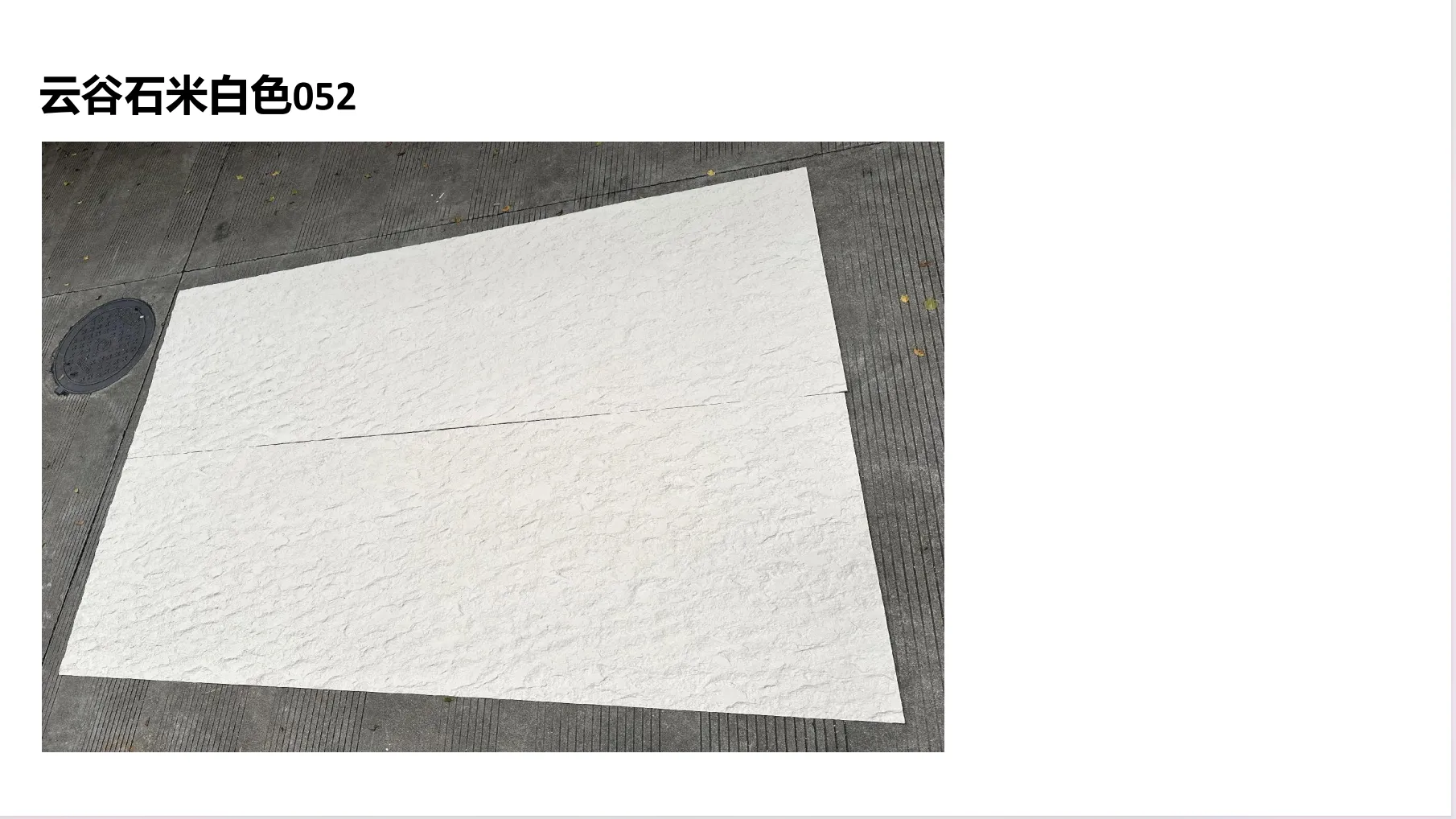
So, what exactly goes into Cloud Stone? Let's peel back the layers. At first glance, it might look like a slab of natural stone—maybe with the swirled patterns of travertine (starry blue) or the muted sheen of lunar peak silvery —but its composition is a carefully engineered blend of science and art. Here's what makes it tick:
Every great story starts with a strong foundation, and Cloud Stone's foundation is high-quality Portland cement. But to boost sustainability and performance, manufacturers often replace a portion of the cement with supplementary cementitious materials (SCMs) like fly ash (a byproduct of coal power plants) or silica fume (from silicon production). These SCMs don't just reduce the carbon footprint of the material—they also fill in tiny gaps in the cement matrix, making the final product denser and more resistant to water penetration. It's a win-win: greener, and stronger.
If cement is the backbone, polymers are the muscles. Cloud Stone typically uses acrylic or epoxy polymers, which are mixed into the cement paste during production. These polymers coat the cement particles, creating a flexible network that allows the material to bend under stress—say, during an earthquake or temperature fluctuations—without cracking. This is why Cloud Stone is often referred to as flexible stone : it combines the look of natural stone with the resilience of a engineered material. Walk up to a wall clad in Cloud Stone, and you might notice it feels slightly warmer than traditional concrete; that's the polymers at work, too, adding a subtle tactile quality that natural stone sometimes lacks.
Aggregates are the "filler" in the mix, but in Cloud Stone, they're chosen with precision. Unlike traditional concrete, which uses coarse gravel, Cloud Stone often relies on fine aggregates like crushed marble dust, quartz sand, or even recycled glass. These smaller particles create a smoother, more uniform surface, which is key for achieving those high-end finishes that mimic natural stone. For textured looks—like the rough-hewn charm of masonry stone or the granular feel of star gravel —manufacturers might add larger aggregates or use specialized molds to create depth. The result? A surface that's not just visually striking but inviting to touch.
No MCM is complete without a dash of additives. Cloud Stone includes everything from water-repellent agents to UV stabilizers, ensuring it holds up in harsh weather. Pigments are another crucial additive: iron oxides, titanium dioxide, and synthetic dyes are mixed in to create colors that range from the earthy tones of lime stone(beige) to the bold hues of travertine (starry red) . What's impressive is how these colors don't fade; the pigments are locked into the material during curing, so a Cloud Stone wall will look just as vibrant in 20 years as it did on day one. Some formulations even include antimicrobial additives, making Cloud Stone a smart choice for healthcare facilities or kitchens where hygiene is key.
To truly appreciate Cloud Stone, it helps to see how it stacks up against other common building materials. Let's take a look at how it compares to traditional concrete, natural stone, and even other MCMs like fair-faced concrete :
| Material | Weight (kg/m²) | Flexibility | Durability | Aesthetic Options |
|---|---|---|---|---|
| Traditional Concrete | 200–240 | Low (brittle) | High (but prone to cracking) | Limited (gray, rough finishes) |
| Natural Travertine | 250–300 | Low (natural stone is rigid) | High (but porous, stains easily) | High (unique veining, but limited colors) |
| Fair-Faced Concrete | 180–220 | Low to Medium | High (smooth, dense finish) | Medium (gray, can be stamped for texture) |
| Cloud Stone (Modified Cementitious) | 80–120 | High (bends without cracking) | High (resistant to weather, stains) | Very High (mimics stone, metal, wood; custom colors/textures) |
The numbers speak for themselves. Cloud Stone is significantly lighter than natural stone or traditional concrete, making it easier and cheaper to install. Its flexibility reduces maintenance costs over time, as it's less likely to crack. And when it comes to aesthetics? It's in a league of its own. Want a wall that looks like lunar peak golden with a metallic sheen? Or travertine (starry orange) with tiny, glittering flecks? Cloud Stone can do that—and more. It's no wonder designers are calling it a "chameleon material."
Creating Cloud Stone is part science experiment, part art form. The process starts in the lab, where chemists and material engineers tweak the mix to achieve the desired properties—whether that's extra flexibility for a curved facade or a specific color match for a historic renovation. Once the formula is locked in, production moves to the factory, where large mixers combine the cement, polymers, aggregates, and additives into a smooth paste. This paste is then poured into molds, which can be custom-designed to create textures like wave panel ridges or thread -like striations.
After casting, the panels are cured in controlled environments—often with steam or heat—to speed up the hardening process. This curing stage is critical; it ensures the polymers bond properly with the cement, giving Cloud Stone its signature flexibility. Once cured, the panels are trimmed, polished (if needed), and inspected for quality. What's fascinating is how much control manufacturers have over the final look. By adjusting the mold texture, aggregate size, or pigment concentration, they can create panels that look like rough-hewn gobi panel (evoking desert landscapes) or sleek foamed aluminium alloy board (vintage silver) (with a metallic sheen). It's a level of customization that natural stone simply can't match.
Cloud Stone isn't just a lab curiosity—it's transforming buildings around the world. Let's take a walk through some of its most impressive applications:
Walk into a modern hotel or office lobby, and chances are you've encountered Cloud Stone without even realizing it. Its ability to create large, seamless slabs (thanks to the mcm big slab board series ) makes it perfect for feature walls. Imagine a reception area with 10-foot-tall panels in marble interstellar gray , their surface swirled with light and dark like a distant galaxy. The panels are lightweight enough that they don't require structural reinforcement, yet durable enough to withstand daily traffic. Hotels love it for its low maintenance—no need for regular sealing like natural marble—and designers love it for the mood it sets: sophisticated, yet approachable.
At home, Cloud Stone is turning ordinary rooms into retreats. Homeowners are using it for kitchen backsplashes, fireplace surrounds, even accent walls in bedrooms. A kitchen clad in travertine (beige) Cloud Stone feels warm and earthy, with the texture of natural stone but none of the porosity that makes natural travertine prone to stains. In bathrooms, stream limestone(dark grey) panels add a spa-like vibe, and since Cloud Stone is water-resistant, it's ideal for wet areas. One homeowner I spoke to described their Cloud Stone accent wall as "like bringing a piece of the mountains inside—calm, grounding, and surprisingly cozy."
Exterior cladding is where Cloud Stone truly proves its mettle. Traditional stone cladding is heavy, requiring strong foundations and expensive installation. Cloud Stone, at half the weight, is a game-changer for high-rise buildings. Its flexibility also helps it withstand temperature swings—expanding in the heat, contracting in the cold—without cracking. In coastal areas, where saltwater and humidity can eat away at other materials, Cloud Stone's resistance to corrosion makes it a favorite. A recent project in Miami used lunar peak black Cloud Stone for the exterior, its deep color contrasting beautifully with the blue sky, and after three hurricane seasons, it still looks brand new.
Even historic buildings are getting a Cloud Stone makeover. When restoring a 19th-century town hall in Prague, architects needed a material that matched the original stone's appearance but was lighter and easier to install. They chose Cloud Stone in historical pathfinders stone , a finish that mimics the weathered texture of the original limestone. The result? A building that looks timeless, but with modern durability. "We could never have lifted the original stone slabs to the upper floors without damaging the structure," the lead architect told me. "Cloud Stone let us preserve the building's character while ensuring it stands for another 100 years."
In an era where sustainability is non-negotiable, Cloud Stone has another trick up its sleeve: it's surprisingly eco-friendly. Let's break it down. First, its lightweight nature reduces transportation emissions—trucks can carry twice as many Cloud Stone panels as natural stone slabs, cutting fuel use in half. Second, many manufacturers use recycled materials in the mix: fly ash (a waste product from coal plants) replaces up to 30% of the cement, reducing the carbon footprint of production. Cement manufacturing is one of the world's largest CO2 emitters, so any reduction here is a big win.
Cloud Stone also lasts longer than many traditional materials, reducing the need for replacement. A natural stone wall might need repairs every 10–15 years; Cloud Stone can go 50 years or more with minimal maintenance. And when it does reach the end of its life, it's often recyclable, crushed up and used as aggregate in new concrete. It's no wonder Cloud Stone is finding its way into green building materials certifications like LEED and BREEAM, helping projects earn points for sustainability.
At the end of the day, building materials aren't just about function—they're about how they make us feel. Cloud Stone excels here because it's designed with the human senses in mind. Run your hand over a panel, and you'll feel texture: the slight roughness of star gravel , the cool smoothness of polish concrete , the subtle grain of wood line . These tactile qualities turn walls into something more than barriers; they become interactive elements that engage us on a physical level.
Architects often talk about "biophilic design"—creating spaces that connect us to nature—and Cloud Stone is a biophilic dream. Its ability to mimic natural materials like bamboo mat board or bali stone brings the outdoors in, reducing stress and boosting wellbeing. A study by the World Green Building Council found that spaces with natural textures and colors can improve productivity by up to 15%—and Cloud Stone delivers that in spades. Whether it's the warm glow of lunar peak golden in a restaurant or the calming blue of travertine (starry blue) in a hospital waiting room, Cloud Stone has a way of making spaces feel more human.
So, what's next for Cloud Stone and MCMs? The future looks bright—and creative. Manufacturers are experimenting with new polymers to make the material even more flexible, opening up possibilities for 3D-printed building components (hello, mcm 3d printing series ). Imagine a home with walls printed on-site in custom shapes, each panel unique like a fingerprint. There's also ongoing research into self-healing MCMs, which use bacteria or microcapsules to repair cracks automatically, extending the material's lifespan even further.
Color technology is advancing too. Soon, we might see Cloud Stone panels that change hue with temperature or light, creating dynamic facades that shift with the sun. And as sustainability becomes more critical, we'll likely see more innovations in recycled aggregates and carbon-negative production methods. The goal? To create a material that's not just strong and beautiful, but actively helps heal the planet.
Recommend Products












