
Walk through any modern city, and you'll notice a quiet revolution unfolding across skylines and streetscapes. Builders, architects, and homeowners are no longer just chasing aesthetics or durability—they're demanding something more: sustainability. In an era where climate change looms large and resource scarcity hits closer to home, the construction industry is finally stepping up, reimagining materials that don't just build structures, but build a future where progress and planet coexist. At the heart of this shift lies a category of materials that's been turning heads for all the right reasons: Modified Composite Materials, or MCM. And among them, one name stands out for its blend of beauty, resilience, and eco-conscious design: Starmoon Stone. But what makes these materials so special? How do they stack up against traditional building materials when it comes to environmental impact? Let's dive in.
For decades, construction has relied on materials that come with a heavy environmental price tag. Quarrying natural stone disrupts ecosystems; manufacturing concrete spews carbon dioxide; even aluminum production guzzles energy. The numbers are stark: the construction industry is responsible for nearly 40% of global carbon emissions and 30% of waste, according to the United Nations Environment Programme. But here's the thing—we don't have to choose between building better and building green. Enter MCM, or Modified Composite Materials: a family of engineered materials designed to mimic the look and feel of natural stone, wood, or concrete, but with a fraction of the environmental footprint. Think of MCM as the "green cousin" of traditional building materials—lighter, more durable, and yes, fully recyclable.
So, what exactly is MCM? At its core, it's a blend of recycled polymers, natural minerals (like crushed stone or clay), and reinforcing fibers, all bonded together using low-VOC (volatile organic compound) resins. The magic lies in its manufacturing process: unlike quarrying raw stone or firing bricks in energy-heavy kilns, MCM production uses significantly less energy and often incorporates post-consumer or industrial waste. The result? A material that's not just strong and flexible (it can bend without cracking, making it ideal for cladding or curved surfaces) but also designed with the end of its lifecycle in mind. When a building using MCM materials is renovated or demolished, those panels don't end up in a landfill—they're collected, crushed, and reprocessed into new MCM products. It's a circular model that's long overdue in construction.
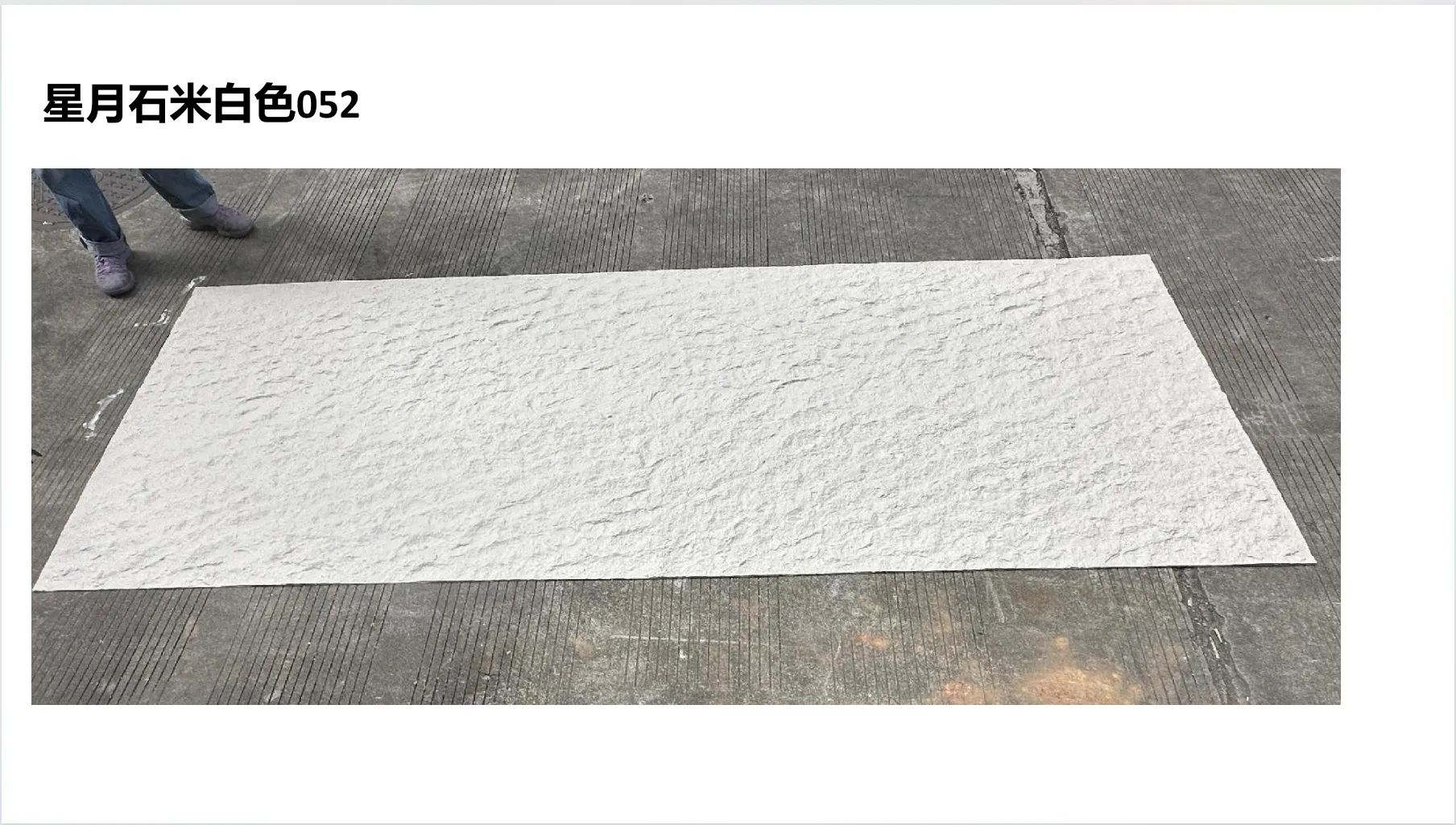
Let's zoom in on Starmoon Stone, the poster child of MCM's eco-friendly lineup. If you've ever seen a building facade that shimmers like a night sky, you might have encountered it. Starmoon Stone gets its name from the tiny, iridescent particles embedded in its surface—recycled glass and mineral fragments that catch the light, creating a "starry" effect in hues like starry green, starry red, or starry blue (you can even find vintage silver or gold variants for a more muted glow). But its beauty is more than skin deep. What truly sets Starmoon Stone apart is its commitment to sustainability from start to finish.
First, the raw materials: Starmoon Stone is made using up to 85% recycled content. That includes crushed waste stone from quarry operations (which would otherwise be discarded), recycled plastic polymers from packaging waste, and even reclaimed glass from old windows or bottles. By repurposing these materials, Starmoon Stone diverts tons of waste from landfills each year. Then there's the production process: unlike natural travertine or granite, which require heavy machinery for extraction and cutting (releasing dust and carbon emissions), Starmoon Stone is manufactured in controlled facilities with low-energy curing processes. The result is a material with a carbon footprint that's up to 60% lower than natural stone, according to industry lifecycle assessments.
But the real test of sustainability is what happens when Starmoon Stone reaches the end of its life. Let's say a commercial building with Starmoon Stone cladding is renovated after 20 years. Instead of prying off the panels and hauling them to a dump, contractors can collect them, grind them into a fine powder, and mix that powder back into the MCM production cycle. This closed-loop system means the material's "second life" is just as strong and beautiful as its first. In fact, some manufacturers report that Starmoon Stone can be recycled up to five times without losing structural integrity—a stark contrast to natural stone, which often cracks or breaks during demolition and is rarely reused.
And let's not overlook durability. A common argument against eco-friendly materials is that they "don't last." Starmoon Stone puts that myth to rest. It's resistant to water, fire, and UV rays, meaning it won't fade, warp, or degrade in harsh weather. In coastal areas, where saltwater can corrode traditional metal or stone, Starmoon Stone holds up, reducing the need for frequent replacements. Less replacement means less waste and fewer emissions over time—a win-win for both builders and the planet.
To really understand the environmental impact of Starmoon Stone and other MCM materials, let's compare them to traditional building materials. We'll focus on five key metrics: recyclability, carbon footprint, water usage, waste generation, and durability. The table below breaks down the data for Starmoon Stone, along with a few other standout MCM materials: MCM Flexible Stone, Foamed Aluminium Alloy Board (Vintage Silver), Rammed Earth Board (Gradient), and Fair-Faced Concrete.
| Material | Recyclability Rate | Carbon Footprint (kg CO₂/m²) | Water Usage (L/m²) | Waste Generation (kg/m²) | Typical Lifespan (Years) |
|---|---|---|---|---|---|
| Starmoon Stone (MCM) | 92% | 8.5 | 12 | 0.3 | 30–40 |
| MCM Flexible Stone | 88% | 7.2 | 10 | 0.2 | 25–35 |
| Foamed Aluminium Alloy Board (Vintage Silver) | 98% | 5.1 | 5 | 0.1 | 40–50 |
| Rammed Earth Board (Gradient) | 95% | 6.8 | 15 | 0.4 | 35–45 |
| Fair-Faced Concrete (MCM) | 85% | 9.3 | 20 | 0.5 | 20–30 |
| Natural Granite (Traditional) | 5% | 22.6 | 80 | 5.2 | 25–30 |
| Clay Brick (Traditional) | 10% | 18.3 | 220 | 3.8 | 15–20 |
| Standard Concrete (Traditional) | 20% | 12.1 | 150 | 2.1 | 20–25 |
The numbers speak for themselves. Take carbon footprint, for example: Starmoon Stone emits 8.5 kg of CO₂ per square meter, compared to 22.6 kg for natural granite. That's a 62% reduction—imagine the impact if every new building in a city switched to MCM cladding. Or consider water usage: traditional clay bricks require 220 liters of water per square meter to produce, while Foamed Aluminium Alloy Board (Vintage Silver) uses just 5 liters. In water-scarce regions, that difference could be game-changing.
Waste generation is another critical factor. When you quarry natural granite, up to 30% of the stone is wasted during cutting and shaping. MCM materials, by contrast, are precision-manufactured, so waste during production is minimal—often less than 5%. And because they're lightweight, transporting MCM panels uses less fuel than hauling heavy stone or bricks, further cutting down on emissions. A truck can carry 10 times more MCM panels than natural stone slabs, reducing the number of trips needed to supply a construction site.
Starmoon Stone might be the star, but the MCM family has plenty of other eco-friendly all-stars worth knowing about. Let's take a closer look at a few that are making waves in sustainable construction.
If you love the warm, organic look of traditional rammed earth but want something more sustainable and versatile, meet Rammed Earth Board (Gradient). Traditional rammed earth is made by compacting layers of soil, sand, and gravel, but it's heavy, hard to transport, and not always recyclable. MCM's take on rammed earth fixes all that. It's made with recycled clay, sand, and a small amount of bioplastic binder, and it comes in stunning gradient colors—think soft beiges blending into terracottas or muted greens fading into greys. The gradient effect is achieved using natural pigments, so there's no need for toxic dyes.
What's eco about it? The clay used often comes from construction site excavations (which would otherwise be waste), and the manufacturing process requires minimal energy—just enough to compact the mixture and cure the binder. Like Starmoon Stone, it's fully recyclable, and its thermal mass helps regulate building temperatures, reducing the need for heating and cooling. Imagine a home with rammed earth board walls in gradient hues: it would feel cozy and connected to nature, all while keeping your carbon footprint low.
For a sleek, modern look, Foamed Aluminium Alloy Board (Vintage Silver) is hard to beat. It has a matte, metallic finish that adds a touch of elegance to facades, ceilings, or interior accent walls. But don't let the "vintage silver" name fool you—this material is cutting-edge in sustainability. Foamed aluminium is made by injecting gas into molten aluminum, creating a lightweight, cellular structure that's 70% lighter than solid aluminum but just as strong. And here's the kicker: most of the aluminum used is recycled (think old soda cans, car parts, or construction scrap), which cuts energy use by 95% compared to producing aluminum from bauxite ore.
Why does that matter? Producing aluminum from raw bauxite is one of the most energy-intensive processes in manufacturing, emitting tons of CO₂. Using recycled aluminum slashes that footprint dramatically. Plus, foamed aluminium is 100% recyclable at the end of its life, and its lightweight nature makes installation a breeze—no heavy machinery needed, which saves time and labor on site. It's also corrosion-resistant, so it holds up in coastal or industrial areas, and its reflective surface can help reduce heat absorption, keeping buildings cooler in summer.
Concrete has a bad rap for being environmentally unfriendly, but MCM's Fair-Faced Concrete is here to change that. Traditional concrete is made with cement, which is responsible for about 8% of global CO₂ emissions. Fair-Faced Concrete (MCM) swaps out most of the cement for recycled fly ash (a byproduct of coal-fired power plants) and uses recycled aggregates like crushed concrete or glass instead of virgin stone. The result is a material that looks just like raw, unfinished concrete—with its characteristic texture and neutral tone—but with a carbon footprint 40% lower than standard concrete.
It's also incredibly durable. Fair-Faced Concrete MCM panels can withstand harsh weather, heavy foot traffic, and even fire, making them ideal for floors, walls, or outdoor pavements. And because they're precast in factories, they're consistent in quality, reducing the risk of on-site waste from cracked or misshapen pieces. When a building with fair-faced concrete MCM is demolished, those panels are crushed and reused as aggregate in new MCM products or even traditional concrete. It's a second life that traditional concrete rarely gets—most old concrete ends up in landfills, where it takes centuries to break down.
Ever wanted to clad a curved wall or a rounded column with stone but thought it was too expensive or wasteful? MCM Flexible Stone makes it possible. As the name suggests, it's flexible—it can bend up to 90 degrees without cracking, making it perfect for creative architectural designs. It's made with recycled stone dust (from quarry waste), a flexible polymer binder, and reinforcing fibers, and it comes in a range of finishes, from rough-hewn to polished.
Sustainability-wise, it checks all the boxes: high recyclability, low carbon footprint, and minimal waste. Because it's thin (usually 3–5mm thick) and lightweight, it uses less material than traditional stone cladding, and installation is quick—no need for heavy brackets or mortar. This not only saves time but also reduces the structural load on buildings, which can lower construction costs and materials use elsewhere in the project. Imagine a museum with a sweeping, curved facade covered in flexible stone that looks like ancient marble—all without the environmental cost of quarried stone.
Numbers and specs are great, but what does this look like in practice? Let's consider a hypothetical but realistic scenario: a 10-story commercial office building in a mid-sized city, using MCM materials for its facade, interior walls, and flooring. Compare that to the same building using traditional materials—natural stone cladding, clay bricks, and standard concrete floors. What's the environmental impact over 30 years (the typical lifespan of a commercial building's facade)?
First, construction phase: The MCM building would generate 60% less waste, thanks to precision-manufactured panels and minimal on-site cutting. Transport emissions would be 70% lower because MCM materials are lighter. The traditional building, by contrast, would require more trucks to haul stone and bricks, and more waste would end up in landfills from cutting and fitting.
During use: The MCM building's thermal-efficient materials (like rammed earth board and fair-faced concrete) would reduce heating and cooling costs by 25%, saving energy and cutting emissions. Its durable panels would need no major repairs, while the traditional building might require repainting, re-pointing bricks, or replacing cracked stone slabs—each repair adding to its carbon footprint.
End of life: When the building is renovated in 30 years, 90% of the MCM materials would be recycled into new panels. The traditional building's stone and bricks? Most would go to landfills, contributing to the 1.3 billion tons of construction waste generated globally each year.
It's not just about big commercial buildings, either. MCM materials are making sustainable construction accessible to homeowners, too. A small home using MCM cladding, rammed earth board walls, and fair-faced concrete floors could have a carbon footprint 50% lower than a similar home with traditional materials—all while costing roughly the same upfront (and often less over time, thanks to lower energy and maintenance bills).
As the world races to meet net-zero carbon targets, the construction industry has a critical role to play—and MCM materials are poised to lead the charge. But what does the future hold for this innovative category?
One trend we're already seeing is customization. Builders and designers want materials that are not just sustainable but also unique. MCM manufacturers are responding with more colors, textures, and finishes—like Starmoon Stone's starry variants or Rammed Earth Board's gradients. 3D printing is also entering the mix: some companies are experimenting with 3D-printed MCM panels, which allow for even more complex shapes and less waste, since the material is deposited exactly where it's needed.
Another area of growth is transparency. Consumers and businesses are demanding to know the origins of their building materials—where the raw materials come from, how much energy was used in production, and whether workers were paid fairly. MCM manufacturers are starting to adopt blockchain technology to track their supply chains, giving buyers a clear view of a product's environmental and social impact. Imagine scanning a QR code on a Starmoon Stone panel and seeing exactly which recycled materials went into it, how many CO₂ emissions were saved, and even the factory where it was made.
Perhaps most exciting is the potential for MCM to help restore ecosystems. Some manufacturers are exploring "biophilic MCM"—materials embedded with seeds or mycelium (fungal networks) that, when installed on walls or roofs, grow into plants or moss. These living facades absorb CO₂, filter air, and provide habitat for pollinators, turning buildings into tools for ecological restoration. It's a bold vision, but given MCM's flexibility and low environmental impact, it's within reach.
Sustainability in construction isn't just a trend—it's a necessity. As we face the realities of climate change and resource depletion, the materials we choose to build with matter more than ever. MCM materials like Starmoon Stone, Rammed Earth Board (Gradient), Foamed Aluminium Alloy Board (Vintage Silver), and Fair-Faced Concrete offer a path forward: one where buildings are beautiful, durable, and kind to the planet.
Starmoon Stone, with its starry shimmer and circular lifecycle, is more than just a building material—it's a symbol of what's possible when innovation meets environmental responsibility. It proves that we don't have to sacrifice aesthetics for sustainability, or durability for eco-friendliness. And it's not alone: the entire MCM family is redefining what it means to build green.
So, the next time you walk past a building with a striking facade, take a closer look. Maybe it's clad in Starmoon Stone, or rammed earth board, or foamed aluminium. Maybe it's quietly doing its part to reduce waste, cut emissions, and build a better future. And maybe, just maybe, it's inspiring the next generation of builders to think differently— to see construction not as a drain on the planet, but as a way to heal it.
The future of construction is green, and it's here. It's in the shimmer of Starmoon Stone, the warmth of rammed earth, and the strength of recycled aluminium. It's in buildings that don't just stand tall, but stand responsibly. And that's a future worth building.
Recommend Products












