
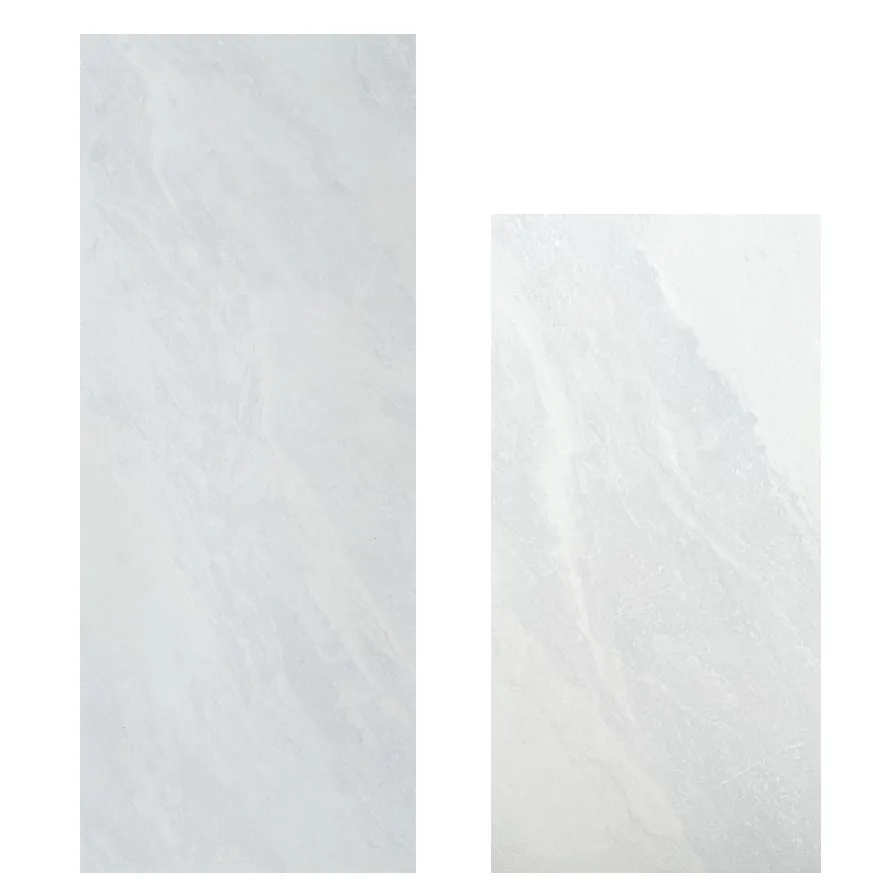
Step into a modern architectural space today, and you might find yourself pausing, transfixed by a wall or surface that feels both timeless and contemporary. It's smooth to the touch, with soft, flowing veins that resemble clouds caught mid-drift or strokes of a watercolor brush left to blend naturally. This isn't just any stone—it's Marble Veil White, a material that has redefined how we think about elegance in built environments. But like all great innovations, its story isn't just about rocks and machines; it's about the people who dared to imagine a material that bridges nature's artistry with human ingenuity.
The journey of Marble Veil White began not in a quarry, but in the minds of designers and architects grappling with a familiar challenge: natural marble is breathtaking, but it's far from perfect. Walk through a historic building clad in natural marble, and you'll notice the inconsistencies—some slabs are veined heavily, others sparsely; some have warm undertones, others cool. For large-scale projects, this variability can disrupt the intended aesthetic. Worse, natural marble is porous and prone to staining, making it high-maintenance in high-traffic areas. "We loved marble's beauty," recalls Elena Rossi, a lead designer at a Milan-based architecture firm who worked on early conceptualization, "but we needed something that could deliver that same 'wow' factor without the headaches."
The team began asking: What if we could capture marble's essence—the soft veining, the depth, the organic feel—but engineer it to be more consistent, durable, and adaptable? That question became the north star. They studied natural marble formations, noting how mineral deposits seep through stone over millennia to create those iconic veins. They also looked at modern materials like Concrete Board, which offered durability but lacked the warmth of natural stone, and Fine Line Stone, which had striking linear patterns but felt too rigid for their vision. "We wanted something that felt alive," Rossi says. "Not just a slab, but a story."
The design phase was equal parts science and art. The team collaborated with geologists to analyze the composition of premium marbles, identifying the minerals that create veining (often calcite, dolomite, or clay). They then turned to material engineers to replicate that process—but with control. "Natural marble's veins are random, which is beautiful, but we needed to guide that randomness," explains Marco Torres, a materials scientist who joined the project. "We wanted veins that felt natural, not forced—like they could have formed in the earth, but with just enough consistency to work across a 10-meter wall."
Early prototypes were hit-or-miss. One attempt used a digital printing technique to lay veins on a stone base, but the result felt flat, like a sticker. Another mixed colored resins into a stone matrix, but the veins lacked the translucency of natural marble. "We were stuck until we tried a hybrid approach," Torres says. The breakthrough came when they combined a base of fine-grained marble dust (sourced from waste from natural marble quarries, adding an eco-friendly angle) with a proprietary blend of pigments and binders. Using 3D modeling, they mapped out vein patterns inspired by real marble slabs, then injected the pigment mixture into the base at precise depths and angles. The result? Veins that didn't just sit on the surface, but flowed through the material, creating depth and movement.
They named it "Marble Veil White" for a reason: the veins are delicate, almost translucent, like a veil draped over the stone. "We tested 17 different white bases before settling on the right one," Rossi laughs. "Too bright, and it felt sterile; too warm, and it lost that 'marble' crispness. The final shade is a soft, creamy white with subtle gray undertones—like sunlight on snow."
Marble Veil White isn't just pretty—it's practical. Unlike natural marble, it's non-porous, thanks to a sealant baked into the manufacturing process. "We tested it with coffee, wine, even oil," Torres says. "No stains. That was a game-changer for commercial spaces." It's also stronger: while natural marble scores a 3-4 on the Mohs hardness scale, Marble Veil White hits a 5-6, making it resistant to scratches from daily wear. And because it's engineered, each slab is nearly identical in color and pattern, a boon for projects where uniformity matters—think hotel lobbies or office buildings where a consistent look across floors is key.
To highlight these advantages, the team created a comparison chart (see below) showing how Marble Veil White stacks up against traditional options. It quickly became clear: this material wasn't just a marble alternative—it was a upgrade.
| Feature | Marble Veil White | Natural Marble | Concrete Board | Fine Line Stone |
|---|---|---|---|---|
| Appearance | Soft, flowing veils; consistent pattern | Striking but variable veining | Industrial, matte finish | Bold, linear patterns |
| Durability (Mohs Scale) | 5-6 | 3-4 | 6-7 | 4-5 |
| Stain Resistance | High (non-porous) | Low (porous, requires sealing) | High | Medium (porous, needs sealing) |
| Application Scale | Large slabs (Architectural Big Slab Solutions) | Limited by natural slab size | Large slabs | Medium slabs |
| Maintenance | Low (occasional cleaning) | High (regular sealing, polishing) | Low | Medium (occasional sealing) |
With the material refined, the next step was proving its mettle in real-world projects. The first major installation was the lobby of the Azure Tower in Dubai, a 40-story luxury hotel. The design called for a 20-meter wall behind the reception desk, and the architects wanted it to feel like a single, unbroken canvas. "Natural marble would have required dozens of seams, disrupting the flow," says project architect Amir Khan. "Marble Veil White came in 3m x 1.5m slabs, so we could install the entire wall with just seven pieces. The result? A space that feels grand, not fragmented."
Guests and critics alike took notice. "It's the first thing people comment on," Khan says. "They run their hands over it, trying to figure out if it's real marble. When we tell them it's engineered, they're shocked—it has that same depth, that same warmth."
Since then, Marble Veil White has popped up in projects worldwide: a boutique hotel in Tokyo, a tech company's headquarters in Seattle, even a residential penthouse in New York. It's particularly popular in spaces where light plays a key role—its subtle veining catches sunlight, creating shifting patterns throughout the day. "In the morning, the veins look silvery; in the afternoon, they warm up to gray," says Rossi. "It's like the wall changes mood with the sun."
What makes Marble Veil White truly special is how it honors tradition while embracing innovation. It pays homage to the timeless allure of marble, a stone used in architecture for millennia—from the Parthenon to the Taj Mahal—yet it's built for the demands of modern life. "We didn't want to replace natural marble," Rossi says. "We wanted to extend its legacy. To let architects and designers keep using that beauty, but in ways that make sense today."
Looking ahead, the team is exploring new variations—veins in soft blues or warm golds, textures that mimic weathered marble. But for now, they're proud of what Marble Veil White represents: a reminder that the best materials don't just build spaces—they inspire them. "When you walk into a room with Marble Veil White," Torres says, "you don't just see a wall. You feel something. That's the power of great design—turning stone into story."
Marble Veil White's journey from concept to construction is a testament to human creativity. It started with a problem—natural marble's limitations—and ended with a solution that doesn't just fix those issues, but elevates the possibilities of what a building material can be. It's durable, it's beautiful, and it's adaptable. But most of all, it's human: the product of designers, scientists, and dreamers asking, "What if?"
So the next time you encounter a wall that makes you pause, that feels both familiar and new, take a closer look. It might just be Marble Veil White—proof that when we blend nature's art with human ingenuity, we don't just build better spaces. We build better stories.
Recommend Products












