
Picture this: you're standing in front of a sleek, contemporary building. Its facade shimmers with a texture that looks like polished stone, yet feels surprisingly light to the touch. Sunlight hits it, and tiny "stars" embedded in the surface catch the glow, turning the wall into a canvas of light and shadow. That's Starmoon Stone in action—a product born from decades of innovation by COLORIA GROUP, a name synonymous with pushing the boundaries of what building materials can do. But to understand Starmoon Stone, we need to start at the beginning: with a group of engineers, a problem, and a stubborn belief that building materials could be better.
Back in the early '90s, when COLORIA GROUP first opened its doors in a small workshop in Barcelona, the building materials industry was stuck in a rut. Architects dreamed of bold, curved facades and intricate textures, but traditional stone and concrete? They were clunky, unforgiving, and heavy enough to require reinforced structures just to hold them up. "We'd sit in meetings with designers who'd sketch these amazing, flowing buildings," recalls Carlos Mendez, COLORIA's founding architect, "and then we'd have to tell them, 'That won't work with marble. It's too heavy. It'll crack when you bend it.' Their faces would fall, and it felt like we were killing creativity. That's when we thought: What if we didn't have to choose between beauty and practicality?"
The team began experimenting with alternative materials, focusing on one key goal: create something that looked and felt like natural stone but was lightweight, flexible, and easy to install. They tested composites, resins, and recycled materials, but nothing stuck—literally. Early prototypes either lacked the durability of real stone or felt cheap, more like plastic than rock. "We spent two years failing," laughs Ana Torres, who joined COLORIA as a materials scientist in 1994. "One batch would crack in the rain; another would fade under UV light. There were days we'd throw prototypes in the trash and wonder if we were chasing a fantasy."
Then, in 1998, they hit on something. While testing a blend of natural calcium carbonate (the main component of limestone), recycled polyester fibers, and a new binding agent developed by a partner lab, the team noticed something unusual: the material was strong, but it bent. Not enough to fold like paper, but enough to curve around a 90-degree angle without cracking. "I remember picking up a slab and flexing it," Carlos says. "It felt like holding a thin piece of wood, but it looked exactly like the travertine I'd seen in ancient Roman ruins. I called the team over, and we just stared at it. That was the moment we realized: We'd found our 'secret sauce.'"
That "secret sauce" became known as MCM—Modified Composite Material. It's a blend of natural minerals, recycled polymers, and a proprietary binding agent that gives the material its strength without the weight. Think of it as stone reimagined: all the depth and texture of natural rock, but with the flexibility of a vinyl sheet and the lightness of foam board. "MCM changed everything," Ana explains. "A typical slab of natural travertine weighs about 20 kg per square meter; our first MCM prototype? Just 6 kg. Suddenly, high-rise buildings could have stone-like facades without reinforcing every floor. Curved walls weren't just blueprints—they were buildable."
By the early 2000s, COLORIA had launched its first MCM product: a line of flexible stone slabs called the "MCM Project Board Series." It was a hit, but the team wasn't done. They wanted a flagship product—something that showcased MCM's potential to be both beautiful and innovative. "We kept asking: What if MCM didn't just mimic stone? What if it improved on it?" Carlos says. "Natural stone has flaws—veins that don't match, colors that fade. What if we could control that? Add elements that nature can't?"
The answer came during a late-night brainstorming session, when someone mentioned the night sky. "We were talking about how light plays on stone," Ana remembers. "Someone said, 'What if the stone itself could sparkle, like stars?' We all paused. Natural travertine has tiny pores—what if we filled those pores with microscopic, reflective particles? It would catch the light, turning a plain slab into something that glows."
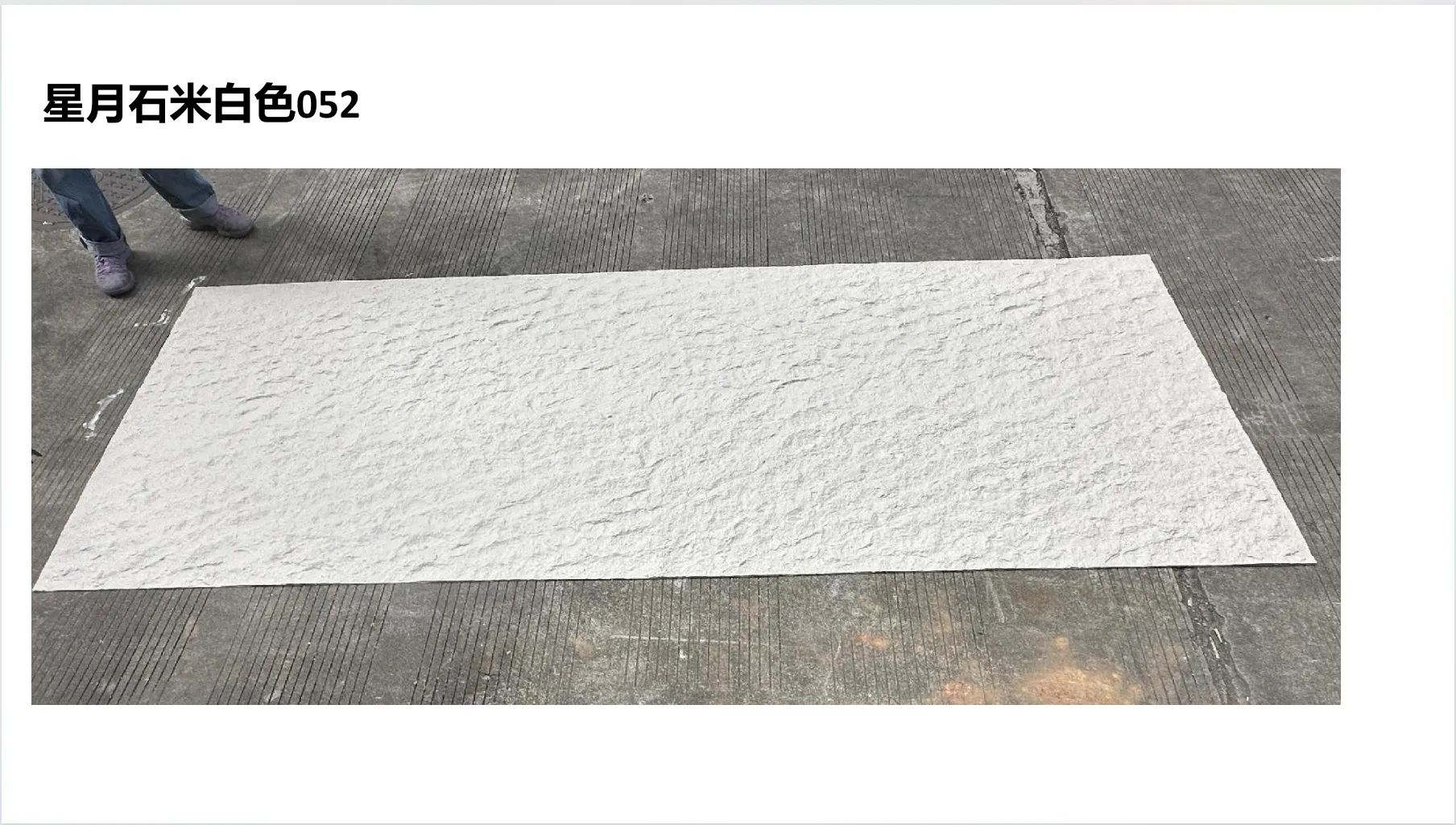
Thus, Starmoon Stone was born. The first prototype was a soft, off-white slab embedded with silver "star" particles that shimmered when hit by light. But the team didn't stop there. They experimented with colors, creating variants like Travertine (starry green)—a deep, forest-hued slab where the stars looked like fireflies in a wood—and Travertine (starry blue), which mimicked the night sky over the Mediterranean. "We took it to a trade show in Milan in 2005," Carlos says, "and people couldn't keep their hands off it. Architects were running their fingers over it, asking, 'Is this real? How does it work?' We knew we had a winner."
Starmoon Stone's beauty is undeniable, but its real genius lies in its practicality. Let's break it down:
| Feature | Traditional Natural Stone (e.g., Marble) | Starmoon Stone (MCM-Based) |
|---|---|---|
| Weight (per m²) | 20–25 kg | 5 kg |
| Flexibility | Rigid; cracks under bending | Can bend up to 30° without damage |
| Installation Time (100 m²) | 3–4 days (requires heavy machinery) | 1 day (installs like wallpaper with adhesive) |
| Design Options | Limited by natural veining/color | Custom colors, textures, and effects (e.g., "star" particles) |
| Durability (UV/Fade Resistance) | Fades over 5–7 years | Resists fading for 20+ years |
Starmoon Stone wasn't the end of the journey; it was the beginning. COLORIA soon expanded its MCM lineup, creating products that complemented Starmoon's celestial vibe with earthy, industrial, and even metallic textures. One of the most popular additions? The Lunar Peak series—slabs that mimic the rugged, cratered texture of mountain peaks, available in silvery, golden, and black hues. "Starmoon is about light and shimmer," Carlos explains. "Lunar Peak is about shadow and grit. Together, they tell a story of sky and stone, which architects love for cultural centers and museums."
Then there's the 3D Printing Series, which uses MCM to create textured panels with geometric patterns—think honeycombs, waves, or even pixelated designs. "We partnered with a 3D printing lab in Berlin to develop a process that layers MCM into 3D shapes," Ana says. "Now, you can have a wall that looks like it was carved by wind, not machines. It's art you can build with."
Not all innovation was in stone-like textures, though. COLORIA also explored metal, developing Foamed Aluminium Alloy Boards in vintage silver, gold, and classic gold. These lightweight, durable panels became a hit for commercial spaces, where their metallic sheen adds a touch of industrial elegance. "We installed them in a tech startup's office in San Francisco," Carlos says. "They paired the vintage silver panels with Starmoon Stone (starry blue), and the effect was wild—like working inside a spaceship that landed in a forest. The employees still send us photos."
Today, Starmoon Stone and its MCM siblings can be found in buildings across the globe. Take the Azure Hotel in Santorini, for example, where the facade is clad in Starmoon Stone (starry white) and Lunar Peak silvery. By day, the white stone reflects the sun, keeping the hotel cool; by night, the "stars" glow under string lights, turning the building into a beacon. "Guests take photos of the walls like they're landmarks," the hotel's designer, Eleni Papadopoulos, told us. "It's not just a hotel anymore—it's an experience."
Closer to home, the Riverside Library in Portland used Travertine (starry green) for its reading room walls. "We wanted a space that felt calm, like being in a forest," says lead architect Mia Chen. "The green stone shimmers subtly, so it's not distracting, but it adds this soft, magical quality. Kids will press their hands against the walls, trying to catch the 'stars.' It's turned a quiet library into a place where imagination starts."
Even historic buildings have gotten the MCM treatment. In Rome, a 17th-century palace being converted into luxury apartments needed a facade update that respected its heritage but added modern durability. The solution? Starmoon Stone (vintage beige), which mimics the look of the palace's original limestone but is lighter and more resistant to pollution. "The preservation board was skeptical at first," Carlos says. "They thought it would look fake. But when they saw it up close, they couldn't tell the difference. Now, the palace stands strong, and it didn't require reinforcing the centuries-old walls. That's the beauty of MCM—it honors the past while protecting it."
So, what's next for COLORIA and Starmoon Stone? The team is already experimenting with gradient colors, where slabs shift from one hue to another (think sunset pink to deep purple), and "smart" MCM that can absorb heat or even generate small amounts of energy via embedded solar particles. "We're not just building materials anymore—we're building tools for storytelling," Ana says. "Architects don't want walls; they want narratives. Starmoon Stone is just the first chapter."
As for Carlos, he still gets a thrill walking past a building with Starmoon Stone. "Last month, I was in Tokyo, and I saw a kindergarten with a Starmoon facade in starry orange. The kids were drawing on the sidewalk, and one little girl looked up and said, 'Mommy, the wall is made of stars!' That's the moment that makes it all worth it. We didn't just create a stone—we created something that sparks wonder. And in a world that's always in a hurry, wonder is the best building material of all."
So the next time you pass a building with a facade that seems to glow, or a wall that bends in a way stone never should, take a closer look. Chances are, you're looking at Starmoon Stone—and behind it, decades of curiosity, failure, and the stubborn belief that building materials could be more than just walls. They could be magic.
Recommend Products












