
When we hear the word "weaving," our minds often drift to textiles—colorful fabrics, cozy blankets, or intricate tapestries. But for centuries, weaving has been a silent storyteller in the world of construction, too. Long before steel and concrete dominated skylines, ancient builders turned to the art of interlacing natural materials to craft walls, roofs, and partitions that were as functional as they were beautiful. From the bamboo huts of Southeast Asia to the thatched roofs of African villages, weaving wasn't just a technique; it was a way to breathe warmth and character into structures, connecting people to the land and their cultural roots.
Think about the bamboo mat board that once shaded homes in rural China: each strand of bamboo, carefully woven by hand, created a lattice that filtered sunlight like a gentle embrace, while letting cool breezes flow through. Or the wood line patterns carved into Japanese fusuma screens—intricate weaves of wood that divided spaces without closing them off, preserving a sense of openness and harmony with nature. These materials weren't just building blocks; they were expressions of (jiàngxīn), or "craftsmanship with heart." They carried the marks of the hands that made them, the climate they were built for, and the stories of the communities that lived within their walls.
For all their charm, traditional weaving-inspired construction materials came with a heavy price. Bamboo, while flexible and renewable, succumbs quickly to moisture—warping, rotting, or becoming a feast for termites in humid climates. Wood, even when treated, fades under harsh sunlight and cracks with age, losing its warm wood grain board texture that once made a room feel like a hug. Natural fibers like jute or straw, woven into mats for insulation, were prone to mold and fire, requiring constant replacement that drained time and resources.
Take the case of a 19th-century Balinese temple, where walls were adorned with woven coconut leaf panels. Local artisans would spend weeks reweaving these panels every monsoon season, their fingers calloused from bending dry leaves into shape. "It was a labor of love," says I Wayan, a fourth-generation craftsman in Ubud, "but we always knew the panels would only last a year. The rain would make them brittle, and the wind would tear them apart. We loved the way they looked—soft, organic, like a part of the forest—but we dreamed of something that could keep that beauty without the heartache of rebuilding."
Even in modern times, architects who tried to revive these traditional aesthetics faced challenges. A boutique hotel in (Dali) once attempted to use hand-woven wool panels for accent walls, hoping to evoke the region's nomadic heritage. Within months, the wool had absorbed moisture from the foggy mountain air, developing a musty smell that guests complained about. The panels were removed, and the designers were left wondering: How do we honor the past without being trapped by its limitations?
Enter Modified Composite Material, or MCM—a revolutionary material that would rewrite the story of weaving in construction. Born from a desire to marry the warmth of traditional textures with the durability of modern engineering, MCM is a blend of natural minerals (like stone powder or fiberglass) and high-performance polymers. It's lightweight, flexible, and resistant to water, fire, and UV rays—everything traditional weaving materials weren't. But what truly sets MCM apart is its ability to mimic the look and feel of handwoven textures so precisely, you'd swear you're touching the real thing.
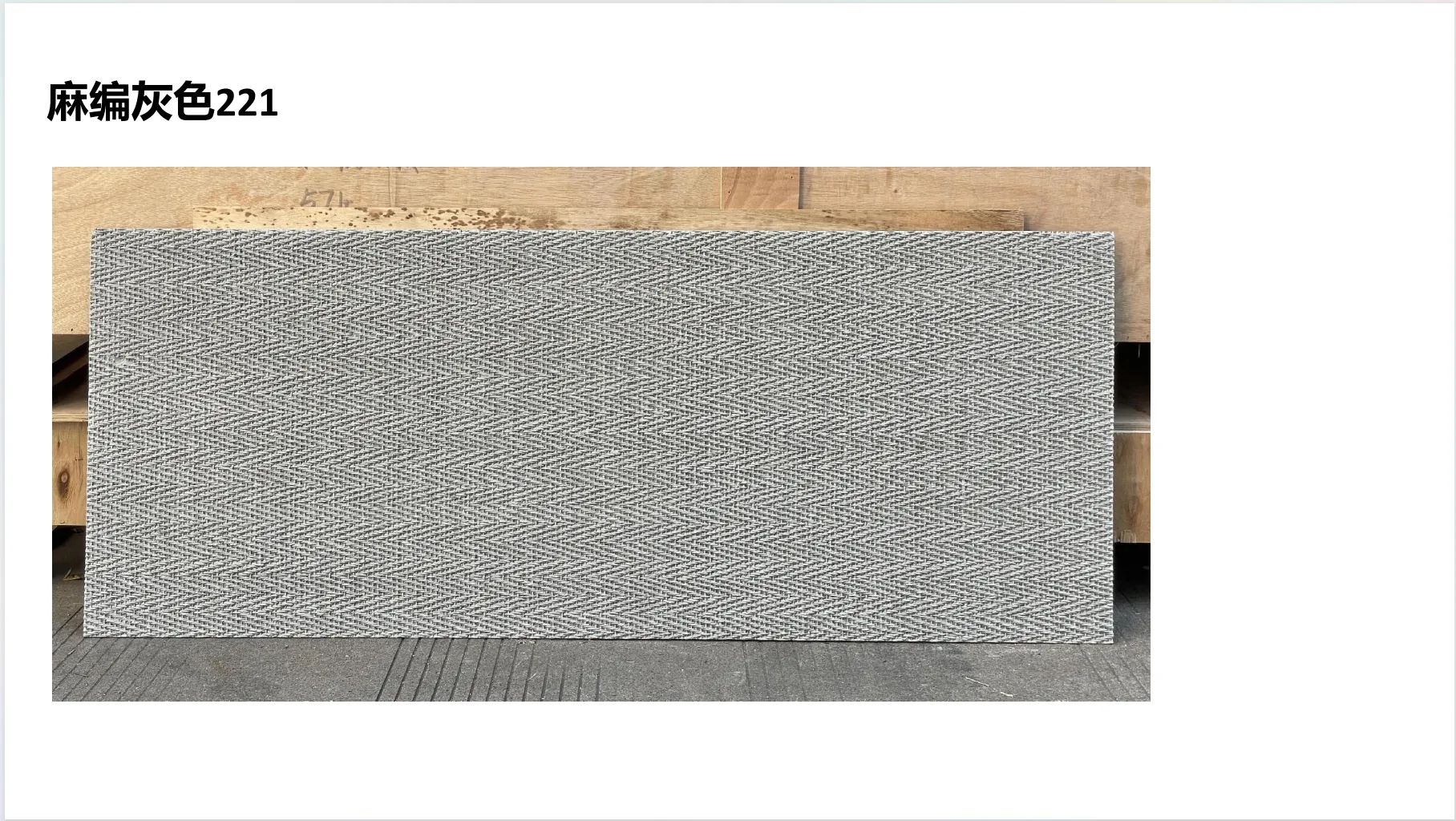
In the early 2000s, MCM manufacturers began experimenting with weaving patterns, creating a series of panels that paid homage to the past while solving its problems. Today, the MCM weaving series includes shades and textures that read like a love letter to traditional craftsmanship: weaving (khaki) , with its earthy, sun-baked tones that recall desert nomad tents; weaving (jacinth) , a rich, ruby hue that echoes the vibrant textiles of Moroccan souks; weaving (grey) , a muted, sophisticated pattern that mirrors the weathered wood weaves of old European barns; and weaving (beige) , soft and warm, like the woven straw mats of rural Japan. Each panel is engineered to capture the depth of handwoven texture—every "strand" of the weave has a subtle variation in height and shadow, just like the real thing—without a single natural fiber in sight.
The magic of MCM weaving panels lies in their versatility. Unlike bamboo or wool, they can be installed in any climate: from the humid tropics of Thailand to the snowy winters of Canada. They're lightweight enough to hang on interior walls without weighing down structures, yet tough enough to clad exterior facades, where they repel rain and resist fading for decades. And because they're made in factories with precise molds, they offer consistency that traditional handwoven materials never could—no two panels are exactly alike, but they all share the same durable, low-maintenance core.
| Aspect | Traditional Weaving Materials | MCM Weaving Series |
|---|---|---|
| Texture & Aesthetic | Warm, organic, with unique handcrafted variations; prone to fading/warping over time. | Replicates handwoven texture (e.g., weaving (khaki) 's earthy weave) with consistent color and pattern; retains vibrancy for 20+ years. |
| Durability | Vulnerable to moisture, pests, UV rays, and fire; requires replacement every 1–5 years. | Waterproof, fire-resistant, and pest-proof; withstands extreme temperatures and lasts 30+ years with minimal maintenance. |
| Installation & Cost | Requires skilled artisans; high labor costs; heavy materials may need structural reinforcement. | Lightweight (8–12 kg/m²) and easy to install with standard tools; lower long-term costs due to minimal upkeep. |
| Sustainability | Renewable but resource-intensive (e.g., frequent harvesting of bamboo/wood). | Low carbon footprint; made with recycled minerals and recyclable polymers; reduces waste from frequent replacements. |
Today, MCM weaving panels are rewriting how we design spaces—blending nostalgia with practicality in ways that would have seemed impossible a generation ago. Walk into a café in Shanghai's Former French Concession, and you might find a feature wall clad in weaving (jacinth) panels, their rich red weave evoking the silk roads that once brought textiles to the city. The panels don't just look like handwoven silk; they feel like it too, with a subtle texture that invites patrons to reach out and touch. But unlike silk, they're easy to wipe clean after a spill, and they won't fade under the café's spotlights.
In residential spaces, weaving (beige) panels have become a favorite for bedroom accent walls. "Clients want their homes to feel 'lived-in,' not sterile," says interior designer Chen Wei in Beijing. "They love the soft, neutral tone of the beige weave—it's like bringing a piece of the countryside indoors, but without worrying about mold or dust. I recently used it in a small apartment, and the (yèzhǔ, homeowner) told me it makes her feel 'calmer, like she's wrapped in a well-loved blanket.' That's the power of texture—it's not just visual; it's emotional."
Even cultural institutions are embracing MCM weaving series to bridge past and present. The (New Silk Road Museum) in Xi'an features a grand hall with ceiling panels in weaving (grey) , inspired by the woven camel saddles that once carried goods along the ancient trade routes. "We wanted visitors to feel the history of the Silk Road, but we needed materials that could handle thousands of people and climate control," explains curator Li Jia. "The MCM panels look like aged leather and wood, but they're fireproof and sound-absorbent. They don't just tell a story—they help preserve it."
As MCM technology advances, the possibilities for weaving-inspired materials are only growing. Manufacturers are now experimenting with 3D printing to create even more intricate weave patterns, mimicking the complexity of traditional bamboo mat board but with customizable designs—think geometric weaves for modern offices or floral motifs for boutique hotels. Some are adding eco-friendly additives, like recycled ocean plastic, to the polymer mix, making MCM weaving panels not just durable, but also kind to the planet.
But perhaps the most exciting trend is the return of "handmade" character in mass-produced materials. New MCM weaving lines, like weaving (khaki) distressed , intentionally include subtle imperfections—tiny variations in strand thickness or color intensity—that echo the uniqueness of handwoven textiles. "We're not trying to replace artisans," says Zhang Wei, a materials engineer at a leading MCM company. "We're trying to give architects and homeowners the best of both worlds: the soul of traditional craftsmanship, and the reliability of modern technology. Because at the end of the day, people don't just build with materials—they build with memories, with culture, with the desire to feel at home."
From the bamboo huts of ancient China to the MCM-clad skyscrapers of today, weaving has always been more than a pattern—it's a language. It speaks of connection: between people and nature, between tradition and progress, between the hands that build and the lives that unfold within. The MCM weaving series —with its khaki , jacinth , grey , and beige hues—isn't just a collection of panels. It's a continuation of that language, rewritten for a world that craves beauty without sacrifice, and heart without hassle.
So the next time you run your hand over a weaving-inspired wall panel, take a moment to appreciate the journey it represents: from the calloused fingers of ancient artisans, to the engineers in lab coats, to the space it now transforms into a home, an office, or a temple. Weaving in construction isn't just about materials—it's about weaving stories, weaving cultures, and weaving a future where the past is never left behind.
Recommend Products












