
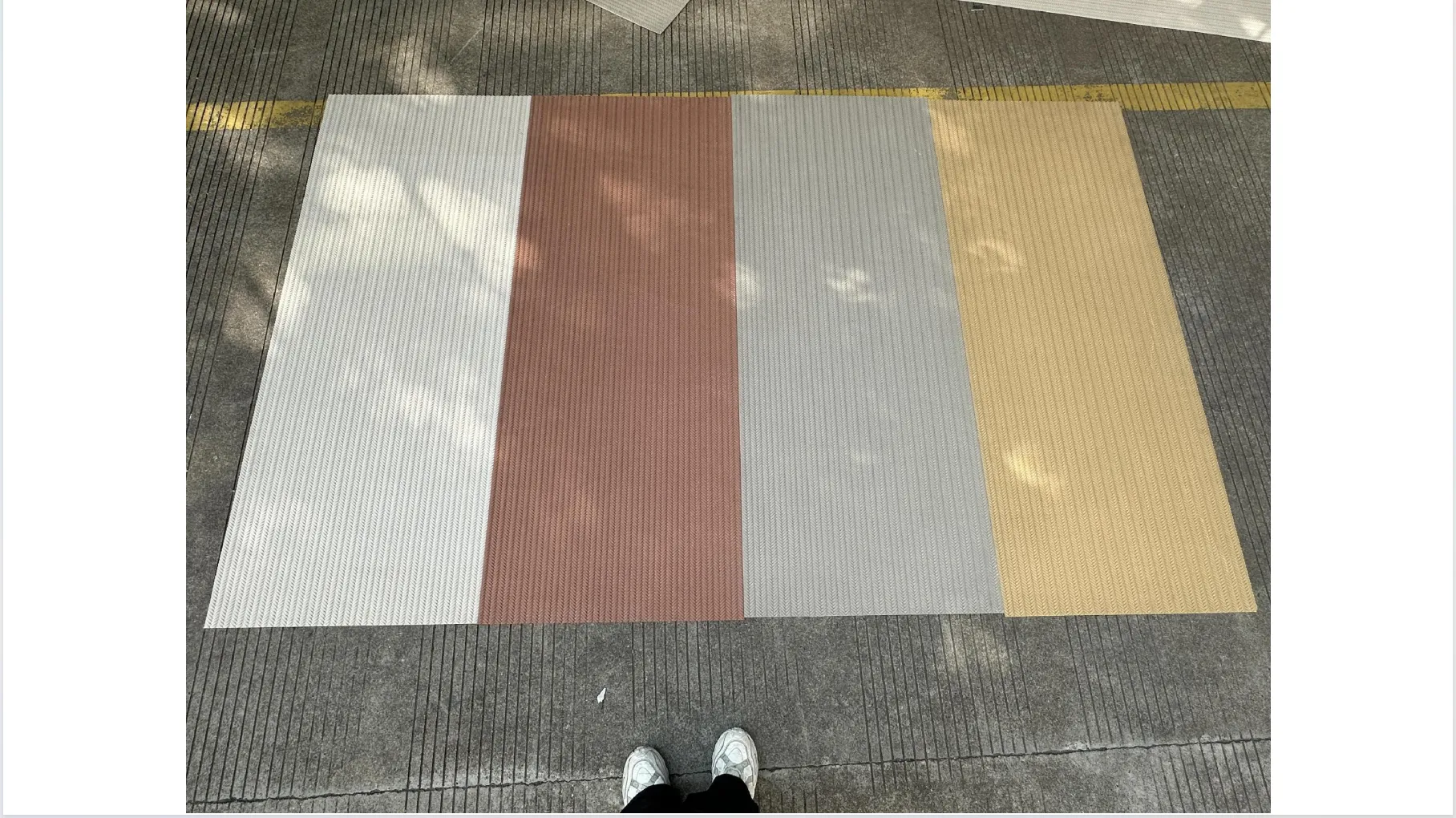
Walk into a thoughtfully designed space, and you'll likely notice it before you can name it—the quiet power of materials. They don't just fill a room; they shape how we feel, move, and connect with our surroundings. In recent years, a new star has risen in the world of architectural and interior design: MCM materials. Short for Modified Composite Material, MCM isn't just a trend—it's a revolution rooted in science, sustainability, and artistry. And at the heart of this revolution lies a detail that bridges technology and humanity: woven real photos. These images don't just showcase materials; they invite us to experience their texture, imagine their warmth, and trust their durability. Today, we're diving into the science behind these materials, from the flexibility of mcm flexible stone to the gradient beauty of rammed earth board, and how woven real photos bring their stories to life.
At first glance, you might mistake an MCM panel for natural stone or wood—but lean in, and you'll realize it's something entirely new. MCM materials are engineered to combine the best of nature and innovation: they're lightweight, flexible, and eco-friendly, without sacrificing the authenticity of natural textures. Unlike traditional heavy stone slabs or resource-intensive wood, MCM starts with a core of recycled minerals, polymers, and fibers, fused together under precise heat and pressure. This process creates a material that's 70% lighter than natural stone, yet just as strong, and far more adaptable. It can bend around curves, adhere to uneven surfaces, and even be cut into intricate shapes—all while leaving a smaller carbon footprint.
But what truly sets MCM apart is its ability to mimic the most delicate details of natural materials. That's where woven real photos come in. These high-resolution images capture not just color, but the tactile quality of woven textures—think the crisscross of a bamboo mat, the soft ridge of a textile weave, or the organic pattern of a handwoven basket. They're more than marketing tools; they're a window into how these materials perform in real life: how light hits a rammed earth board (gradient) at dawn, how a foamed aluminium alloy board (vintage silver) ages gracefully over time, or how the starry blue veins in travertine (starry blue) create a sense of depth in a minimalist space.
If there's one material that embodies MCM's magic, it's mcm flexible stone. Imagine running your hand over a wall that looks like rough-hewn limestone, yet bends slightly under your touch—no, not fragile, but resilient, like a leaf that sways in the wind without breaking. The science here is in the blend: a base of natural stone powder (often recycled from quarry waste) mixed with a polymer binder and reinforced with glass fibers. This combination creates a material that's both rigid enough to withstand weather and wear, and flexible enough to be rolled into large sheets for easy installation.
Take, for example, a project using mcm flexible stone in a coastal home. Traditional stone would crack under the constant expansion and contraction from humidity and temperature changes, but MCM's flexibility acts like a buffer. The polymer binder allows the material to flex up to 30 degrees without snapping, while the stone powder retains that authentic, earthy texture. Woven real photos of this stone in action might show it wrapping around a curved fireplace or cladding an outdoor patio, proving that durability and beauty don't have to be mutually exclusive.
But it's not just about physical flexibility—it's about design flexibility, too. Architects and designers love mcm flexible stone because it can be customized to fit any vision. Want the look of aged travertine in a shade that complements your brand's palette? Or a woven texture that mimics a traditional basket weave for a boutique hotel lobby? The material adapts, and woven real photos become the bridge between concept and reality, letting clients see exactly how that texture will interact with light, furniture, and foot traffic before a single panel is installed.
MCM's versatility shines when you step beyond traditional stone looks. Take rammed earth board (gradient), for instance—a material that brings the warmth of ancient building techniques into the modern age. Rammed earth has been used for centuries, but traditional methods are labor-intensive and limited to thick, heavy walls. MCM reimagines it: a blend of clay, sand, and stabilizers pressed into thin, lightweight panels with gradient color transitions that mimic the way sunlight fades across desert landscapes. The science here lies in color layering during manufacturing—each layer of the panel is dyed slightly differently, creating a soft, natural shift from, say, warm terracotta to pale sand, or deep matcha green to soft sage.
Woven real photos of rammed earth board (gradient) often highlight these transitions, showing how they add depth to a space without overwhelming it. Imagine a yoga studio where the walls flow from soft beige to warm ochre, creating a sense of calm movement that mirrors the practice itself. Or a restaurant where the gradient panels behind the bar evoke a sunset, turning a simple meal into an experience. These photos don't just show color—they show mood, proving that materials are as much about emotion as they are about structure.
For a more modern edge, there's foamed aluminium alloy board (vintage silver). Aluminium is already prized for its lightness and resistance to corrosion, but foaming it adds a new dimension: tiny air bubbles trapped in the alloy create a texture that's both sleek and slightly porous, like a metallic sponge. The vintage silver finish adds warmth, softening the industrial feel of metal and making it suitable for everything from high-end retail facades to home accent walls. Woven real photos here might focus on how the material catches light—during the day, it shimmers subtly; at night, under artificial light, it takes on a rich, velvety glow. It's a material that bridges the gap between nature and innovation, proving that "eco-friendly" doesn't have to mean "rustic."
And then there's travertine (starry blue)—a nod to the cosmos in material form. Traditional travertine is known for its pitted, porous surface, but MCM's version takes it further, embedding tiny, iridescent particles into the panel that catch light like stars in a night sky. The science here is in the particle size and distribution: microbeads of glass or mineral crystals are mixed into the stone powder during production, ensuring they're evenly spread without disrupting the material's flexibility. Woven real photos of this travertine might be taken in a home theater, where the dark blue panels come alive with "stars" when the lights dim, turning a movie night into a celestial experience. It's a reminder that MCM materials don't just cover walls—they tell stories.
To truly appreciate the diversity of MCM materials, let's put a few under the microscope. The table below highlights key features of four standout options, showing how science and design intersect to create materials that are as functional as they are beautiful:
| Material Type | Core Composition | Key Features | Ideal Applications |
|---|---|---|---|
| mcm flexible stone | Stone powder, polymer binder, glass fibers | 30-degree flexibility, weather-resistant, authentic stone texture | Outdoor patios, curved walls, coastal homes |
| rammed earth board (gradient) | Clay, sand, stabilizers, layered dyes | Soft color transitions, lightweight, thermal insulation | Yoga studios, restaurants, residential accent walls |
| foamed aluminium alloy board (vintage silver) | Aluminium alloy with foaming agents, vintage silver finish | Corrosion-resistant, lightweight, iridescent texture | Retail facades, modern home interiors, commercial lobbies |
| travertine (starry blue) | Travertine powder, polymer binder, iridescent microbeads | "Starry" light-catching particles, porous texture, eco-friendly | Home theaters, feature walls, boutique hotels |
Woven real photos aren't just pretty pictures—they're a critical part of the MCM experience. In an industry where texture and light can make or break a design, these photos act as a universal language, translating technical specs into tangible beauty. But what makes them "woven"? It's not just about capturing a woven pattern (though many MCM materials do mimic weaving); it's about capturing the interplay of texture, color, and context—the way a material "weaves" into the fabric of a space.
The science of photography here is as precise as the science of the materials themselves. Professional photographers use specific lighting setups—soft diffused light to highlight texture, angled spotlights to show depth—to ensure every detail is visible. Close-up shots might focus on a single square inch of a woven texture, revealing how each fiber or particle is arranged, while wide-angle shots show the material in situ, paired with furniture, plants, and people to give a sense of scale. It's this combination of macro and micro that makes woven real photos so powerful: they let you examine the science (the particle distribution in travertine, the gradient layers in rammed earth) while also imagining the experience (how that travertine will feel under your hand, how that gradient will make you feel when you walk into the room).
For designers, these photos are invaluable. They allow for remote collaboration—an architect in New York can share woven real photos of foamed aluminium alloy board (vintage silver) with a client in Tokyo, discussing how it will complement the building's glass facade without either party needing to visit a showroom. For homeowners, they reduce uncertainty: choosing a material sight unseen is risky, but a high-quality woven real photo lets you "test drive" it, visualizing how it will look at different times of day, in different seasons, with different decor.
At a time when sustainability is more than a buzzword, MCM materials stand out for their commitment to the planet. The science of eco-friendliness here starts with raw materials: most MCM panels use recycled or upcycled content, from stone powder reclaimed from quarry waste to aluminium scrap melted down and refoamed. Even the polymer binders are often plant-based or low-VOC (volatile organic compounds), reducing off-gassing and improving indoor air quality.
Manufacturing processes are optimized for minimal waste, too. Traditional stone cutting generates up to 30% waste material; MCM production, by contrast, uses precise molding and cutting techniques that reduce waste to less than 5%. And because MCM panels are lightweight, transportation emissions are significantly lower than those for natural stone slabs—imagine shipping 100 square feet of MCM versus 100 square feet of marble: the MCM shipment would weigh a fraction, requiring fewer trucks and less fuel.
Durability plays a role in sustainability, too. A well-maintained MCM panel can last 20–30 years, far longer than many synthetic materials that need frequent replacement. And when it does reach the end of its life, many MCM materials are recyclable, closing the loop on the production cycle. Woven real photos often highlight these eco-credentials indirectly, showing MCM materials in green buildings, LEED-certified projects, and spaces designed to connect people with nature—because sustainability isn't just about the material itself; it's about the healthier, happier spaces it creates.
As we look ahead, MCM materials and woven real photos are set to redefine how we think about design. With advances in 3D printing, we might soon see even more intricate woven textures—panels that mimic not just baskets or textiles, but the delicate veins of leaves or the ripples of water. Imagine a hospital where the walls are clad in mcm flexible stone printed with a subtle leaf pattern, proven to reduce patient anxiety, or a school where rammed earth board (gradient) in soft blues and greens creates a calming environment that enhances focus.
Foamed aluminium alloy board could evolve to include integrated smart features—panels that absorb sound, regulate temperature, or even generate small amounts of electricity from light, all while maintaining that sleek vintage silver finish. And travertine (starry blue) might get "programmable" stars, with particles that change color based on lighting or mood, turning a home office into a starry night sky at the touch of a button.
But no matter how advanced the technology gets, the heart of MCM will always be connection—to nature, to history, to each other. Woven real photos will continue to be the bridge, reminding us that behind every panel is a story: of ancient rammed earth techniques reimagined, of waste stone given new life, of metals and minerals dancing together to create something both strong and beautiful.
In the end, MCM materials are more than just building blocks—they're storytellers. From the flexibility of mcm flexible stone to the gradient beauty of rammed earth board, from the modern sheen of foamed aluminium alloy to the cosmic charm of travertine (starry blue), each material carries with it a blend of science and soul. And woven real photos? They're the chapters of that story, inviting us to lean in, touch, and imagine.
So the next time you walk into a space and find yourself drawn to the walls, take a moment to appreciate the science behind that beauty. It's not just stone or metal or clay—it's innovation, sustainability, and art woven together, creating spaces that don't just exist, but breathe. And in a world that often feels disconnected, that's a material difference.
Recommend Products












