
Cities are living, breathing entities. They grow, they change, they carry the weight of decades—sometimes centuries—of stories in their bricks, their cobblestones, their weathered facades. But urban redevelopment? It's a delicate dance. It's about peeling back layers of neglect to reveal the soul of a place, while gently guiding it into the future. Too often, this dance feels clumsy: glass towers overshadowing historic row houses, cold concrete replacing the warm, worn textures that once made a neighborhood feel like home. What if there was a material that could bridge that gap? A material that whispers of the past while standing firm in the present? Enter Cloud Stone—a quiet revolutionary in the world of urban design.
Walk down any redeveloped street, and you'll notice it: the materials tell a story. A chipped brick here, a weathered stone there—they're not just building blocks; they're memories. But as cities evolve, those memories can fade under the pressure of modern demands: durability, sustainability, the need to accommodate new functions. Cloud Stone doesn't just cover those memories; it honors them. It's a material that feels like it's been there all along, yet works harder than any traditional stone to keep up with the pace of today. In this article, we'll dive into how Cloud Stone is redefining urban redevelopment—one texture, one neighborhood, one story at a time.
Ask any architect or city planner about urban redevelopment, and they'll likely sigh before listing the challenges. First, there's the identity crisis : how do you update a space without erasing the very thing that made it special? A 19th-century factory district might have character in its rusted beams and uneven brickwork, but those same features can make it impractical for modern offices or apartments. Then there's sustainability : tearing down old structures generates mountains of waste, while building new often means relying on resource-heavy materials like traditional concrete or natural stone, which strain the environment. And let's not forget durability : city materials take a beating—rain, pollution, foot traffic, the occasional graffiti. They need to last, but they also need to look like they've lasted, in a way that feels authentic, not forced.
Take, for example, the problem of "facadism"—preserving a historic building's front while gutting the rest. It's well-intentioned, but the result can feel hollow: a pretty face with no soul. The materials used to replicate that facade? Often cheap imitations that crack, fade, or just feel "off." A local resident might pass by and think, "That used to be my grandfather's shop… but it doesn't feel like it anymore." That disconnect is what urban redevelopment too often gets wrong: it prioritizes function over feeling.
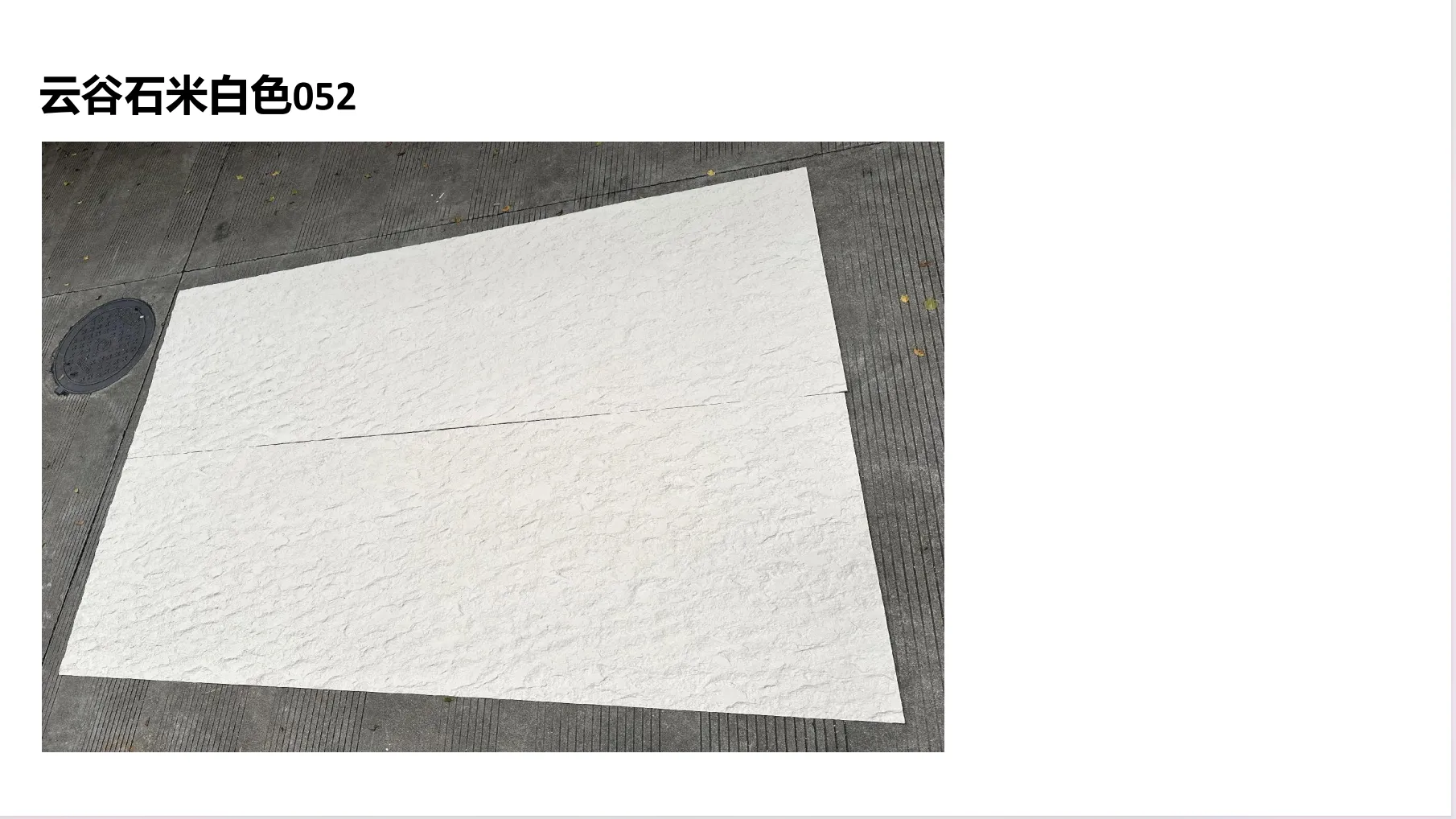
Cloud Stone enters this conversation not as a solution, but as a collaborator . It's a composite material designed to mimic the look and feel of natural stone—think the soft pockmarks of travertine, the subtle veining of marble, the rough-hewn charm of ancient limestone—but with a modern twist: flexibility, durability, and a lighter environmental footprint. Run your hand over a Cloud Stone panel, and you'll feel the texture of time: the slight indentations that look like they were carved by decades of rain, the warm, earthy tones that shift with the light. But unlike natural stone, it won't crack under pressure, fade in harsh sunlight, or require constant maintenance. It's as if someone took the best parts of history's most beloved materials and gave them a resilience boost.
What makes Cloud Stone truly special, though, is its ability to adapt . It comes in a range of finishes that pay homage to regional styles: the golden warmth of Lunar Peak Golden for spaces that need a touch of grandeur, the cool elegance of Slate Veil White for minimalist designs, or the rustic charm of Historical Pathfinders Stone for areas steeped in local lore. And because it's lightweight and flexible, it can be applied to curved surfaces, old brick walls, even 3D-printed structures (hello, MCM 3D Printing Series)—making it ideal for retrofitting historic buildings without compromising their structural integrity.
But let's talk about the "why" behind the "what." Cloud Stone isn't just about aesthetics or practicality; it's about connection . When you use a material that feels familiar—like the stone from a nearby quarry that was used in the original buildings—it sparks a memory. A child might run their fingers along a Cloud Stone wall and ask, "Did people used to touch this a long time ago?" And the answer can be yes, in spirit. It's a material that doesn't just cover a wall; it invites interaction . It says, "This space has a past, and you're part of its future."
Let's zoom in on a real-world example: the Mill District, a 10-block area in a mid-sized city that was once the heart of the region's textile industry. By the early 2000s, it was a ghost town—abandoned factories with broken windows, overgrown lots, and a reputation for being "unsafe." Local leaders wanted to revive it, but not as a strip of generic condos. They envisioned a mixed-use space: apartments, cafes, art galleries, and a community center—all while honoring the district's industrial heritage.
The lead architect, Maria Gonzalez, put it this way: "We didn't want to erase the mills; we wanted to celebrate them. But we also needed to make the space livable for today. The original brick was crumbling, the stone foundations were cracked, and the buildings weren't up to code. We needed a material that could wrap around that history, not bury it."
Enter Cloud Stone. Gonzalez and her team chose a finish inspired by the district's original limestone—warm beige with subtle gray veining, a nod to the stone quarried locally in the 1800s. They paired it with MCM Flexible Stone for the accent walls and trim; its flexibility allowed it to conform to the uneven surfaces of the old factory walls, creating a seamless blend of old and new. In the community center, they used Historical Pathfinders Stone panels, etched with quotes from former mill workers, turning the walls into a living timeline. "It was important that the space didn't feel like a museum," Gonzalez explained. "Historical Pathfinders Stone isn't just decorative; it's a conversation starter. A teenager might stop and read a quote from 1923 and think, 'My great-grandma worked here. She touched these walls, too.'"
Today, the Mill District is unrecognizable—and yet, somehow, more itself than ever. The Cloud Stone-clad buildings retain the district's industrial grit but feel cared for, alive. Local businesses have moved in: a bakery with Cloud Stone countertops that match the exterior, a bookstore with shelves built into niches lined with Lunar Peak Silvery panels that catch the afternoon light. "I used to avoid this area," says longtime resident Carlos Mendez. "Now I walk my dog here every morning. The walls feel… familiar . Like they remember, too."
Cities are sensory experiences. The hum of traffic, the smell of street food, the way sunlight filters through skyscrapers—these are the things that make a place memorable. Materials play a huge role in that, and Cloud Stone excels at engaging our senses in ways that traditional materials often miss.
Take touch, for starters. Natural stone can be cold and unforgiving, concrete even more so. Cloud Stone, though, has a warmth to it—literally. Its composite makeup retains heat in winter and stays cool in summer, making it pleasant to lean against on a chilly morning or rest a hand on during a hot afternoon. The texture, too, is intentional: not so rough that it scrapes, not so smooth that it feels sterile. It's the kind of surface that invites interaction—children tracing the veining with their fingers, artists sketching its patterns, neighbors pausing to adjust a loose brick (though with Cloud Stone, there are no loose bricks).
Then there's sight. Cloud Stone's color palette is rich but not overwhelming—think the soft beige of Travertine (Beige), the deep gray of Dolomitic Travertine (Dark Grey), or the subtle shimmer of Lunar Peak Silvery. These tones don't compete with the surrounding environment; they complement it. In the Mill District, the Cloud Stone walls reflect the changing seasons: golden in fall, soft in winter snow, vibrant in spring blooms. At night, when the streetlights come on, the stone glows gently, turning the area into a place that feels safe and welcoming, not dark and abandoned.
Sound, too, is affected. Hard surfaces like concrete or metal bounce noise around, creating a harsh, echoey environment. Cloud Stone, with its porous texture, absorbs sound, softening the buzz of conversation or the clatter of footsteps. Stand in the Mill District's central plaza, and you'll notice the difference: it's lively, but not overwhelming. You can hear the laughter of kids playing, the strum of a busker's guitar, without straining to be heard.
Sustainability isn't just a buzzword in urban redevelopment—it's a necessity. Cities account for 70% of global carbon emissions, and much of that comes from construction and building materials. Traditional options like natural stone require heavy mining, transportation, and processing, while concrete production is a major source of CO2. Cloud Stone, by contrast, is designed with the planet in mind.
First, its composition: Cloud Stone is made from recycled materials (think crushed stone, glass, and natural fibers) bound together with a low-VOC resin. This reduces the need for new resource extraction and keeps waste out of landfills. Second, its lightweight nature: a Cloud Stone panel weighs up to 70% less than natural stone, which means less fuel is needed for transportation, and less structural support is required for buildings—cutting down on steel and concrete use. Third, its durability: Cloud Stone resists fading, cracking, and water damage, so it doesn't need to be replaced every decade, reducing long-term waste.
Compare that to fair-faced concrete, a popular choice for modern urban projects. While it has a sleek, industrial look, it's heavy (straining building foundations), prone to cracking in extreme weather, and requires large amounts of cement—a material responsible for about 8% of global CO2 emissions. Historical Pathfinders Stone, while beautiful, is often quarried from fragile ecosystems, disrupting local wildlife and water sources. Cloud Stone offers the best of both worlds: the aesthetic of natural stone with the eco-friendliness of modern composites.
| Feature | Cloud Stone | Fair-Faced Concrete | Historical Pathfinders Stone (Natural) |
|---|---|---|---|
| Carbon Footprint | Low (recycled materials, minimal processing) | High (cement production emits CO2) | High (mining, transportation) |
| Durability | High (resists fading, cracking, water damage) | Medium (prone to cracking in freeze-thaw cycles) | High (but heavy; can stress structures over time) |
| Aesthetics | Versatile (mimics natural stone, customizable finishes) | Sleek, industrial (limited texture options) | Authentic, historic (but limited to natural patterns) |
| Installation Ease | High (lightweight, flexible; can be applied to uneven surfaces) | Medium (requires formwork, heavy machinery) | Low (heavy, requires skilled labor for cutting/fitting) |
As cities continue to grow and evolve, the demand for materials that blend history, sustainability, and humanity will only increase. Cloud Stone, and its counterparts like MCM Flexible Stone and the MCM 3D Printing Series, are leading the charge by offering not just products, but possibilities . Imagine a historic theater being restored with Cloud Stone panels that replicate the original plasterwork, but with integrated LED lighting that highlights the architecture at night. Or a public park where the benches are made from Cloud Stone, carved with local stories, and the pathways are lined with MCM 3D-printed tiles that mimic the patterns of the city's original cobblestones.
Customization is key here. Cloud Stone can be tailored to reflect local culture: in a coastal city, panels might mimic the texture of weathered driftwood; in a mountain town, they could evoke the rough surface of granite cliffs. The MCM 3D Printing Series takes this a step further, allowing architects to create one-of-a-kind designs—think a community center facade shaped like the skyline of the city's past, or a school wall with 3D-printed Cloud Stone murals of local heroes. These aren't just buildings; they're narratives .
And as technology advances, so too will Cloud Stone's capabilities. Researchers are exploring ways to integrate air-purifying coatings into the material, turning walls into natural filters for city pollution. Others are experimenting with self-healing resins that repair small cracks over time, extending the material's lifespan even further. The goal? To create urban spaces that don't just exist , but contribute to the health and happiness of their residents.
At the end of the day, urban redevelopment isn't about bricks, mortar, or even materials—it's about people. It's about creating spaces where a grandmother can tell her granddaughter, "I used to walk these streets when I was your age," and the granddaughter can reply, "I love it here, too." It's about honoring the past without being trapped by it, embracing the future without losing sight of what makes a place feel like home.
Cloud Stone, in its quiet way, helps make that possible. It's a material that carries the weight of history but doesn't feel heavy. It's durable enough to stand up to the chaos of city life, but soft enough to invite a touch, a pause, a memory. When paired with materials like MCM Flexible Stone or Historical Pathfinders Stone, it becomes part of a larger story—one of resilience, creativity, and respect for the places we call our own.
So the next time you walk through a redeveloped urban area, take a moment to touch the walls. Notice the texture, the color, the way the light plays on the surface. If it feels like it has a story to tell, chances are, it's not just stone—it's Cloud Stone. And that story? It's yours to be part of.
Recommend Products












