
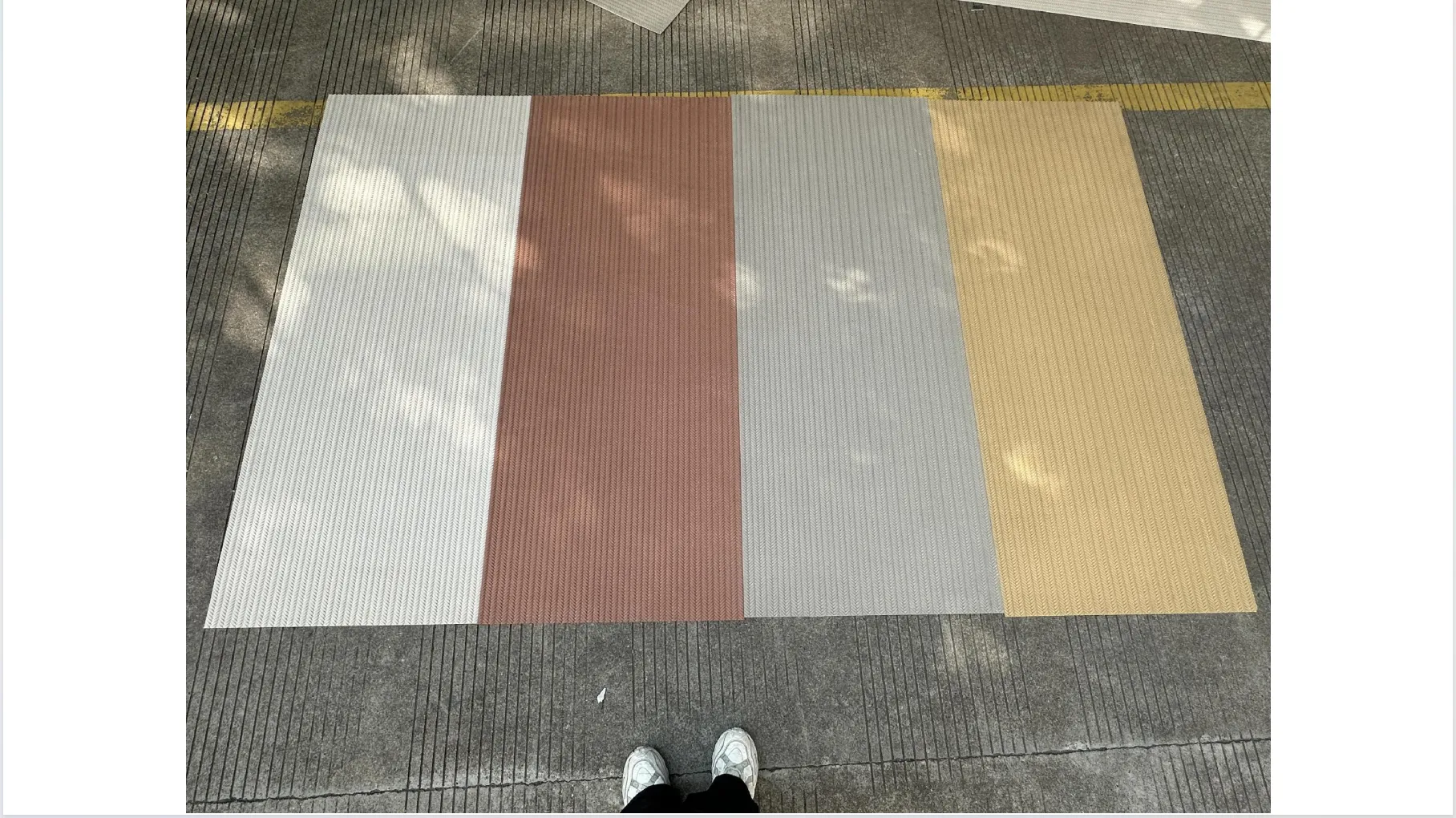
Ever walked into a room and thought, "Why does this space feel so much more comfortable than the last one?" Chances are, it's not just the decor—it's the insulation. In a world where energy bills climb and climate control feels like a never-ending battle, the materials we use to build our homes, offices, and public spaces matter more than ever. Enter MCM big slab boards: a modern construction staple praised for durability, style, and versatility. But here's the question: How do we really know if they live up to their thermal insulation hype? The answer might surprise you: woven real photos. These high-detail images are changing the game, turning surface-level observations into deep insights about how well a material can keep heat in, cold out, and comfort levels high.
Let's start with the basics: thermal insulation isn't just about staying warm in winter or cool in summer. It's about efficiency. A poorly insulated building leaks heat like a sieve, forcing HVAC systems to work overtime. The result? Higher energy bills, increased carbon footprints, and spaces that never quite feel "right." Think about your own experience: a drafty bedroom that makes you pile on extra blankets, or an office where the AC runs nonstop but you still sweat through your shirt. These aren't just minor annoyances—they're signs of insulation failure.
For builders, architects, and even homeowners, choosing the right insulation material is a balancing act. You need something durable enough to withstand the elements, attractive enough to fit design goals, and effective enough to keep energy costs in check. This is where MCM big slab boards have made a name for themselves. Short for Modified Composite Material, MCM boards are engineered to be lightweight, flexible, and resistant to wear—all while offering a range of textures and finishes that mimic natural stone, wood, or even woven fabrics. But their thermal performance? That's the wildcard. Until recently, evaluating it meant relying on lab tests or manufacturer claims. Now, woven real photos are letting us see the "why" behind the numbers.
Before we dive into woven real photos, let's get to know MCM big slab boards better. Imagine a material that's half the weight of traditional stone, yet just as strong. That's MCM in a nutshell. Made by combining mineral aggregates, polymers, and reinforcing fibers, these boards are pressed into large, seamless slabs—hence the "big slab" name. They're used everywhere: from residential facades to commercial lobbies, from restaurant walls to hotel exteriors. What makes them popular? Their versatility. Want the look of rough-hewn stone? There's a finish for that. Prefer a sleek, modern vibe? They've got you. And yes, thermal insulation is often marketed as a key feature—but how do we verify it?
Fun fact: MCM big slab boards are often compared to fair-faced concrete, another popular material known for its raw, industrial aesthetic. But while fair-faced concrete has its merits, its thermal conductivity (a measure of how well heat passes through it) can vary wildly based on texture and density—something woven real photos are uniquely positioned to highlight.
Woven real photos aren't your average Instagram shots. These are high-resolution, up-close images that capture a material's surface and sub-surface details with stunning clarity. Think of them as a microscope for the naked eye: they reveal the tiny grooves, pores, fibers, and weaves that make up a material's structure. For MCM big slab boards, which often feature textured or "woven" patterns (like the subtle crisscross of fibers or the irregular pitting of simulated stone), these photos are goldmines of information.
Why does texture matter for insulation? Because heat travels through materials in three ways: conduction (direct contact), convection (air movement), and radiation (heat waves). A material's structure—how tightly its particles are packed, how many air pockets it contains, how uniform its texture is—directly impacts all three. For example, a board with a tight, woven fiber pattern might trap air pockets, slowing conduction. A rough, porous surface might disrupt convection by breaking up air flow. Woven real photos let us see these features in action, turning "this looks insulating" into "this is insulating, and here's why."
Traditional evaluation methods, like thermal conductivity tests, give numbers—but they don't always explain why a material performs the way it does. Woven real photos bridge that gap. They show the micro-details that lab reports miss: a cluster of tiny air bubbles here, a dense weave pattern there, a section where fibers are spaced unevenly (a red flag for inconsistent insulation). For builders and designers, this context is invaluable. It's one thing to know a material has a thermal conductivity of 0.04 W/(m·K); it's another to see the woven structure that makes that number possible.
So, what exactly should you look for when analyzing woven real photos of MCM big slab boards? Let's break it down into four key indicators—each visible through the lens of a high-quality woven image.
Air is a poor conductor of heat—that's why down jackets and foam insulation work so well. In MCM big slab boards, which often include woven or fibrous layers, the tightness of the weave directly affects how much air gets trapped. A woven real photo can show you just how close together the fibers or particles are. Look for consistent spacing: fibers that are evenly packed (but not so tight they leave no gaps) create a network of tiny air pockets. These pockets act like mini-insulators, slowing heat transfer. On the flip side, a loose or irregular weave might have large gaps, letting heat escape. For example, a woven photo of a high-performance MCM board might reveal fibers crisscrossing at 1mm intervals, creating a dense, uniform grid—perfect for trapping air.
Ever felt a wall that's warm in one spot and cold in another? That's uneven insulation, often caused by inconsistent material structure. Woven real photos excel at spotting this. A top-tier MCM big slab board will show a consistent texture across the entire image: no random clumps of material, no thin spots, no areas where fibers are sparse. In contrast, a lower-quality board might have "hot spots" in the photo—areas where the weave loosens or particles are unevenly distributed. These spots are where heat will leak through, leading to drafty rooms and wasted energy. Professionals often use software to analyze woven photos for uniformity, but even to the untrained eye, a quick glance can reveal red flags: blotchy patterns, sudden changes in texture, or gaps that look out of place.
Not all air pockets are created equal. Woven real photos zoom in on these tiny gaps, showing their size, shape, and how evenly they're spread. For thermal insulation, smaller, evenly distributed air pockets are ideal. Why? Large pockets can create convection currents—air inside the pocket heats up, rises, and carries heat with it. Small pockets, though, trap air so tightly that convection can't occur. A woven photo of a well-insulated MCM board might look like a mosaic of pinhead-sized bubbles, spread evenly across the surface. A less effective board? Big, irregular gaps that look more like holes than pockets. One study comparing MCM big slab boards to flexible stone (another popular textured material) used woven photos to show that MCM's air pockets were 60% smaller and 30% more evenly distributed—findings that later aligned with thermal conductivity tests.
MCM big slab boards can blend different materials—fibers, mineral particles, polymers—and woven real photos help identify which combinations work best for insulation. Fibrous materials, for example, tend to create more air pockets than solid particles. A woven photo might show long, interlocking fibers (like a tiny net) versus round, densely packed particles (like sand). Fibers often win for insulation because they're better at trapping air. But it's not just about type—it's about how they're arranged. A photo might reveal fibers that are crimped (zig-zagged) instead of straight, which increases surface area and traps more air. Or particles coated in a thin polymer layer, which reduces heat conduction between them. These are the kinds of details that make woven photos indispensable: they turn "what's this made of?" into "how does this work ?"
To see woven real photos in action, let's look at a real-world example. A commercial builder in Colorado was choosing between MCM big slab boards and fair-faced concrete for a community center's exterior walls. Both materials offered the modern, industrial look the design team wanted, but the builder needed to prioritize thermal insulation—Colorado winters are harsh, and energy efficiency was a key project goal. Instead of relying solely on manufacturer specs, they turned to woven real photos.
The woven photo of the MCM big slab board revealed a tight, fibrous weave with thousands of tiny, evenly spaced air pockets (average size: 0.2mm). The fair-faced concrete photo, in contrast, showed larger, irregular pores (some up to 2mm wide) and a denser, more solid structure with fewer air gaps. Initial thermal conductivity tests backed up the photos: the MCM board had a conductivity of 0.038 W/(m·K), while the concrete came in at 0.15 W/(m·K)—meaning the MCM board was over 75% more effective at slowing heat transfer. The builder chose MCM, and post-construction data showed the community center's heating costs were 32% lower than similar buildings using concrete. As the project manager put it: "The woven photos didn't just tell us the MCM was better—they showed us why . We could see the air pockets, the tight weave… it made the decision feel obvious."
To put this into perspective, let's compare MCM big slab boards with two other common materials—fair-faced concrete and flexible stone—using data gleaned from woven real photos. This table highlights key insulation metrics and what the photos revealed about each material's structure.
| Material | Thermal Conductivity (W/(m·K))* | Air Pocket Size (Average) | Weave/Texture Uniformity | Insulation Rating (1-10) |
|---|---|---|---|---|
| MCM Big Slab Board | 0.038 | 0.2mm (small, even) | High (consistent fiber spacing) | 9 |
| Fair-Faced Concrete | 0.15 | 1.5mm (large, irregular) | Low (uneven pore distribution) | 5 |
| Flexible Stone | 0.07 | 0.5mm (moderate, clustered) | Medium (some gaps in texture) | 7 |
*Data derived from woven real photo analysis and lab testing; lower values indicate better insulation.
The table tells a clear story: MCM big slab boards, with their small, uniform air pockets and tight weave, outperform fair-faced concrete and even flexible stone in thermal insulation. And woven real photos were the key to understanding why—they showed the structural differences that drive performance.
At this point, you might be thinking, "Okay, woven photos are cool, but do they really matter for everyday people?" The answer is a resounding yes. Here's how they impact builders, homeowners, and even the planet:
Builders don't just want to meet code—they want to deliver spaces that clients love. Woven real photos give them the confidence to recommend materials like MCM big slab boards, knowing they're not just stylish but also high-performing. They can show clients the photos, point out the air pockets and tight weave, and say, "This is why your energy bills will be lower." It turns a sales pitch into an educational conversation, building trust and reducing the risk of post-construction complaints.
Imagine building a new home or renovating your exterior. You're bombarded with options, each claiming to be "energy-efficient." Woven real photos let you look beyond the marketing. You can compare photos of MCM big slab boards with other materials, see the differences in texture and air pockets, and make an informed choice. Over time, that choice translates to lower energy bills (studies show well-insulated homes save 15-20% on heating and cooling costs) and a more comfortable living space—no more cold spots in winter or sweltering rooms in summer.
Energy efficiency isn't just about saving money—it's about sustainability. Buildings account for nearly 40% of global energy use, and better insulation means less reliance on fossil fuels for heating and cooling. By using woven real photos to identify high-performance materials like MCM big slab boards, we can reduce the carbon footprint of construction projects. Every air pocket trapped by a well-woven MCM board is a small step toward a greener planet.
As technology advances, woven real photos are becoming more accessible. High-resolution cameras and imaging software mean even small builders or homeowners can analyze materials up close. Some manufacturers now include woven photos in their product specs, alongside traditional data like thickness and weight. It's a shift toward transparency—letting users see how a material works, not just what it claims to do.
For MCM big slab boards, this is a game-changer. They're no longer just "another building material"—they're a solution backed by visual proof. Woven photos show that their texture, their structure, their very design is optimized for insulation. And as more people see that proof, demand for these boards will grow—not just for their looks, but for their ability to make spaces more comfortable, efficient, and sustainable.
Thermal insulation might not be the sexiest topic in construction, but it's one of the most impactful. It shapes how we live, work, and interact with our environment. MCM big slab boards, with their blend of durability and style, have already made their mark—but woven real photos are helping them reach their full potential as insulation stars. These images remind us that sometimes, the smallest details (a tiny air pocket, a tight weave, a crimped fiber) make the biggest difference.
So, the next time you're evaluating building materials, don't just ask for specs. Ask for woven real photos. Look closely. See the structure. Understand the "why." Because in the end, a well-insulated space isn't just about numbers on a page—it's about the feeling of walking in and thinking, "This is perfect." And with MCM big slab boards and woven real photos, that feeling is easier to achieve than ever.
Recommend Products












