
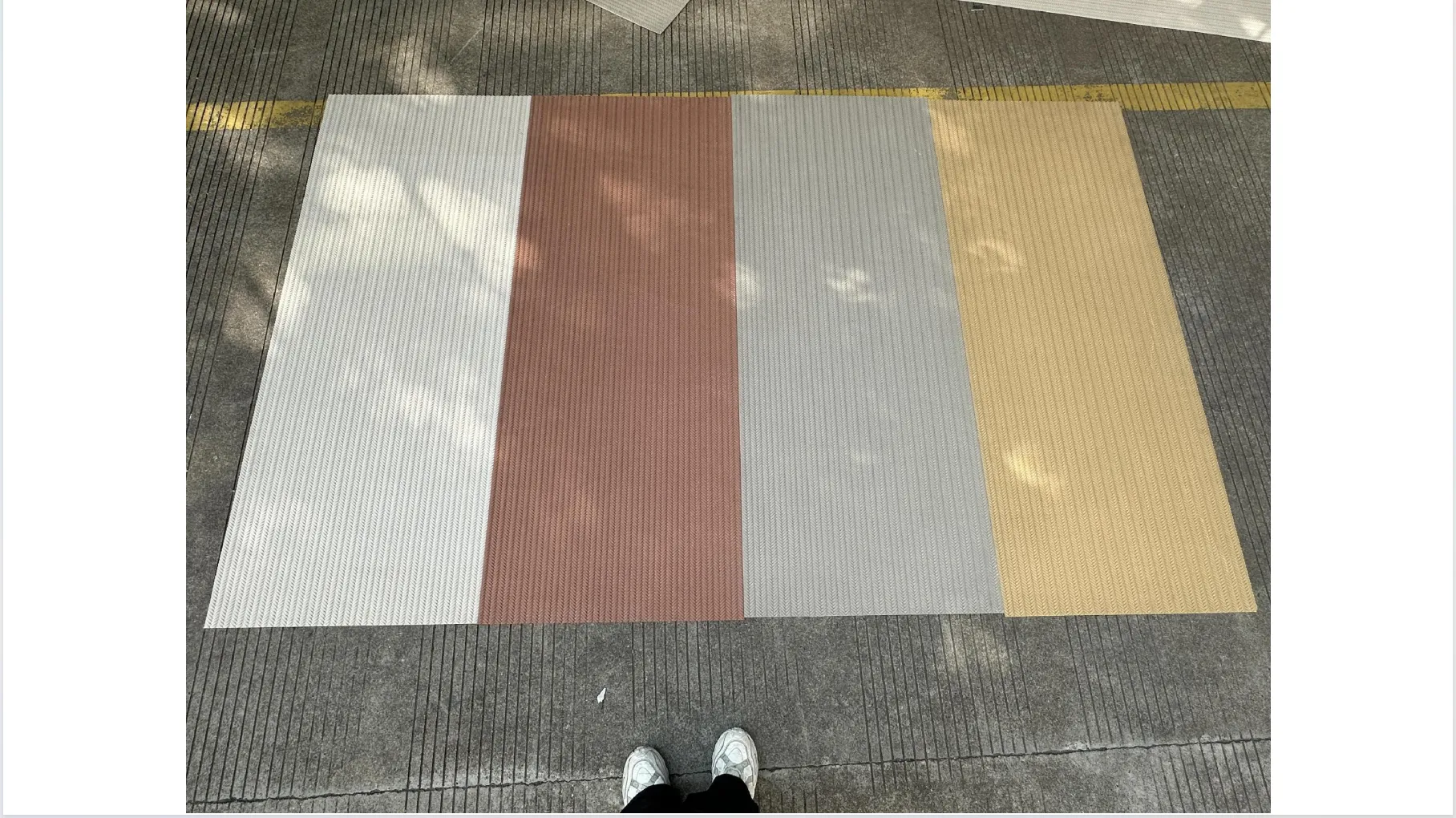
Close your eyes and think about the last time you tried to visualize a space before it existed. Maybe it was a home renovation, a café you dreamed of opening, or an office where your team would collaborate. Chances are, you relied on something flat—a paint chip, a tiny material sample, or a digital render that felt more like a cartoon than reality. For designers and architects working with cutting-edge materials like MCM's 3D Printing Series, that disconnect between imagination and reality has long been a frustrating hurdle. But what if you could hold a "photo" that let you almost feel the texture of a wall, see how light dances on its surface at 3 p.m., or trace the curve of a flexible panel with your eyes? That's the magic of woven real photos—and it's changing how we plan MCM installations, one tactile detail at a time.
MCM materials aren't your average building supplies. The MCM 3D Printing Series, for example, is a playground of precision—intricate patterns, custom textures, and geometries that push the boundaries of what's possible with traditional construction. Then there's MCM Flexible Stone, which bends and curves like fabric but wears like rock, and the MCM Big Slab Board Series, where massive, seamless panels become canvases for natural stone patterns or bold, modern designs. These materials thrive on detail: the way a 3D-printed ridge catches shadow, the subtle variation in a travertine slab, the flexibility of a stone panel that wraps around a corner without cracking.
But for years, designers and clients have had to rely on tiny swatches or generic digital images to imagine these details. A 4x4-inch sample of MCM Flexible Stone can't show you how it'll look stretched across a 20-foot wall. A stock photo of travertine (starry green) might miss the way its "starry" flecks shift color when hit by warm vs. cool light. And even high-res renders often flatten texture, making a rough granite surface look like a smooth Photoshop filter. The result? Second-guessing, missed opportunities, and sometimes, installations that feel "off" because the reality didn't match the vision. "I once had a client who fell in love with a small sample of lunar peak silvery," says Maria, an interior designer in Chicago. "But when the big slabs arrived, the silver had a blue undertone in their space's morning light that the sample never showed. We had to pivot, and it cost weeks of time."
Woven real photos aren't just high-resolution images. They're experiences . Captured with specialized cameras that mimic human perception—focusing on how light interacts with texture, how colors shift in different environments, and even the subtle imperfections that make natural materials feel alive—these photos are stitched together (or "woven") to create large, immersive visuals that feel almost three-dimensional. Imagine unrolling a poster-sized image of MCM Big Slab Board Series' travertine (starry green) and seeing not just a flat color, but the depth of its pores, the sparkle of its mineral deposits, and the way a single beam of sunlight would turn those "stars" into tiny spotlights. That's the difference.
What makes them game-changing for MCM installations? They bridge the gap between the technical and the tactile. For the MCM 3D Printing Series, where every ridge and groove is designed with purpose, woven real photos zoom into the 3D-printed texture, letting you count the layers or trace the pattern with your eyes—critical for designers trying to align a custom print with a space's flow. For MCM Flexible Stone, they showcase flexibility in action: a woven photo might capture a panel curved at 45 degrees, highlighting how its texture compresses slightly on the bend but retains its integrity. And for the Big Slab Board Series, they reveal the full story of a slab—no more guessing how the pattern will repeat across 10 feet. You see the entire canvas, just as it will appear on your wall.
| Traditional Planning Tools | Woven Real Photos |
|---|---|
| Small samples (limit texture/scale perception) | Full-scale, high-res visuals of entire slabs/panels |
| Flat digital renders (misses light/texture interplay) | Captures color shifts in morning/evening light, shadow details |
| Generic stock images (no material-specific nuance) | Material-specific: shows MCM 3D print ridges, Flexible Stone bend, etc. |
| Relies on imagination (risk of mismatched expectations) | Reduces guesswork—clients "see it to believe it" |
When Leo, the owner of Starry Night Café in Portland, decided to renovate his space, he had a vision: walls that felt like looking up at the night sky, paired with a curved bar that invited people to linger. He'd fallen for MCM's travertine (starry green) from the 3D Printing Series—its deep green base dotted with iridescent flecks that mimicked stars. But his designer, Priya, was wary. "Starry green sounds bold," she recalls. "Leo kept saying, 'It'll be subtle!' but with a small sample, I couldn't tell if those flecks would read as magical or messy under his warm pendant lights."
Enter woven real photos. Priya ordered a full-scale woven image of the travertine (starry green) slab, printed on a lightweight, textured canvas. When she unrolled it in Leo's empty café at 2 p.m.—the same time his afternoon sunlight streams through the windows—they both gasped. "The sample had looked flat, almost matte," Leo says. "But the woven photo showed how the starry flecks catch light like tiny mirrors. In the afternoon sun, the wall would glow softly, not shout. And in the evening, under warm bulbs, it turned into this cozy, galaxy-like backdrop. I almost cried—I could see people sitting there, taking photos, feeling like they were dining under the stars."
The woven photo didn't just sell Leo on the color; it solved a practical problem. Priya had worried the 3D-printed texture might trap dirt in a busy café. But the photo's close-up detail showed the texture was subtle—more "gentle ridge" than "deep groove"—easy to wipe clean. Today, the café's starry green walls are its most Instagrammed feature. "People ask if we used actual stars," Leo laughs. "I tell them it was just a really good photo… and a little MCM magic."
For a tech startup in Austin, "rigid" was the last word they wanted associated with their new office. They dreamed of a space that felt fluid, with curves instead of corners—a physical reflection of their collaborative, flexible work style. Their designer, Raj, immediately thought of MCM Flexible Stone. "It's stone that moves," he explains. "But convincing the client to wrap it around 12-foot curved walls? They needed to see it wouldn't crack, that the texture wouldn't warp, that it would feel intentional, not like a mistake."
Traditional samples of MCM Flexible Stone are small and stiff—they don't bend, so clients can't visualize the curve. But Raj used a woven real photo that showed a full-scale Flexible Stone panel wrapped around a mock curved wall. The photo zoomed in on the bend: you could see how the stone's natural texture compressed slightly on the inner curve but retained its pattern, no cracks or warps in sight. "The client ran their hand over the photo like they were touching the wall," Raj says. "They kept saying, 'It looks soft .' That's the power of it—you're not just seeing a material; you're feeling its personality."
The final installation? Curved Flexible Stone walls in lunar peak silvery, which shifts from cool silver in daylight to warm gray at night. "Employees call it the 'hug wall,'" Raj smiles. "And it all started with a photo that proved stone could be gentle."
Nothing kills a high-end restaurant vibe like mismatched stone seams. When Sofia, a restaurateur in Miami, chose MCM Big Slab Board Series for her new coastal-themed eatery—specifically, travertine (vintage gold) for the main dining room walls—she wanted seamless luxury. "Big slabs mean no ugly lines," she says. "But I'd heard horror stories of clients who ordered 'seamless' slabs only to find the pattern clashed where two panels met. I wasn't taking that risk."
Sofia's fear was valid: natural stone patterns vary, and even "big slabs" have subtle shifts. But with woven real photos, she didn't have to guess. MCM provided a woven image of the exact travertine (vintage gold) slabs that would be used in her space—10 feet tall, side by side, in the same lighting as her restaurant. "I could see the entire flow," she says. "The gold veining in the first slab curved left; the second picked it up and curved right. It looked like a river, not two separate stones. I signed off immediately."
Today, diners at Sofia's restaurant often comment on the "continuous golden wave" of her walls. "They think it's one giant slab," she laughs. "It's not—but the woven photo made sure it looks that way. No seams, no surprises, just that 'wow' factor I was after."
At the end of the day, woven real photos aren't just about avoiding mistakes. They're about building confidence—for designers, clients, and even contractors. When everyone can see exactly how MCM 3D Printing Series textures will interact with a room's light, or how MCM Flexible Stone will a curve, or how a Big Slab Board will transform a space, the process becomes collaborative instead of stressful. Clients feel heard ("They get my vision!"), designers feel trusted ("I can push boundaries without fear"), and contractors feel prepared ("I know exactly how to install this").
And let's not underestimate the joy factor. There's something deeply human about falling in love with a texture you can almost touch, or a color that shifts like a living thing. Woven real photos turn material selection from a checklist item into an experience—one that sparks excitement, not anxiety. "I had a client who teared up when she saw the woven photo of her bedroom wall," Maria, the Chicago designer, recalls. "She said, 'That's exactly how I dreamed it would feel.' That's the power of seeing the real thing—even before it exists."
As MCM continues to innovate—with new 3D printing techniques, more sustainable materials, and even bolder designs—woven real photos will only grow more essential. Imagine pairing them with AR: hold up your phone, and a woven real photo of MCM Lunar Peak Black comes to life in your space, shifting with the light as you walk around. Or using them to plan entire buildings, where every MCM panel is visualized in context, from the lobby to the rooftop.
But for now, the magic is in the basics: a photo that makes you lean in, squint, and say, "Is that… real?" It's a reminder that great design isn't just about materials—it's about stories, feelings, and the moments when imagination becomes tangible. And with woven real photos, MCM installations aren't just built—they're felt , long before the first panel goes up.
So the next time you're planning a space, ask yourself: Are you just looking at materials… or are you seeing the story they'll tell? With woven real photos and MCM, the answer might just take your breath away.
Recommend Products












