
Walk through any modern city, and your eyes will drift upward—toward skyscrapers that pierce the clouds, their facades telling stories of innovation and ambition. But behind those gleaming exteriors lies a quiet challenge: how to make these giants feel human. Architects and designers have long grappled with a tug-of-war: the desire to create visually stunning buildings versus the need to keep them structurally sound. Traditional materials like heavy stone or solid concrete often tip the scales—literally—adding unnecessary weight that strains foundations and limits creative freedom. Enter a new era of building materials, where flexibility meets durability, and aesthetics dance with practicality. At the heart of this revolution? MCM flexible stone, and a suite of companion materials that are redefining what high-rises can look and feel like.
Think about the last time you stood at the base of a tall building. Did it feel imposing? Cold? That's often the side effect of prioritizing structural strength over soul. For decades, high-rise construction leaned on dense materials—thick concrete slabs, heavy marble, solid granite—to withstand wind, rain, and time. But these choices came with a cost: buildings that felt disconnected from the people inside them. Worse, their weight forced engineers to overdesign foundations, driving up costs and limiting how high (or how creatively) a building could rise. "We wanted to create a tower that felt like it belonged to the city, not just loomed over it," says Maria Gonzalez, a senior architect at a leading urban design firm. "But with traditional stone, even a small facade detail added tons of weight. It was like trying to paint a masterpiece with a sledgehammer."
That's where lightweight materials step in. Today's innovators are reimagining building skins—thin, durable, and surprisingly versatile. They're not just lighter; they're smarter, blending textures and colors that turn facades into canvases. And leading the charge is MCM flexible stone, a material that feels like a contradiction until you see it in action: tough as stone, yet flexible enough to bend around curves, and light enough to reduce structural load by up to 70% compared to traditional options.
Let's start with the star of the show: MCM flexible stone. Picture this: a material that looks and feels like natural travertine or rough-hewn granite, but weighs about as much as a thick carpet. It's made by bonding mineral composites to a flexible backing, creating panels that can be cut, shaped, and installed with the ease of wallpaper—minus the fragility. "We used MCM flexible stone for the facade of a 42-story residential tower last year," says James Chen, a project manager at a construction firm. "The client wanted the warmth of stone but was worried about the building's weight. MCM solved both. We even curved panels around the corners to mimic the flow of a river—something we couldn't have done with real stone without breaking the budget (or the foundation)."
What makes MCM flexible stone a hit with architects? It's not just the weight. It's the texture. Unlike flat, uniform concrete, MCM panels come in finishes that tell a story: the pockmarked surface of travertine (starry green), the weathered grain of historical pathfinders stone, or the smooth sheen of marble veil white. These details matter. They turn a blank wall into a landscape—one that catches the light at dawn, softens shadows at dusk, and makes people pause and think, "That building feels alive."
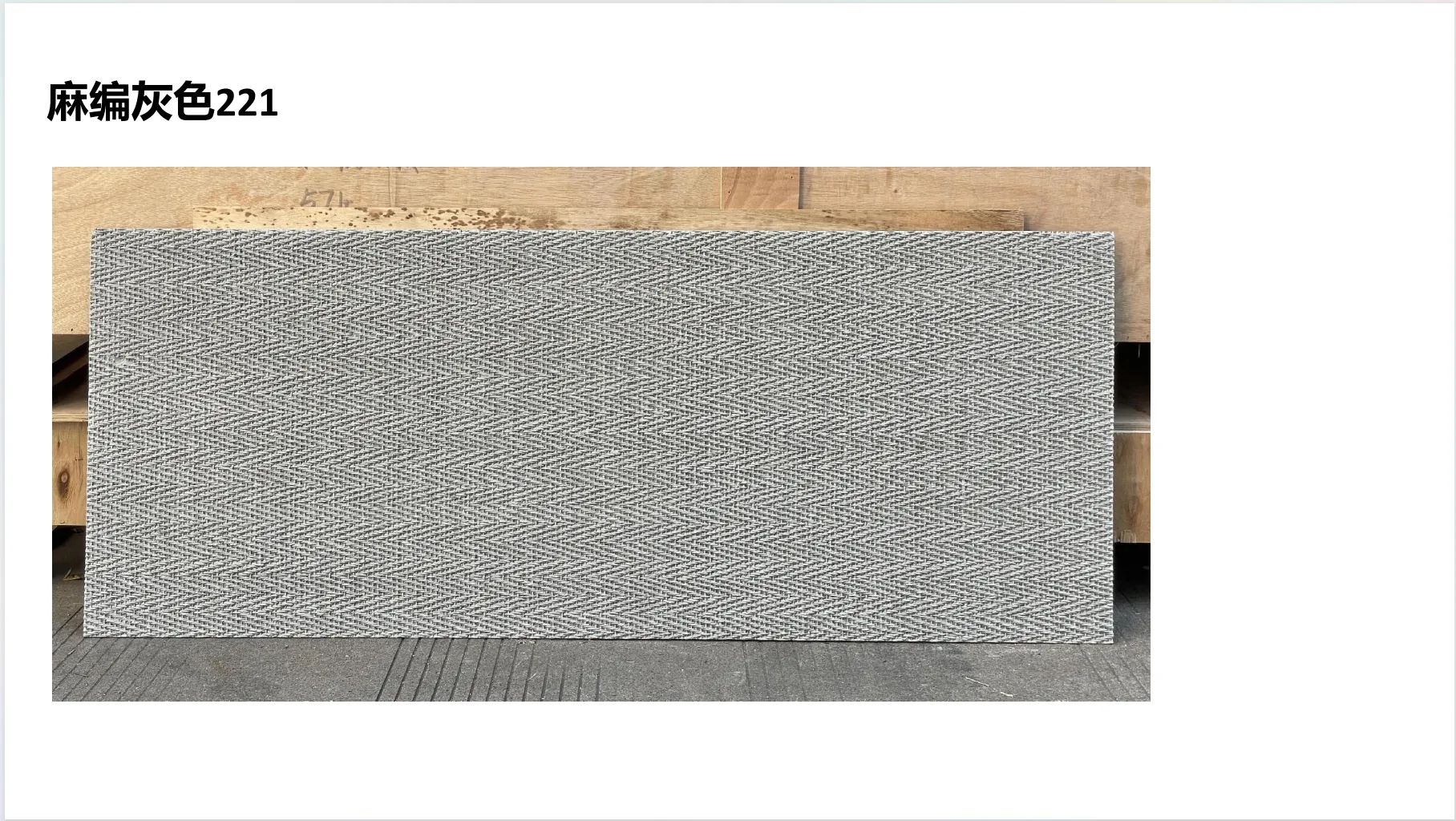
Here's where things get personal: weaving real photos. No, we're not talking about printing snapshots on walls. Think of it as texture with memory. Weaving (khaki) panels, for example, mimic the look of handwoven textiles—loose threads, subtle knots, the kind of imperfections that make something feel handmade. When paired with MCM flexible stone, these woven textures add a layer of softness that balances the stone's ruggedness. "I visited a co-working space in Tokyo last month that used weaving (jacinth) panels alongside MCM travertine," recalls Lisa Wong, a design journalist. "The woven sections ran along the lobby walls, and you could almost feel the warmth—like walking into a friend's living room, not a corporate building. It's small details like that that make high-rises feel less like machines and more like communities."
Weaving textures aren't just about looks. They're about sound, too. The interlaced fibers dampen noise, turning echoey lobbies into quiet retreats. And because they're lightweight (like MCM), they can be layered without adding stress to the structure. Imagine a high-rise apartment where your morning coffee is sipped in a space that feels both grand and cozy—thanks to a wall that combines the strength of stone with the comfort of woven fabric. That's the magic of pairing MCM flexible stone with weaving real photos.
MCM flexible stone and weaving textures are just the start. Enter foamed aluminium alloy boards—specifically, the vintage silver and vintage gold variants—and the lunar peak series. These materials bring a touch of glamour to high-rises, proving that "lightweight" doesn't mean "dull." Foamed aluminium is exactly what it sounds like: aluminium that's been aerated to create a lightweight, yet strong, panel. The vintage silver finish has a muted, industrial-chic vibe—think old factory windows with a modern twist—while vintage gold adds a warm, sunlit glow. "We used foamed aluminium alloy board (vintage gold) for the spire of a hotel in Dubai," says Chen. "At night, the gold catches the city lights, and it looks like the building is crowned with stardust. And because it's foamed, it didn't add extra weight to the top floors—critical for stability."
Then there's the lunar peak series: silvery, golden, and black. These panels mimic the surface of the moon—cratered, uneven, and otherworldly. Lunar peak silvery, in particular, has a metallic sheen that shifts with the sun, turning from bright silver at noon to a soft gray-blue at twilight. "A university campus in Boston used lunar peak black for their science center facade," Gonzalez notes. "It's meant to evoke the night sky, inspiring students to look up and dream. And because it's lightweight, they could install larger panels, creating a seamless, immersive experience."
For those who prefer understated elegance, there's fair-faced concrete. It's not your average gray slab. Fair-faced concrete is poured and finished with such precision that the raw texture of the material becomes the design—small air bubbles, subtle color variations, the impression of human hands at work. "We used fair-faced concrete alongside MCM flexible stone for a museum in Berlin," says Wong. "The concrete walls act as a neutral canvas, letting the stone's patterns pop, while adding a sense of permanence. It's a reminder that sometimes, the most beautiful things are the ones that don't try too hard."
| Material | Aesthetic Vibe | Weight Advantage | Best For |
|---|---|---|---|
| MCM Flexible Stone | Natural, earthy (travertine, granite, stone textures) | 70% lighter than traditional stone | Residential towers, commercial facades |
| Foamed Aluminium Alloy (Vintage Silver) | Industrial-chic, metallic sheen | 50% lighter than solid aluminium | Spires, accent panels, modern hotels |
| Lunar Peak Silvery | Otherworldly, cratered, moon-like texture | Lightweight composite core | Cultural centers, universities, statement facades |
| Weaving (Khaki) | Soft, textile-like, handwoven texture | Ultra-light (similar to fabric panels) | Lobbies, co-working spaces, interior accents |
| Fair-Faced Concrete | Raw, minimalist, industrial elegance | Lighter than traditional concrete (with precision finishing) | Museums, art galleries, modernist buildings |
At the end of the day, buildings are for people. We don't just live and work in them—we feel them. Heavy, cold facades push us away; light, textured ones pull us in. MCM flexible stone, foamed aluminium, lunar peak, weaving textures, and fair-faced concrete aren't just materials—they're tools for connection. They let architects build higher, dream bigger, and create spaces that feel like home, even in the clouds.
So the next time you look up at a high-rise, take a closer look. Is that stone? Is that metal? Or is it something lighter, smarter, more alive? Chances are, it's a mix of materials working together—proving that the future of architecture isn't just about reaching new heights, but about bringing those heights down to earth.
Recommend Products












