
Ten years ago, a team of designers, engineers, and dreamers at COLORIA GROUP sat around a table, sketching ideas on crumpled paper napkins. They weren't just brainstorming building materials—they were reimagining how spaces feel. "What if a wall could tell a story?" someone asked. "What if a facade could feel as alive as the people inside?" That question sparked a journey: a decade of turning raw materials into something more—textures that breathe, surfaces that evoke memory, and MCM (Modified Composite Material) products that blur the line between industry and art. Today, as we look back, COLORIA's legacy isn't just in the catalog of products they've created, but in the way they've invited us to see buildings not as structures, but as canvases for life.
When COLORIA first introduced MCM flexible stone, it was a quiet revolution. At the time, cladding materials were often rigid, heavy, or limited in design. Contractors grumbled about installation headaches; designers sighed over the lack of creative freedom. But MCM flexible stone changed that. Imagine a material that bends like fabric but stands up to rain, wind, and time—a material so lightweight it reduces construction costs, yet so durable it outlasts traditional stone. "It wasn't just about solving problems," says Maria Gonzalez, COLORIA's lead material scientist, who's been with the company since day one. "It was about giving people permission to dream bigger. If a wall can curve, if a ceiling can slope, suddenly the rules of architecture disappear."
Over the years, MCM became the backbone of COLORIA's innovation. From the MCM project board series, designed for large-scale commercial projects, to the intricate 3D printing series that lets designers create custom textures layer by layer, the material evolved into a playground for creativity. But what truly set COLORIA apart was their obsession with "realness." They didn't want MCM to mimic nature—they wanted it to honor it. Which is why, when you run your hand over a piece of their MCM flexible stone, you'll feel the same subtle irregularities as natural travertine. When you step into a room clad in their wood grain board, you'll swear you can smell pine in the air.
Walk into COLORIA's design studio, and you'll find shelves lined with inspiration: a frayed khaki woven basket from a market in Marrakech, a piece of driftwood with threads of bark still clinging to it, a lunar rock sample borrowed from a geology lab (yes, really). These aren't just decor—they're the starting points for products like Weaving (khaki), a texture that has become a fan favorite for residential interiors. "We spent six months studying woven textiles," recalls Javier Ruiz, head of texture design. "Not just how they look, but how they move . The way light catches the threads, the slight give when you press a finger to them, the way shadows pool in the gaps. We wanted Weaving (khaki) to feel like a well-loved blanket—something that wraps a room in warmth."
Creating that "lived-in" feel isn't easy. The process starts with high-resolution scans of real woven materials—thousands of images, taken in different lighting, from every angle. Then, using 3D modeling software, the team translates those scans into a digital texture map, adjusting for scale and depth. But the magic happens in the MCM production line, where a proprietary printing technique layers color and texture with microscopic precision. The result? A surface that looks like it was woven by hand, not machine. "A client once told me her daughter refused to believe the wall in her bedroom wasn't actually a giant woven rug," Javier laughs. "That's the highest compliment we can get."
The "weaving real photos" concept isn't just a marketing term—it's a promise. COLORIA's design team doesn't rely on stock images or generic patterns. They travel the world to photograph real textiles, from the handwoven rugs of Oaxaca to the fishing nets of coastal Vietnam. For Weaving (jacinth), they spent a week in a small village in India, documenting the way local artisans dyed threads with natural indigo and turmeric, creating the rich, earthy reds that give the texture its name. "Those photos aren't just references," explains Elena Kim, who leads the photography team. "They're memories. When we print that texture onto MCM, we're not just replicating a pattern—we're preserving a piece of someone's craft, someone's story."
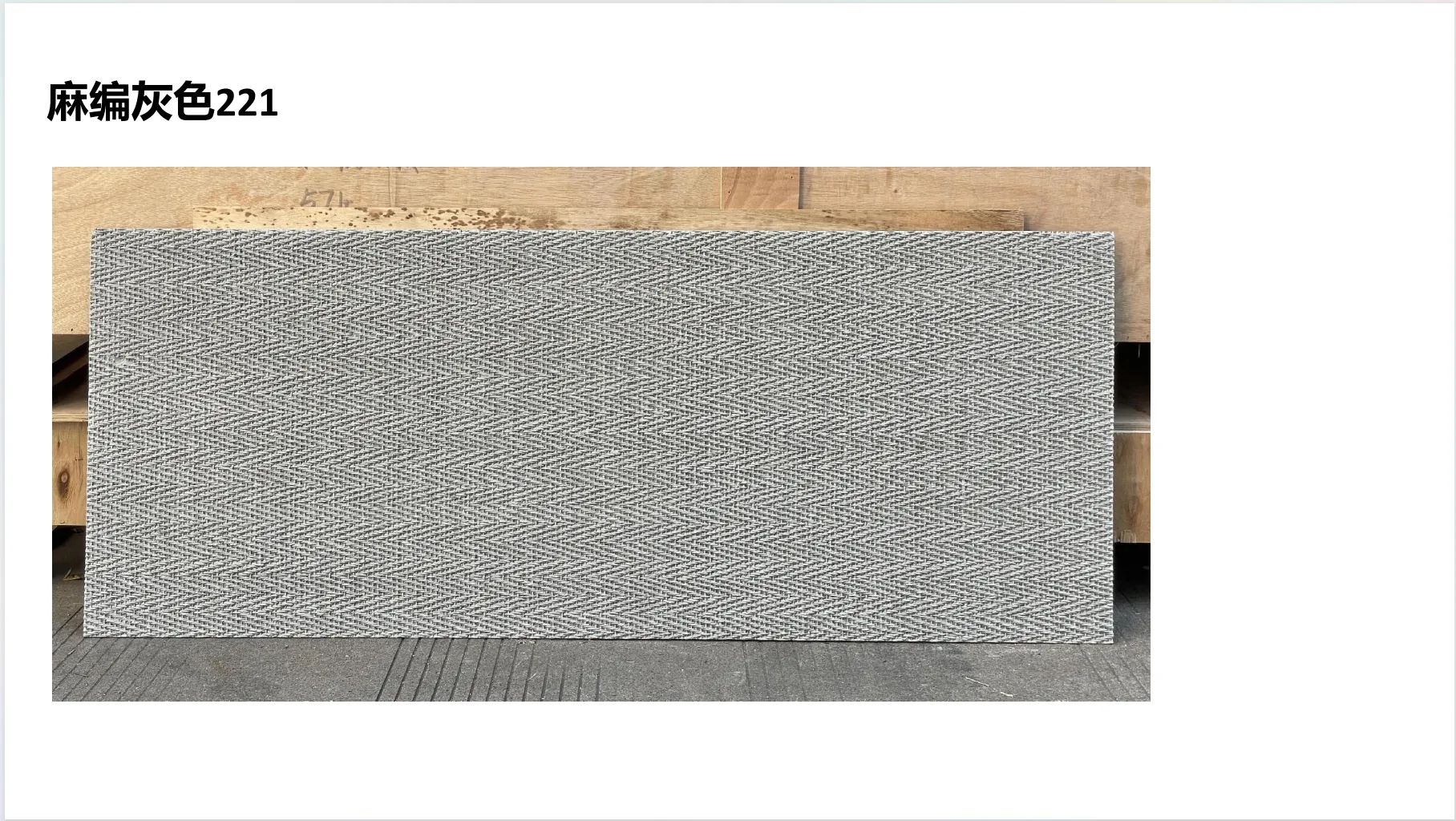
It's that attention to detail that makes Weaving (grey) a staple in modern offices. The subtle variations in thread thickness, the way some strands are slightly frayed—these aren't flaws. They're what make the texture feel authentic. "Offices can feel so sterile," says David Chen, an architect who used Weaving (grey) in a tech startup's headquarters. "But with this material, the walls feel approachable. Employees tell me it's like working in a space that remembers what it's like to be human."
While weaving textures tap into the warmth of human craft, much of COLORIA's innovation draws from the natural world. Take the Travertine (starry green) series, for example. It started with a hike. "A group of us were trekking in the Italian countryside," remembers Carlos Mendez, COLORIA's founder. "We came across a travertine quarry at sunset, and the stone was glowing—green, gold, like it was sprinkled with stardust. I thought, 'Why can't a building feel like this?'" That moment led to months of R&D, as the team worked to replicate the way light dances off natural travertine's pores and veins. The result? Travertine (starry green) isn't just a color—it's an experience. Installed in a hotel lobby in Barcelona, guests often pause to stare, mistaking it for real stone. "One even asked if we'd imported it from Italy," Carlos grins. "We told him the truth: we imported the feeling ."
Then there's the Lunar Peak series—silvery, golden, black—born from a late-night conversation about the moon. "We were talking about how the moon looks different every night," Maria Gonzalez says. "Sometimes it's a silvery disk, sometimes a golden crescent, sometimes just a dark shadow against the sky. We wanted a texture that captured that duality—modern and timeless, bold and understated." Lunar Peak silvery, with its cool, metallic sheen, has become a hit for high-end retail spaces, while Lunar Peak golden warms up restaurants and cafes. "It's not just about color," Maria adds. "It's about mood. A wall in Lunar Peak black feels intimate, like a night sky you can reach out and touch. That's the power of texture—it shapes how we feel in a space."
| Product | Key Features | Design Inspiration | Ideal For |
|---|---|---|---|
| MCM Flexible Stone | Lightweight (80% lighter than natural stone), bendable, weather-resistant | Natural stone's durability, with the flexibility of fabric | Curved facades, accent walls, outdoor cladding |
| Weaving (khaki) | Handwoven texture, soft color variation, matte finish | Traditional Moroccan baskets and woven textiles | Bedrooms, living rooms, cozy cafes |
| Lunar Peak Silvery | Metallic sheen, subtle crater-like texture, scratch-resistant | The moon's surface, modern minimalism | Retail stores, corporate lobbies, art galleries |
| Travertine (starry green) | Porcelain-like finish, iridescent flecks, heat-resistant | Sunset over Italian travertine quarries | Hotel lobbies, luxury homes, spa interiors |
| Foamed Aluminium Alloy Board (vintage silver) | Industrial-chic texture, lightweight, corrosion-resistant | Retro factory walls, mid-century modern design | Loft apartments, brewpubs, tech offices |
COLORIA's products aren't just pretty—they work hard. Take foamed aluminium alloy board (vintage silver), part of their metal series. Designed for both indoor and outdoor use, it's fire-resistant, sound-absorbing, and requires almost no maintenance. "We tested it in the Arizona desert for a year," says Raj Patel, COLORIA's product testing lead. "Temperatures hit 120°F, sandstorms rolled through, and it still looked brand new. A traditional aluminium panel would have faded or dented, but this? It laughed at the elements." That durability has made it a favorite for outdoor patios and restaurant terraces, where style can't come at the cost of practicality.
Then there's the rammed earth board series—gradient colors, warm reds, and earthy khakis—that brings the beauty of adobe homes into modern construction. Rammed earth has been used for centuries, but traditional methods are labor-intensive and hard to scale. COLORIA's version? It's prefabricated, lightweight, and available in gradients that mimic the way sun bleaches soil over time. "We worked with indigenous builders in New Mexico to understand the original technique," Raj explains. "They taught us that rammed earth isn't just about dirt—it's about balance. The way layers of soil, clay, and straw compress to create something strong and beautiful. Our gradient rammed earth board tries to capture that balance, but in a way that fits 21st-century construction timelines."
What's most striking about COLORIA's decade of innovation is the diversity of their catalog. There's the Bali stone, inspired by the weathered beaches of Indonesia, perfect for coastal homes. The charcoal burnt wood board, which replicates the look of shou sugi ban—Japanese burnt wood—without the environmental guilt. The travertine (starry red), (orange), and (blue) series, which turn the night sky into a wall texture. "We don't believe in one-size-fits-all," Carlos Mendez says. "A hospital needs calm, reassuring textures. A nightclub needs energy. A school needs warmth and durability. Our job is to give designers the tools to tell each building's unique story."
Take the historical pathfinders stone, for example. Designed for heritage restoration projects, it mimics the weathered look of 19th-century stone, complete with the slight chips and discoloration that come with age. "We worked on a project in Boston, restoring a 1800s townhouse," says architect Sofia Lee. "The original stone was too fragile to reuse, but COLORIA's historical pathfinders stone matched it so perfectly, even the historians couldn't tell the difference. It's not just about preserving the past—it's about letting it live on."
As COLORIA celebrates ten years, they're already looking ahead. The team is experimenting with AI to create "adaptive textures"—MCM surfaces that change color or pattern based on temperature, light, or even sound. They're exploring partnerships with sustainability-focused architects to develop carbon-negative MCM, using recycled materials and renewable energy in production. "The future isn't just about new products," Carlos says. "It's about new relationships —between materials and the planet, between buildings and the people who love them."
But for all the high-tech plans, there's a quiet truth at the heart of COLORIA's work: innovation without heart is just novelty. "At the end of the day, we're not selling MCM," Maria Gonzalez says. "We're selling moments. The moment a child runs her hand over a weaving (white) wall and gasps, 'It's so soft!' The moment a homeowner looks at their lunar peak golden kitchen backsplash and thinks, 'This feels like me.' That's what keeps us going."
Ten years ago, COLORIA asked, "What if a building could feel alive?" Today, as they stand on the cusp of their second decade, the answer is clear: it can. Because when materials are made with intention, when textures are woven from real stories, and when innovation is rooted in empathy, buildings don't just exist—they breathe . And in a world that often feels cold and disconnected, that's the greatest innovation of all.
Recommend Products












