
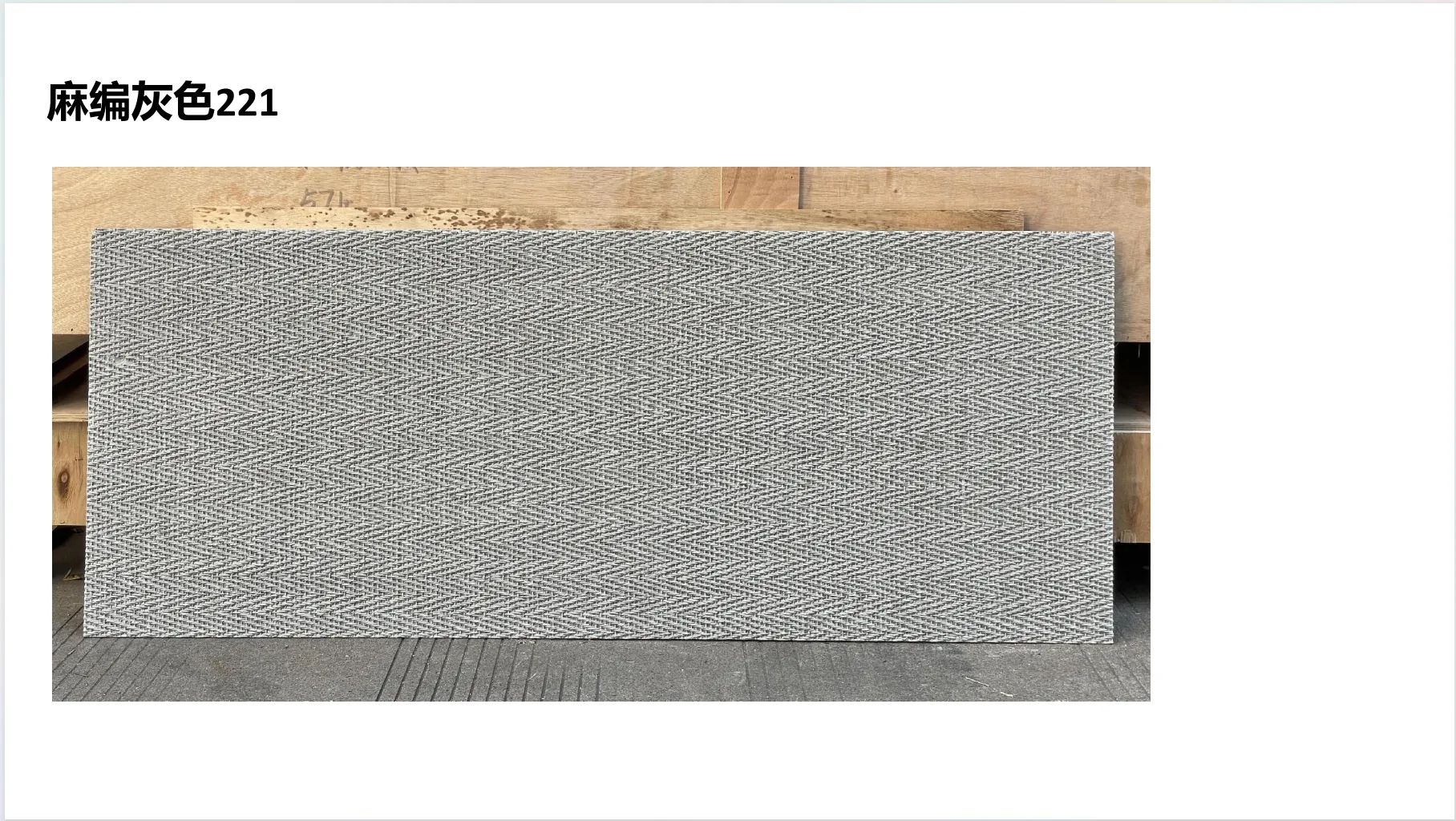
In the world of architecture and design, every surface tells a story. It's the soft glow of a wall at sunset, the tactile warmth of a countertop under your palm, the way light dances on a textured panel—these are the details that turn a space into a memory. For over a decade, COLORIA has been writing these stories, blending cutting-edge material science with the timeless art of craftsmanship. At the heart of their innovation lies MCM (Modified Composite Material), a revolutionary category that redefines what building materials can be. Today, we dive into how COLORIA's global supply chain transforms raw ingredients into living, breathing elements of design—with a spotlight on the weaving (khaki) collection, travertine (starry green) , lunar peak silvery , and more.
Before we explore the global journey, let's talk about the star of the show: mcm flexible stone . Traditional stone is heavy, brittle, and limited in application—think massive slabs that require cranes and reinforced structures. MCM flexible stone shatters that mold. By combining natural stone particles with a high-performance polymer matrix, COLORIA creates sheets that are 70% lighter than natural stone, yet just as durable. Imagine a material that bends to follow the curve of a modern facade, wraps around a column like fabric, or adorns a ceiling with the elegance of marble—without the weight. It's stone, reimagined as art.
But flexibility is just the beginning. What truly sets MCM apart is its ability to capture the soul of natural materials. Take travertine (starry green) , for example. Sourced from the rolling hills of Tuscany, where ancient thermal springs have deposited layers of calcium carbonate over millennia, this travertine isn't just a stone—it's a slice of Earth's history. The "starry" effect? Tiny mineral deposits, trapped as the stone formed, that glint like constellations when hit by light. In its MCM form, this travertine retains every nuance of those starry veins, but now it can grace a boutique hotel's lobby wall or a home's backsplash, bringing a piece of the Italian countryside indoors.
COLORIA's supply chain isn't a logistical flowchart—it's a global network of artisans, quarries, and innovators, each contributing a chapter to the final product. Let's trace the journey of a single weaving (khaki) panel, a fan favorite in the "Weaving Real Photos" collection. The story starts in a small village in rural Vietnam, where master weavers have practiced their craft for generations. Using sustainable jute fibers dyed with natural indigo and turmeric, they create intricate patterns that mimic the texture of handwoven textiles. These patterns are then digitized, and COLORIA's engineers translate them into a 3D mold, which presses the design into MCM composite. The result? A panel that looks and feels like a vintage khaki rug, but with the durability to withstand foot traffic, moisture, and time. It's tradition, woven into modernity.
Then there's lunar peak silvery , a material that seems to have fallen from the sky. To create its otherworldly sheen, COLORIA sources aluminum from a family-owned foundry in Germany, known for producing aerospace-grade alloys. The aluminum is melted, mixed with a foaming agent, and extruded into sheets that capture the matte, cratered texture of the moon's surface. The "silvery" hue comes from a specialized anodizing process in Japan, where the metal is dipped in electrolytes to form a protective layer that shimmers like moonlight. The result? A panel that turns a commercial building's facade into a canvas for the sun and stars, shifting from cool silver at dawn to warm pewter at dusk.
Even the foamed aluminium alloy board (vintage silver) has a global passport. Its lightweight core is crafted in Belgium, where aluminum is foam-pressed to create a honeycomb structure that's 80% air—making it easy to install and energy-efficient. The "vintage silver" finish? A hand-brushing technique learned from artisans in India, who've been aging metal for jewelry and architecture for centuries. The result is a material that blends industrial edge with artisanal warmth, perfect for a trendy café's accent wall or a tech startup's office ceiling.
To truly appreciate COLORIA's craft, let's put four standout products under the microscope. The table below breaks down their origins, textures, and the stories they tell:
| Product | Origin Story | Texture & Feel | Perfect For |
|---|---|---|---|
| weaving (khaki) | Vietnamese jute weavers + Japanese 3D molding | Soft, matte, with raised woven patterns that invite touch | Bedroom accent walls, boutique retail displays |
| travertine (starry green) | Tuscan travertine quarries + Italian stone artisans | Smooth with subtle ridges; cool to the touch, with glittering mineral flecks | Hotel lobbies, high-end kitchen backsplashes |
| lunar peak silvery | German aluminum alloys + Japanese anodizing | Matte, slightly gritty, with a metallic sheen that mimics moon dust | Modern facades, museum exteriors |
| foamed aluminium alloy board (vintage silver) | Belgian foam-pressed aluminum + Indian hand-brushing | Lightweight, with a weathered metallic texture; cool and industrial | Tech offices, restaurant ceilings |
| mcm flexible stone (base collection) | Global stone particles + Korean polymer matrix | Varied (marble, granite, slate); smooth or textured, always true to natural form | Curved walls, columns, ceilings |
Sourcing globally is thrilling, but it comes with a challenge: how do you ensure that a weaving (khaki) panel from Vietnam feels the same as one from a batch produced six months later? Or that travertine (starry green) from a new quarry in Tuscany has the same starry sparkle as the last shipment? COLORIA's answer lies in its "Quality Triangle": strict raw material standards, real-time testing, and local partnerships.
Every supplier—whether a quarry in Italy or a weaving cooperative in Vietnam—undergoes a rigorous audit. COLORIA's team visits sites to check for sustainability (no over-mining, no child labor), consistency (is the travertine's color range stable?), and ethical practices. Once materials arrive at COLORIA's manufacturing hubs in Germany and China, they're tested for everything from colorfastness to impact resistance. A lunar peak silvery panel, for instance, must withstand 500 hours of UV exposure without fading—a test that simulates 20 years of sunlight. Foamed aluminium alloy board (vintage silver) is pressure-tested to ensure it can handle the weight of a person (though we don't recommend standing on ceilings!).
Perhaps the most human part of this process is the "sensory check." Before a batch is approved, designers and artisans run their hands over the materials, comparing them to a "gold standard" sample. Does the weaving (khaki) feel as soft as the original handwoven rug? Does the travertine (starry green) glint in the same way? It's a reminder that quality isn't just about numbers—it's about feeling.
At the end of the day, COLORIA's materials aren't just for building—they're for living. Imagine walking into a café with weaving (khaki) walls. The texture, reminiscent of a grandmother's old rug, wraps around you like a hug, making the space feel cozy yet modern. Or stepping into a hotel lobby where travertine (starry green) panels climb the walls, their starry veins catching the light and making you pause, as if you've stumbled into a secret garden under the stars. Lunar peak silvery on a museum facade doesn't just reflect the sun—it tells visitors they're entering a place of innovation, where the past and future meet.
Even the most industrial materials, like foamed aluminium alloy board (vintage silver) , have a soft side. In a tech office, its weathered finish adds warmth to sleek glass and steel, creating a workspace that feels human, not sterile. It's a reminder that good design isn't about being perfect—it's about being authentic.
COLORIA's global supply chain is more than a way to source materials—it's a commitment to storytelling. Every panel, every stone, every woven texture carries with it the hands of the weaver in Vietnam, the geologist in Tuscany, the engineer in Germany. It's a reminder that in a world of mass production, the most impactful materials are those with a story to tell.
So the next time you run your hand over a wall and feel the texture of mcm flexible stone , or gaze at a facade shimmering with lunar peak silvery , remember: you're touching a global tapestry. And that's the magic of COLORIA—they don't just supply materials. They supply memories.
Recommend Products












