
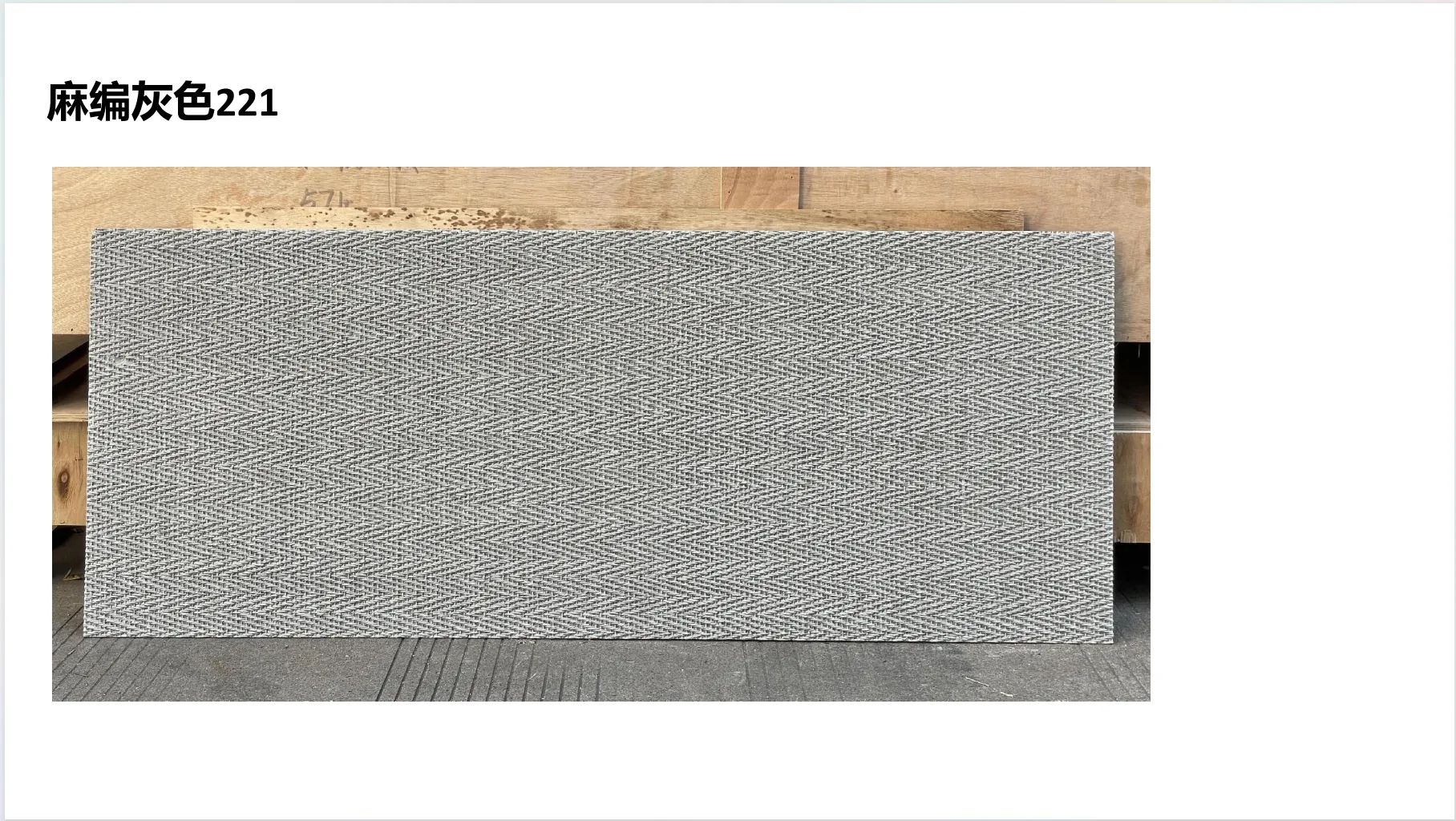
Before diving into the magic of the technology, let's start with the basics: MCM, or Modified Composite Material, is the backbone of COLORIA's products. Unlike traditional stone or concrete, MCM is lightweight, flexible, and eco-friendly—made by blending natural mineral powders with high-performance polymers. The result? Panels that can bend without breaking, resist harsh weather, and mimic the look of rare materials like fair-faced concrete or travertine (starry red) without depleting natural resources. But for COLORIA's founder, Elena Marquez, MCM was always missing something: "We could make it durable, but could we make it breathe ?" she asks, running a hand over a mcm flexible stone panel. "That's where the idea for Weaving Real Photos Technology began."
It was a rainy afternoon in 2018 when Elena first noticed the gap. A client had requested a wall panel that looked like handwoven khaki fabric—something warm, with the irregularities of human craft. The team tried traditional printing, but the result felt flat, artificial. "It was a photograph of a texture, not the texture itself," recalls Carlos Mendez, COLORIA's lead designer. "Elena came into the studio, threw a real woven scarf on the table, and said, 'Why can't we capture this? Not just copy it.'"
That question set them on a two-year journey. They traveled to remote villages in Turkey to study traditional weaving techniques, scanned ancient travertine quarries in Italy, and even spent weeks in a Japanese temple, documenting the weathered grain of fair-faced concrete walls. "We realized the secret wasn't in perfection," Carlos says. "It was in the imperfections : the slight unevenness of a woven thread, the tiny cracks in a 200-year-old concrete slab, the way light hits lunar peak silvery stone at dawn."
"Last year, I was in Morocco, chasing a specific weaving (jacinth) pattern used by Berber tribes. The weaver, an 82-year-old woman named Fatima, let me scan her loom on one condition: I had to help her wind thread for three days. By the end, she said, 'You're not just taking a picture—you're taking a piece of my hands.' That's the responsibility we carry. Every texture in our library has a story, and our job is to honor it."
At its core, Weaving Real Photos Technology is a marriage of old and new: 3D scanning to capture textures, AI to refine them, and precision manufacturing to replicate them. Here's how it unfolds, step by step:
Maria and her team are the first link in the chain. Armed with a portable 3D scanner (think of a high-tech camera that captures depth, not just color), they document real materials: a handwoven weaving (khaki) rug from Peru, the pitted surface of travertine (starry blue) from a Turkish cave, the brushed finish of foamed aluminium alloy board (vintage silver) sourced from a 1950s factory. Each scan captures 100 million data points—every bump, groove, and variation—creating a digital "twin" of the original.
Back at headquarters, the scans land on the desks of the "digital alchemists," a team of designers and engineers who turn raw data into usable patterns. "It's not just about copying the texture," explains Lina Chen, lead texture engineer. "We have to make it work for MCM. For example, fair-faced concrete has tiny air bubbles that would be too fragile in a panel. We preserve the look but strengthen the structure using AI." They also mix and match: combining the weave of weaving (grey) with the color gradient of lunar peak golden to create something entirely new, yet still rooted in reality.
Once the digital design is finalized, it moves to the production floor—where the real fun begins. In the 3D printing lab, rows of printers hum as they extrude layers of MCM composite, guided by the digital texture map. For larger panels, like boulder slab (vintage black) , the team uses a mold-making process: the scanned texture is etched into a metal plate, which then presses the pattern into wet MCM mix. "The pressure has to be just right," says Juan Lopez, production supervisor, adjusting a dial on a machine. "Too much, and you lose the fine details; too little, and the texture won't hold."
Then comes the "marriage" phase: combining MCM with substrates like foamed aluminium alloy board (vintage silver) for strength, or fair-faced concrete for a raw, industrial look. The panels are cured, sanded, and sealed—all by hand. "Machines can do the heavy lifting," Juan grins, "but a human eye catches the things a sensor might miss. Like that travertine (starry orange) panel last week—one corner had a bubble. A machine would've passed it, but old Manolo [a 68-year-old quality checker] spotted it in two seconds."
| Aspect | Traditional Printing | Weaving Real Photos Technology |
|---|---|---|
| Texture Depth | Flat, 2D (looks like a sticker) | 3D, up to 5mm depth (feels real to the touch) |
| Material Waste | High (over 30% of ink/paint unused) | Low (less than 5%—textures are precision-mapped) |
| Design Flexibility | Limited (pre-set patterns only) | Unlimited (mix real textures: e.g., weaving (beige) + stream limestone (claybank) ) |
| Authenticity | Artificial (lacks natural irregularities) | Faithful (captures 98% of original texture's nuances) |
"I've worked with stone my whole life—quarrying in Spain, polishing in Italy. Back then, you judged a slab by its 'soul.' Does it feel like it's been shaped by time? With these MCM panels… they have soul. Last month, we made a travertine (vintage gold) piece that reminded me of my abuela's kitchen floor—same little chip by the corner, same way the light hits it. I teared up. Technology didn't take the soul out; it gave it a new home."
Walk through any modern office, hotel, or home, and chances are you've seen COLORIA's work. A restaurant in Tokyo uses foamed aluminium alloy board (vintage gold) for its bar front, the warm metal tone offsetting marble veil white walls. A school in Berlin chose weaving (white) panels for its classrooms, creating a calm, textile-like atmosphere. Even historic buildings—like a 19th-century theater in Lisbon—used mcm flexible stone to restore facade details that would've been impossible with traditional stone.
"The best part?" Elena says, watching a truck load up boulder slab (vintage silver) panels bound for a hospital in Canada. "We're not just selling a product. We're selling access. A small café in Brazil can now have walls that look like travertine (starry green) —something that would've cost a fortune in real stone. And because it's lightweight, installers don't need cranes or heavy equipment. It's design democracy."
As the day winds down, the factory floor quiets. Engineers huddle over a new prototype: a panel that combines fair-faced concrete with ethereal shadow travertine , scanned from a cave in Iceland. "We're experimenting with dynamic textures," Carlos says, eyes lighting up. "Imagine a wall that shifts color slightly with temperature, or panels that mimic the movement of water. Weaving Real Photos Technology is just the start."
But for now, the focus remains on the human element. As the last panel of the day—a weaving (khaki) beauty with flecks of gold—is packed into a crate, Maria pauses to run her hand over it. "Fatima would've loved this," she says softly. "Her hands, her story—now they'll live in a home in Paris. That's the real technology, isn't it? Not the scanners or printers, but the people who care enough to say, 'This matters. This should be shared.'"
And with that, the day ends—not with a whir of machines, but with a quiet sense of purpose. Because at COLORIA, Weaving Real Photos Technology isn't just about capturing texture. It's about capturing life .
Recommend Products












