
Architecture has always been more than just walls and roofs—it's a language. It speaks to who we are, what we value, and how we want to interact with the world around us. In recent years, that conversation has shifted dramatically. We're no longer just asking buildings to "work"; we're asking them to care —to tread lightly on the planet, to inspire joy, and to stand the test of time without draining resources. Enter MCM, a name that's quietly redefining what sustainable architecture can look like, one innovative panel at a time. And at the heart of their revolution? A technology that turns the ordinary into the extraordinary: Weaving Real Photos Technology.
For decades, architects and designers faced a frustrating trade-off: choose materials that were eco-friendly but lacked visual punch, or opt for stunning natural stones and metals that came with a heavy environmental cost. Quarrying travertine, for example, often meant disrupting fragile ecosystems; traditional concrete production released tons of carbon dioxide; and wood cladding, while warm and inviting, risked deforestation. Even when "sustainable" options existed, they often felt generic—like a compromise rather than a choice. "I remember sitting with a client in 2018, trying to explain why recycled plastic panels were the 'responsible' pick, but watching their face fall when they saw the flat, lifeless finish," says Sarah Lin, a senior architect at a global design firm. "It felt like we were asking them to sacrifice beauty for a good cause. That shouldn't be the case."
MCM didn't just set out to solve this problem; they wanted to erase the trade-off entirely. Weaving Real Photos Technology is their masterpiece. Think of it as a bridge between the digital and physical worlds: using high-resolution scanning, 3D modeling (drawing on MCM's 3D Printing Series expertise), and advanced inkjet printing, the technology captures the essence of natural materials—every crack, vein, and texture—and replicates it onto lightweight, eco-friendly substrates. The result? Panels that look and feel like they were plucked from a mountainside or a forest floor, but are made with recycled content, low-energy processes, and zero waste.
"It's not about copying nature—it's about honoring it," explains Dr. Elena Park, MCM's lead materials scientist. "We scan real stone quarried from sustainable sites, aged wood from reclaimed barns, even weathered metal from decommissioned bridges. Then, we analyze that data to understand what makes the material visually striking—the way light hits a travertine's pores, the way grain swells in old oak—and replicate those details with microscopic precision. The substrate? A blend of recycled polymers, natural fibers, and mineral composites that's 70% recycled and 100% recyclable. It's sustainability without the sacrifice."
Let's dive into five standout materials from MCM's lineup, each enhanced by Weaving Real Photos Technology and each a testament to how sustainability and beauty can dance together.
Travertine has been a design staple for centuries, prized for its soft, porous texture and warm tones. But traditional travertine extraction can scar landscapes and consume massive amounts of water. MCM's travertine (starry green) flips the script. The team scanned a rare deposit of green travertine from a small, family-run quarry in Tuscany—one that operates on a "quarry and restore" model, replanting native flora as they work. Weaving Real Photos Technology captured every nuance: the mossy green base, the flecks of gold and silver (the "starry" effect, caused by mineral deposits), even the tiny indentations where water once flowed through the stone.
The result? A panel that's indistinguishable from natural travertine to the untrained eye, but uses 60% recycled materials and requires 45% less energy to produce. A boutique hotel in Kyoto recently used it for their indoor courtyard walls. "Guests often kneel down to touch it," Yuki Tanaka, the hotel's interior designer. "They think it's real stone, and when I tell them it's MCM, they're shocked. 'But it feels alive ,' they say. That's the magic—you get the soul of natural stone without the environmental cost."
Aluminium is already one of the most recyclable materials on the planet, but MCM took it further with their foamed aluminium alloy board (vintage silver). The "foamed" structure makes the panels 60% lighter than solid aluminium, reducing shipping emissions and structural load on buildings. Then, Weaving Real Photos Technology steps in, adding a "vintage silver" finish that mimics the patina of aluminium that's aged gracefully over decades—think the weathered siding of a coastal cottage, softened by salt and sun.
Unlike traditional metal cladding, which often relies on toxic coatings to achieve color, MCM's version uses a water-based, low-VOC sealant that's safe for installers and occupants. A tech campus in Austin, Texas, chose this material for their facade, and the results are striking: the panels catch the afternoon sun, glowing softly like old silver, while staying cool to the touch (thanks to the foam core's insulating properties). "We wanted a material that felt both modern and timeless," says the campus architect, Raj Patel. "And knowing that every panel is made from recycled aluminium cans? That's the cherry on top."
Rammed earth—compressed layers of soil, sand, and clay—has been used for millennia, valued for its durability and thermal mass. But traditional rammed earth is labor-intensive, limited in color, and heavy. MCM's rammed earth board (gradient) reimagines this ancient material. Using a blend of recycled clay, sand, and natural pigments, the panels are formed with a low-energy compression process, then enhanced by Weaving Real Photos Technology to create stunning gradient effects—soft pinks fading to terracottas, or sage greens melting into warm beiges—that would be impossible to achieve with hand-rammed earth.
A community center in Santa Fe, New Mexico, used these gradient panels for their exterior walls, and the impact is transformative. "The building looks like it's rising out of the desert floor," says local resident Maria Gonzalez. "The colors shift with the sun—soft in the morning, rich at sunset—and it feels like it's been here forever, even though it's brand new. And the best part? The center stays cool in summer and warm in winter, so we save on energy bills. It's like the earth itself is keeping us comfortable."
Concrete is the backbone of modern construction, but its carbon footprint is notoriously high—traditional mixes release CO2 during production. MCM's fair-faced concrete panels tackle this head-on. They replace 30% of the cement with fly ash (a byproduct of coal power plants, diverting it from landfills) and use a carbon-capture system during curing, reducing emissions by 35%. Weaving Real Photos Technology adds the finishing touch: replicating the organic variations of hand-poured concrete—small air bubbles, slight color shifts, even the faint impression of wooden formwork—without the waste of traditional "trial pours."
A co-working space in Berlin chose this material for their ceilings and accent walls. "We wanted a raw, industrial vibe, but we didn't want to contribute to climate change," says the space's founder, Lukas Meyer. "MCM's fair-faced concrete gives us that 'unfinished' look we love, but with a clear conscience. Clients walk in and say, 'Wow, this feels so authentic,' and I get to tell them it's also one of the greenest options out there. It's a conversation starter—and a planet saver."
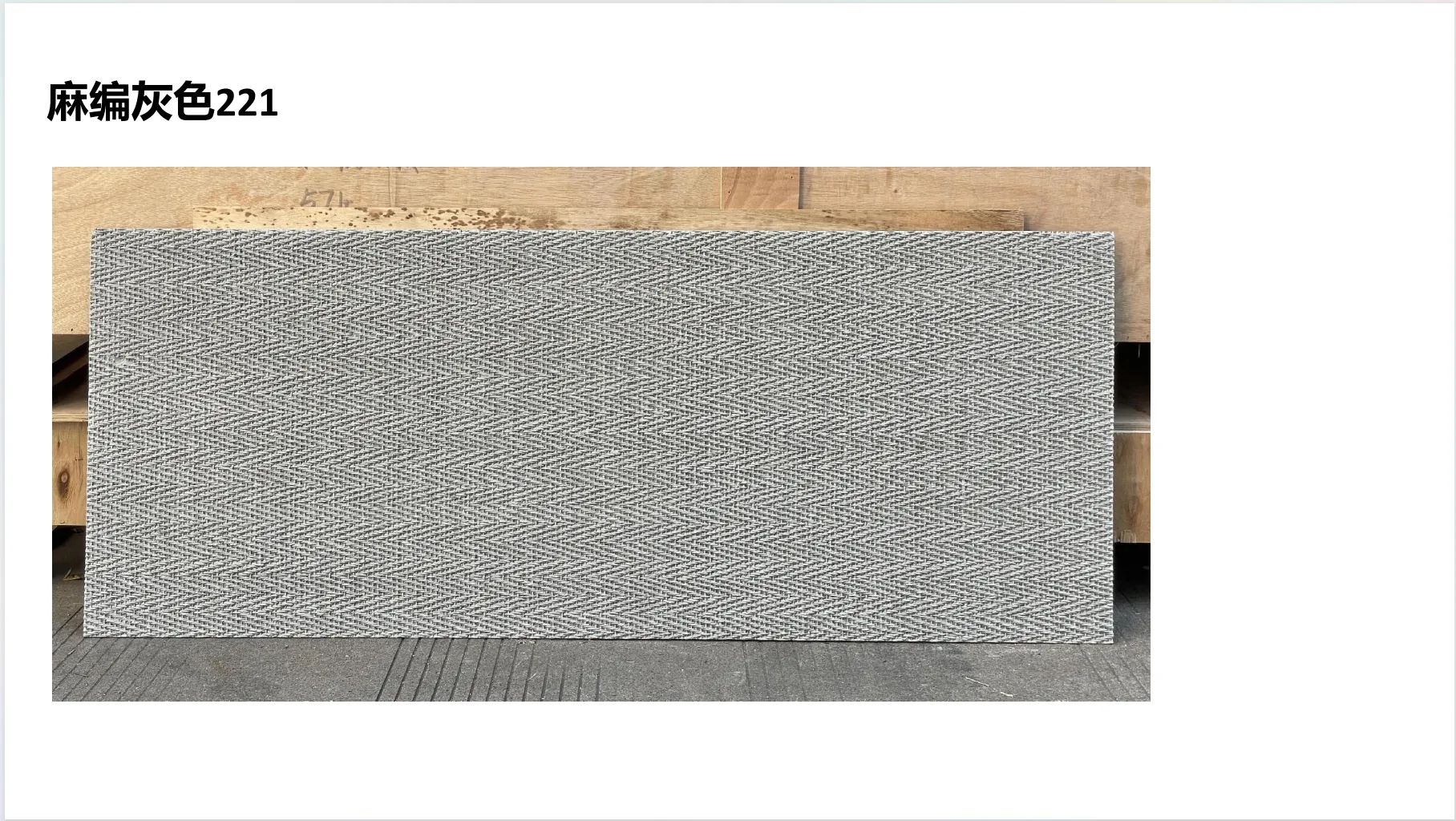
Weaving isn't just for fabrics anymore. MCM's weaving (khaki) panels are made from 100% recycled polyester fibers—think plastic bottles and textile scraps—woven into a tight, durable mesh, then bonded to a lightweight MCM substrate. Weaving Real Photos Technology enhances the texture, adding subtle variations in thread thickness and color that mimic hand-woven jute or hemp. Unlike natural fibers, which can fade or mildew, these panels are UV-resistant, moisture-proof, and easy to clean—perfect for high-traffic areas.
A café in Portland, Oregon, used them for their banquette backs and partition screens. "We wanted the space to feel cozy, like a friend's living room," says owner Jamie Liu. "The weaving panels add that softness—people run their hands over them while they wait for coffee, and it makes the space feel welcoming. And when I tell them the panels are made from old plastic bottles? Their minds are blown. It's proof that sustainability can be huggy , not harsh."
| Material | Sustainability Features | Design Flexibility | Best For |
|---|---|---|---|
| Travertine (Starry Green) | 60% recycled content, 45% less energy use than quarried stone | Replicates rare green travertine with "starry" mineral flecks | Lobbies, accent walls, high-end retail |
| Foamed Aluminium Alloy (Vintage Silver) | 100% recyclable, water-based sealant, lightweight (reduces shipping emissions) | Mimics aged metal patina; available in custom finishes | Facades, outdoor cladding, commercial buildings |
| Rammed Earth Board (Gradient) | Recycled clay/sand, low-energy compression, natural pigments | Custom gradient colors; thermal insulation properties | Residential exteriors, community centers, desert climates |
| Fair-Faced Concrete | 30% fly ash, carbon-capture curing, 35% lower emissions | Replicates hand-poured texture; customizable finish variations | Ceilings, accent walls, industrial-style interiors |
| Weaving (Khaki) | 100% recycled polyester, UV/moisture resistant | Mimics hand-woven textiles; available in multiple colors | Indoor partitions, furniture, hospitality spaces |
It's one thing to talk about sustainability in a lab; it's another to see it in action. Take the "EcoHaven" mixed-use development in Barcelona, a project that brings together all five materials we've explored. The ground-floor retail spaces feature travertine (starry green) walls, creating a warm, inviting entrance. The residential towers use foamed aluminium alloy (vintage silver) for their facades, reflecting sunlight to keep interiors cool and reducing the need for air conditioning. The community garden walls are clad in rammed earth (gradient), blending into the landscape. Inside, the lobby and hallways feature fair-faced concrete ceilings, while the rooftop lounge uses weaving (khaki) partitions for privacy.
The result? EcoHaven reduced its carbon footprint by 52% compared to similar developments, earned LEED Platinum certification, and became a neighborhood landmark. "People don't just live here—they love here," says project manager Carlos Mendez. "Parents tell me their kids point out the 'shiny walls' and 'sparkly stones' on the way to school. Seniors sit on the rooftop and run their hands over the weaving panels, saying it reminds them of their grandmother's blankets. That's the power of MCM's materials: they don't just build buildings—they build connections."
Sustainable architecture isn't a trend—it's a necessity. As we face climate change, resource scarcity, and a growing population, the buildings we create must do more with less. MCM's Weaving Real Photos Technology is just the beginning. The team is already experimenting with "living" panels that incorporate moss or algae (capturing CO2 as they grow) and self-healing materials that repair small cracks over time. "Our goal is to make sustainability so beautiful, so intuitive, that it becomes the default," says Dr. Park. "Imagine a world where every building is a story of care—for the planet, for the people who use it, for the generations to come. That's the future we're building."
At the end of the day, architecture is about people. It's about the child who touches a wall and feels wonder, the worker who walks into an office and feels pride, the community that gathers in a space and feels belonging. MCM's Weaving Real Photos Technology doesn't just make buildings sustainable—it makes them human . It reminds us that we don't have to choose between doing right by the planet and doing right by our souls. We can have both.
So the next time you walk into a building and pause, struck by its beauty, take a closer look. Maybe it's not just stone or metal or wood. Maybe it's a story—one of innovation, of respect, of a better future. And maybe, just maybe, it's MCM, weaving that story into every panel.
Recommend Products












