
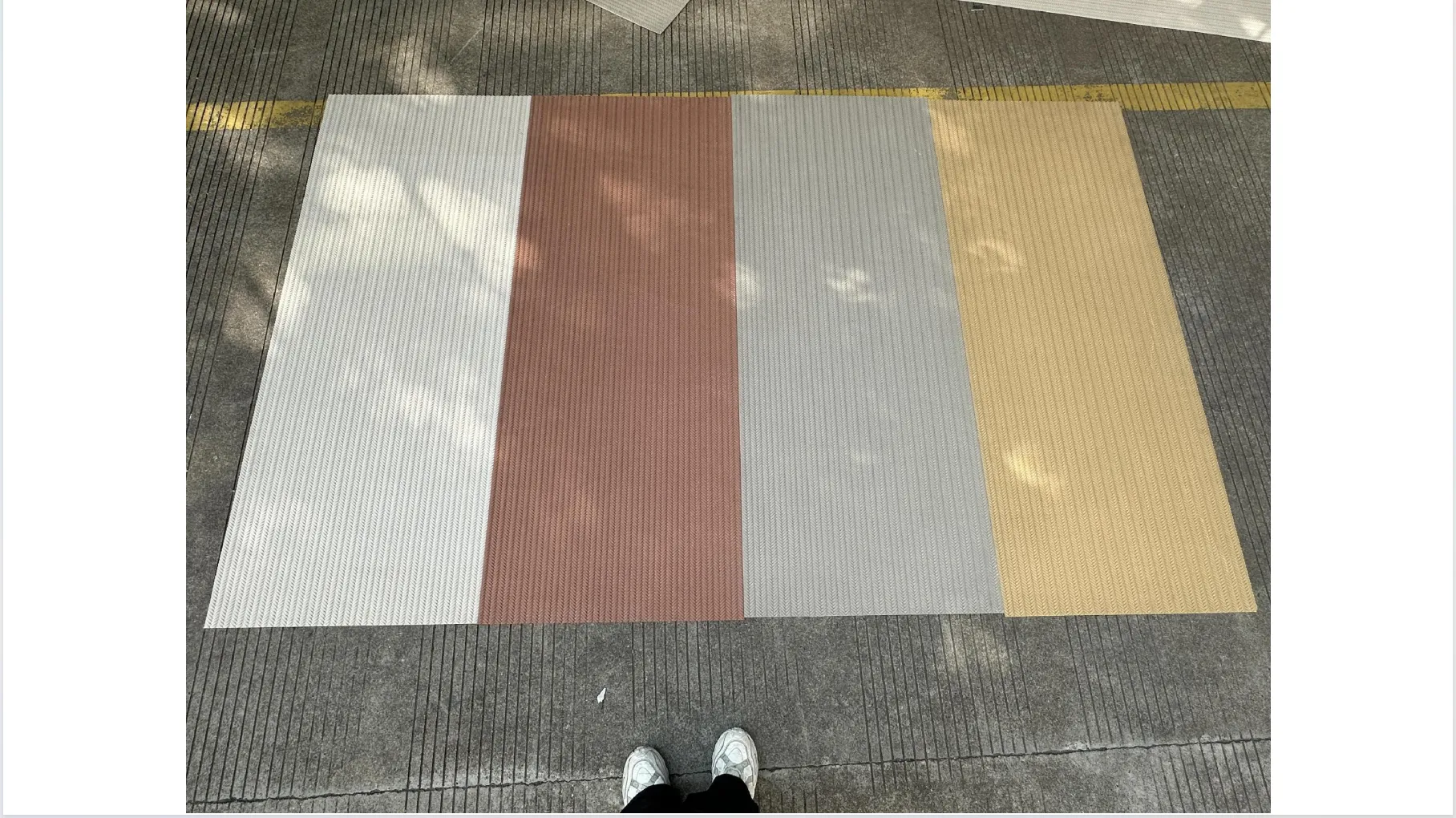
Materials speak, but not always in words. Sometimes, their language is in the grain of a wood line, the porosity of travertine, or the tightness of a woven thread. In the world of modern construction and design, MCM (Modified Composite Material) big slab boards have emerged as quiet revolutionaries—blending durability, flexibility, and aesthetic depth. But how do you judge their quality before running your hand across their surface? Enter woven real photos: those high-resolution, up-close shots that capture the texture of a "weaving (khaki)" panel or the interplay of threads in a "bamboo mat board." These images aren't just marketing tools; they're unfiltered stories about craftsmanship, resilience, and design excellence. Let's pull back the curtain and see what woven real photos really reveal about MCM big slab board quality.
In an era where architects and designers scroll through catalogs on tablets, the line between "seeing" and "experiencing" a material has blurred. Spec sheets list density and fire resistance, but they can't convey the way light catches a "weaving (jacinth)" texture at dusk or how a "wood grain board" feels underfoot. Woven real photos bridge that gap. They're the next best thing to holding a sample: a close-up of "weaving (grey)" might show individual threads aligned with military precision, while a shot of "bamboo mat board" reveals the natural variation in fiber thickness—details that hint at how the material will age, how it will interact with light, and how it will elevate a space.
For MCM big slab boards, which often mimic natural materials like travertine or slate, woven real photos are even more critical. A poorly captured image might flatten the depth of "travertine (starry green)" or wash out the metallic sheen of "lunar peak silvery," making a premium material look generic. But a high-quality woven real photo? It's a promise. It says, "This is exactly what you'll get"—and that transparency is the first sign of a manufacturer confident in their product's quality.
Walk into a luxury hotel lobby, and you might notice the "fair-faced concrete" walls—their raw, unpolished texture exuding understated elegance. Now imagine that texture paired with a "weaving (beige)" accent panel. The magic lies in how the two textures complement each other, and woven real photos capture that synergy. Look closely at a photo of "weaving (white)" in an MCM big slab board: Are the threads evenly spaced? Do the edges of the weave blend seamlessly into the board, or are there frays or gaps? These details aren't just about looks—they're about consistency, a hallmark of quality manufacturing.
Take "bamboo mat board," for example. A genuine woven real photo will show the natural irregularity of bamboo fibers—some thicker, some thinner—without compromising the overall pattern. This balance of organic variation and structural order tells you the manufacturer didn't cut corners with cheap, uniform synthetic fibers. Similarly, "wood line" MCM boards, when photographed well, reveal the subtle "grain" direction that mimics real wood, right down to the occasional knot or swirl. These are the signs of a material crafted to feel authentic, not just look it.
Quality isn't just skin-deep, and woven real photos know it. Look at a close-up of "MCM flexible stone" with a woven texture—say, "rust square line stone" paired with a thread pattern. Notice how the threads are embedded into the stone composite, not just printed on top. The lack of peeling edges or fuzzy fibers in the photo is a clue: this material is built to withstand scrubbing, humidity, and the daily wear of high-traffic areas like airports or shopping malls. Similarly, "foamed aluminium alloy board (vintage silver)" with a woven finish might show a tight, interlocking pattern in photos—this isn't just for looks; it's engineered to resist dents and scratches, ensuring the texture stays crisp for decades.
Even "fair-faced concrete," a material prized for its industrial robustness, tells durability stories through woven real photos. A high-quality shot will highlight the uniformity of its surface texture, with no uneven air bubbles or cracks—signs of controlled curing and precise manufacturing. Compare that to a photo where the concrete looks porous or patchy, and you'll instantly sense a difference in quality. Woven textures, in particular, act as "stress testers" in photos: if the weave pattern stays sharp under close magnification, it's a good bet the material itself will hold up under pressure.
MCM big slab boards aren't one-trick ponies. They adapt—from the sleek minimalism of a "fair-faced concrete" office lobby to the bohemian warmth of a "bali stone" café. Woven real photos showcase this versatility by placing textures in context: a "weaving (beige)" panel might be photographed against a neutral wall to highlight its softness, while a "rammed earth board (matcha green)" with woven accents could be shot in a sunlit atrium, proving it can stand up to bold lighting. These images answer the question: Will this texture work for my project?
To illustrate, let's look at how woven elements appear across key MCM series:
| MCM Series | Woven/Textured Highlight | Design Vibe | Quality Clue in Photos |
|---|---|---|---|
| Big Slab Board Series | Weaving (khaki), Bamboo Mat Board | Rustic-chic, organic | Threads align evenly; no loose fibers at edges |
| 3D Printing Series | Wave Panel, Thread | Modern, sculptural | 3D weave patterns have sharp, consistent angles |
| Flexible Stone Series | Travertine (starry blue) with woven threads | Natural-luxe, earthy | Stone pores and woven threads blend seamlessly |
| Wood Grain Series | Wood Line, Charcoal Burnt Wood Board | Warm, timeless | Grain direction flows naturally; no abrupt pattern breaks |
In each case, the woven real photo acts as a "mood board" and a quality check. A "wave panel" in the 3D Printing Series, for example, should have a weave pattern that repeats uniformly across the slab—no skewed lines or blurred edges. That consistency in the photo translates to consistency in installation, ensuring your design vision doesn't get derailed by material flaws.
One of MCM's greatest strengths is its ability to mimic natural materials while outperforming them. Take "travertine (starry green)"—a stone-like texture dotted with tiny, starry pores. When paired with a woven "thread" accent, the result is a material that feels both ancient and modern. Woven real photos capture this duality beautifully: a close-up might show a pore in the travertine overlapping with a woven thread, creating depth that no solid-color panel could match. Similarly, "lunar peak golden"—with its metallic, crater-like texture—becomes even more otherworldly when photographed with subtle woven undertones, proving MCM can blend the ruggedness of natural stone with the precision of engineered design.
These blends also reveal a manufacturer's attention to detail. A "travertine (vintage silver)" photo that looks flat or artificial is a red flag; a high-quality shot, though, will highlight how the woven elements enhance the stone's natural character, not mask it. The same goes for "dolomitic travertine (dark grey)" with linear threads: the photo should show the threads following the stone's natural veining, creating a cohesive look that feels intentional, not haphazard. This harmony is the mark of thoughtful material engineering.
Let's not overlook the photos themselves. Shooting a "weaving (white)" panel in harsh, direct light can wash out its texture, making it look cheap. But a manufacturer that cares about quality will invest in professional photography: soft, diffused lighting to highlight texture depth, macro lenses to capture thread details, and multiple angles to show how the material behaves in different environments. These choices aren't accidental—they reflect a commitment to transparency. If a brand is willing to zoom in on a "rough granite stone (medium grey)" and show every imperfection (or lack thereof), it's because they trust their product to stand up to scrutiny.
Consider "foamed aluminium alloy board (vintage gold)" with a woven finish. A poorly lit photo might make it look brash or garish, but a well-captured image will showcase the subtle interplay of gold tones and woven texture, proving it can add warmth without overwhelming a space. The same logic applies to "epoch stone" or "century stone"—materials designed to evoke timelessness. Their woven real photos should feel lived-in, not sterile, with textures that invite touch and storytelling.
At the end of the day, woven real photos are more than just pretty pictures. They're a manufacturer's handshake—a silent agreement that what you see is what you'll get. For MCM big slab boards, they reveal the heart of the product: the care in every thread of "weaving (jacinth)," the precision in every pore of "travertine (starry orange)," and the resilience in every inch of "fair-faced concrete." These details matter because great design isn't about grand gestures; it's about the way a "bamboo mat board" feels under your fingertips or how a "weaving (grey)" panel softens the acoustics of a room.
So the next time you're scrolling through MCM catalogs, pause on those woven real photos. Look for the alignment of threads, the consistency of texture, and the way light plays across the surface. You're not just looking at a material—you're reading its story. And if that story is one of craftsmanship, durability, and attention to detail, you've found a MCM big slab board that's worth investing in. After all, the best materials don't just fill spaces—they make them feel alive. And woven real photos? They're the first chapter of that life.
Recommend Products












