
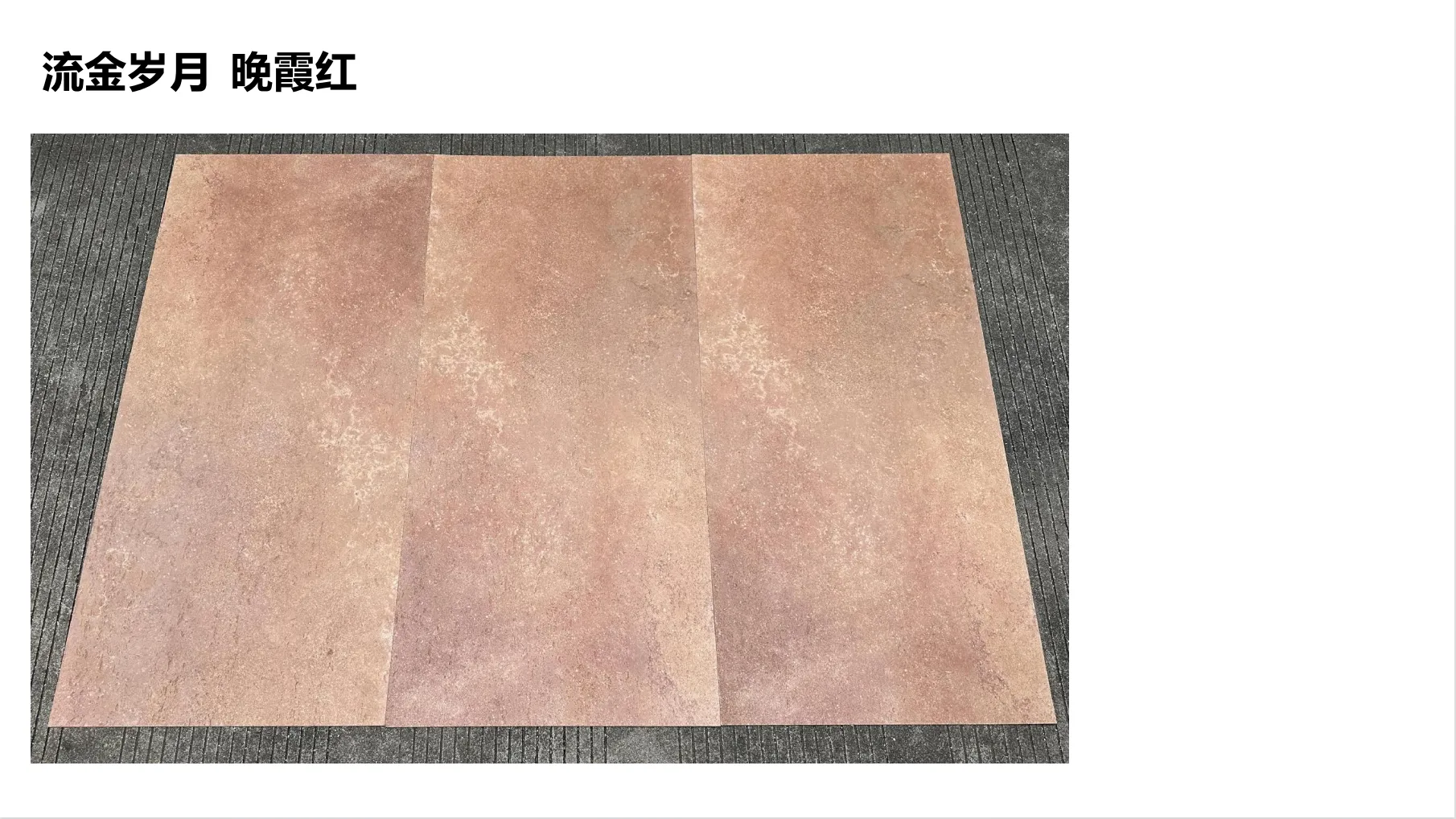
Walk into any modern café, boutique hotel, or sleek office building these days, and there's a good chance you're surrounded by a material that's quietly revolutionizing design: MCM, or Modified Cementitious Material. It's not just another construction product—it's a bridge between durability and artistry, between the raw strength of cement and the endless possibilities of creative expression. But what exactly is MCM, and why is it becoming the go-to choice for designers and homeowners alike? Let's dive in, and along the way, we'll explore some of its most stunning variants, from the warm glow of Golden Faith to the cosmic allure of Travertine (Starry Blue) .
At its core, MCM is a composite material engineered to mimic the look and feel of natural stone, wood, or metal—without the heft, fragility, or cost of the real thing. Think of it as nature's beauty, reimagined with modern science. It starts with a base of cement, but "modified" with polymers, fibers, and other additives that give it superpowers: flexibility that lets it bend without breaking, a lightweight design that makes installation a breeze, and a durability that stands up to rain, sun, and even the occasional coffee spill.
Traditional materials like marble or solid concrete are tough, sure, but they're heavy. Hauling slabs up a high-rise? Not fun. Cutting them to fit tricky corners? Risky—one wrong move, and you've got a cracked tile and a wasted budget. MCM changes the game. It's thin (often just a few millimeters thick), light enough for one person to carry, and flexible enough to curve around columns or wrap over uneven surfaces. And here's the kicker: it looks so real, you'd swear you're touching natural stone or aged wood.
Let's break down why designers are obsessing over MCM. It's not just about looks—though those are impressive. It's about solving real problems that have plagued construction and design for decades.
To really get MCM, you need to see it in spaces where it shines. Let's walk through a few real-world scenarios—no blueprints, just stories of how MCM transforms rooms from "meh" to "wow."
Picture a small café in the heart of the city, where the goal is to make customers feel like they're stepping into a friend's living room. The owner wanted something warm, inviting, and a little bit luxurious without blowing the budget. Enter Golden Faith MCM. The walls behind the counter are covered in large slabs of this material—its golden hue catches the morning light, making the space feel bright and cheerful, while its subtle texture adds depth (no flat, boring paint here). Because it's lightweight, the installers didn't need heavy machinery—they just cut it to size on-site and glued it up. Now, every latte sipped there comes with a side of "this place feels special."
A young couple building their first home wanted a showstopper in their living room—a feature wall that would be the center of attention. They loved the idea of a starry night sky but didn't want something too kitschy. Travertine (Starry Blue) MCM was the answer. This variant mimics natural travertine but with a twist: tiny, iridescent flecks that catch the light like stars. During the day, it's a calming blue-gray; at night, with the right lighting, it sparkles like the Milky Way. And because MCM is moisture-resistant, they even used a small section of it in their bathroom as a backsplash—no worries about water damage.
A tech company wanted their new headquarters to scream "innovation." They went with a sleek, modern design, and the exterior needed to match. Traditional metal panels would have been expensive and heavy, but Lunar Peak Silvery MCM offered the same metallic sheen at a fraction of the weight. The building's facade now glows silver in the sun, looking like something out of a sci-fi movie, and because MCM is weather-resistant, it'll stay that way for years—no rust, no fading, just that futuristic vibe the company was after.
A family in the suburbs wanted a kitchen that felt "country" but wasn't stuck in the past. They chose Rust Mosaic Stone MCM for their backsplash. The material is cut into small, irregular tiles that mimic the look of aged, rusted metal (but without the actual rust, thank goodness). The warm, earthy tones pair perfectly with their wooden cabinets, and because it's easy to clean, spaghetti sauce splatters wipe right off. It's rustic with a modern twist—exactly what they wanted.
With so many MCM options out there, it can feel overwhelming. To simplify, here's a breakdown of some popular types, their vibes, and where they work best.
| MCM Type | Color/Finish | Vibe | Best For |
|---|---|---|---|
| Golden Faith | Warm golden hue, subtle texture | Inviting, luxurious, cozy | Café walls, bedroom accents, fireplaces |
| Travertine (Starry Blue) | Deep blue with starry iridescent flecks | Dramatic, cosmic, serene | Living room feature walls, hotel lobbies |
| Rust Mosaic Stone | Rusty red, mosaic tile pattern | Rustic, industrial, charming | Kitchen backsplashes, outdoor patios |
| Lunar Peak Silvery | Metallic silver, smooth finish | Modern, sleek, futuristic | Office exteriors, high-end retail facades |
| Fair-Faced Concrete | Matte gray, raw concrete look | Minimalist, industrial, understated | Loft apartments, modern home interiors |
Let's be real—any new material comes with questions. Here are the ones we hear most, answered like we're chatting over coffee.
Absolutely! Most MCM products are designed to handle rain, snow, UV rays, and even extreme temperatures. Think of it as the superhero of building materials—tough on the outside, but still looking good. Just make sure to check the product specs; some variants are better for indoors only, but most outdoor-rated MCM will last for decades.
Nope! A little soap and water is usually all you need. For tougher stains (like that rogue ketchup spill at the café), a mild cleaner and a soft brush will do the trick. Avoid harsh chemicals or abrasive scrubbers—they can scratch the surface. Easy peasy.
It depends on what you're comparing it to. High-end natural stone (looking at you, marble) will cost more than MCM. And while basic concrete might be cheaper upfront, MCM saves you money in the long run: lighter weight means lower shipping and labor costs, and its durability means you won't be replacing it every few years. Plus, you get that "luxury look" without the luxury price tag. Win-win.
If you're handy with tools and have some DIY experience, you could probably tackle small projects (like a bathroom backsplash). But for large areas or exteriors, we recommend hiring a pro. They'll know how to cut it precisely, apply the right adhesive, and ensure it's sealed properly. Better safe than sorry—you don't want your beautiful new wall peeling off a year later!
MCM isn't just a material—it's a design revolution. It's for the café owner who wants to create a welcoming space on a budget, the homeowner who dreams of a starry accent wall, and the architect who needs a lightweight, durable solution for a skyscraper. It blends the best of nature and technology, proving that you don't have to choose between form and function.
And when it comes to seeing MCM's true beauty, Golden Faith real photos (and shots of Travertine (Starry Blue) , Rust Mosaic Stone , and all the rest) are worth a thousand words. They capture the texture, the color, the way light plays off the surface—details that specs and samples can't fully convey. So if you're considering MCM for your next project, do yourself a favor: look at the photos. Let them inspire you. Then, go create something amazing.
After all, design isn't just about building walls—it's about building spaces that make us feel something. And with MCM, that "something" is almost always: "Wow, this is perfect."
Recommend Products












