
Walk into any modern café, boutique hotel, or residential space today, and you'll likely notice something different about the walls, floors, or facades. Gone are the days when building materials were chosen purely for function—today, they tell stories, evoke emotions, and bridge the gap between nature and innovation. One material leading this charge is Modified Cementitious Material, or MCM. But what exactly is MCM, and how does it stand apart from traditional options like sawing wood boards? Let's dive in.
For centuries, humans have relied on what the earth provided. Wood, quarried stone, and clay bricks were the backbone of construction—materials with character, yes, but also limitations. Sawing wood boards, for instance, have long been cherished for their warmth and organic (wood grain), but they're prone to warping, rotting, and insect damage. Worse, the demand for wood has led to deforestation, a crisis that weighs heavy on eco-conscious builders and designers.
Then came the industrial age: concrete, steel, and synthetic composites took over, offering durability but often lacking soul. Cold, uniform, and disconnected from nature, these materials left many spaces feeling sterile. Enter MCM—a material born from the desire to merge the best of both worlds: the resilience of modern engineering and the beauty of natural materials, without the environmental cost.
At its core, MCM is a blend of cement, minerals, and polymers, engineered to mimic the look and feel of natural materials like stone, wood, or even metal—but with supercharged performance. Think of it as nature's beauty, reimagined through science. The "modified" in its name refers to the additives that enhance its flexibility, strength, and resistance to weather, fire, and time. Unlike rigid concrete or fragile natural stone, MCM is lightweight, bendable, and easy to install, making it a favorite among architects and contractors.
But MCM isn't a one-size-fits-all material. It's a family of products, each designed to cater to specific aesthetic and functional needs. From the MCM 3D printing series that lets designers create custom textures to the MCM big slab board series for seamless, grand surfaces, MCM adapts to the vision, not the other way around.
Sawing wood boards have their charm—there's a reason they've been used for millennia. The way light filters through wood grain, the warmth they add to a room, the nostalgia of a handcrafted table—these are hard to replicate. But in a world where sustainability and longevity matter as much as aesthetics, MCM offers a compelling alternative. Let's break down the differences.
| Feature | MCM | Sawing Wood Boards |
|---|---|---|
| Durability | Resistant to water, mold, insects, and fire; lasts 50+ years with minimal maintenance. | Prone to warping, rotting, and termite damage; requires regular sealing and replacement every 10–15 years. |
| Sustainability | Uses recycled materials; reduces reliance on deforestation; low carbon footprint in production. | Requires logging, contributing to deforestation; slow regrowth of hardwoods makes it resource-intensive. |
| Design Flexibility | Available in hundreds of textures, colors, and finishes (e.g., travertine starry green, lunar peak silvery, rust square line stone). | Limited by natural wood grain patterns; staining can alter color but not texture. |
| Installation | Lightweight (3–5 kg/m²) and flexible; can be cut, curved, or 3D-printed on-site. | Heavy; requires precise cutting and sealing; prone to splintering. |
| Cost Over Time | Higher upfront cost but lower long-term maintenance and replacement expenses. | Lower upfront cost but high maintenance (sealing, repairs) and frequent replacements. |
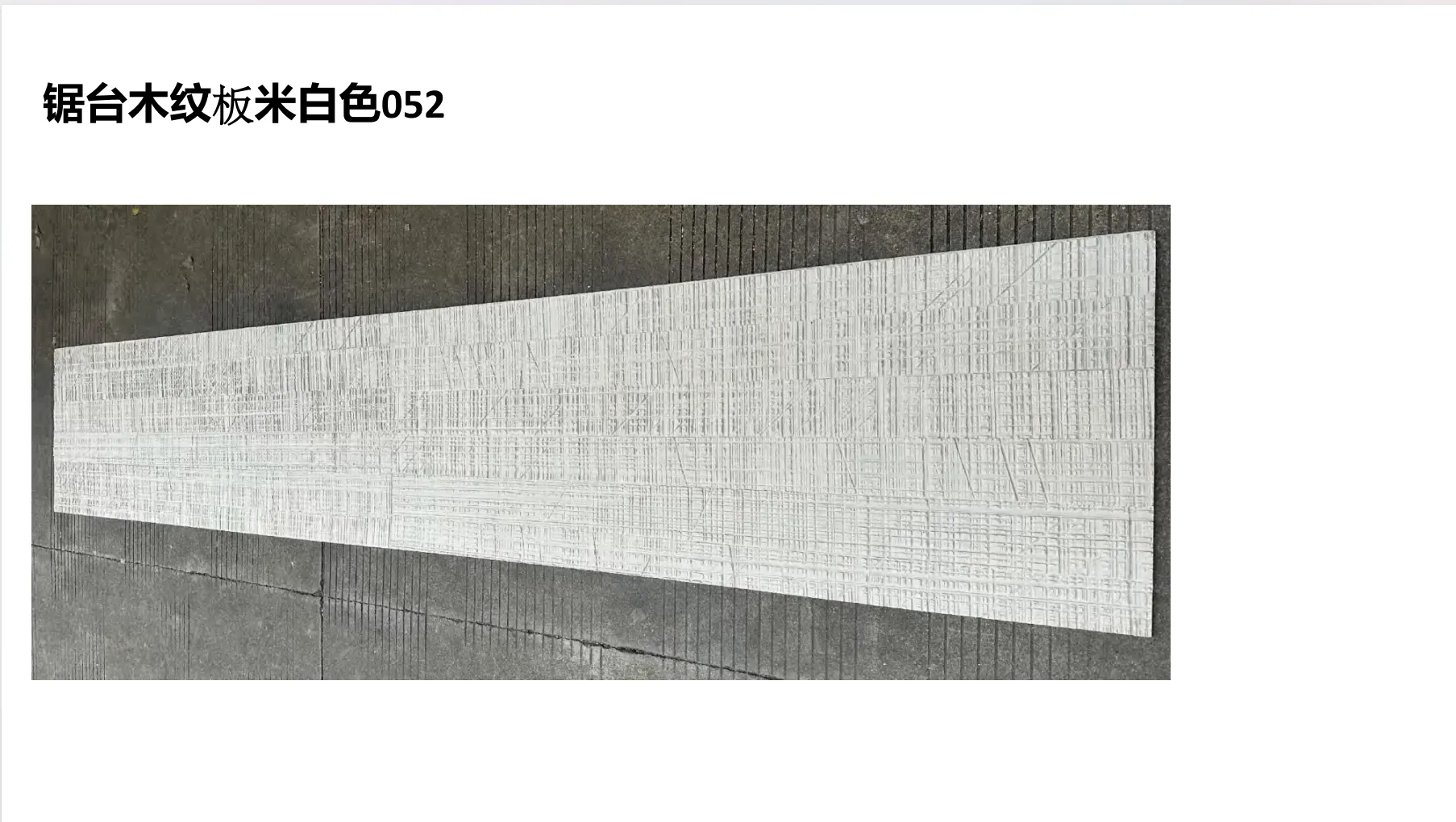
Take, for example, a restaurant owner choosing between sawing wood boards and MCM wood grain board for their walls. The wood grain board offers the same warm, organic look as real wood but won't swell in humid kitchens or attract pests. It's a small shift that saves time, money, and stress down the line—all while keeping the space's cozy vibe intact.
What truly sets MCM apart is its versatility. It doesn't just mimic one material—it channels the essence of dozens, each with its own personality. Let's explore some of the most popular MCM series and products, and how they're transforming spaces.
Imagine a stone wall that curves like fabric, wrapping around a staircase or hugging a rounded facade. That's the magic of MCM flexible stone. Unlike traditional stone, which cracks under pressure, MCM flexible stone can bend up to 30 degrees without breaking. It's perfect for architects pushing the boundaries of geometric design—think organic, flowing shapes in lobbies or statement walls in retail spaces. One standout variant? Travertine (starry green), which mimics the look of natural travertine but with a twist: tiny, iridescent flecks that catch the light like stars in a forest canopy. It's nature, but make it whimsical.
In a world that craves uniqueness, the MCM 3D printing series is a game-changer. Designers can upload custom textures—from the ripples of a stream (stream limestone, claybank) to the rough-hewn edges of a mountain (lunar peak black)—and have them printed directly onto MCM panels. This isn't just about aesthetics; it's about storytelling. A hotel inspired by the Gobi Desert, for instance, might use the gobi panel to recreate the desert's undulating dunes on its exterior. Or a tech startup could opt for foamed aluminium alloy board (vintage silver) to channel an industrial, futuristic vibe—all without the weight or cost of real metal.
For spaces that demand drama—airport terminals, luxury malls, or sprawling (villas)—size matters. The MCM big slab board series delivers panels up to 3 meters in length, creating seamless surfaces with minimal joints. Picture a lobby floor made of boulder slab (vintage gold), its warm metallic hue stretching from wall to wall, unbroken by grout lines. It feels expansive, luxurious, and meticulously crafted. And because the slabs are lightweight, installation is faster and safer than hauling massive natural stone slabs—no cranes required.
Travertine has long been a staple in high-end design, loved for its porous, earthy texture. MCM takes this classic and turns it up to 11 with variants like travertine (starry red), (starry orange), and (starry blue)—each embedded with colored particles that mimic the night sky. A boutique hotel in Santorini might use travertine (starry blue) in its rooftop bar, where the walls glow softly under string lights, blending the island's blue domes with a celestial touch. For a more understated look, there's travertine (vintage silver), which adds a modern, muted elegance to offices or minimalist homes.
If travertine is about warmth, the lunar peak series is about mystery. Lunar peak silvery, golden, and black channel the otherworldly beauty of moonlit landscapes—silvery whites that glow like moonlight, deep blacks that absorb light like a lunar eclipse, and golds that shimmer like stardust. These panels are a favorite for modern homes and tech spaces, where the goal is to create an atmosphere of calm sophistication. Imagine a home theater with lunar peak black walls, where the only light comes from the screen and the faint glow of the panels—immersive, intimate, and utterly transportive.
At the end of the day, MCM isn't just a building material—it's a collaborator. It adapts to the designer's vision, the client's needs, and the environment's demands. Let's look at a hypothetical case study to see how it all comes together.
Meet Maya, an interior designer tasked with creating a beachfront café in Bali. The client wants the space to feel "tropical but timeless," with nods to local culture and minimal environmental impact. Maya immediately rules out sawing wood boards—Bali's humidity would warp them within a year. Instead, she turns to MCM.
For the walls, she chooses Bali stone, an MCM variant that mimics the rough, sun-bleached stone of Balinese temples. The floors get bamboo mat board, which looks like woven bamboo but won't rot or attract bugs. The bar facade? Stream limestone (claybank), its rippled texture evoking the nearby ocean. To add a pop of color, she uses travertine (starry orange) for the accent wall behind the counter—tiny orange flecks that echo the sunset over the water. The result? A space that feels deeply rooted in Bali's landscape, but built to last through monsoons and salt air.
Maya's story isn't unique. From urban apartments to rural retreats, MCM is proving that sustainability and beauty don't have to be trade-offs. It's a material that respects the past—channeling the warmth of wood, the grandeur of stone—while embracing the future of design.
As we face growing climate challenges, the demand for eco-friendly, durable building materials will only rise. MCM isn't just a trend; it's a step toward a more sustainable, creative, and connected built environment. It asks us to rethink what's possible: Do we need to cut down trees to have warm, inviting spaces? Do we need to mine mountains to get the look of stone? With MCM, the answer is no.
Sawing wood boards will always hold a special place in design history—they're a reminder of our roots. But MCM is the next chapter: a material that honors tradition while writing new rules. It's for the designer who wants to create a wall that curves like a wave, the homeowner who refuses to choose between beauty and durability, and the planet that deserves materials as resilient as the people who inhabit it.
So the next time you walk into a space that takes your breath away, take a closer look at the walls. Chances are, you're standing in front of MCM—proof that innovation and soul can coexist, one panel at a time.
Recommend Products












