
Walk into any old European city, and you'll feel it—the weight of history underfoot. Cobblestones worn smooth by centuries of footsteps, church facades carved from golden stone, and public squares lined with columns that have stood since emperors ruled. Much of that timeless beauty comes down to one material: travertine. For millennia, this natural stone has been the backbone of grand architecture, from Rome's Colosseum to the steps of the U.S. Capitol. But here's the thing about history: it doesn't stand still. Today, a new contender has emerged, blending the best of tradition with cutting-edge innovation. It's called Modified Cementitious Material, or MCM for short. And it's not just challenging travertine—it's redefining what building materials can do.
Let's start with the classic. Travertine is a form of limestone, born from mineral-rich hot springs. As water flows over rocks, it deposits calcium carbonate, layer by layer, creating a stone with unique pores, soft veining, and a warm, earthy tone. The ancient Romans fell in love with it. They quarried massive blocks from Tivoli, a town east of Rome, and used them to construct some of the world's most iconic structures. The Pantheon's dome? Travertine. The Colosseum's exterior? Travertine. Even today, when you run your hand over a travertine wall, you can almost feel the echoes of chisels and the bustle of ancient builders.
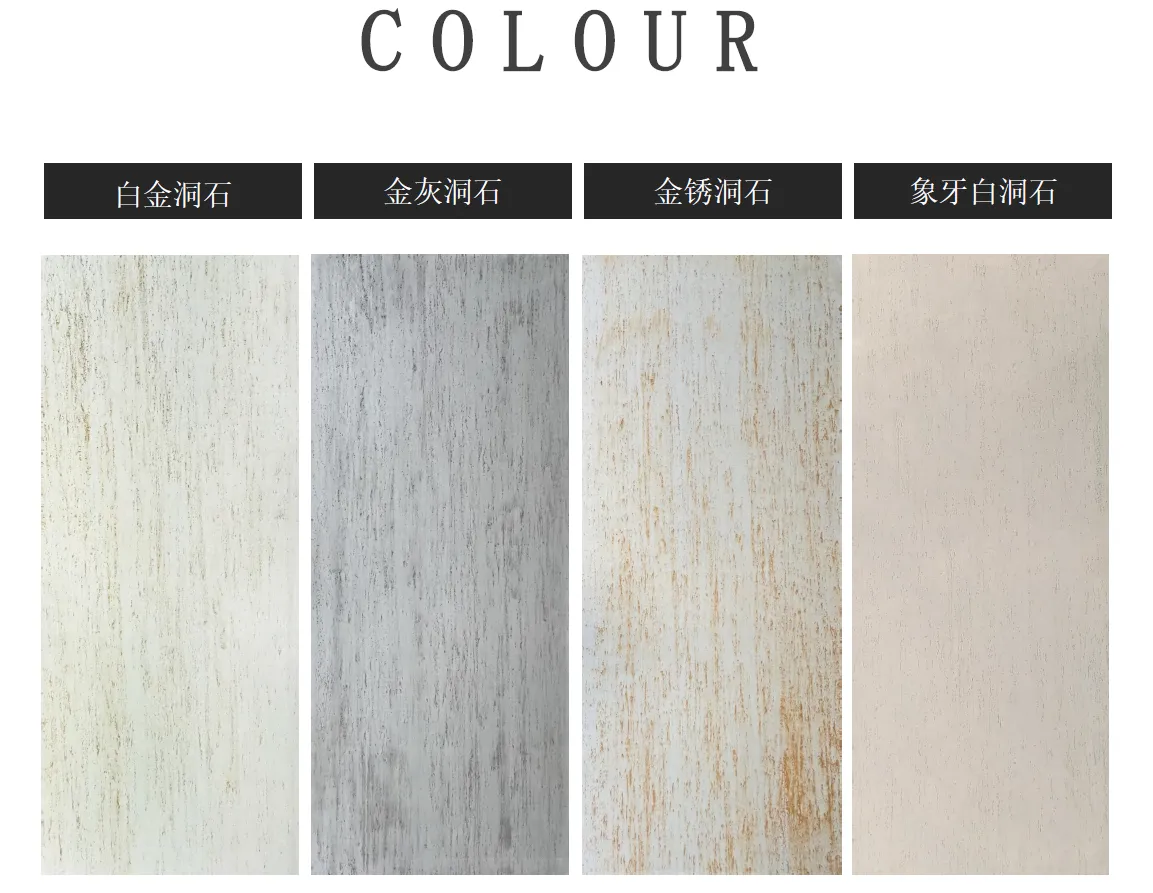
But travertine isn't just about history—it's about texture. Take travertine (starry green) , for example. This variety shimmers with tiny, iridescent flecks that catch the light like scattered emeralds, turning a plain wall into a night sky. It's the kind of stone that makes you pause, that adds depth to a room, that feels alive. No two slabs are the same; each carries the unique fingerprint of the earth that formed it. That's the magic of natural stone—but it's also its limitation.
Traditional travertine is heavy. A single slab can weigh 20–30 kilograms per square meter, requiring reinforced walls and specialized labor to install. It's porous, too, meaning it soaks up spills like a sponge and needs regular sealing to avoid stains. And while its natural veining is beautiful, it's unpredictable—you can't ask for a specific pattern or color. If you want a wall that matches your vision exactly, travertine might leave you.
Fast forward to the 21st century. Architects and designers are no longer bound by the constraints of natural stone. Enter MCM: a composite material made from cement, mineral aggregates, and a reinforcing mesh, engineered to be lightweight, flexible, and infinitely customizable. Think of it as stone, but reimagined. It looks and feels like the real thing—warm, textured, authentic—but it bends, cuts, and installs like a dream. And at the heart of this revolution is mcm flexible stone .
MCM flexible stone is a marvel of modern engineering. At just 3–5 kilograms per square meter, it's a fraction of the weight of traditional travertine. But don't let its lightness fool you—it's tough. It resists moisture, UV rays, and even fire, making it suitable for everything from kitchen backsplashes to outdoor facades. And "flexible" isn't just a buzzword: this material can bend up to 90 degrees, hugging curves and uneven surfaces that would crack rigid stone. Imagine wrapping a column in a seamless, stone-like finish, or adding a textured accent wall to a curved staircase—with MCM, it's possible.
Traditional stone is rigid by nature. Installers have to work around its limitations, building extra support or avoiding complex designs altogether. MCM flips that script. Its flexibility means it can be applied to almost any surface: drywall, metal, wood, even existing tile. No need for heavy machinery or structural overhauls. A small team can install it in hours, not days, cutting down on labor costs and project timelines. For homeowners and businesses alike, that's a game-changer.
Curious how these two stack up? Let's put mcm flexible stone and travertine (starry green) side by side. This table breaks down their key features, so you can see why MCM is quickly becoming the go-to for modern designers.
| Features | MCM Flexible Stone | Travertine (Starry Green) |
|---|---|---|
| Weight | Lightweight (3–5 kg/m²) – no structural reinforcement needed | Heavy (20–30 kg/m²) – requires sturdy walls and support beams |
| Flexibility | Bends up to 90 degrees; ideal for curved surfaces | Rigid; prone to cracking if stressed or installed on uneven walls |
| Installation | DIY-friendly (with basic tools); cuts easily with a utility knife | Needs professional stonemasons; requires wet cutting and mortar |
| Design Options | Custom colors, patterns, and textures (think: metallic finishes, geometric prints, or even 3D effects) | Limited by natural variation; "starry green" veining is unique but not customizable |
| Maintenance | Stain-resistant; wipe clean with soap and water (no sealing required) | Porous; needs annual sealing to prevent water damage and staining |
| Durability | Resists fading, chipping, and moisture – lasts 20+ years outdoors | Susceptible to weathering; may develop cracks or discoloration over time |
MCM isn't a one-trick pony. While mcm flexible stone steals the spotlight, the MCM family includes a range of materials designed to suit every aesthetic. Let's explore a few standouts that are turning heads in the design world.
Ever wanted the look of a massive stone boulder sliced into panels, but without the hassle of moving actual rock? That's boulder slab in a nutshell. MCM boulder slabs mimic the rough, hewn texture of natural stone, complete with deep grooves and uneven edges that scream "mountain cabin" or "rustic retreat." But unlike real boulders, these slabs are lightweight and easy to install. They're perfect for accent walls in living rooms, outdoor fireplaces, or even restaurant facades aiming for that "cozy yet bold" vibe.
And here's the kicker: boulder slab comes in vintage finishes, like silver, gold, and black. Imagine a feature wall in a modern apartment, clad in vintage black boulder slab, paired with warm wood floors and brass fixtures. It's rugged meets refined—a look that's hard to pull off with traditional stone.
Not all MCM products are stone-like. Take foamed aluminium alloy board (vintage silver) , for example. This material blends the industrial cool of metal with the lightweight practicality of MCM. It's made by foaming aluminium alloy, creating a panel with tiny air pockets that reduce weight while adding strength. The vintage silver finish gives it a weathered, almost steampunk feel—think old factory beams meets modern minimalism.
Designers love it for commercial spaces: coffee shops with exposed brick walls, co-working spaces aiming for an "urban loft" aesthetic, or boutique hotels wanting to balance edginess with warmth. It's also surprisingly versatile. Use it as a backsplash in a kitchen, a ceiling panel in a lobby, or even as cladding for a retail storefront. And because it's aluminium, it's resistant to corrosion—making it ideal for coastal areas where salt air can eat away at other metals.
Texture is everything in design. It's what makes a space feel inviting, layered, and alive. Enter weaving (khaki) —an MCM texture that mimics the look of handwoven fabric, but in a durable, wall-ready panel. Imagine the soft, crisscross pattern of a khaki-colored woven mat, enlarged and rendered in stone-like material. It adds depth to a room without overwhelming it, perfect for bedrooms, home offices, or hotel lobbies where calm is key.
The beauty of weaving (khaki) lies in its subtlety. It's not a bold statement piece, but a quiet contributor to a room's mood. Pair it with warm lighting, and it glows; pair it with cool tones, and it adds a touch of earthiness. And because it's MCM, it's easy to clean—no worrying about dust trapped in woven fibers or stains seeping into fabric.
Gone are the days when walls had to be smooth and plain. Today's designers crave texture—rough, soft, woven, hewn—and MCM delivers. From the stone-like pores of flexible stone to the woven patterns of weaving (khaki) , these materials let you add tactile interest without sacrificing durability. It's design for the senses: not just what you see, but what you feel when you run your hand across a wall.
In a world where "green" isn't just a trend but a necessity, MCM has another ace up its sleeve: sustainability. Traditional stone mining is resource-intensive. Quarrying travertine requires heavy machinery, which burns fossil fuels, and transporting massive slabs adds to a project's carbon footprint. MCM, on the other hand, is engineered to be eco-friendly from the start.
Many MCM products use recycled materials, like crushed stone dust or reclaimed aggregates, reducing the need for virgin resources. The manufacturing process is also energy-efficient, with most producers using low-temperature curing methods that cut down on greenhouse gas emissions. And because MCM is lightweight, transporting it uses less fuel than hauling traditional stone. For architects and builders aiming for LEED certification or other green building standards, that's a big win.
But sustainability isn't just about production—it's about longevity. MCM products are built to last, reducing the need for frequent replacements. A well-installed MCM wall can last 20–30 years with minimal maintenance, outperforming many traditional materials that degrade over time. And when it does reach the end of its life, some MCM products are recyclable, closing the loop on the material's lifecycle.
Still not convinced? Let's look at how MCM is being used in real projects around the world.
Take the case of a family in Portland, Oregon, who wanted to renovate their 1950s ranch home. They loved the idea of a stone fireplace but worried about the weight—their living room wall wasn't reinforced. Enter mcm flexible stone in a warm beige tone. The installer cut the panels to fit the fireplace's curved edges, applied them with adhesive, and voilà: a stone-like fireplace that didn't require structural changes. The family even added weaving (khaki) panels to the adjacent accent wall, creating a cozy, textured nook for reading.
A boutique hotel in Barcelona wanted to stand out in a crowded market. Their theme? "Old World meets New." They used travertine (starry green) for the lobby floor (paying homage to local stone), but opted for foamed aluminium alloy board (vintage silver) for the reception desk and ceiling panels. The result? A space that feels both timeless and contemporary, with materials that tell a story about the hotel's identity.
Cities are also embracing MCM. A park in Seoul, South Korea, recently renovated its outdoor pavilion, choosing boulder slab (vintage gold) for the walls. The material withstands rain, snow, and heavy foot traffic, while its warm gold tone complements the park's natural surroundings. Kids climb on the walls (don't tell the maintenance crew), and visitors snap photos of the interplay between the rough boulder texture and the sleek modern roof. It's public art meets practical design.
Travertine isn't going anywhere. Its beauty and history are irreplaceable, and there will always be projects that demand the real thing. But MCM isn't trying to replace travertine—it's offering a new chapter. It's for the homeowner who wants stone-like beauty without the hassle, the designer who craves customization, and the builder who needs materials that keep up with modern demands.
As technology advances, we can expect even more innovation from MCM. Imagine panels that change color with temperature, or MCM infused with air-purifying materials. The possibilities are endless. But for now, one thing is clear: MCM has earned its place alongside travertine as a material that shapes the spaces we live, work, and play in.
So the next time you walk into a room and feel that "wow" factor—whether it's a cozy fireplace, a sleek lobby, or a rugged outdoor pavilion—take a closer look. It might just be MCM, quietly revolutionizing the way we build, one flexible, lightweight, beautiful panel at a time.
Recommend Products












