
There's a moment each day when the world seems to hold its breath—the golden hour. That soft, honeyed light that spills over rooftops, gilds city streets, and turns ordinary scenes into something almost ethereal. For photographers, it's the holy grail of lighting; for designers, it's a chance to make materials sing. But here's the thing: not all surfaces can keep up with that magic. Some fade, others look flat, and a few even clash with the warm glow. Enter MCM Big Slab Boards—a collection of building materials so in tune with light and color that they don't just survive the golden hour; they thrive in it. In this article, we're diving into why these slabs have become the unsung heroes of golden sunset photography, exploring their textures, tones, and the way they dance with that fleeting, beautiful light.
Before we get lost in the glow of golden sunsets, let's ground ourselves in what makes MCM Big Slab Boards unique. These aren't your average construction materials. MCM, short for Modified Composite Material, is a blend of natural minerals, polymers, and fibers—engineered to be lightweight, durable, and incredibly versatile. The "Big Slab" part? Exactly what it sounds like: large-format panels (think 1200x2400mm or bigger) that create seamless, sweeping surfaces. No grout lines breaking up the view, no tiny tiles to distract—just pure, uninterrupted texture and color. That's a game-changer for photography, where continuity and flow can make or break a shot.
But here's where they really shine (pun intended): MCM Big Slab Boards are designed with light interaction in mind. Unlike glossy marbles that can feel harsh under direct sun or matte concretes that absorb too much warmth, these slabs strike a balance. They've got texture—subtle ridges, pockmarks, veining—that catches light from every angle, but they're not so rough that they look messy. They've got color depth—hues that shift when the light changes, from soft beiges at noon to rich golds at dusk. And because they're engineered, they're consistent. No two natural stones are alike, which can be charming, but for a photographer chasing a specific mood? Consistency means reliability. You know exactly how that slab will look when the sun dips to 10 degrees, and that's priceless.
Pro Tip for Photographers: When shooting MCM Big Slab Boards at golden hour, try angling your camera slightly upward. The large, flat surface will reflect the sky's warm tones, while the texture adds depth—creating a foreground that feels both expansive and intimate. It's a trick that turns a simple wall into a storytelling element.
Golden hour light is warm, diffused, and full of red, orange, and yellow wavelengths. It's the kind of light that makes skin look radiant, landscapes look lush, and yes—building materials look like they've been dipped in liquid gold. But to truly harness that, a material needs to do two things: reflect the right tones and absorb the rest. MCM Big Slab Boards excel here because they're not just "colored"; they're layered .
Take, for example, the way light hits a slab of Travertine (Starry Orange). Travertine is a natural stone known for its porous, honeycomb-like texture—those tiny holes and grooves that give it character. MCM's version amplifies that texture, adding "starry" flecks of metallic orange that catch the light. When the sun is low, those flecks don't just reflect the light—they scatter it, creating a subtle sparkle that mimics the sky at dusk. It's not glittery or over-the-top; it's more like the way sunlight filters through autumn leaves—dappled, warm, and full of life.
Then there's the color palette. Many MCM Big Slab Boards are designed with earthy, warm tones as their base: beiges, terracottas, soft golds. These are the same tones that dominate the golden hour, so there's no clashing. Instead, the slabs act like a canvas, letting the sunset's colors paint them rather than fighting against them. A slab of Golden Travertine (White Golden), for instance, has a creamy, off-white base with veins of pale gold running through it. In midday light, it's elegant and understated. But at sunset? Those gold veins come alive, glowing like liquid sunlight against the ivory backdrop. It's not just a surface—it's a collaboration between the material and the sky.
Not all MCM Big Slab Boards are created equal when it comes to golden sunsets. Some have textures that play better with light, others have color gradients that mirror the sky, and a few even have metallic hints that catch that last ray of sun. Let's meet the standouts:
| Product Name | Core Color & Texture | How It Interacts with Golden Light | Best For |
|---|---|---|---|
| Travertine (Starry Orange) | Warm terracotta base with porous texture and metallic orange "star" flecks | Metallic flecks scatter light, creating a "starry" glow; porous texture softens harsh shadows | Accent walls, outdoor patios, or focal points in sunset-facing rooms |
| Golden Travertine (White Golden) | Creamy white base with thin, irregular gold veins | Veins glow under golden light, turning the slab into a "lit from within" effect | Large feature walls, countertops, or minimalist exteriors |
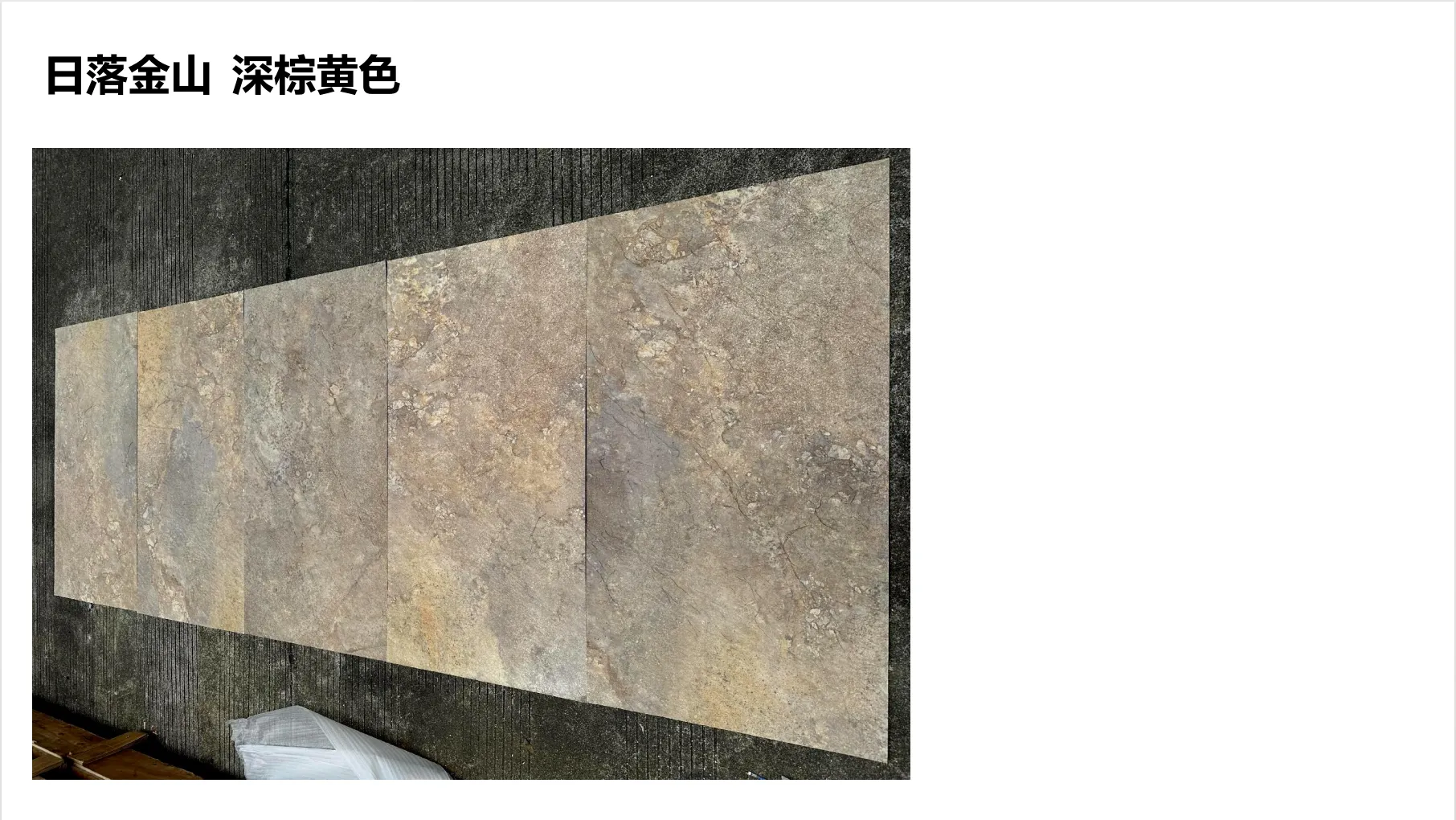
| Lunar Peak Golden | Deep, earthy brown base with shimmering golden particles and subtle linear texture | Golden particles mimic moonlight (hence "Lunar Peak") but also amplify sunset warmth; linear texture creates depth in side-lighting | Rustic or industrial-inspired spaces, outdoor fireplaces, or textured facades |
| Fair-Faced Concrete | Soft gray base with a smooth, matte finish and tiny aggregate specks | Neutral tone acts as a "blank canvas," reflecting golden light without overwhelming the scene; aggregate specks add subtle texture | Modern, minimalist backdrops, urban photography, or pairing with bolder slabs |
Let's zoom in on a couple of these to really understand their magic. Take Lunar Peak Golden. At first glance, it's a rich, chocolatey brown slab with a slightly rough, almost stony texture. But run your hand over it, and you'll notice something—those "shimmering golden particles" aren't just for show. They're microscopically small, mixed into the composite material, so they catch light from every angle. At golden hour, when the sun is low, those particles light up like a field of fireflies—subtle, but enough to add warmth and depth. It's the kind of slab that makes you want to reach out and touch it, to see if that glow is real (spoiler: it is).
Then there's Fair-Faced Concrete, the quiet achiever. You might be thinking, "Concrete? In golden hour photos?" Hear us out. Concrete's neutral gray might seem like it would clash with warm light, but in reality, it's the perfect complement. Gray is a mix of all colors, so it reflects the golden tones without adding its own hue—letting the sunset be the star. Those tiny aggregate specks? They're like little mirrors, catching and scattering the light just enough to keep the surface from looking flat. Pair it with a bold slab like Travertine (Starry Orange), and you've got contrast: the concrete calms the scene, while the travertine adds energy. It's photography 101—balance—and MCM nails it.
Here's a truth photographers know well: light loves texture. A smooth, flat wall might reflect light evenly, but it won't create shadows, depth, or that "lived-in" feel that makes a photo relatable. Texture, on the other hand, gives light something to play with—crevices to darken, ridges to highlight, and surfaces to soften. MCM Big Slab Boards are obsessed with texture, and that's why they're so good in golden hour shots.
Consider the Ripple Board (White), another MCM favorite. Its surface isn't flat; it's covered in gentle, wave-like ridges that rise and fall like a calm ocean. When the golden light hits it, those ridges cast tiny shadows—soft, not harsh—that create a sense of movement. It's like the slab itself is breathing, the way the sun dips below the horizon. A photo of a Ripple Board wall at sunset doesn't just show a wall; it shows a moment —the light changing, the shadows shifting, time passing.
Or take the Wood Grain Board, which mimics the look of weathered oak with deep, tactile grooves. In golden light, those grooves act like little light traps—some catch the sun, others hide in shadow—creating a pattern that feels organic and alive. It's the difference between a photo that looks "staged" and one that looks "real." People don't just see a wall; they imagine running their fingers over the grain, feeling the warmth of the wood, and suddenly, the photo has a story.
Let's be real: as much as we love talking about aesthetics, photographers have practical needs too. Heavy materials are a hassle to transport, fragile slabs can chip during shoots, and some surfaces require constant cleaning to look their best. MCM Big Slab Boards check all the practical boxes, making them as photographer-friendly as they are beautiful.
First, they're lightweight. Traditional natural stone slabs can weigh 50+ kg per square meter; MCM versions? Closer to 15 kg. That means you can set up a backdrop in minutes, move slabs around to chase the light, or even shoot on location without needing a crew. For a solo photographer working at golden hour (which, let's face it, is a race against time), that's a game-changer.
They're also durable. Scratches? Stains? Water damage? MCM slabs laugh them off. That means you can shoot outdoors in dewy grass, set up props directly on the surface, or even get a little creative with lighting (hello, spray bottles for "rain" effects) without worrying about ruining the material. And because they're fade-resistant, you can shoot the same slab at golden hour week after week, and it will look just as vibrant as the first time.
Finally, they're versatile. MCM Big Slab Boards come in large formats, but they can also be cut to size, curved, or even applied to irregular surfaces. Want a custom backdrop for a sunset portrait? Cut a slab to fit your studio wall. Need to mimic a desert landscape for a commercial shoot? Use Gobi Panels (another MCM favorite with a sandy, windswept texture) to create rolling "dunes." The possibilities are endless, and for photographers, endless possibilities mean endless creativity.
Let's step out of the studio and into the real world. How do MCM Big Slab Boards perform in actual sunset scenarios? We talked to a few designers and photographers who've used them, and their stories speak for themselves.
Take the "Sunset Lounge" project in Barcelona—a rooftop bar with an exterior clad in Lunar Peak Golden slabs. The designer, Carlos, wanted the space to feel "like sitting inside a golden hour that never ends." At sunset, the Lunar Peak Golden slabs turn into something extraordinary: the metallic particles in the slab catch the last rays of sun, and the deep brown base soaks up the warm light, creating a cocoon-like atmosphere. "Photographers line up to shoot here," Carlos laughs. "They say it's like the building itself is glowing from the inside."
Then there's the home of Lisa, a travel photographer in Arizona, who used Travertine (Starry Orange) on her backyard patio wall. "Arizona sunsets are intense—bright oranges, deep reds, and then that soft gold as it fades," she says. "I wanted a wall that could keep up. The Travertine (Starry Orange) doesn't just reflect the colors; it adds to them. The starry flecks look like little embers, and the porous texture softens the light so it doesn't glare in photos. Now, my backyard isn't just a place to relax—it's my favorite photoshoot location."
And let's not forget commercial projects, like the "Ember" restaurant in Tokyo, which features Golden Travertine (White Golden) on its interior walls. The chef wanted the dining room to feel "warm and inviting, like eating in a sunlit garden at dusk." The golden veins in the travertine catch the restaurant's soft lighting, but it's the sunset views through the floor-to-ceiling windows that really make the slabs shine. "When the sun sets, the walls turn into this creamy, golden canvas," says the restaurant's manager. "Guests take photos of their food, but half the time, they're really taking photos of the walls. It's become part of the experience."
Golden hour is fleeting. It lasts, at most, an hour a day (sometimes less, depending on the season). For photographers and designers, that means every second counts. MCM Big Slab Boards don't just make the most of that time—they extend it. They're engineered to catch light, to hold color, and to turn ordinary surfaces into extraordinary backdrops. Whether it's the starry sparkle of Travertine (Starry Orange), the warm veins of Golden Travertine (White Golden), or the celestial glow of Lunar Peak Golden, these slabs don't just look good in golden hour photos—they elevate them.
So the next time you're chasing that perfect sunset shot, remember: the right material can make all the difference. MCM Big Slab Boards aren't just building materials; they're collaborators. They work with the light, they enhance the color, and they turn moments into memories. And in the end, isn't that what photography is all about?
Recommend Products












