

Walk into any award-winning high-end home or sleek commercial space these days, and there's a quiet star stealing the show: Bali Stone. It's not the flashiest material in the architect's toolkit—no marble's icy sheen or concrete's stark minimalism—but there's something about it that makes designers pause, run a hand over its surface, and say, "This is the one." What is it about Bali Stone that has become a go-to for those crafting spaces that feel both luxurious and lived-in? Let's dive into the reasons why this natural stone has cemented its place as a favorite among the industry's most discerning creators.
Architects don't just design buildings—they design experiences. And Bali Stone, with its earthy palette and organic veining, has a unique ability to turn "space" into "place." Unlike the cool uniformity of fair-faced concrete or the sometimes sterile smoothness of polished surfaces, Bali Stone brings warmth. Its tones range from soft, sunlit beiges that evoke desert mornings to deeper, weathered grays that whisper of ancient cliffs, with subtle flecks of gold or cream that catch the light like scattered sunlight. It's a material that doesn't shout; it invites. In a high-end residential project in Beverly Hills, for example, the architect used Bali Stone for the entire living room accent wall. Paired with floor-to-ceiling windows and a wood-burning fireplace, the stone didn't compete with the view—it grounded it, making the space feel like a cozy retreat rather than a cold showcase.
What's striking is how versatile this warmth is. In commercial settings, where "approachable luxury" is often the goal, Bali Stone bridges the gap between professionalism and personality. A boutique hotel in Lisbon used it for the lobby's reception desk and surrounding columns, replacing the typical marble with Bali Stone's more tactile surface. Guests often comment on how the space feels "grand but not intimidating"—exactly the vibe the architects were after. It's a reminder that luxury doesn't have to mean cold perfection; sometimes, it means feeling welcome.
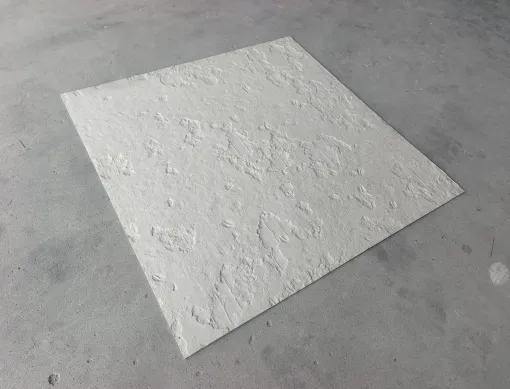
If you've ever run your hand over Bali Stone, you know it's not just something to look at—it's something to experience. Unlike the repetitive patterns of wood grain board (which, don't get us wrong, has its charm) or the manufactured consistency of mcm flexible stone, Bali Stone is a product of time and nature. Each slab bears the marks of its formation: tiny pits that look like raindrops frozen in stone, swirling veins that resemble river currents petrified mid-flow, and a surface that's slightly rough to the touch, like the bark of an old oak tree. These imperfections aren't flaws; they're character. They make a wall or countertop feel less like a "material" and more like a piece of the earth itself.
Architects love this because it adds layers of visual interest without overwhelming a space. In a recent penthouse project in New York, the designer used Bali Stone for the kitchen backsplash. From a distance, it reads as a soft, neutral backdrop for the sleek cabinetry and brass fixtures. Up close, though, the texture reveals itself—guests find themselves running fingers over it while waiting for coffee, drawn to its tactile story. It's the kind of detail that makes a space memorable, turning a "nice kitchen" into a "kitchen you can't stop talking about."
High-end projects demand materials that can keep up with their ambition. A luxury home or commercial building isn't just a one-time investment—it's a legacy. And Bali Stone, formed over millennia under heat and pressure, is built to last. Unlike wood grain board, which can warp or fade with moisture, or even some types of travertine that require constant sealing, Bali Stone is naturally resistant to wear, weather, and time. It stands up to rain, sun, and foot traffic without losing its character. A coastal restaurant in Sydney, for instance, used Bali Stone for its outdoor patio flooring. After five years of salt air, summer heatwaves, and nightly foot traffic, the stone still looks as rich and textured as the day it was installed—no refinishing, no touch-ups, just natural aging that only adds to its charm.
Sustainability plays a role here, too. Architects today are hyper-aware of their projects' environmental footprints, and Bali Stone checks that box. Sourced from quarries with strict ethical standards, it's a natural material that doesn't rely on harsh chemicals or energy-intensive manufacturing (unlike some synthetic alternatives). And because it lasts so long, it reduces the need for replacements—a win for both the planet and the client's long-term budget. In a world where "fast design" is sometimes prioritized over longevity, Bali Stone is a quiet rebel: it's here to stay.
One of the biggest frustrations for architects is falling in love with a material that only works in one style. Not Bali Stone. It's a chameleon, adapting to everything from ultra-modern to rustic, industrial to traditional. Want to go for a Scandinavian minimalism vibe? Pair Bali Stone with light wood grain board and neutral textiles—the stone's soft texture will add depth without clashing. Dreaming of a bold, contemporary commercial space? Use it as a backdrop for sleek metal accents and vibrant art; its neutral tones will make the colors pop. In a historic renovation in Rome, an architect even used Bali Stone to repair a crumbling 18th-century villa's exterior, matching the original stone's weathered look so seamlessly that visitors can't tell where the old ends and the new begins.
| Material | Texture | Best For | Limitations |
|---|---|---|---|
| Bali Stone | Earthy, slightly rough with organic veining | Accent walls, exteriors, fireplaces, high-traffic areas | Heavier than synthetic options; requires skilled installation |
| Wood Grain Board | Smooth with replicated wood patterns | Floors, cabinetry, accent panels (low-moisture areas) | Prone to scratching; not ideal for exteriors or high moisture |
| Fair-Faced Concrete | Cool, smooth, uniform gray | Modern exteriors, industrial interiors | Can feel cold; shows stains easily without sealing |
It's easy to get swept up in the latest material trends. MCM flexible stone, for example, offers the look of natural stone at a lower cost and lighter weight, making it popular for quick renovations. But architects working on high-end projects often prioritize authenticity over convenience. Bali Stone isn't a "lookalike"—it's the real deal. Its imperfections, its uniqueness, its connection to the earth—these are the things that make a space feel intentional, not just designed. A luxury resort in Bali (fittingly) used Bali Stone for its villa exteriors, and guests regularly mention how the stone "feels like part of the landscape," as if the buildings grew from the island itself. That's the power of natural material: it doesn't just decorate the environment—it belongs to it.
Even when compared to other natural stones, Bali Stone stands out. Travertine, for instance, is beloved for its porous, honeycomb texture, but it can be fragile and requires regular sealing. Bali Stone, with its denser composition, offers that same organic charm without the high maintenance. And unlike the bold, statement-making veins of marble, Bali Stone's patterns are subtler—more "background music" than "solo performance"—which makes it easier to integrate into a variety of color schemes and design styles.
At the end of the day, architects choose Bali Stone because it makes their job easier. Not in terms of installation (though skilled craftsmen make it look effortless), but in terms of storytelling. It's a material that carries meaning—of nature, of time, of warmth—and that meaning translates directly to the people who use the spaces. Whether it's a family curling up by a Bali Stone fireplace on a winter night or a business executive feeling unexpectedly at ease in a lobby lined with the stone, it creates moments that matter.
In a world where so much feels disposable, Bali Stone is a reminder that good design is about longevity—both in materials and in memory. And for architects, that's the highest compliment: creating something that doesn't just exist, but endures.
Recommend Products












