
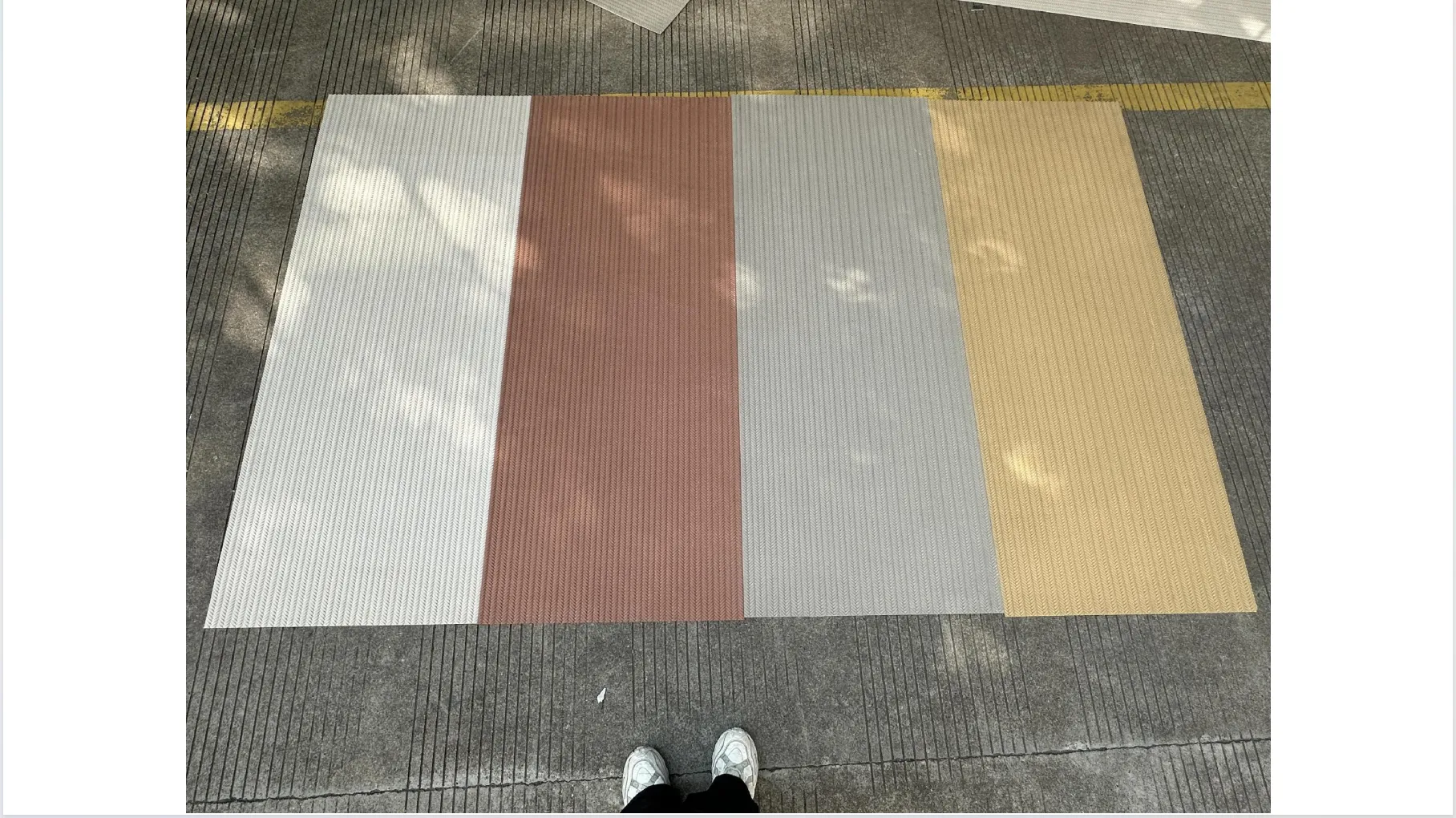
Picture this: An architect sits at their desk, surrounded by material swatches, CAD drawings, and a laptop glowing with renderings. They're designing a new community center, and the client wants the exterior to feel both modern and inviting—industrial yet warm. The problem? The swatches of fair-faced concrete feel cold in their hand, and the generic 3D renderings on the screen make the proposed wood grain board look flat, almost artificial. How do they convey the way sunlight will catch the texture of a woven panel at dawn? Or how rain might deepen the earthy tones of woven (khaki) when paired with rough-hewn wood grain board? For today's architects, the answer increasingly lies in a tool that bridges the gap between imagination and reality: woven real photos.
In the world of Modern Composite Material (MCM) exterior design, where options range from sleek foamed aluminium alloy boards to rustic gobi panels, the ability to visualize materials accurately isn't just a luxury—it's a necessity. Clients don't just want to see colors; they want to feel how a facade will age, how it will interact with the environment, and how it will make people feel when they walk past it. Traditional methods—small swatches, low-res stock images, or overly polished renders—often fall short. That's where woven real photos come in. These high-fidelity, context-rich images capture the nuance of woven textures in real-world settings, making them an indispensable tool for architects navigating the complex landscape of MCM materials.
Let's be honest: Architects have always faced an uphill battle when it comes to material visualization. For decades, the process has relied on a patchwork of tools that never quite tell the whole story. Swatches, for example, are tiny—maybe 6x6 inches at best. They're useful for checking color, but hold one up next to a 50-foot facade, and it's impossible to imagine how the material will scale. A swatch of woven (khaki) might look uniform in your hand, but in reality, when stretched across a wall, the threads will catch light differently, creating subtle shadows and variations that a small square of fabric can't replicate.
Then there are generic renderings. Most 3D software can simulate materials, but they often default to "perfect" versions—no flaws, no texture irregularities, no signs of how the material might interact with weather. A rendering of wood grain board might look smooth and consistent, but in real life, wood grain has knots, streaks, and color shifts that give it character. Clients, understandably, get disappointed when the finished building looks nothing like the "perfect" render they approved. It's not that the architect misrepresented the material; it's that the render couldn't capture its soul .
Stock photos, too, are hit-or-miss. Search for "woven facade" online, and you'll find a handful of images—most taken in ideal lighting, with no context about the material's brand, durability, or how it pairs with other MCM products like fair-faced concrete or lime stone (beige). An architect trying to combine woven (grey) with fair-faced concrete might struggle to find a stock photo that shows how those two textures play off each other. The result? Guesswork. And guesswork, in architecture, can lead to costly redesigns or unhappy clients.
Worst of all, these traditional methods fail to account for the emotional impact of materials. A facade isn't just a collection of panels; it's a statement. Woven textures, in particular, evoke warmth, craftsmanship, and softness—qualities that are hard to convey with a swatch or a render. When an architect is trying to sell a client on using woven (jacinth) for a school's exterior, they're not just selling a color; they're selling a feeling of approachability, of safety, of care. Traditional visualization tools can't capture that feeling.
Enter woven real photos: high-resolution, professionally shot images that showcase woven textures in real-world settings. These aren't just pretty pictures—they're meticulously crafted tools designed to address the very frustrations architects face with traditional visualization. Let's break down why they've become a favorite among design professionals.
Woven materials are inherently dynamic. The threads shift, the colors vary, and the texture changes depending on the light. A woven (khaki) panel, for example, might look warm and golden at noon, when sunlight hits it directly, but soft and muted in the late afternoon, as shadows stretch across its surface. Woven real photos don't just show a static color—they show this change . They're taken at different times of day, in different weather conditions, and from different angles, so architects can show clients exactly how the material will evolve throughout the day and across seasons.
Take, for instance, a photo of woven (beige) panels on a commercial building. Shot at sunrise, the threads catch the pinkish light, making the facade feel welcoming. The same panels, photographed at dusk, take on a cozier, amber hue. These details matter because they help clients imagine the building as a living, breathing part of the community—not just a static structure. Traditional renders, which often use a single light source, can't replicate this dynamism.
Architects rarely use a single material for an exterior. More often, they're mixing and matching: woven panels with wood grain board, fair-faced concrete with lunar peak silvery, or foamed aluminium alloy boards with slate veil white. The challenge? Making sure these combinations feel intentional, not haphazard. Woven real photos excel here because they're often shot in context —paired with other MCM materials in actual architectural settings.
Imagine an architect designing a boutique hotel. They want to balance the industrial edge of fair-faced concrete with the warmth of woven (jacinth) panels. A woven real photo of this exact pairing—concrete's raw, unpolished surface next to the soft, tactile weave of the panels—immediately tells the story. The client can see how the concrete grounds the design, while the woven texture adds a layer of luxury. Without this context, explaining the vision would require endless descriptions: "The concrete is rough, but the woven panels will soften it…" With a real photo, the client sees it.
This context is especially valuable for less familiar materials. Take wood grain board, which mimics the look of natural wood but with the durability of MCM. Pairing it with woven (grey) in a real photo helps clients understand that wood grain board isn't just "fake wood"—it's a complementary texture that enhances the woven panels' organic feel. Traditional swatches, laid side by side on a table, can't replicate the depth of this relationship.
At the end of the day, architecture is a collaborative process—and trust is the foundation of that collaboration. Clients need to trust that the architect's vision will translate to reality. Woven real photos build that trust by being unapologetically authentic . They don't hide flaws; they celebrate them. A woven (khaki) panel in a real photo might have a slight imperfection in the weave, or a thread that's a shade darker than the rest—and that's a good thing. It shows the material is real, not a computer-generated fantasy.
Consider a scenario where a client is hesitant about using woven textures, fearing they'll look cheap or dated. An architect could show them a woven real photo of a 10-year-old building with woven (khaki) panels that still look vibrant, with the texture only deepening with age. The photo doesn't just prove durability; it builds confidence. "This is how it will look in 10 years," the architect can say, pointing to the image. "Not just on day one, but for decades." Traditional renderings, which always look brand-new, can't make that promise.
Still not convinced? Let's put traditional visualization methods head-to-head with woven real photos. The table below breaks down how they stack up across key criteria architects care about:
| Criteria | Traditional Swatches | Generic Renders | Woven Real Photos |
|---|---|---|---|
| Scale Representation | Limited (small size; hard to imagine full facade) | Artificial (often oversimplified; no real-world scale cues) | Accurate (shot in full architectural context; shows material at scale) |
| Texture Detail | Basic (shows weave pattern but not depth or shadow) | Flat (computer-generated; lacks tactile nuance) | High-Fidelity (captures every thread, shadow, and color variation) |
| Light/Weather Interaction | None (static; no context for light or weather) | Limited (single light source; no weather effects) | Dynamic (shot in different lighting/weather; shows material behavior over time) |
| Material Pairing Context | Isolated (swatches shown alone; no pairing examples) | Forced (simulated pairings; no real-world chemistry) | Natural (paired with other MCM materials in actual buildings) |
| Client Trust | Low (client must "imagine" scale and context) | Mixed (can feel overpromising; lacks authenticity) | High (real-world proof; shows material as it truly is) |
To truly understand the impact of woven real photos, let's dive into a few real-world examples. These case studies show how architects have used woven real photos to turn client skepticism into excitement—and designs into reality.
Architect Maria Gonzalez was tasked with designing a community center along a riverfront in Portland, Oregon. The client's brief was clear: create a space that felt "inviting to all ages" while reflecting the area's industrial heritage. Maria's vision? A facade that combined the raw, utilitarian look of fair-faced concrete with the warmth of woven (khaki) panels. The challenge? The client, a local government board, was hesitant about the woven texture, fearing it might look "too casual" for a public building.
Maria turned to woven real photos. She found a series of images showing woven (khaki) panels paired with fair-faced concrete on a similar community project in Seattle. The photos, taken at different times of day, showed how the woven texture softened the concrete's starkness, creating a facade that felt both durable and approachable. One image, taken during a community event, even showed kids leaning against the woven panels—proof of their tactile appeal.
"The photos did the talking," Maria recalls. "The board could see how the woven texture made the building feel welcoming, not just functional. They stopped asking, 'Will this work?' and started asking, 'When can we break ground?'" Today, the Riverside Community Center is a local landmark, with residents often commenting on how the woven panels "make the building feel like it's hugging the neighborhood."
For a luxury residential development in Boulder, Colorado, architect James Chen wanted to balance modern design with the area's natural surroundings. His plan: use wood grain board for the main structure, accented with woven (grey) panels and lunar peak golden for trim. The client, a high-end developer, was on board with the wood grain but worried the woven panels might "date the design."
James countered with woven real photos of a residential project in Aspen that had used woven (grey) panels five years prior. The photos showed the panels had aged beautifully—their texture deepening, their color softening into a rich, heathered grey that complemented the wood grain board. "I didn't just show them the panels new," James says. "I showed them how they'd look in five years, ten years. That's the power of real photos—they're not just snapshots; they're glimpses into the future."
The client was sold. Today, the Willow Creek Residences are known for their "timeless warmth," with real estate agents noting that the woven panels are a major selling point. "Buyers love that the exterior feels both modern and rooted in nature," James adds. "And I have woven real photos to thank for helping them see that vision."
As MCM materials continue to evolve—with innovations like 3D printing series, flexible stone, and epoch stone—architects will only demand more sophisticated visualization tools. Woven real photos, once a niche option, are quickly becoming the gold standard. Here's why:
Thanks to platforms like Pinterest, Instagram, and architectural blogs, clients today are more visually literate than in the past. They've seen stunning facades from around the world, and they expect their own projects to measure up. Generic renders or small swatches no longer cut it. Clients want to see exactly what they're getting—and woven real photos deliver that.
Materials like the lunar peak series (silvery, golden, black) or the travertine starry variants (starry green, starry red, starry blue) have intricate textures and color variations that demand high-fidelity visualization. Woven real photos, with their ability to capture micro-details, are the only way to do these materials justice. Imagine trying to explain the "starry" effect in travertine (starry green) with a swatch—it's impossible. A woven real photo, showing the stone's subtle glittering flecks in natural light? That tells the story.
Today's clients also care deeply about sustainability. They want materials that are durable, low-maintenance, and eco-friendly. Woven real photos align with this valueshift by showcasing materials in their real-world, weathered state. A photo of a 10-year-old woven panel isn't just proof of its longevity; it's proof of its sustainability. Clients can see that the material won't need frequent replacement, reducing waste and environmental impact.
At the end of the day, architecture is about storytelling. It's about creating spaces that tell the story of a community, a client, or a vision. Woven real photos aren't just tools for visualization—they're tools for storytelling. They help architects translate abstract ideas into tangible narratives, showing clients not just what a building will look like , but how it will live in the world.
Whether it's the earthy warmth of woven (khaki) paired with fair-faced concrete, the modern elegance of woven (grey) alongside wood grain board, or the dynamic interplay of woven textures with lunar peak silvery, woven real photos capture the essence of these stories. They turn "what if" into "this is." For architects navigating the ever-expanding universe of MCM materials, that's not just helpful—it's transformative.
So the next time you see a striking MCM facade, take a closer look. Chances are, woven real photos played a role in bringing it to life. And for the architects behind it? They'll tell you: when it comes to winning over clients and creating unforgettable designs, woven real photos aren't just preferred—they're indispensable .
Recommend Products












