
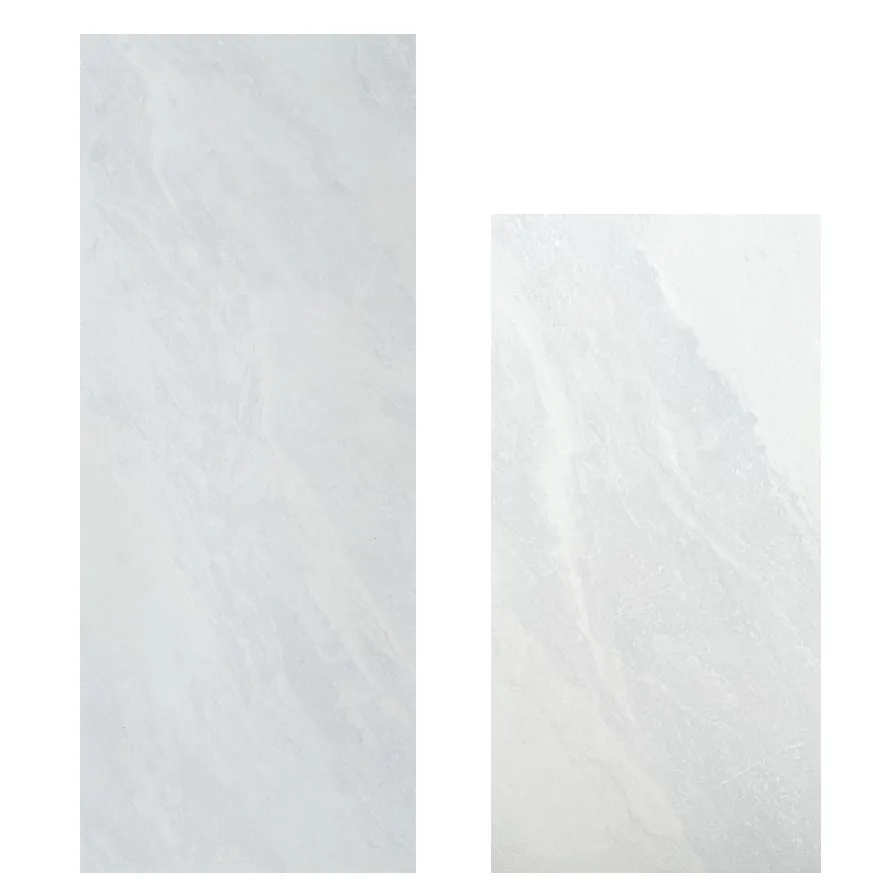
Let's start with a moment we've all lived through: standing in a home improvement store, staring at endless rows of samples, trying to picture how they'll transform your space. The sales rep points to porcelain tiles—"They're the standard," she says. "Tough, easy to clean, budget-friendly." And sure, they check the boxes. But when you run your finger over their smooth, unyielding surface, something feels missing. It's like choosing a printed poster over an original painting—functional, but lacking the heartbeat of something real. That's where Marble Veil White MCM enters the story. Not just as a material, but as a way to turn walls, floors, and backsplashes into stories. Let's unpack why this matters.
Porcelain tiles are designed for consistency. Every square is a near-identical copy of the one next to it, with patterns that repeat like a broken record. Walk into a room clad in them, and you might think, "This looks neat," but rarely, "This takes my breath away." Marble Veil White MCM, on the other hand, is a masterclass in controlled chaos—just like the natural marble it mimics. Its veining isn't a digital print; it's a texture built into the material, with swirls of soft white and faint gray that flow like watercolor on paper. It's the difference between a stock photo of a forest and standing in the middle of one, where no two trees (or stones) are exactly alike.
Think about travertine (beige), that beloved natural stone with its honeyed tones and pitted surface. It's warm, timeless, but heavy—so heavy that installing it on a wall might require reinforced framing. MCM flexible stone captures that same organic texture—those tiny indentations that catch the light, that subtle variation in color—but at a fraction of the weight. Hold a sample of Marble Veil White MCM next to a travertine (beige) tile, and you'll swear they share a soul. But MCM won't crack under its own weight, and it won't demand a structural engineer's stamp of approval just to grace your bathroom wall.
"I designed a café last year where the client wanted 'rustic elegance,'" says interior designer Mia Chen. "Porcelain tiles felt too sterile—like a chain restaurant. We went with Marble Veil White MCM on the accent wall, and customers still comment on it. They'll trace the veins with their fingers and say, 'It feels like it was here before the building.' That's the magic of MCM—it doesn't just look natural; it feels like it belongs ."
Let's talk about touch—a sense we often overlook when choosing building materials. Porcelain tiles are cold. Not just temperature-wise, but emotionally. Run your hand across them, and it's a flat, unresponsive surface—like petting a plastic plant. MCM, though? It's tactile. Marble Veil White MCM has a slight grit to it, a soft roughness that feels like weathered stone, not a factory mold. It's the difference between a silk sheet and a linen one—both nice, but linen makes you want to linger.
Take wood grain board, for example. People love it because it adds warmth, that "lived-in" feel. MCM does the same, but with stone. Imagine a kitchen backsplash of Marble Veil White MCM: when you're washing dishes, your arm brushes against it, and instead of a jarring chill, you feel a gentle, earthy texture. It turns a mundane task into a small, sensory pleasure. Porcelain can't do that. It's all function, no feeling.
Porcelain tiles are tough, no one denies that. But "tough" doesn't always mean "forgiving." drop a pot on a porcelain floor, and you might end up with a spiderweb of cracks. MCM flexible stone, though, is built to bend, not break. It's made from a composite of minerals and recycled materials, pressed into thin, flexible sheets. That flexibility means it can handle impacts that would shatter porcelain. It's like the difference between a glass cup and a silicone tumbler—both hold water, but one won't leave you sweeping up shards after a clumsy moment.
And let's talk about water. Porcelain is water-resistant, but it's not impervious. Grout lines? They're magnets for mold and mildew, especially in showers or basements. MCM panels can be installed with minimal grout, or even seamlessly, depending on the design. That means fewer nooks for moisture to hide, and less time spent scrubbing with a toothbrush. A homeowner in Seattle once told me, "We replaced our bathroom porcelain tiles with MCM after a mold issue. Two years later, the walls still look brand-new, and I've stopped stressing about steam from the shower."
Then there's fair-faced concrete—a material praised for its industrial, raw look. It's durable, but it stains easily, and it's in both appearance and touch. MCM offers that same "unfinished" vibe with Marble Veil White, but with a warmer undertone and better stain resistance. Spill red wine on fair-faced concrete, and you'll be googling "concrete stain remover" at midnight. Spill it on MCM? Wipe it up with a damp cloth, and it's like it never happened.
Let's get practical: installing porcelain tiles is a hassle. They're heavy, so you'll need help lifting them. Cutting them requires a wet saw, which is loud, messy, and not exactly DIY-friendly. And if you misalign a tile? Good luck fixing it without chipping the ones around it. MCM, though, is a lightweight rebel. A single panel weighs about as much as a large textbook, so you can carry a stack by yourself. Cutting it? Grab a utility knife and a straightedge—no power tools needed. It's like hanging wallpaper, but sturdier.
"I'm not handy," laughs homeowner Raj Patel, who installed MCM in his home office. "I tried porcelain tiles in the guest bathroom once, and I ended up with uneven grout lines and a few broken tiles. With Marble Veil White MCM, I finished the entire accent wall in a Saturday afternoon. The panels are flexible, so they curved slightly around the window frame without cracking. My wife still teases me about how proud I was—like I'd built the wall from scratch."
We're all trying to make greener choices, and building materials are no exception. Porcelain tile production is energy-intensive: mining clay, firing it in kilns at 2,200°F, shipping heavy tiles across the country. MCM, by contrast, uses recycled stone dust and glass in its composition, and because it's lightweight, transporting it emits less CO2. It's also durable enough to last decades, reducing the need for replacements (and more waste).
Natural stone, like travertine (beige), is beautiful, but quarrying it disrupts ecosystems, leaving scars on the landscape. MCM flexible stone lets you enjoy the look of natural stone without the environmental cost. It's a small choice, but small choices add up. As architect Carlos Mendez puts it: "Sustainability isn't just about solar panels and LED lights. It's about choosing materials that respect the planet. MCM does that, and it doesn't ask you to sacrifice beauty."
Let's be clear: porcelain tiles aren't evil. They're a solid choice for high-traffic areas like garages or mudrooms, where aesthetics take a backseat to function. But for spaces where you want to feel something—your kitchen, your bedroom, your living room—MCM shines. It's for the homeowner who wants their home to tell a story, not just serve a purpose.
Imagine a boutique hotel lobby with a wall of Marble Veil White MCM, paired with wood grain board accents. It's luxurious, but not intimidating—like a grand old home that's been loved. Now imagine that same lobby with porcelain tiles: it feels like a conference center. No warmth, no personality, just a space to pass through. Which one would you remember? Which one would make you want to stay?
At the end of the day, choosing between MCM and porcelain tiles isn't just about durability or cost. It's about the kind of space you want to create. Do you want a home that feels like a catalog—perfect, but impersonal? Or do you want a home that feels like yours , with walls that have character, texture, and a little bit of imperfection?
Marble Veil White MCM isn't just a building material. It's a way to infuse your space with life. It's the difference between a song played on a synthesizer and one played on a piano—both make sound, but one has heart. So the next time you're standing in that home improvement store, holding a porcelain tile sample, ask yourself: Does this make me feel something? If the answer is no, put it down. And pick up MCM. Your walls (and your soul) will thank you.
Recommend Products












