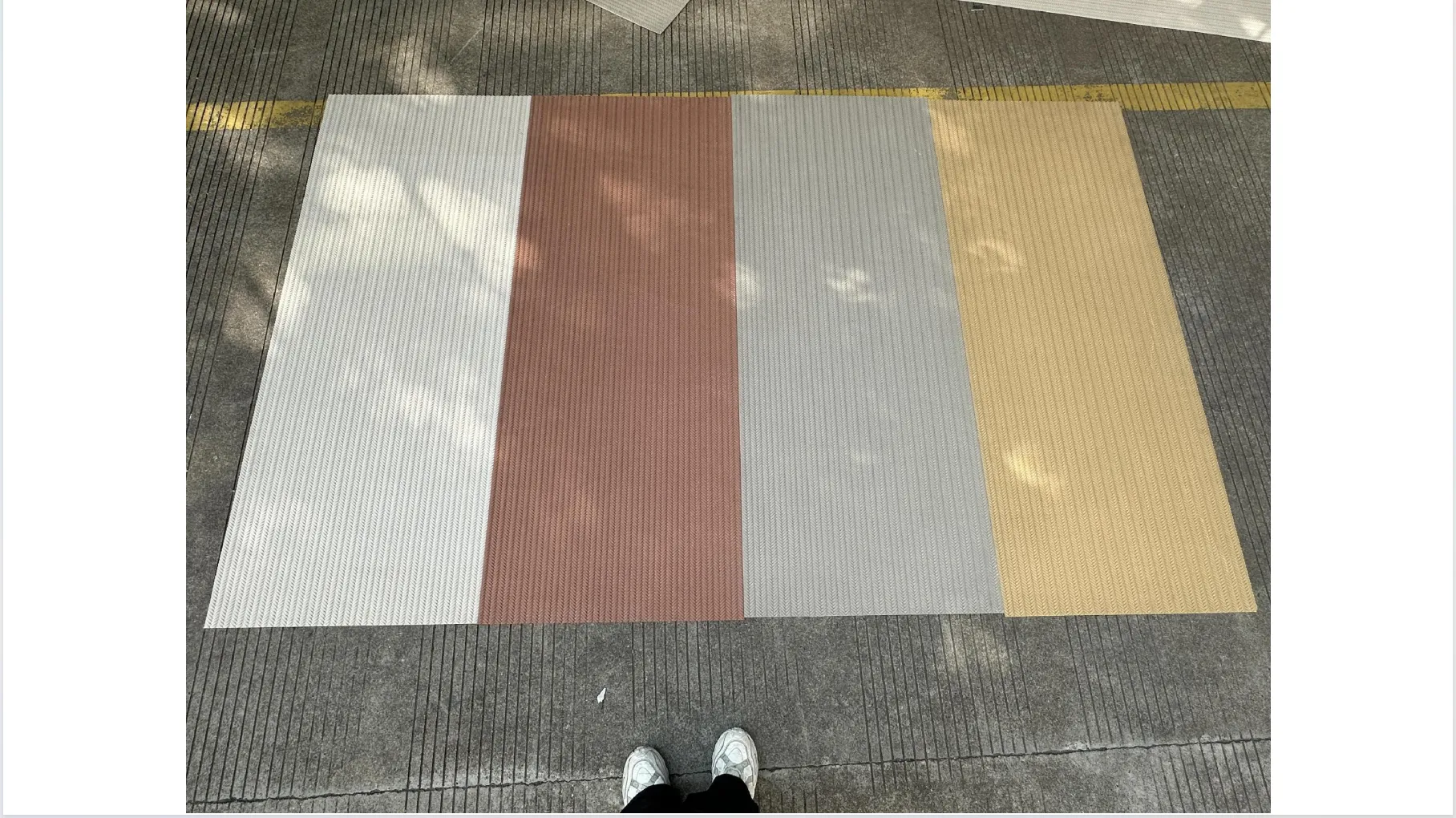
To understand why
woven real photos are essential, let's break down the specific challenges commercial buyers face—and how these photos address them head-on.
1. Texture: The "Feel" Factor in Visual Form
Woven materials, by nature, are defined by texture. Whether it's a tight weave that adds subtle depth or a loose, organic pattern that mimics natural fibers, texture dictates how light interacts with the surface, how the material ages, and even how it feels to the touch (a detail that matters for high-traffic areas like retail floors or hotel lobbies). Catalog images often flatten texture, making it hard to gauge if a woven panel will read as "busy" or "elegant" in person.
Woven real photos, however, use high-resolution close-ups and varied lighting to capture every ridge, dip, and
thread. For example, a photo taken in natural sunlight might reveal how the weave casts soft shadows at midday, while an indoor shot could show how artificial light enhances its warmth. This level of detail is critical for architects designing facades that need to look cohesive from dawn to dusk.
2. Color Accuracy: Avoiding the "That's Not What I Ordered" Disaster
Color is the backbone of any commercial design palette. A slight shift in hue—from "warm beige" to "cool taupe"—can throw off an entire scheme, forcing redesigns, reorders, and costly delays. Woven materials are particularly prone to color variation because their texture can absorb or reflect light differently depending on the angle. A catalog might depict a woven panel as "soft gray," but in reality, the threads could have undertones of blue or green that only become visible in large installations.
Woven real photos, shot in consistent, natural lighting, eliminate this guesswork. They show the material's true color under different conditions—morning light,, even artificial illumination—so buyers can be confident the woven panels will complement, not clash with, other materials like
fair-faced concrete
or stone accents.
3. Scale: From Sample to Skyline
One of the biggest risks in commercial purchasing is underestimating how a material will look when scaled up. A woven sample the size of a postcard might have a delicate pattern that feels refined, but when installed as part of the
MCM big slab board series
(which can span 4x8 feet or more), that same pattern could become repetitive or overwhelming.
Woven real photos solve this by showcasing materials in context—on actual buildings, in full-size installations, or alongside reference points (like a door or window) to convey scale. For example, a photo of a woven
MCM flexible stone panel on a hotel facade would reveal whether the pattern holds up visually from the street or if it gets lost in the building's height. This is invaluable for projects where the material's impact from a distance is just as important as its close-up detail.
4. Authenticity: The "Warts and All" Advantage
Commercial buyers don't need perfection—they need
predictability
. A material with slight variations or "imperfections" (like the raw, unpolished look of
fair-faced concrete
) can add character, but only if those variations are consistent and intentional. Catalogs often airbrush out these nuances, presenting a version of the material that doesn't exist in reality.
Woven real photos, by contrast, embrace authenticity. They show the natural inconsistencies in woven threads, the subtle color shifts in large slabs, and even how the material ages (e.g., how a woven texture might collect light dust or wear over time). This transparency allows buyers to make informed decisions: Is this level of variation acceptable for the project? Will it enhance the design, or become a distraction? For commercial projects with tight quality control standards, this honesty is priceless.