
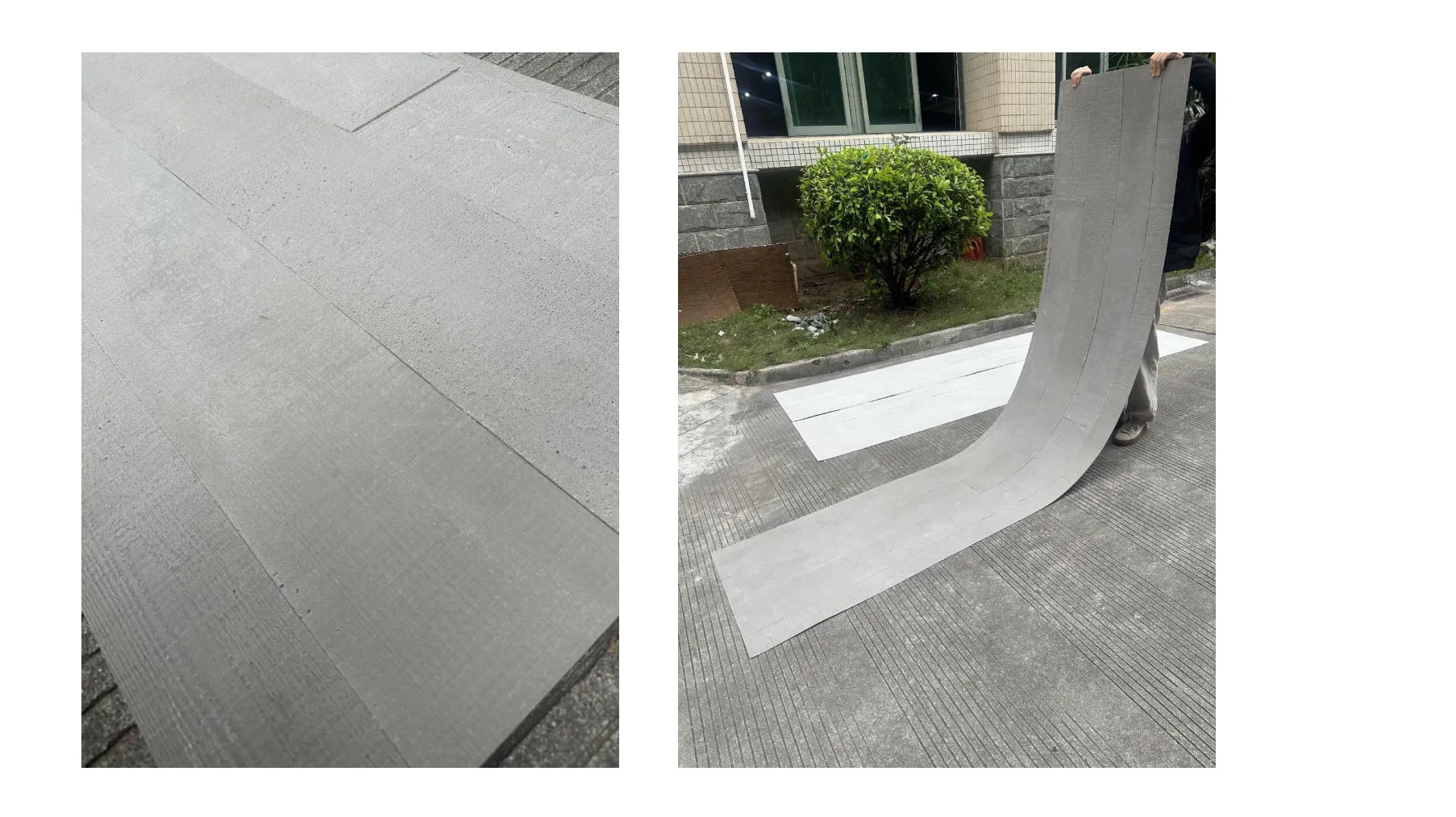
Walk into any space—a cozy café downtown, a sunlit home office, or a sleek modern gallery—and what hits you first isn't just the layout or the lighting. It's the materials. The rough warmth of a wooden table, the cool smoothness of marble floors, the earthy texture of stone walls—these surfaces don't just fill a room; they shape how we feel in it. For decades, architects and designers have chased that perfect balance between durability, beauty, and soul in building materials. But all too often, the options felt limited: heavy stones that strained structures, synthetic panels that lacked character, or natural materials so fragile they required constant upkeep. That is, until the rise of MCM (Modified Composite Material) and its game-changing innovations like the MCM 3D Printing Series , Wood-Cement Board , and MCM Flexible Stone . Today, we're diving into how these materials—brought to life through Wood-Cement Board real photos and tangible craftsmanship—are rewriting the rules of architectural detail.
Let's start with the obvious: traditional building materials have their charm, but they're far from perfect. Take natural stone, for example. Travertine or marble might look stunning in a luxury hotel lobby, but their weight? A nightmare for contractors. A single slab of granite can weigh hundreds of pounds, requiring reinforced structures and driving up construction costs. Then there's flexibility—or the lack thereof. Carving intricate patterns into stone? Possible, but expensive and time-consuming. Want a curved wall with a seamless stone finish? Good luck; most rigid materials crack under pressure. And sustainability? Quarrying natural stone leaves massive environmental footprints, while synthetic alternatives like PVC panels often off-gas harmful chemicals and end up in landfills after a short lifespan.
Wood, too, has its struggles. Solid hardwood is beautiful, but it warps with moisture, fades in sunlight, and is prone to termite damage. Plywood or particleboard? They're cheaper but feel hollow, lacking the depth of real wood grain. Even concrete, the workhorse of modern construction, can feel cold and industrial—great for a warehouse, less so for a home where you want to curl up with a book.
Designers often found themselves stuck in a loop: choose durability and sacrifice beauty, or chase aesthetics and compromise on practicality. That's where MCM stepped in, asking a simple question: What if we could have it all?
MCM isn't just a material—it's a philosophy. Born from the desire to merge cutting-edge technology with the organic warmth of natural materials, MCM products are engineered to be lightweight, flexible, durable, and stunningly authentic. At the heart of this revolution are three standout stars: the MCM 3D Printing Series , Wood-Cement Board , and MCM Flexible Stone . Each addresses a specific pain point in traditional construction, but together, they're transforming how we think about building surfaces.
What makes MCM different? It starts with the base: a composite of natural minerals, recycled fibers, and eco-friendly resins. This blend creates a material that's up to 80% lighter than natural stone, yet just as strong. But the real magic is in the details. Using advanced manufacturing techniques—including 3D printing—MCM can mimic the exact texture of travertine, the grain of oak, or the roughness of weathered concrete, all while offering unprecedented design freedom. And unlike synthetic imitations, MCM doesn't feel "fake." Run your hand over a Wood-Cement Board , and you'll swear it's real wood—until you realize it's water-resistant, fire-retardant, and won't warp in humidity. That's the MCM promise: authenticity without the hassle.
If MCM is the canvas, the MCM 3D Printing Series is the brush that lets designers paint their wildest ideas. Traditional 3D printing in construction is often associated with clunky concrete structures or prototype models, but MCM's take is different. Here, 3D printing isn't just about speed—it's about precision and artistry. Imagine a wall panel that isn't flat or repetitive, but swirled with the organic patterns of a riverbed, or etched with geometric designs so intricate they look hand-carved. That's what this series delivers.
Take the Travertine (Starry Green) panel, part of the 3D Printing Series. At first glance, it looks like a slab of natural travertine, with its signature pitted surface and soft, earthy green hue. But look closer: the "stars" are tiny, iridescent flecks embedded during the 3D printing process, catching light and shifting color as you move. It's a detail that would be nearly impossible to replicate with traditional stone cutting, yet MCM achieves it with consistency and affordability. Or consider the Wave Panel , a 3D-printed masterpiece that mimics the undulating surface of ocean waves. Installed in a beachfront restaurant, it doesn't just decorate the wall—it tells a story, transporting diners to the shore with every glance.
But 3D printing isn't just for show. It solves practical problems, too. For example, the MCM Big Slab Board Series , often paired with 3D printing technology, offers panels up to 12 feet long and 4 feet wide. That means fewer seams in large installations—say, a hotel lobby wall or a commercial kitchen backsplash—creating a seamless, high-end look without the cost of custom stone cutting. And because MCM is lightweight, these big slabs are easy to transport and install, cutting down on labor time and structural stress.
| Feature | MCM 3D Printing Series | Traditional Stone/Panel Materials |
|---|---|---|
| Weight | Up to 80% lighter than natural stone | Heavy (50-100+ lbs per sq ft for stone) |
| Design Flexibility | Custom 3D patterns, curves, and textures | Limited to flat or simple shapes; intricate designs require expensive carving |
| Sustainability | Uses recycled materials; low carbon footprint | High environmental impact (quarrying, transportation) |
| Installation Ease | Lightweight, can be cut on-site; no special tools needed | Requires heavy machinery and specialized labor |
| Aesthetic Range | Over 50 finishes (stone, wood, metal, etc.) with custom options | Limited to natural variations; hard to replicate rare textures |
If the 3D Printing Series is about pushing boundaries, Wood-Cement Board is about honoring tradition—then making it better. Wood has been a building staple for millennia because it feels alive. It warms up a space, adds character, and connects us to nature. But as we mentioned earlier, real wood has its flaws. Enter MCM's Wood-Cement Board: a hybrid material that takes the best of wood (the texture, the grain, the warmth) and pairs it with the best of cement (durability, water resistance, fire safety).
This is where Wood-Cement Board real photos become invaluable. A picture might be worth a thousand words, but in this case, it's worth dispelling a thousand doubts. Scroll through these photos, and you'll see kitchen backsplashes that look like reclaimed barn wood, but are actually impervious to grease and heat. Bathroom walls that mimic oak paneling, but won't rot or grow mold. Outdoor decks that have the rich color of teak, but don't require annual staining. One photo, in particular, stands out: a home office with Wood-Cement Board walls in a "White Wood" finish. The light streams in, highlighting the subtle grain patterns, and you can almost feel the coziness—until you notice the window above the desk, open to a rainstorm, with no warping or water damage to the panels below. That's the proof in the picture.
But the beauty of Wood-Cement Board isn't just in its looks; it's in its versatility. It comes in finishes like Charcoal Burnt Wood Board , which mimics the deep, smoky tones of wood that's been torched (a technique known as shou sugi ban, popular for its natural resistance to pests). Or Bamboo Mat Board , which replicates the woven texture of bamboo, perfect for adding a tropical vibe to a restaurant or a spa. And because it's part of the MCM family, it's compatible with other products—pair it with MCM Flexible Stone for a wall that combines wood grain and stone texture, creating a layered, organic look that feels both rustic and modern.
Let's talk about flexibility—a feature that sounds simple but is revolutionary in construction. Traditional stone is rigid; bend it, and it breaks. MCM Flexible Stone? It bends. Not like rubber, but enough to wrap around curved surfaces, follow the contour of a column, or even be applied to furniture with rounded edges. It's a game-changer for designers who want the look of stone in places stone has never gone before.
Take the Rust Square Line Stone , a Flexible Stone option with a weathered, industrial look. Imagine a retail store with a curved counter wrapped in this stone—it would look like the counter was carved from a single piece of rusted metal, but in reality, it's lightweight MCM that was bent to shape during installation. Or consider a home fireplace with a curved surround: instead of using multiple stone tiles with visible grout lines, Flexible Stone creates a seamless, high-end finish that's easy to clean and maintain. And because it's thin (as little as 3mm thick), it adds minimal weight to structures, making it ideal for renovations where you don't want to reinforce walls or floors.
But flexibility doesn't mean fragility. MCM Flexible Stone is scratch-resistant, impact-resistant, and UV-stable, so it holds up in high-traffic areas like airports or shopping malls. It's also eco-friendly: made with recycled stone powder and natural resins, it reduces the need for quarrying and cuts down on waste. For architects and homeowners alike, it's the answer to the age-old question: "Can we have beauty, durability, and sustainability—without compromise?" With Flexible Stone, the answer is a resounding yes.
In a world of filters and digital renderings, there's something powerful about Wood-Cement Board real photos and unretouched images of MCM products. These photos don't just show a material—they show a moment . A contractor holding a Wood-Cement Board panel, marveling at how light it is. A homeowner running their hand over a Flexible Stone wall, surprised by how real it feels. A designer pointing to the 3D-printed details of a Lunar Peak Silvery panel, explaining how it mimics the craters of the moon.
Real photos build trust. They prove that MCM isn't just a marketing buzzword—it's a tangible product that looks as good in a living room as it does in a catalog. They also inspire. Scroll through a gallery of Travertine real photos or Ripple Board real photos , and you start to see possibilities: a home office with a Ripple Board accent wall that calms the mind, a restaurant with Travertine floors that feel warm underfoot, a hotel lobby with Lunar Peak panels that transport guests to another world. These photos aren't just documentation; they're invitations to imagine what could be.
At the end of the day, MCM products like the 3D Printing Series, Wood-Cement Board, and Flexible Stone aren't just materials—they're tools for storytelling. Architecture has always been about more than function; it's about emotion, memory, and connection. A hospital with warm Wood-Cement Board walls might help patients feel more at ease. A school with 3D-printed Wave Panels could spark curiosity in students. A community center with Flexible Stone accents might feel more welcoming, like a place that belongs to everyone.
Sustainability also plays a big role in MCM's future. As the world becomes more eco-conscious, builders and homeowners are seeking materials that reduce environmental impact without sacrificing style. MCM delivers here, too: its lightweight nature cuts down on transportation emissions, its recycled content reduces waste, and its durability means less replacement over time. It's a material that aligns with the values of modern design—proof that you don't have to choose between looking good and doing good.
In the end, what makes MCM products like the MCM 3D Printing Series , Wood-Cement Board , and MCM Flexible Stone so special isn't just their technical specs—it's how they make us feel. They're materials with soul: they look real, feel real, and behave like real materials, but they're smarter, stronger, and more sustainable. They let designers stop compromising and start creating spaces that are as functional as they are beautiful, as durable as they are emotional.
And when you see Wood-Cement Board real photos or stand in front of a wall made with MCM 3D Printing Series panels, you don't just see a building material—you see potential. Potential for homes that feel like sanctuaries, offices that spark creativity, and public spaces that bring communities together. That's the true power of MCM: it doesn't just redefine architectural details; it redefines how we experience the world around us. And in a world that often feels cold and digital, that's a detail worth celebrating.
Recommend Products












