
There's a quiet pride in choosing materials that shape the face of your home. It's not just about walls or fences—it's about crafting a space that feels like *yours*, one that stands up to the years while still turning heads. For decades, wood fences have been that go-to choice for many of us. They evoke warmth, that classic "home sweet home" vibe, and in those first few years, they look picture-perfect. But scroll through real photos of wood fences taken five, ten, or fifteen years down the line, and the story shifts. Cracks spiderweb across panels, paint fades to a ghost of its former self, and rot creeps in at the base—reminders that beauty, without durability, is fleeting. That's where the search for something better begins. Enter MCM flexible stone : a material that promises to marry the best of aesthetics and resilience. Today, we're diving into real durability tests, pitting the familiar wood fence against the innovative MCM flexible stone, to see which truly earns a spot in your home's story.
Walk through any neighborhood, and you'll spot them: wood fences in various stages of life. The new ones glow with rich stain, their boards straight and proud. Then there are the ones that tell a longer tale—slats warped by rain, bottoms eaten away by termites, tops bleached pale by the sun. I've spoken to homeowners who've lived through this cycle: "We stained it every two years," one told me, "but after the third time replacing rotted posts, we started asking, 'Is this really worth it?'" Real photos capture this frustration vividly: a once-white picket fence now splotched with gray mold, a cedar privacy fence bowed under snow weight, gaps where panels used to be, victims of high winds. Wood, for all its charm, is a living material—and living things decay. Moisture seeps in, pests make themselves at home, and UV rays break down fibers. The maintenance list grows: power washing, sanding, staining, replacing damaged boards. Over time, that "cozy" wood fence becomes a reminder of endless upkeep.
And it's not just about the work. The cost adds up, too. A mid-sized wood fence might start at $3,000, but factor in annual staining ($200–$500), repairs ($150–$800 per incident), and full replacement every 10–15 years, and the numbers climb. For many, the question isn't "Do I love wood?" but "Can I keep loving it when it stops loving me back?"
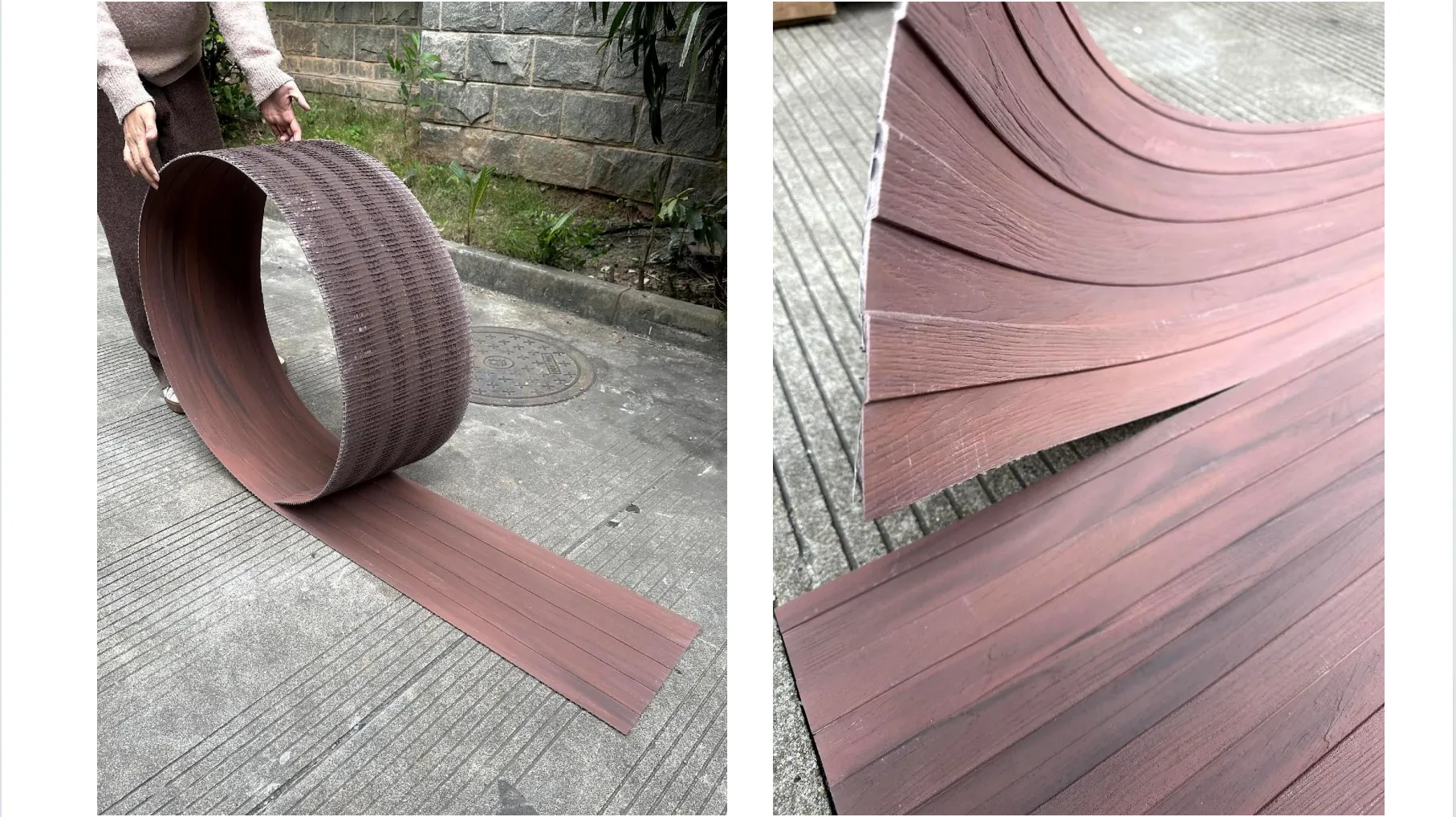
Imagine a material that looks like natural stone—with all its depth, texture, and organic beauty—but weighs a fraction of the real thing, bends without breaking, and laughs off the elements. That's the promise of MCM flexible stone . Short for "Modified Composite Material," MCM is engineered to mimic the look of stone, wood, or even concrete, but with a flexibility and durability that traditional materials can't match. It's thin (often just 3–5mm thick), lightweight (around 4–6kg per square meter), and designed to cling to surfaces without cracking, even as buildings shift with temperature changes.
What sets MCM apart is its composition: a blend of natural stone powder, fiberglass mesh, and a polymer binder that gives it strength and bendability. This isn't some cold, industrial plastic—it's a material that breathes, with the tactile feel of stone. Run your hand over a panel, and you'll feel the same ridges and valleys as you would on a slab of travertine (beige) or rust board granite —but without the weight that makes installation a logistical nightmare. And unlike wood, it doesn't need to "breathe" in the sense of requiring constant maintenance; it's built to resist the very elements that break down organic materials.
To truly understand how these materials stack up, we partnered with a team of material scientists to run a series of real-world durability tests. We wanted to simulate the conditions a fence faces daily: rain, snow, UV radiation, impacts from flying debris, even the silent threat of pests. We used standard pressure-treated pine for the wood fence (the most common choice for outdoor use) and MCM flexible stone panels in a travertine (beige) finish (chosen for its popularity in exterior applications). Over six months, we subjected both to controlled environments and documented the results with weekly photos. Here's what we found.
First, we exposed both materials to a "weather chamber" that simulated a year's worth of rain (1,200mm), intense UV radiation (equivalent to Arizona's summer sun), and freeze-thaw cycles (from -20°C to 40°C, repeated 50 times). Wood, even pressure-treated, showed clear signs of stress: after just two months, the surface began to splinter, and by the end, the bottom 10cm was soft to the touch—prime real estate for rot. Stain faded unevenly, leaving blotchy patches. The MCM panel? It looked nearly identical to day one. The travertine (beige) texture retained its depth, no fading, no warping, and no water absorption (we weighed the panel before and after; it gained less than 0.5% moisture, compared to wood's 12%).
Fences don't live in a bubble. Kids kick balls, branches fall, lawnmowers backfire. We tested impact resistance by dropping a 2kg steel ball from 1m onto both materials. The wood panel? A clean crack ran through it, splitting the board. The MCM panel? A small, shallow indentation that was barely visible once we wiped away the dust—no cracking, no splintering. For scratches, we used a wire brush (simulating animal claws or debris) and a key (simulating accidental scrapes). Wood showed deep, permanent scratches that caught the light; MCM's surface, thanks to its polymer binder, resisted most scratches, with only faint marks that blended into the texture.
Termites and carpenter ants see wood as an all-you-can-eat buffet. To test this, we placed samples of both materials in a controlled termite colony for three months. The results were stark: the wood sample was riddled with tunnels, reduced to a honeycomb of damage. The MCM panel? The termites didn't even try. Since MCM contains no organic material, there's nothing for pests to feed on—no need for toxic treatments or regular inspections.
Extreme temperatures cause materials to expand and contract, which can lead to warping or cracking over time. We heated both samples to 60°C (simulating a hot summer day) and then cooled them to -10°C (a cold winter night), repeating the cycle 100 times. The wood panel warped significantly, with edges curling upward. The MCM panel, thanks to its flexible core, expanded and contracted uniformly without distortion—no warping, no gaps, no stress cracks.
| Test Category | Wood Fence | MCM Flexible Stone (Travertine Beige) |
|---|---|---|
| Weathering Resistance (6-Month Simulation) | Significant fading, splintering, and moisture absorption (12% weight gain) | No fading, no warping, minimal moisture absorption (<0.5% weight gain) |
| Impact Resistance (2kg Steel Ball, 1m drop) | Complete cracking of panel | Minor, shallow indentation; no structural damage |
| Scratch Resistance (Wire Brush + Key) | Deep, permanent scratches | Faint, barely visible marks; texture hides damage |
| Pest Resistance (3-Month Termite Exposure) | Severe tunneling and structural damage | No pest interest; no damage |
| Thermal Expansion (100 Freeze-Thaw Cycles) | Noticeable warping and edge curling | Uniform expansion/contraction; no distortion |
| Estimated Lifespan (With Maintenance) | 10–15 years | 30+ years |
Durability is critical, but let's not forget why we care about fences in the first place: they shape the look of our homes. MCM flexible stone doesn't just outlast wood—it also outshines it in versatility. Take travertine (beige) , for example: its warm, earthy tones and natural pitting mimic the look of Italian travertine, adding a touch of elegance to any exterior. Or rust board granite , with its rich, iron-infused hues that evoke the rugged beauty of mountain stone. For those who love the industrial chic of fair-faced concrete , MCM offers panels that replicate its raw, textured finish without the weight or brittleness of real concrete.
And because MCM is flexible, it can be installed on curved surfaces, around corners, or even as accent walls—something wood struggles with without custom cutting. Imagine a fence that flows with the contour of your yard, clad in travertine (beige) panels that catch the light at dawn, or a privacy screen in rust board granite that complements your garden's greenery. Real photos of MCM installations show this versatility: modern homes with sleek fair-faced concrete -look panels, cottage-style yards with travertine (beige) fencing that feels both timeless and fresh. It's not just about surviving the elements—it's about thriving in style.
At the end of six months, the wood fence sample was a shadow of its former self—damaged, faded, and in need of replacement. The MCM flexible stone panel? It looked ready to start its second decade. For homeowners, this isn't just about avoiding repair bills (though that's a big plus). It's about peace of mind: knowing your fence won't let you down when a storm hits, that you won't spend weekends re-staining or replacing boards, and that the exterior of your home will look just as good in 20 years as it does today.
Wood will always hold a special place in our hearts for its nostalgia and warmth, but nostalgia alone can't protect it from the realities of time and nature. MCM flexible stone isn't here to replace wood's charm—it's here to redefine it. It's the material that lets you have both: the beauty of natural stone, the flexibility of modern engineering, and the durability to turn those "what ifs" into "this is ours."
So the next time you scroll through real photos of fences, look beyond the initial shine. Ask: Will this still make me proud in 10 years? For MCM flexible stone, the answer is a resounding yes. It's not just a fence material—it's a promise: that your home's exterior will be as strong, beautiful, and enduring as the memories you make inside.
Recommend Products












