
Where material innovation meets the art of flowing spaces
There's something inherently inviting about a curved wall. Unlike sharp angles that feel like barriers, curves flow—they guide the eye, soften the edges of a room, and wrap spaces in a quiet embrace. Think of the Guggenheim's spiraling ramp or the gentle archways of a historic mosque; these forms don't just serve a function—they evoke emotion. But for decades, architects and designers have grappled with a challenge: how to clothe these organic shapes in materials that match their beauty without sacrificing durability or flexibility. Enter MCM flexible stone—a material that's redefining what's possible when curves meet craftsmanship.
Curved walls have always held a special place in architecture. They harken back to nature—rolling hills, meandering rivers, the curve of a shell—and in doing so, they make built spaces feel more alive, more human. But traditional building materials? They've often been the limiting factor. Heavy natural stone cracks under the stress of bending; rigid concrete struggles to follow complex arcs without unsightly seams; even lightweight panels can lack the texture and depth that make a wall feel like more than just a surface.
That's where MCM flexible stone steps in. Short for Modified Composite Material, MCM is a revolutionary blend of natural minerals and advanced polymers that marries the best of both worlds: the authentic look and feel of natural stone with the flexibility of a fabric. It's lightweight (often 70% lighter than traditional stone), durable enough to withstand the elements, and—most importantly for curved walls—able to bend and conform to even the most intricate geometries. Suddenly, the dream of a sweeping, 360-degree curved wall clad in stone-like texture isn't just possible; it's accessible.
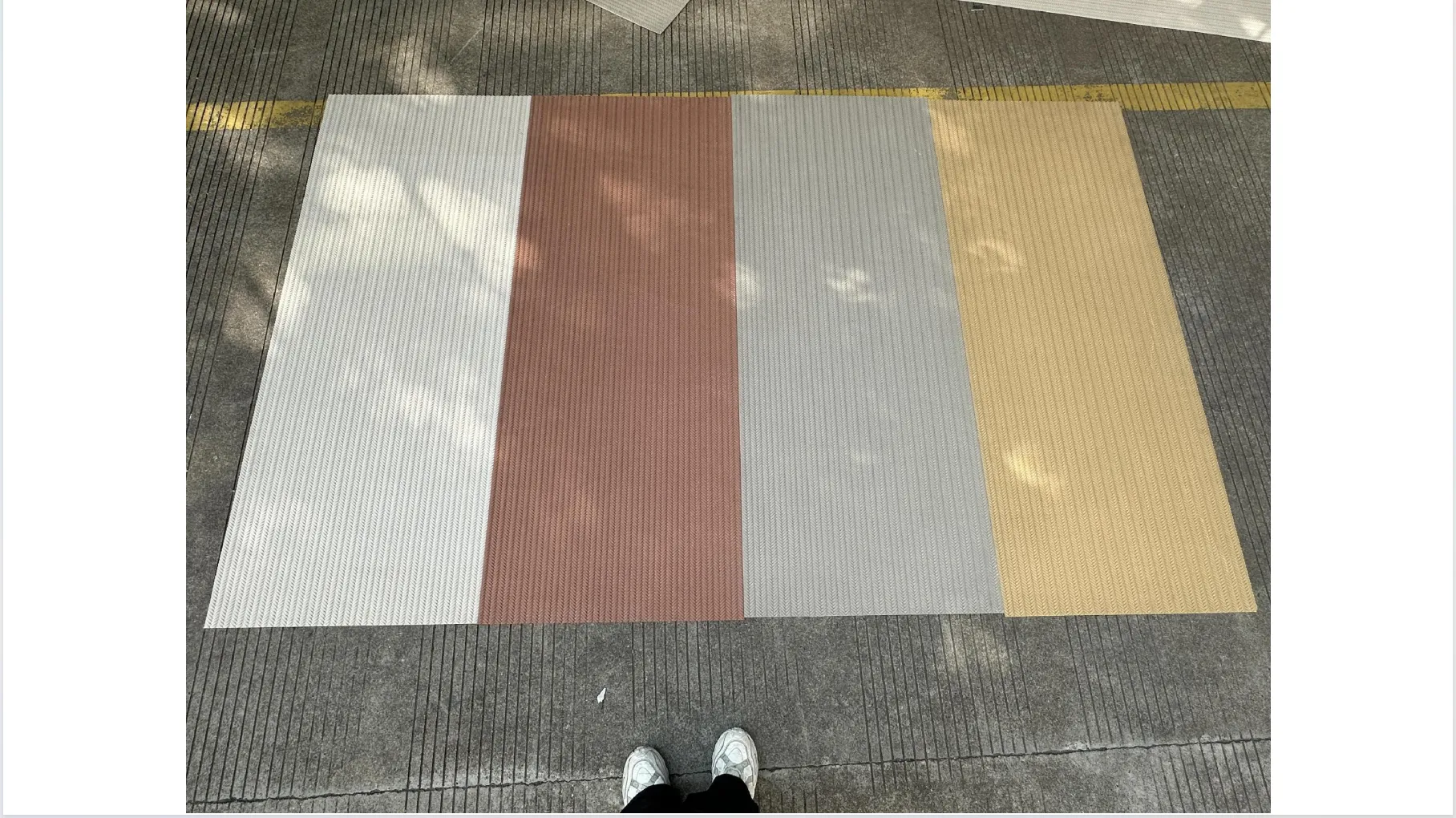
If MCM flexible stone is the canvas, then the Woven Real Photos collection is the paint that brings it to life. Picture this: a wall that doesn't just look like it has texture—it feels like it. High-resolution images of handwoven textiles, from soft khaki linens to rich jacinth weaves, are embedded into the MCM surface during production, creating a finish that's both visually striking and tactilely engaging. Run your hand over it, and you'll swear you're touching fabric, not a composite material.
Take, for example, a recent project in a downtown yoga studio. The designer wanted the space to feel like a "sanctuary of softness," a retreat from the sharp angles of the city outside. They chose Woven Real Photos in a muted beige and grey pattern, applied to MCM flexible stone panels that curved gently around the studio's perimeter. The result? A wall that seems to breathe. When sunlight filters through the windows, the woven patterns cast delicate shadows, shifting throughout the day and making the space feel dynamic yet calm. "It's not just a wall anymore," the studio owner noted. "It's part of the practice—something that grounds you, that feels warm and familiar."
What makes Woven Real Photos so powerful is its ability to bridge the gap between nature and craft. In a world of mass-produced surfaces, these panels feel personal, like they carry a story. A woven pattern in jacinth might evoke the warmth of a grandmother's quilt; a grey weave could mirror the texture of a well-loved sweater. When paired with the organic flow of a curved wall, it creates a space that feels less like a building and more like a hug.
MCM's innovation doesn't stop at flexibility and texture—it's also pushing boundaries with its 3D printing series. Imagine being able to design a curved wall with custom textures, patterns that are impossible to achieve with traditional stone-cutting or molding. 3D printing makes that a reality. Using advanced additive manufacturing, MCM can create panels with intricate reliefs, from subtle wave patterns that mimic ocean swells to geometric motifs that play with light and shadow.
Consider the Azure Boutique Hotel in coastal California. The lobby features a sweeping curved wall that serves as the focal point of the space. The design team wanted to echo the nearby ocean, so they turned to MCM's 3D printing series to create panels with undulating, wave-like textures. These panels were then paired with Woven Real Photos in soft blue and beige, creating a wall that looks like it's been shaped by the tides—rough yet rhythmic, dynamic yet serene. "Traditional stone would have required months of carving and would have been too heavy for the curved structure," explains the project architect. "With 3D-printed MCM, we got precision, speed, and a finish that feels handcrafted."
The 3D printing series also opens doors for sustainability. By printing only the material needed, there's less waste compared to cutting stone from a block. And because MCM panels are lightweight, transportation and installation require less energy—making the entire process greener. It's a perfect example of how technology can enhance, not replace, the art of design.
To truly appreciate MCM flexible stone's impact, it helps to see how it compares to other common materials used for curved walls. Below is a breakdown of key factors like flexibility, weight, and design versatility:
| Material | Flexibility (1-10) | Weight (kg/m²) | Installation Ease | Design Versatility |
|---|---|---|---|---|
| MCM Flexible Stone | 9/10 (bends up to 120° without cracking) | 8-12 kg/m² | High (lightweight, can be cut on-site) | Exceptional (Woven, 3D printing, custom colors) |
| Traditional Natural Stone | 2/10 (rigid, prone to cracking) | 40-80 kg/m² | Low (requires heavy machinery, skilled labor) | Limited (fixed patterns, colors) |
| Fair-Faced Concrete | 4/10 (can be formed into curves but lacks texture) | 20-30 kg/m² | Medium (requires formwork, longer curing time) | Moderate (smooth or lightly textured) |
| 3D Printed MCM Panels | 8/10 (slightly less flexible than standard MCM) | 10-15 kg/m² | High (precisely engineered for easy fit) | Unmatched (custom 3D reliefs, complex patterns) |
The table tells a clear story: MCM flexible stone outperforms traditional materials in flexibility, weight, and design options—making it the ideal choice for curved walls that demand both beauty and practicality.
Nestled along the banks of the Seine in Paris, the Riverfront Cultural Center was designed to be a "bridge between art and nature." Its most striking feature? A 120-meter-long curved facade that wraps around the building, mimicking the river's flow. The design team chose MCM flexible stone in the Woven Real Photos (khaki and jacinth) collection, paired with fair-faced concrete accents. The result is a wall that feels both soft and strong—like a woven blanket draped over a concrete frame.
"We wanted the facade to change with the light," says lead architect Marie Dubois. "In the morning, the Woven Real Photos panels glow warm; in the afternoon, the concrete cools the space. And because MCM is so lightweight, we could extend the curve higher than we'd originally planned—no need for extra structural support." Visitors often comment on how the building "feels alive," as the woven patterns shift with the sun, creating a dynamic backdrop for the center's art exhibitions.
In Tokyo, where space is at a premium, a family wanted their small apartment to feel "spacious and serene." The solution? A curved living room wall clad in MCM flexible stone from the Woven Real Photos line, specifically the travertine (starry blue) pattern. The wall curves gently from the entryway to the balcony, creating a sense of flow that makes the 600-square-foot space feel larger. The starry blue woven texture, inspired by night skies, adds depth, while the wall's curve softens the room's sharp corners.
"Our kids used to run into the sharp corners of the old rectangular room," says homeowner Yuki Tanaka. "Now, the curved wall feels safe, like a big hug. And the texture—you can't stop touching it! It's become the focal point of our home."
At the end of the day, buildings are for people—and people connect with emotion. Curved walls clad in MCM flexible stone don't just look good; they make us feel good. The Woven Real Photos texture triggers memories of comfort: a favorite sweater, a handwoven rug, the softness of nature. The flexibility of the material means spaces can be shaped to fit how we move and interact, not the other way around. And the 3D printing series adds a touch of uniqueness—no two walls have to be the same, making each space feel personal.
In a world that often feels cold and impersonal, these details matter. They turn a house into a home, a museum into a sanctuary, a hotel into a retreat. As one designer put it: "MCM flexible stone doesn't just cover walls—it wraps stories around them."
As technology advances, MCM is poised to push even further. Imagine 3D printing series panels that integrate LED lighting, turning curved walls into dynamic light displays. Or Woven Real Photos that mimic not just textiles, but natural elements like tree bark or ocean waves. There's also a growing focus on sustainability: MCM's production process already uses 30% less energy than traditional stone manufacturing, and future iterations aim to be carbon-neutral.
But perhaps the most exciting trend is the democratization of design. With MCM flexible stone, curved walls are no longer reserved for luxury projects—they're accessible to homeowners, small businesses, and community spaces. And that means more spaces that feel human, more walls that tell stories, and more buildings that remind us: architecture, at its best, is about connection.
Recommend Products












