
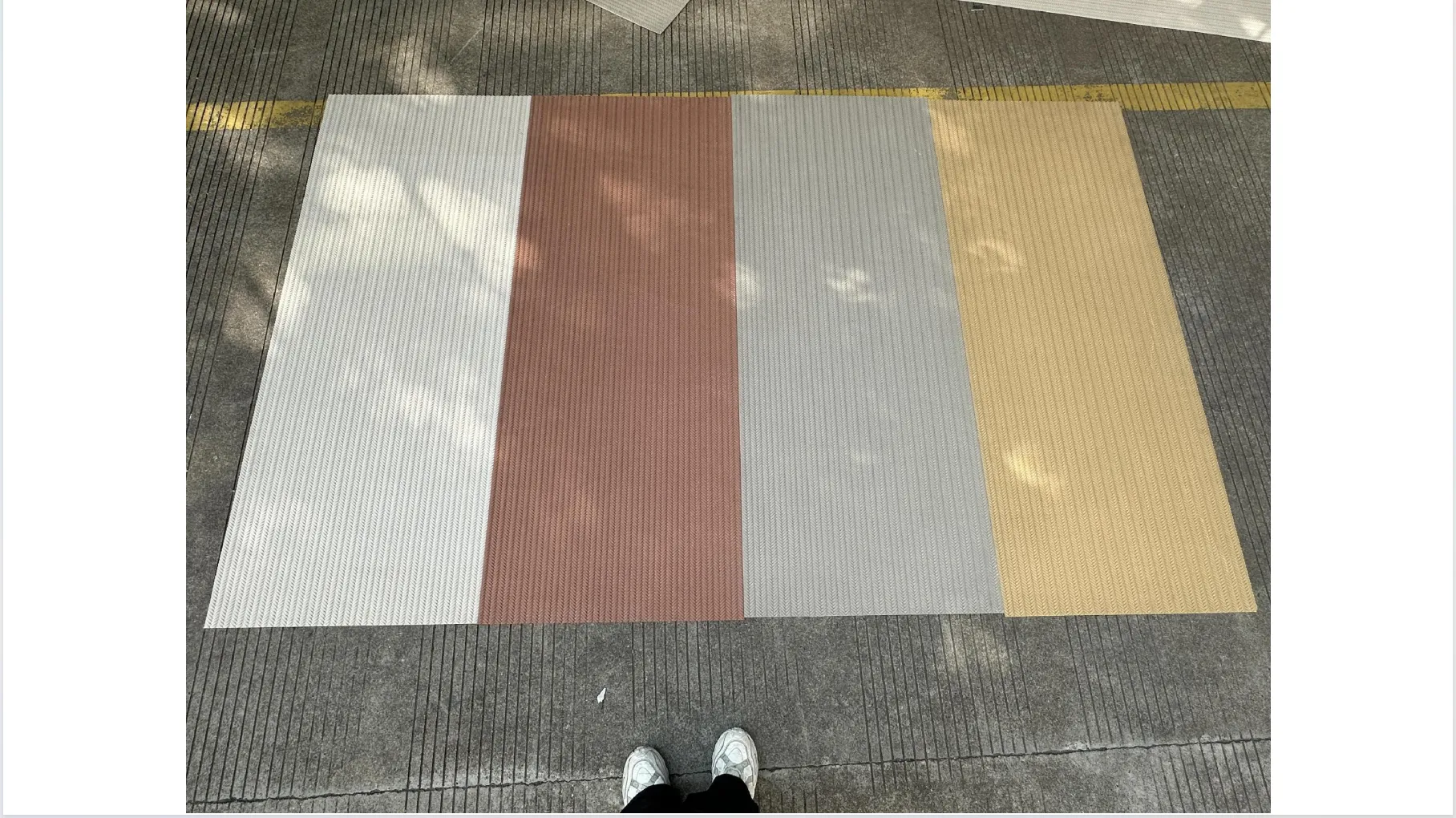
Picture this: You're standing in a sunlit room, your hand gliding over a wall surface that feels less like "material" and more like a story. It has the rough-hewn warmth of aged stone, the subtle grain of weathered wood, or the quiet elegance of a starry night sky—all without the heft, coldness, or limitations of traditional options. This is the promise of COLORIA's MCM (Modified Composite Material) wall panels, a revolution in interior design that's challenging the long-reigning king of wall coverings: ceramic tiles. But how do these two stack up when it comes to turning a house into a home? Let's dive in, weaving through real-world texture, design freedom, and the little moments that make a space feel uniquely yours.
Walk into any home with ceramic tiles, and you'll likely notice the same thing first: their smooth, often glossy finish. It's clean, it's uniform, and it's… well, consistent . But consistency can sometimes feel like sterility. Ceramic tiles, fired at high temperatures, harden into a dense, non-porous surface that repels water and stains—but also repels warmth. Run your palm across a ceramic wall, and it's cool, almost clinical, like touching a refrigerator door on a summer day.
Now, run that same hand over COLORIA's MCM panels. Take mcm flexible stone , for example. It bends slightly under pressure, mimicking the give of natural stone without the weight. Its surface isn't just "textured"—it's tactile : tiny ridges that catch your fingertips, subtle pits that hint at years of natural erosion, and a warmth that feels more like wood than stone. Or consider wood grain board : unlike ceramic tiles printed with wood patterns (which often look flat and artificial), MCM's wood grain has depth—you can almost feel the annual rings, as if the tree itself was pressed into the material.
Ceramic tiles have long been loved for their durability, but their design language is limited by their nature. They're rigid, heavy, and typically come in standard sizes—12x12 inches, 18x18 inches—with edges that require grout lines. This makes them great for bathrooms or kitchens, where functionality is key, but less so for living rooms, bedrooms, or home offices, where personality matters most.
COLORIA's MCM panels, by contrast, are a designer's playground. Let's start with flexibility—literally. mcm flexible stone can curve around corners, wrap columns, or even follow the slope of a vaulted ceiling, turning architectural "flaws" into focal points. Imagine a reading nook with walls clad in bamboo mat board , its gentle curves hugging the space like a cozy blanket—something ceramic tiles, with their brittle edges, could never do.
Then there's the color and pattern palette. Ceramic tiles offer solid hues or simple prints, but MCM? It's a library of stories. Want to evoke the's quiet grandeur? Try gobi panel , with its sandy swirls and muted oranges. Dreaming of a bedroom that feels like a mountain retreat? lunar peak silvery shimmers like moonlight on snow, while lunar peak golden warms the room like sunrise over rock. And for the bold? travertine (starry red) bursts with fiery flecks, turning a wall into a conversation piece that guests can't stop staring at.
Maria, a small-business owner in Portland, wanted her café, "Starry Night," to feel like a hybrid of a Parisian bistro and a mountain lodge. She initially considered ceramic tiles in "cream" and "rust" to keep costs low—but something felt off. "They looked like every other café wall," she said. "I wanted customers to walk in and think, 'This is Starry Night —no place else.'"
Then she discovered COLORIA's travertine (starry orange) and wood grain board . The starry orange panels, with their warm base and glittering accents, lined the ceiling above the bar, mimicking a sunset. The wood grain boards, with their weathered texture, wrapped the lower walls, grounding the space. "Customers now take photos of the walls as much as the food," Maria laughed. "One regular said it feels like 'dining under a harvest moon in a cabin.' That's the magic MCM brings—it turns a wall into a mood."
Ceramic tiles are famous for their toughness—they resist scratches, stains, and moisture, making them a staple in high-traffic areas. But they're not indestructible. drop a heavy pot, and a tile might crack; chip the edge, and it's nearly impossible to repair without replacing the whole tile. Grout lines, too, are a hassle—they collect dirt, mildew, and require regular scrubbing to stay white.
MCM panels, surprisingly, hold their own in the durability department—often even better. Made from a blend of natural minerals and polymers, they're lightweight (about 1/5 the weight of ceramic tiles) but incredibly strong. foamed aluminium alloy board (vintage silver) , for example, is dent-resistant and fireproof, making it ideal for busy family rooms. fair-faced concrete MCM panels mimic the industrial-chic look of raw concrete but without the porosity—spill coffee, wipe it up, and there's no stain. Even rust square line stone , with its "aged" appearance, is treated to resist actual rust, so that rustic charm won't fade into flakiness over time.
Maintenance? A quick wipe with a damp cloth is usually enough. No grout to scrub, no sealant to reapply every few years. For busy homeowners—parents, professionals, anyone who'd rather spend weekends hiking than cleaning—this is a game-changer. As one homeowner put it: "I used to dread cleaning my kitchen backsplash. Now, with MCM wood concrete board (light grey) , I just spray and wipe. It's like having a high-maintenance look with low-maintenance effort."
| Feature | COLORIA MCM Panels | Ceramic Tiles |
|---|---|---|
| Texture & Warmth | Varied, tactile (e.g., mcm flexible stone , wood grain board ); warm to the touch | Smooth, glossy or matte; cool, hard surface |
| Design Flexibility | Bendable, customizable sizes; 100+ styles (e.g., travertine (starry blue) , lunar peak black ) | Rigid, standard sizes; limited patterns |
| Installation | Lightweight (easy to handle); adhesive-backed (no mortar); cuts with standard tools | Heavy (requires professional installation); needs mortar and grout |
| Durability | Scratch, stain, and moisture-resistant; fireproof options (e.g., foamed aluminium alloy board ) | Scratch-resistant but brittle (prone to chipping); grout lines trap dirt |
| Maintenance | Wipe with damp cloth; no grout or sealant needed | Regular grout cleaning; occasional sealant reapplication |
| Emotional Impact | Evokes mood (cozy, adventurous, serene) through texture and color | Functional but often lacks personality |
In an era where "sustainability" isn't just a buzzword but a way of life, material choices matter. Ceramic tiles have a hidden environmental cost: their production requires mining clay and firing it in kilns at temperatures up to 2,200°F, releasing significant CO2. Plus, their weight means higher transportation emissions, and if a tile cracks, it often ends up in a landfill—hardly a green choice.
COLORIA's MCM panels, by contrast, are designed with the planet in mind. Many are made from recycled materials: foamed aluminium alloy board uses recycled aluminum, while fair-faced concrete incorporates industrial byproducts like fly ash. Their lightweight nature also slashes transportation emissions—one truck can carry 10 times more MCM panels than ceramic tiles. And because they're flexible and easy to install, there's less waste during construction; no broken tiles, no excess mortar, just precision-cut panels that fit like puzzle pieces.
Perhaps most importantly, MCM panels are long-lasting. A well-maintained MCM wall can last 30+ years, reducing the need for replacements and the waste that comes with them. As environmental designer Jake Lin puts it: "Sustainability isn't just about what a product is made of—it's about how long it serves you. MCM doesn't just look good; it does good, too."
They say a picture is worth a thousand words, but "woven real photos"—the kind that COLORIA's MCM panels create—are worth a thousand feelings. Imagine a bedroom wall clad in lunar peak silvery : as morning light filters through the window, the panel's metallic flecks catch the sun, making the wall glow like a starlit sky. In the evening, with soft lamp light, it shifts to a cool, calming silver, lulling you into relaxation. That's not just a wall—that's a daily mood enhancer.
Or consider a home office with historical pathfinders stone panels. Their weathered, earthy texture feels like a connection to the past, grounding you during busy workdays. Pair that with thread accents—subtle, woven lines that add movement—and suddenly, the space feels both rooted and inspired, perfect for sparking creativity.
Ceramic tiles, for all their practicality, can't weave these stories. They're static, unchanging, and ultimately, forgettable. MCM panels, though? They're dynamic, emotional, and deeply personal. They don't just cover walls—they define spaces, turning houses into homes and rooms into memories.
Ceramic tiles have their place—there's no denying their utility in wet areas or high-traffic zones. But when it comes to interior walls that reflect who you are, that make you pause and think, "I love this space," COLORIA's MCM panels are in a league of their own. They offer texture that invites touch, design freedom that fuels creativity, durability that eases stress, and a planet-friendly footprint that feels good.
So, whether you're renovating a tiny apartment or building your dream home, ask yourself: Do I want walls that just exist , or walls that live ? With MCM—with its travertine (starry green) skies, wood grain board warmth, and mcm flexible stone versatility—you'll never have to settle for "just existing" again.
Featured COLORIA MCM Series:
mcm project board series mcm 3d printing series mcm flexible stone mcm big slab board series travertine (starry green) wave panel star gravel lunar peak silvery fair-faced concrete wood grain boardRecommend Products












